Important adipokine involved in the control of fat metabolism and insulin sensitivity, with direct anti-diabetic, anti-atherogenic and anti-inflammatory activities. Stimulates AMPK phosphorylation and activation in the liver and the skeletal muscle, enhancing glucose utilization and fatty-acid combustion. Antagonizes TNF by negatively regulating its expression in various tissues such as liver and macrophages, and also by counteracting its effects. Inhibits endothelial NF-kappa-B signaling through a cAMP-dependent pathway. May play a role in cell growth, angiogenesis and tissue remodeling by binding and sequestering various growth factors with distinct binding affinities, depending on the type of complex, LMW, MMW or HMW.
Post-translational: Hydroxylated Lys-33 was not identified in PubMed:16497731, probably due to poor representation of the N-terminal peptide in mass fingerprinting. HMW complexes are more extensively glycosylated than smaller oligomers. Hydroxylation and glycosylation of the lysine residues within the collagene-like domain of adiponectin seem to be critically involved in regulating the formation and/or secretion of HMW complexes and consequently contribute to the insulin-sensitizing activity of adiponectin in hepatocytes. O-glycosylated. Not N-glycosylated. O-linked glycans on hydroxylysines consist of Glc-Gal disaccharides bound to the oxygen atom of post-translationally added hydroxyl groups. Sialylated to varying degrees depending on tissue. Thr-22 appears to be the major site of sialylation. Higher sialylation found in SGBS adipocytes than in HEK fibroblasts. Sialylation is not required neither for heterodimerization nor for secretion. Not sialylated on the glycosylated hydroxylysines. Desialylated forms are rapidly cleared from the circulation.
生物活性
Measured by its ability to induce TIMP-1 secretion by mouse macrophages. The ED₅₀for this effect is 1-5 µg/mL.
Lyophilized from 10mM PBS, 5% Trehalose, 5% Mannitol, pH7.4.
复溶
Reconstitute in water to a concentration of 0.1-1.0 mg/ml.
储存条件
-20°C储存
运输条件
超低温运输
稳定性与储存
长期储存-20~-80℃(1年);复溶后建议分装,避免反复冻融。
图片
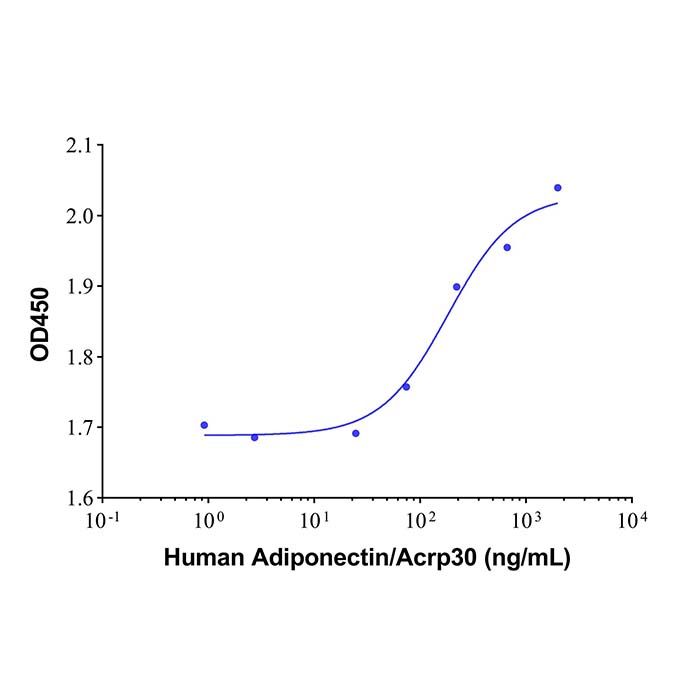
Recombinant Human Adiponectin/Acrp30 Protein (rp142573) - Protein Bioactivity Fully biologically active determined by the dose dependent increase in MCF7 cell proliferation. The ED₅₀ for this effect is 0.18 μg/mL. Adiponectin induces a dichotomic effect on breast cancer growth. It stimulates growth in ERα+ MCF-7 cells while inhibiting proliferation of ERα- MDA-MB-231 cells.
Recombinant Human Adiponectin/Acrp30 Protein (rp142573) - Protein Bioactivity Measured by its ability to induce TIMP-1 secretion by mouse macrophages. The ED₅₀ for this effect is 2.14 µg/mL.
Recombinant Human Adiponectin/Acrp30 Protein (rp142573) - SDS-PAGE 3 μg/lane of Recombinant Human Adiponectin/Acrp30 was resolved with SDS-PAGE under reducing (R) and non-reducing (N) conditions and visualized by Coomassie® Blue staining, showing a band at 31.2 kDa under reducing conditions and 30.2 & 55.0 kDa under non-reducing conditions.

 ZJ25F0116518


 危险品化学品经营许可证(带存储)