储存缓冲液:Dl water, 0.05% KroVin 300.
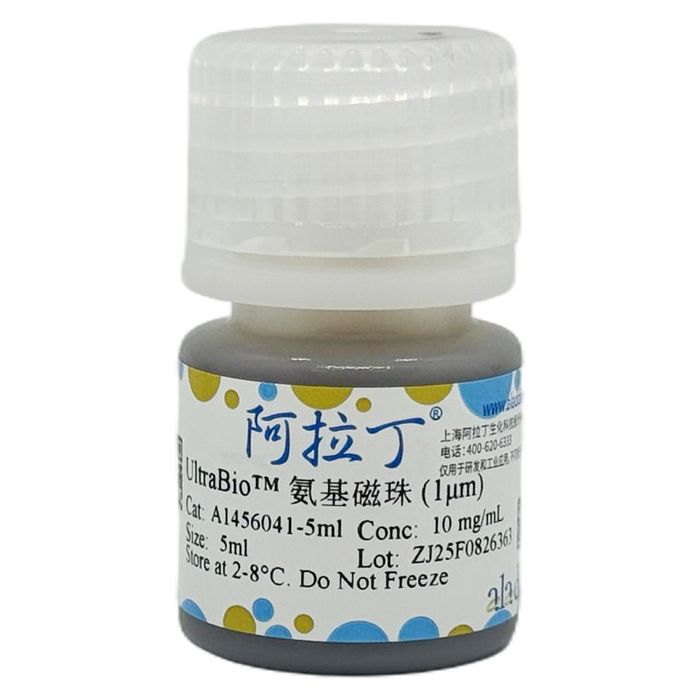
UltraBio™ 氨基磁珠 (1μm) 是一种高饱和磁化强度的磁性微球珠,其表面修饰氨基功能团。微球表面的氨基功能团能够在特殊化学试剂(如戊二醛)的作用下将多肽、蛋白、抗体、寡聚核苷酸等生物配体共价偶联到微球表面,从而可以快速地将目标物从样品中分类和富集,是医学与分子生物学研究中重要的载体工具。
参数
| 指标
|
基质
| 聚合物磁性微球 |
配基
| Amine |
| 磁珠浓度 | 10 mg/mL
|
粒径
| 1 μm |
| 偶联量 | >10 μg IgG/mg磁珠
|
保存
| Dl water, 0.05% KroVin 300. |
产品特点及优势
- 微球粒度均一,批次稳定性好;
- 具有超顺磁性,磁相应速度快,可加快分离速度,提高实验效率;
- 表面氨基修饰提高了配体结合能力,可快速实现配体共价偶联;
- 适用于蛋白免疫沉淀反应、酶促反应、细胞分离、体外诊断检测等,应用范围广。
使用方法
1. 缓冲液的准备
活化溶液:50 mM PBS,pH 7.4
10% 戊二醛溶液:50 mM PBS,pH7.4 溶解,现配现用。
封闭液:50 mM Tris,pH 7.4或50 mM 乙醇胺,pH 8.0
清洗液:0.1% Tween-20 或 Triton X-100的1×PBS溶液,pH 7.4
保护液:PBS,0.01% Tween-20,0.1% kv300 (v/v)。
2. 微球活化及偶联
2.1 取200 µL UltraBio™ 氨基磁珠 (1μm) 于离心管中,在样品混合仪上振荡,充分混匀。
2.2 将离心管置于磁分离器上约1 min,待溶液变澄清后,用移液器吸弃清液。(注:不要吸掉磁性微球,下同。)
2.3 将离心管磁分离器上取下来,加入与悬浮液等体积的活化溶液,使用枪头反复吹打5-10次,将离心管置于磁分离器上,大约1 min,待溶液变澄清后,用移液器吸弃清液,重复洗涤1次。
2.4 加入200 µL 10% 戊二醛溶液,漩涡混合均匀。室温孵育 30-60 min,确保磁性微球充分混匀,否则影响活化效率。
2.5 加入100-300 µg 配体蛋白(具体用量可根据实验进行优化,缓冲液中无游离氨基,pH 8.0左右),充分混匀,室温25℃反应4 h,或者4℃反应过夜,确保磁珠处于悬浮状态。
2.6 将离心管置于磁分离器上约1 min,待溶液变澄清后,用移液器吸弃清液。加入500 µL 封闭液,室温孵育1 h。
2.7 反应后用清洗液清洗2次去除非特异性吸附,1×PBS溶液清洗2次,待用。如果暂时不用,可将偶联好配体的磁性微球保存在保护液中,2-8℃保存。
注意事项
1. UltraBio™ 氨基磁珠 (1μm) 2-8℃保存,切勿冷冻;
2. 使用本品前,请务必充分振荡或超声使其充分混匀;
3. 微球可以结合的配体量与待偶联的物质的分子量大小、空间构象、所含伯胺基数量、反应条件等有关。
UltraBio™ Amine Magnetic Beads (1 μm) are polymeric magnetic microspheres with high saturation magnetization. Their surfaces are modified with amino functional groups. These surface amino groups enable the covalent coupling of biological ligands—such as peptides, proteins, antibodies, and oligonucleotides—to the microsphere surface via specific chemical reagents (e.g., glutaraldehyde). This facilitates rapid separation and enrichment of target molecules from samples, making them essential carrier tools in medical and molecular biology research.
| Parameter | Specification |
|---|
| Matrix | Polymeric magnetic microspheres | | Ligand | Amine | | Bead Concentration | 10 mg/mL | | Particle Size | 1 μm | | Coupling Capacity | >10 μg IgG/mg beads | | Storage Buffer | DI water, 0.05% KroVin 300 |
|
Features and Advantages
Uniform particle size with excellent batch-to-batch consistency.
Superparamagnetic properties enable rapid magnetic response, accelerating separation and improving experimental efficiency.
Surface amino modification enhances ligand-binding capacity for fast covalent coupling of ligands.
Suitable for a wide range of applications, including immunoprecipitation, enzymatic reactions, cell separation, and in vitro diagnostic assays.
Protocol
1. Buffer Preparation
Activation Buffer: 50 mM PBS, pH 7.4
10% Glutaraldehyde Solution: Prepared fresh in 50 mM PBS, pH 7.4.
Blocking Buffer: 50 mM Tris, pH 7.4, or 50 mM Ethanolamine, pH 8.0.
Washing Buffer: 1× PBS containing 0.1% Tween-20 or Triton X-100, pH 7.4.
Storage Buffer: PBS containing 0.01% Tween-20 and 0.1% KroVin 300 (v/v).
2. Bead Activation and Ligand Coupling
2.1 Transfer 200 µL of UltraBio™ Amine Magnetic Beads (1 μm) to a centrifuge tube. Mix thoroughly by vortexing or using a sample mixer to ensure a homogeneous suspension.
2.2 Place the tube on a magnetic separator for approximately 1 minute. Once the solution becomes clear, carefully aspirate and discard the supernatant using a pipette. (Note: Do not aspirate the magnetic beads. This applies to all subsequent steps involving magnetic separation.)
2.3 Remove the tube from the magnetic separator. Add a volume of Activation Buffer equal to the original suspension volume. Gently pipette up and down 5–10 times to resuspend the beads. Place the tube back on the magnetic separator for approximately 1 minute. Once the solution clears, aspirate and discard the supernatant. Repeat this washing step once more.
2.4 Add 200 µL of 10% Glutaraldehyde Solution. Mix thoroughly by vortexing. Incubate at room temperature for 30–60 minutes. Ensure the beads remain well suspended during incubation, as this affects activation efficiency.
2.5 Add 100–300 µg of the target ligand protein (the optimal amount may be determined experimentally; ensure the buffer is free of primary amines and has a pH of approximately 8.0). Mix thoroughly. Incubate for 4 hours at 25°C or overnight at 4°C. Ensure the beads remain suspended throughout the reaction.
2.6 Place the tube on the magnetic separator for approximately 1 minute. After the solution clears, aspirate and discard the supernatant. Add 500 µL of Blocking Buffer and incubate at room temperature for 1 hour.
2.7 Following blocking, wash the beads twice with Washing Buffer to remove non-specifically bound material, then wash twice with 1× PBS. The ligand-coupled beads are now ready for use. If not used immediately, resuspend the beads in Storage Buffer and store at 2–8°C.
Precautions
Store UltraBio™ Amine Magnetic Beads (1 μm) at 2–8°C. Do not freeze.
Before use, ensure the beads are thoroughly resuspended by vigorous vortexing or sonication.
The amount of ligand that can be coupled to the beads depends on factors including the molecular weight, spatial conformation, and number of primary amine groups of the target molecule, as well as the specific reaction conditions.

 ZJ26F0535115


 危险品化学品经营许可证(带存储)