
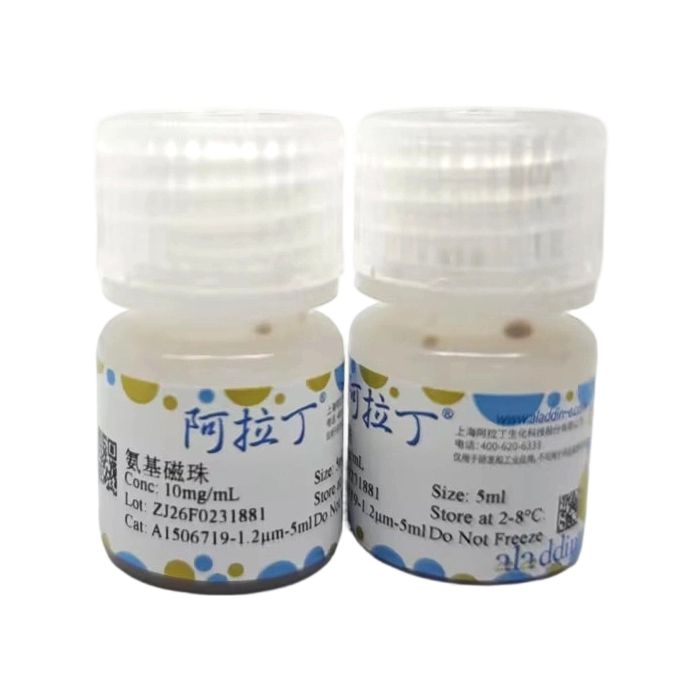
氨基磁珠

货号: A1506719
只有 %1 左
级别和纯度: BioReagent ? 生物试剂级(BioReagent)—— 经测试适用于生命科学和分子生物学。适用于需要生物相容性的细胞培养、检测和生化工作。 用于化学发光 ? 化学发光级 —— 纯度受控以避免猝灭/背景光。适用于信号保真至关重要的化学发光检测。
储存条件
2-8°C储存,禁止冷冻
运输条件
低温运输,禁止冷冻
应用
CLIA
价格
低至 ¥339.90

概述

储存缓冲液:Purified Water, 0.05% ProClin 300.
磁微粒化学发光免疫分析是将磁性分离技术、化学发光技术、免疫分析技术三者结合的分析方法。磁微粒作为载体偶联抗体或抗原,可捕获目标分子,因其具有超顺磁性可实现多次磁分离,有利于检测仪器的全自动化并加快检测速度。目前,磁微粒化学免疫分析技术因其灵敏度高、检测范围宽、自动化程度高等优点已被广泛应用于生物医学检测领域。
氨基磁珠表面有氨基(NH₂)修饰,可通过戊二醛等偶联试剂与蛋白上的氨基共价结合形成席夫碱(亚胺),经还原剂还原胺化得到稳定的仲胺结构。
产品特点
1、弥散式结构:磁核材料为超顺磁性γ-Fe₂O₃纳米颗粒
2、氧化铁含量:12%-20%(不同磁珠有差异)
3、粒径:常规1.2、2.8μm
4、 粒径高度均一,批间差CV<5%:保证稳定可靠的性能
5、分散性优良,检测本底低:自主创新设计的独特包覆层结构,具有极低的非特异性吸附
6、单批次2公斤级产能:满足化学发光客户日常需求
7、高稳定性:长时间存储后不会出现氧化变色和核磁泄露现象
使用说明
1、偶联条件选择
(1) 推荐偶联缓冲液为PBS(pH 7.4),应避免使用含有伯胺基团(如 Tris、甘氨酸)的缓冲液。
(2) 以 IgG 抗体为例,推荐偶联比例为 IgG / Beads=10~30 μg / mg;但由于偶联蛋白的多样性,建议筛选不同的偶联比例,以获得最优结果。
(3) 偶联完成后可用含氨基的小分子(如乙醇胺)封闭,也可酌情添加 BSA 等蛋白进行封闭。
2、偶联注意事项
(1) 磁珠在取用前,务必充分振荡使磁珠呈均匀的悬浮状态。
(2) 干燥、冷冻操作极易引起磁珠团聚,且会影响磁珠表面功能基团的活性,请注意保存。

3、偶联推荐方案
名称详情
偶联缓冲液
10mM PBS,pH 7.4 
戊二醛溶液
用纯水稀释至0.5%,需新鲜配制
氰基硼氢化钠溶液
5M 氰基硼氢化钠(溶解于1M NaOH)
封闭液
0.1M 乙醇胺,pH 7.4
保存液
PBS,含0.5% BSA,pH 7.4
4、偶联方法
(1) 使用涡旋混匀器将氨基磁珠充分混匀悬浮,取10mg到离心管中;
(2) 将离心管放置在磁力架上 1~2 分钟,移除上清液;
(3) 加入 1.0 mL 的偶联缓冲液,涡旋分散,按照步骤 (2) 移除上清;
(4) 用偶联缓冲液重复洗涤 1 次;
(5) 加入 1.0 mL 的戊二醛溶液,涡旋分散,保持旋转混匀,25°C下避光反应1小时,按照步骤 (2) 移除上清;
(6) 加入 1.0 mL 的偶联缓冲液,涡旋分散,按照步骤 (2) 移除上清;
(7) 用偶联缓冲液重复洗涤 2 次;
(8) 加入 1.0 mL 的偶联缓冲液,涡旋分散,再加入 200 μg 抗体,涡旋分散,保持旋转混匀, 25°C 下避光反应 2 小时;
(9) 加入 10 μL 氰基硼氢化钠溶液,保持旋转混匀,25°C 下孵育 1 小时,按照步骤 (2) 移除上 清;
(10) 加入 1.0 mL 的封闭液,涡旋分散,保持旋转混匀,室温下孵育 30 分钟,按照步骤 (2) 移除上清;
(11) 用保存液重复洗涤 3 次;
(12) 加入 1.0 mL 的保存液,涡旋混匀,得到浓度为10mg/mL的磁珠混悬液,2~8 ℃下保存。

Storage buffer: Purified Water, 0.05% ProClin 300

Magnetic Particle Chemiluminescence Immunoassay is an analytical method that combines magnetic separation technology, chemiluminescence technology, and immunoassay technology. Magnetic particles, as carriers conjugated with antibodies or antigens, can capture target molecules. Due to their superparamagnetic properties, they enable multiple magnetic separations, facilitating full automation of detection instruments and accelerating testing speed. Currently, magnetic particle chemiluminescence immunoassay technology is widely used in biomedical detection due to its high sensitivity, broad detection range, and high automation.

Amine Magnetic Beads are surface-modified with amino groups (-NH₂). These groups can covalently bind to amino groups on proteins via coupling reagents such as glutaraldehyde, forming Schiff bases (imines). The resulting structure can be stabilized by reductive amination using reducing agents, yielding a stable secondary amine linkage. 

检测标志物改成:Detection Marker

捕获抗体改成:Capture Antibody

磁性微球改成:Magnetic beads

检测标志物与抗体反应后改成:After reaction between detection marker and antibody

加磁场进行分离改成:Magnetic separation is applied

磁铁改成:Magnet

检测抗原改成:Detected Antigen

酶标抗体改成:Enzyme-labeled Antibody

Product Features

  1. Diffuse Structure: The magnetic core consists of superparamagnetic γ-Fe₂O₃ nanoparticles.

  2. Iron Oxide Content: 12% - 20% (varies depending on the specific bead type).

  3. Particle Size: Standard sizes of 1.2 μm and 2.8 μm.

  4. Highly Uniform Particle Size with CV < 5% between Batches: Ensures stable and reliable performance.

  5. Excellent Dispersion and Low Detection Background: Features a uniquely designed, proprietary coating layer that exhibits extremely low non-specific adsorption.

  6. Production Capacity of 2 kg per Batch: Meets the routine demands of chemiluminescence customers.

  7. High Stability: No oxidation/discoloration or magnetic core leakage occurs after long-term storage.

Instructions for Use

1. Conjugation Conditions

(1) PBS (pH 7.4) is recommended as the conjugation buffer. Buffers containing primary amine groups (e.g., Tris, glycine) should be avoided.

(2) For IgG antibodies, the recommended conjugation ratio is IgG:Beads = 10–30 μg:1 mg. However, due to the diversity of proteins, screening different ratios is advised for optimal results.

(3) After conjugation, blocking can be performed using small molecules containing amino groups (e.g., ethanolamine). Additionally, blocking with proteins such as BSA can be considered as needed.

2. Precautions

(1) Before use, thoroughly vortex the magnetic beads to ensure a uniform suspension.

(2) Drying or freezing can cause bead aggregation and may affect the activity of surface functional groups. Please adhere to the recommended storage conditions.

3. Recommended Conjugation Protocol

Item
Details
Conjugation Buffer
10 mM PBS, pH 7.4
Glutaraldehyde Solution
Diluted to 0.5% with pure water; prepare fresh
Sodium Cyanoborohydride Solution
5 M Sodium Cyanoborohydride (dissolved in 1 M NaOH)
Blocking Buffer
0.1 M Ethanolamine, pH 7.4
Storage Buffer
PBS containing 0.5% BSA, pH 7.4
4. Conjugation Method
(1) Thoroughly vortex the amino magnetic beads to suspend evenly, and transfer 10 mg to a centrifuge tube.
(2) Place the tube on a magnetic rack for 1–2 minutes and remove the supernatant.
(3) Add 1.0 mL of Conjugation Buffer, vortex to disperse, and remove the supernatant as in step (2).
(4) Repeat the wash with Conjugation Buffer once more.
(5) Add 1.0 mL of Glutaraldehyde Solution, vortex to disperse. Maintain suspension with mixing and react at 25°C for 1 hour protected from light. Remove the supernatant as in step (2).
(6) Add 1.0 mL of Conjugation Buffer, vortex to disperse, and remove the supernatant as in step (2).
(7) Repeat the wash with Conjugation Buffer twice.
(8) Add 1.0 mL of Conjugation Buffer, vortex to disperse. Then add 200 μg of antibody, vortex to disperse. Maintain suspension with mixing and react at 25°C for 2 hours protected from light.
(9) Add 10 μL of Sodium Cyanoborohydride Solution. Maintain suspension with mixing and incubate at 25°C for 1 hour. Remove the supernatant as in step (2).
(10) Add 1.0 mL of Blocking Buffer, vortex to disperse. Maintain suspension with mixing and incubate at room temperature for 30 minutes. Remove the supernatant as in step (2).
(11) Repeat the wash with Storage Buffer three times.
(12) Add 1.0 mL of Storage Buffer, vortex to mix, resulting in a magnetic bead suspension at 10 mg/mL. Store at 2–8°C.

规格

规格或纯度
BioReagent, 用于化学发光
稳定性与储存
Store at 2-8℃ long term (48 months). Do not freeze. Keep the vial upright.
英文名称
Amine Magnetic Beads
储存条件
2-8°C储存,禁止冷冻
运输条件
低温运输,禁止冷冻
名称和识别符
分子类型
生物试剂/缓冲液

技术文档

📋 安全数据表 (SDS)

全面的危险、操作、储存及法规合规文件。

下载 SDS →

✅ 分析证书 (COA)

批次质量数据。输入批号以获取对应 COA。

查询 COA →

📊 产品数据表

产品规格和应用的快速参考摘要。

查看数据表 →

🔬 规格说明书

该级别的完整质量属性和验收标准。

查看规格说明 →

高级数据

质检证书(CoA,COO,BSE/TSE 和分析图谱)
C of A & Other Certificates(BSE/TSE, COO):
输入批号以搜索分析图谱:

通过匹配包装上的批号来查找并下载产品的 COA,每批产品都进行了严格的验证,您可放心使用!

找到3个结果

批号(Lot Number) 证书类型 货号
ZJ26F0231884 分析证书 A1506719
ZJ26F0231882 分析证书 A1506719
ZJ26F0231881 分析证书 A1506719
技术文档和文章
溶液计算器

常见问题

什么是「用于化学发光」?
「用于化学发光」表示该化学品经过纯化和检测,专用于专项分析技术。关键规格通常包括:常用检测波长处的受控紫外吸收、低不挥发残渣、受控的水分含量以及经验证的批间一致性。「用于化学发光」用于此工作流程中的流动相、样品制备和分析标准品。
什么是「BioReagent」?
「BioReagent」表示该产品经过加工和检测,适用于生物和生化应用。规格可能包括内毒素限值、微生物控制、无菌性、低 DNase/RNase/蛋白酶活性,以及在相关情况下的生物活性验证。
本产品应如何储存?
请于2–8 °C条件下保存。请勿冷冻。冷冻可能对本品造成不可逆的损坏。
本产品如何运输?
本产品采用湿冰冷藏运输。收货后请立即拆包,并按上述储存条件保存。
如何获取批次专用COA?
每个订单都会随附分析证书(COA),您也可以从账户订单历史中下载。如需订购前的COA,请联系您的客户代表,或使用PDP上的"申请COA"按钮——我们将提供代表性批次的COA。

需要帮助选择级别?

我们的级别选择指南涵盖了目录中所有的变体的纯度、稳定剂状态和应用适用性。

查看 BioReagent 级别指南 → 查看 for Chemiluminescence 级别指南 →
