丙酮酸(Pyruvic acid),原称焦性葡萄酸,也称2-氧代丙酸,其分子式为 C₃H₄O₃ ,分子量为88.06。丙酮酸可通过乙酰辅酶A和三羧酸循环实现体内糖、脂肪和氨基酸之间的互相转化,作为生物体三大营养物质(糖、脂肪、氨基酸)代谢的核心枢纽分子,其含量变化直接反映细胞代谢状态,在代谢调控研究、疾病机制探索及药物筛选等领域具有重要应用价值。例如在多数情况下,丙酮酸浓度的升高不会在组织内积累以致产生有害的作用,但当肝脏发生严重病变或存在遗传性代谢紊乱时血液中丙酮酸浓度会升高。因此,丙酮酸的含量检测对疾病的检测和治疗有重要意义。
本试剂检测原理:丙酮酸在丙酮酸氧化酶作用下生成过氧化氢(H₂O₂),试剂盒中的Amplex Red在辣根过氧化物酶(Horseradish peroxidase, HRP)存在的情况下,Amplex Red能与 H₂O₂ 发生强烈显色反应,产生红色荧光物质试卤灵(Resorufin),其最大激发波长为571nm,最大发射波长为585nm,并且在激发波长处有很强的可见光吸收,因此本试剂盒可以用分光光度法和荧光两种方法来进行检测,检测灵敏度高,线性范围宽,样品用量少。在样品体积为20 µL时,采用分光度法检测在10-500μM浓度范围内有良好的线性关系;采用荧光法检测在1-100μM浓度范围内有良好的线性关系。
A1507492 | 组件 | 100 T | 储存条件 | A1507492A | 丙酮酸氧化酶 | 200uL | -20℃.避光 | A1507492B | 辣根过氧化物酶 | 200uL | -20℃.避光 | A1507492C | 辅因子 | 400uL | -20℃.避光 | A1507492D | Amplex Red | 200uL | -20℃.避光 | A1507492E | 检测缓冲液 | 7mL | -20℃. | A1507492F | 提取液 | 20mL | -20℃ | A1507492G | 丙酮酸标准品(10mM) | 200uL | -20℃.避光 |
|
使用方法
1 样本制备
(1) 血液样品的准备:对于血清样品,将全血在常温下静置30分钟-2小时,4ºC约1000-2000×g离心10分钟,取上清;对于血浆样品,将全血用肝素或者EDTA进行抗凝,4ºC约1000-2000×g离心10分钟,取上清。
(2) 细胞样本的准备:对于贴壁细胞,弃掉培养基,用胰酶消化或适当拍打使细胞脱离培养器皿并转移至离心管中,用PBS 重悬洗涤一次,离心 (400-500×g, 5分钟)收集细胞到离心管内,弃上清并吸净残留液体。对于培养的悬浮细胞,离心 (400-500×g, 5分钟)收集细胞到离心管内,PBS 重悬洗涤一次,离心 (400-500×g, 5分钟)收集细胞,弃上清并吸净残留液体。每100万个细胞加入100-200μL提取液,适当吹打,然后在4℃或冰浴等低温条件下进行匀浆或者超声破碎细胞。4ºC, 12,000×g离心5分钟,取上清用于后续检测。
(3) 对于组织样品,每10 mg组织加入100 -200μL 提取液,在4℃或冰浴等低温条件下进行匀浆或者超声破碎。4ºC约12,000×g离心5分钟,取上清用于后续检测。
(4) 细胞培养上清样品的准备:对于贴壁细胞,直接取培养液;对于悬浮细胞,离心取培养液。
注意:以上所有操作均需在4ºC或冰上操作。制备好的细胞或组织样品如果不能立即检测,可以-20ºC或-80ºC冻存。
2 丙酮酸显色工作液的配制
首先将检测缓冲液平衡至室温,然后按照每个检测反应80 μL的体积配制显色工作液。根据待检测样品(包括标准品)的数量,配制适量的显色工作液。显色工作液的各个组份的具体配制方法参考下表。由于Amplex Red室温容易见光分解,建议尽量现配现用,如果不能及时检测,请置于4℃或者冰浴避光保存且不要过夜,以免影响检测效果。
样本数 | 1 | 10 | 20 | 50 | 丙酮酸氧化酶 | 2 μL | 20 μL | 40 μL | 100 μL | 辣根过氧化物酶 | 2 μL | 20 μL | 40 μL | 100 μL | 辅因子 | 4 μL | 40 μL | 80 μL | 200 μL | Amplex Red | 2 μL | 20 μL | 40 μL | 100 μL | 检测缓冲液 | 70 μL | 700 μL | 1400 μL | 3500 μL |
|
3 样本测定
3.1 标准曲线绘制:
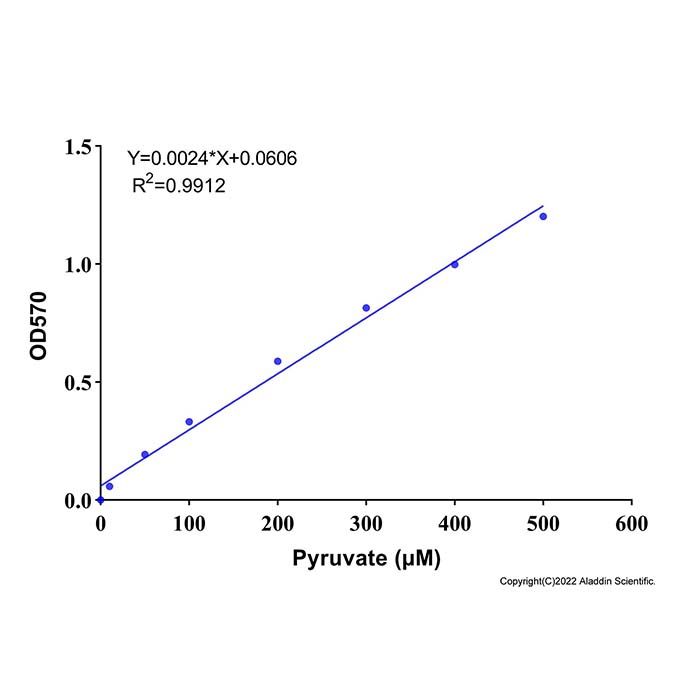
1) 分光光度法:取10μL丙酮酸标准溶液(10mM),加入190μL提取液,配制成浓度为500μM的丙酮酸标准溶液。分别取500μM的丙酮酸标准溶液0μL,2μL,4μL,8μL,12μL,16μL,20μL加入96孔板的标准品孔中,然后用提取液补足至20μL,此时,标准溶液的浓度分别为0、50、100、200、300、400、500μM。每孔加入丙酮酸显色工作液80μL,混匀,37ºC避光反应30分钟后读取 A₅₇₀ 。
2) 荧光检测法:取2μL丙酮酸标准溶液(10mM),加入198μL检测缓冲液,配制成浓度为100μM的丙酮酸标准溶液。分别取100μM的丙酮酸标准溶液0μL,2μL,4μL,8μL,12μL,16μL,20μL加入96孔板的标准品孔中,然后用提取液补足至20μL,此时,标准溶液的浓度分别为0、10、20、40、60、80、100μM。每孔加入丙酮酸显色工作液80μL,混匀,37ºC避光反应30分钟后读取荧光强度。
3.2 样品测定
1) 取1-20 μL样品或稀释后的样品至96孔板样品孔中,并相应地加入提取液补足至20 µL。同时设置仅含提取液的孔为空白对照孔。每孔加入丙酮酸显色工作液80μL,混匀,37ºC避光反应30分钟。
2) 反应结束后,如果是分光光度法检测,读取 A₅₇₀ ;如果是荧光法检测,设置激发波长560nm,发射波长590nm进行荧光强度检测。
4 结果计算
建立标准曲线时,需要减去空白孔对照。标准曲线建立完毕后,可根据标准曲线计算出样品中的丙酮酸浓度(C),计算公示如下:
C(μM)=A×n
注:A为根据标准曲线计算出的丙酮酸浓度(μM);n为样品稀释倍数。也可以根据丙酮酸的分子量88.06计算出质量浓度(μg/mL) = C × 0.08806。
注意事项
1. 显色工作液建议尽量现配现用。
2. Amplex Red容易室温见光分解,开启后应尽快使用,且在使用过程中一定要注意适当避光。
3. 建议反应体系的pH值维持在7-8之间,否则可能会影响Amplex Red的稳定性,从而影响检测信号。
4. 在样品检测时,需合理设置样品背景对照孔,例如 H₂O₂ 的存在会使得检测信号偏高,从而干扰检测结果。因此,如果样品自身含有 H₂O₂ 时,在设置样品背景对照孔时,需要将丙酮酸显色工作液中的丙酮酸氧化酶组份用等体积的检测缓冲液替换掉,配制成不含丙酮酸氧化酶的“显色工作液”。
Pyruvic acid, formerly known as pyroracemic acid and also referred to as 2-oxopropanoic acid, has a molecular formula of C₃H₄O₃ and a molecular weight of 88.06. Serving as a core hub molecule in the metabolism of three major nutrients including carbohydrates, lipids and amino acids, pyruvic acid facilitates the interconversion of these substances in vivo via acetyl coenzyme A and the tricarboxylic acid cycle. Its concentration directly reflects cellular metabolic status, granting it vital application value in metabolic regulation research, pathological mechanism investigation and drug screening. Generally, elevated pyruvic acid concentration does not accumulate in tissues to cause toxic effects. Nevertheless, abnormal rise of blood pyruvic acid level often occurs in patients with severe liver damage or hereditary metabolic disorders. Hence, the quantification of pyruvic acid is of great significance for disease diagnosis and therapeutic monitoring.
In this assay kit, pyruvate is converted into hydrogen peroxide (H₂O₂) under the catalysis of pyruvate oxidase. Amplex Red reacts intensely with hydrogen peroxide H₂O₂ in the presence of horseradish peroxidase (HRP), generating red fluorescent resorufin. The maximum excitation and emission wavelengths are 571 nm and 585 nm respectively. Resorufin also exhibits strong visible light absorbance at the excitation wavelength, enabling dual detection modes via spectrophotometric and fluorescence. This assay features high sensitivity, wide linear range and low sample consumption. With a sample volume of 20 μL, the spectrophotometric method maintains favorable linearity within 10-500 μM, while the fluorescence method shows excellent linear correlation ranging from 1-100 μM.
A1507492 | Components | Appearance | 100T | Storage | Usage volume per test | A1507492A | PO | Colorless liquid | 200uL | -20℃. dark. | 2µL | A1507492B | HRP | Colorless liquid | 200uL | -20℃. dark. | 2µL | A1507492C | Cofactor | Yellow-liquid | 400uL | -20℃. dark. | 4µL | A1507492D | Amplex Red | Pale red liquid | 200uL | -20℃. dark. | 2µL | A1507492E | Assay Buffer | Colorless liquid | 7mL | -20℃. | 70µL | A1507492F | Extraction buffer | Colorless liquid | 20mL | -20℃ | As need | A1507492G | Pyruvate Standard (10mM) | Colorless liquid | 200uL | -20℃. dark. | As need |
|
1 Sample Preparation
1) Preparation of blood samples:
For serum samples, let the whole blood stand at room temperature for 30 minutes to 2 hours, centrifuge at 4ºC at about 1000-2000×g for 10 minutes, and take the supernatant; for plasma samples, anticoagulate the whole blood with heparin or EDTA, centrifuge at 4ºC at about 1000-2000×g for 10 minutes, and take the supernatant.
2) Preparation of cell samples:
For adherent cells, discard the culture medium, digest with trypsin or tap appropriately to detach the cells from the culture vessel and transfer to a centrifuge tube, resuspend and wash once with PBS, centrifuge (400-500×g, 5 minutes) to collect the cells into the centrifuge tube, discard the supernatant and aspirate the residual liquid. For cultured suspension cells, centrifuge (400-500×g, 5 minutes) to collect the cells into a centrifuge tube, resuspend and wash once with PBS, centrifuge (400-500×g, 5 minutes) to collect the cells, discard the supernatant and aspirate the residual liquid. Add 100-200 μl of extraction buffer per 1 million cells, pipette properly, then homogenize or sonicate the cells at low temperature such as 4℃ or ice bath. Centrifuge at 4ºC, 12,000×g for 5 minutes, and take the supernatant for subsequent detection.
3) Preparation of tissue samples:
For tissue samples,add 100-200 μL of extraction buffer per 10 mg of tissue, and homogenize or sonicate at low temperature such as 4℃ or ice bath. Centrifuge at 4ºC at about 12,000×g for 5 minutes, and take the supernatant for subsequent detection.
4) Preparation of cell culture supernatant samples:
For adherent cells, directly take the culture medium; for suspension cells, centrifuge and take the culture medium.
Note: All the above operations must be performed at 4ºC or on ice. If the prepared cell or tissue samples cannot be detected immediately, they can be stored at -20ºC or -80ºC.
2 Preparation of Pyruvic acid Chromogenic Working Solution
First, equilibrate the Assay Buffer to room temperature, then prepare the chromogenic working solution according to the volume of 80 μL per detection reaction. Prepare an appropriate amount of chromogenic working solution according to the number of samples to be detected (including standards). For the specific preparation method of each component of the chromogenic working solution, refer to the following table. Since Amplex Red is easily decomposed by light at room temperature, it is recommended to prepare it fresh as much as possible. If it cannot be detected in time, please store it at 4℃ or ice bath protected from light and do not leave it overnight to avoid affecting the detection effect.
Number of sample | 1 | 10 | 20 | 50 | PO | 2 μL | 20 μL | 40 μL | 100 μL | HRP | 2 μL | 20 μL | 40 μL | 100 μL | Cofactor | 4 μL | 40 μL | 80 μL | 200 μL | Amplex Red | 2 μL | 20 μL | 40 μL | 100 μL | Assay Buffer | 70 μL | 700 μL | 1400 μL | 3500 μL |
|
3 Sample Determination
3.1 Standard Curve Drawing:
1) Spectrophotometric detection method : Take 10 μL of Pyruvic acid standard solution (10mM), add 190 μL of Extraction Buffer to prepare a Pyruvic acid standard solution with a concentration of 500 μM. Take 0 μL, 2 μL, 4 μL, 8 μL, 12 μL, 16 μL and 20 μL of 500 μM Pyruvic acid standard solution into the standard wells of a 96-well plate, then make up to 20 μL with Extraction buffer. The concentrations of the standard solutions are 0, 50, 100, 200, 300, 400 and 500 μM respectively. Add 80 μL of Pyruvic acid Chromogenic Working Solution to each well, mix well. Incubate at 37 °C for 30 minutes away from light, then measure absorbance at 570 nm.
2) Fluorescence detection method: Take 2 μL of Pyruvic acid standard solution (10mM), add 198 μL of Extraction buffer to prepare a Pyruvic acid standard solution with a concentration of 100 μM. Take 0 μL, 2 μL, 4 μL, 8 μL, 12 μL, 16 μL and 20 μL of 100 μM Pyruvic acid standard solution into the standard wells of a 96-well plate, then make up to 20 μL with Extraction buffer . The concentrations of the standard solutions are 0,10, 20, 40, 60,80 and 100 μM respectively. Add 80 μL Pyruvate Chromogenic Working Solution to each well and mix thoroughly. Incubate at 37 °C for 30 minutes in dark, then detect fluorescence intensity.
3.2 Sample Determination
1) Take 1-20 μL of sample or diluted sample into the sample well of a 96-well plate, and add Extraction buffer to make up to 20 µL accordingly. At the same time, set a well containing only Extraction buffer as a blank control well. Add 80 μL of Pyruvic acid Chromogenic Working Solution to each well, mix well, and incubate at 37ºC protected from light for 30 minutes.
2) After the reaction, if using the spectrophotometric assay method, read A ₅₇₀ ; if using the fluorescence method, set the excitation wavelength to 560 nm and the emission wavelength to 590 nm for fluorescence intensity detection.
4 Result Calculation
When establishing the standard curve, the blank well control needs to be subtracted. After the standard curve is established, the Pyruvic acid concentration (C) in the sample can be calculated according to the standard curve, and the calculation formula is as follows:C(μM) = A × n.
Note: A is the Pyruvic acid concentration (μM) calculated according to the standard curve; n is the sample dilution factor. The mass concentration (μg/ml) can also be calculated according to the molecular weight of Pyruvic acid (88.06) as follows: mass concentration (μg/ml) = C × 0.08806.
Precautions
1. It is recommended to prepare the chromogenic working solution fresh as much as possible.
2. Amplex Red is prone to photodegradation at room temperature. It should be used as soon as possible after opening, and proper protection from light must be ensured during use.
3. It is recommended that the pH value of the reaction system be maintained between 7 and 8; otherwise, the stability of Amplex Red may be affected, thereby interfering with the detection signal.
4. Proper blank control wells shall be arranged during sample testing. For instance, endogenous hydrogen peroxide can raise detection signals and interfere with final results. If hydrogen peroxide exists in samples, replace pyruvate oxidase component in chromogenic working solution with equal volume of assay buffer to prepare oxidase-free chromogenic working solution for blank control setup.

 ZJ26F0636858


 危险品化学品经营许可证(带存储)