
计算溶液所需的质量、体积或浓度。
为什么选择此级别
,适用于对基线干扰要求严格的色谱和分析工作流程。
储存与运输
室温。 。请查阅批次 COA 获取详细规格。
质量文档
SDS、COA、产品数据表及规格说明书均可下载。可通过批号查询获取批次 COA。
文献证明
在色谱分析、有机合成和交叉偶联反应领域已被 0 篇同行评审文献引用。
概述
Information
Acesulfame potassium is a non-nutritive sweetener.
In vitro
Acesulfame potassium activates two members of the human TAS2R family (hTAS2R43 and hTAS2R44) to stimulate bitter taste. Acesulfame potassium elicited robust elevation of cytosolic Ca2+ in hTAS2R44-expressing cells, with a threshold value of activation of 0.25 mM and an EC50 value of 2.5 mM. Acesulfame potassium elicited response of hTAS2R43-expressing cells with a threshold value of 3.1 mM and an estimated EC50 value ﹥10 mM\nAcesulfame potassium acts directly on the pancreatic islets and potentiates glucose-induced insulin release. Acesulfame potassium (1.0-15.0 mM) augmented insulin release from islets incubated in the presence of 7.0 mM d-glucose. [2]\nAcesulfame Potassium enhanced glucose absorption via activating sweet taste receptors in the enterocyte to translocate GLUT2 to the apical membrane through the PLC βII. In Caco-2 and RIE-1 cells, Acesulfame potassium (10 mM) increased glucose uptake by 20-30 % when incubated for 10 min with glucose >25 mM.\nAcesulfame potassium increased the contractile response of isolated rat detrusor muscle strips via increased extracellular Ca2+ influx. Acesulfame potassium (10-7 M to 10-2 M) enhanced the contractile response to 10 Hz EFS compared to control. The atropine-resistant response to EFS is marginally increased by Acesulfame potassium (10-6 M). Acesulfame potassium (10-6 M) increased the maximum contractile response to α, β methylene ATP by 35% and to KCl by 12%. Acesulfame potassium (10-6 M) increased the log EC50 from -2.7 to -3.03.
In vivo
Acesulfame potassium acts on two members of the TAS1R family of G-protein-coupled receptors (TAS1R2 and TAS1R3) to stimulate sweet taste. Selective elimination of T1R-subunits differentially abolishes de tection and perception of these two taste modalities. \nAcesulfame potassium can also induce insulin secretion in rats. Injection of Acesulfame potassium (150 mg/kg body weight) increased the plasma insulin concentration at 5 min from 27.3 mU/mL to 58.6 mU/mL. Infusion of Acesulfame potassium (20 mg/kg body weight/min) for one hour maintained the insulin concentration at a high level (about 85-100 mU/mL). When using different amounts of Acesulfame potassium, the insulin secretion is stimulated in a dose-dependent fashion. \nOral administration of Acesulfame potassium (60, 450, 1500 and 2250 mg/kg body weight) induced a significant increase in the frequency of cellular damage and chromosome aberrations in the Bone marrow cells isolated from mice femora. Oral administration of Acesulfame potassium at the concentration of 150, 300, and 600 mg/kg body weight is found to induce DNA damage in bone marrow cells of mice with a minimum effective concentration (MEC) value of 150 mg/kg in the comet assay. \n
规格
别名
乙酰磺胺酸钾
英文名称
Acesulfame Potassium
储存条件
室温
名称和识别符
分子类型
小分子
Smiles
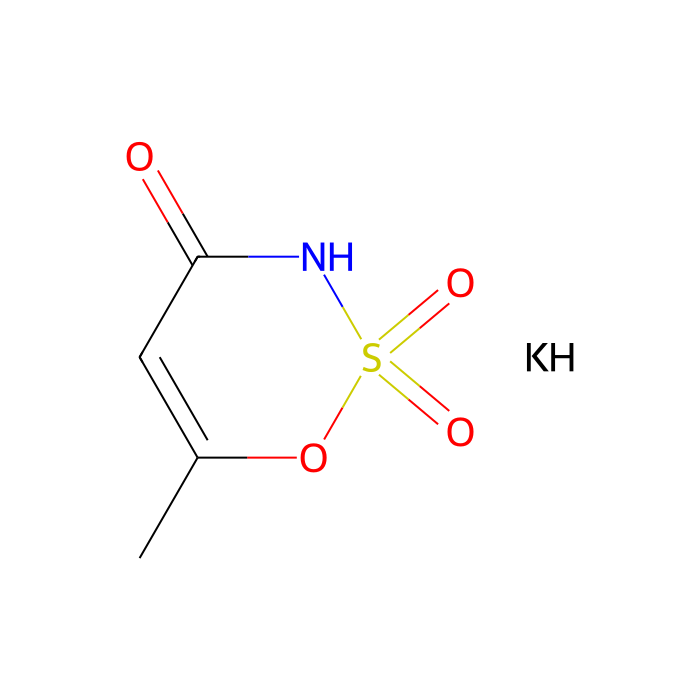
[KH].CC1=CC(=O)N[S](=O)(=O)O1
Reaxy-Rn
24254301
Reaxys-RN link address
https://www.reaxys.com/reaxys/secured/hopinto.do?context=S&query=IDE.XRN=24254301&ln=
技术文档
高级数据
产品属性
| ALogP | -0.858 |
|---|---|
| hba_count | 2 |
| HBD Count | 1 |
化学和物理性质
DMSO(mg / mL) Max Solubility
40
DMSO(mM) Max Solubility
197.7750309
Water(mg / mL) Max Solubility
40
Water(mM) Max Solubility
197.7750309
质检证书(CoA,COO,BSE/TSE 和分析图谱)
C of A & Other Certificates(BSE/TSE, COO):
输入批号以搜索分析图谱:
溶液计算器
产品仅提供给经过验证的企业、机构和合格的专业人员用于研发。不适用于人类、动物、诊断或治疗。
Copyright © 2023至今 上海阿拉丁生化科技股份有限公司 保留所有权利。


 危险品化学品经营许可证(带存储)