
计算溶液所需的质量、体积或浓度。
为什么选择此级别
,适用于对基线干扰要求严格的色谱和分析工作流程。
储存与运输
干燥,-80℃储存。特低温运输 。请查阅批次 COA 获取详细规格。
质量文档
SDS、COA、产品数据表及规格说明书均可下载。可通过批号查询获取批次 COA。
文献证明
在色谱分析、有机合成和交叉偶联反应领域已被 0 篇同行评审文献引用。
概述
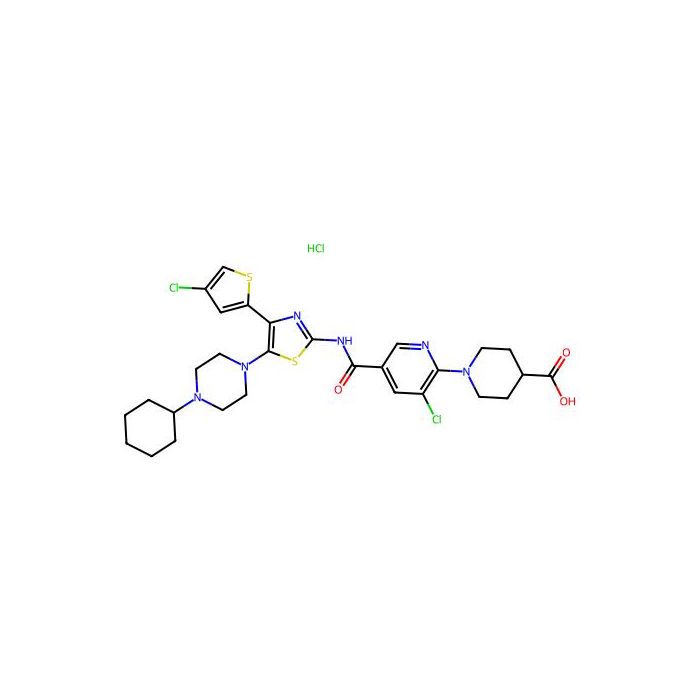
Avatrombopag (AKR-501) hydrochloride is an orally active, nonpeptide thrombopoietin (TPO) receptor agonist ( EC 50 =3.3 nM). Avatrombopag hydrochloride mimics the biological activities of TPO. Avatrombopag hydrochloride increases platelet production by activating the intracellular signaling system, and promotes production of platelets and megakaryocytes from hemopoietic precursor cells. Avatrombopag hydrochloride is a substrate of cytochrome P450 (CYP) 2C9 and CYP3A .
In Vitro
Avatrombopag (E5501; AKR-501) hydrochloride specifically targets the TPO receptor and stimulated megakaryocytopoiesis throughout the development and maturation of megakaryocytes just as recombinant human TPO (rhTPO) did. Avatrombopag hydrochloride is showed to have effect in humans and chimpanzees only. Avatrombopag hydrochloride (0-100 nM) supports the proliferation of TPO receptor expressing Ba/F3 cell in a concentration-dependent fashion. Avatrombopag hydrochloride (0-3 μM) induces tyrosine phosphorylation of STAT3 and STAT5, and threonine phosphorylation of ERK in the cells, as did rhTPO. Avatrombopag hydrochloride promotes megakaryocyte colony formation from human CB CD34 + cells in a concentration-dependent fashion. The EC 50 is 25 nM for Avatrombopag hydrochloride and the maximum activity of Avatrombopag hydrochloride is similar to that of rhTPO. MCE has not independently confirmed the accuracy of these methods. They are for reference only.
In Vivo
Avatrombopag hydrochloride (0.3-3 mg/kg; p.o.; daily for 14 days) increases the number of human platelets in NOD/SCID mice transplanted with human FL CD34 + cells . MCE has not independently confirmed the accuracy of these methods. They are for reference only. Animal Model: NOD/SCID mice (transplanted with human FL CD34+cells) Dosage: 0.3, 1, and 3 mg/kg Administration: P.o.; daily for 14 days Result: Dose-dependently increased the number of human platelets, resulting in approximately a 2.7‐fold increase at 1 mg/kg/d and a 3.0-fold increase at 3 mg/kg/d on day 14 after the start of administration.
规格
别名
盐酸阿伐曲波帕
规格或纯度
10mM in DMSO
英文名称
Avatrombopag hydrochloride
生化机理
阿伐曲波帕(AKR-501)盐酸盐是一种口服活性非肽促血小板生成素(TPO)受体激动剂(EC 50 =3.3 nM)。阿伐曲博帕格盐酸盐可模拟 TPO 的生物活性。阿伐曲波帕格盐酸盐可通过以下途径增加血小板生成
储存条件
干燥,-80℃储存
运输条件
特低温运输
作用类型
激动剂
名称和识别符
分子类型
小分子
Isomeric SMILES
C1CCC(CC1)N2CCN(CC2)C3=C(N=C(S3)NC(=O)C4=CC(=C(N=C4)N5CCC(CC5)C(=O)O)Cl)C6=CC(=CS6)Cl.Cl
PubChem CID
分子量
686.12
技术文档
高级数据
质检证书(CoA,COO,BSE/TSE 和分析图谱)
C of A & Other Certificates(BSE/TSE, COO):
输入批号以搜索分析图谱:
溶液计算器
产品仅提供给经过验证的企业、机构和合格的专业人员用于研发。不适用于人类、动物、诊断或治疗。
Copyright © 2023至今 上海阿拉丁生化科技股份有限公司 SSE:688179 保留所有权利。


 危险品化学品经营许可证(带存储)