Deubiquitinating enzyme that plays various roles in the regulation of the immune response and inflammation. During TCR engagement and activation, translocates into the cytoplasm and deubiquitinates its substrates LAT and TRAT1 and prevents their lysosome-dependent degradation to stabilize the TCR signaling complex at the plasma membrane. Plays an essential role in the selective LPS-induced macrophage response through the activation of NF-kappa-B pathway. In addition, promotes that antiviral immune response through targeting DNA sensor IFI16 to inhibit its proteasome-dependent degradation. Participates in the interferon signaling pathway and antiviral response independently of its deubiquitinase activity by maintaining nuclear phosphorylated STAT1 levels via inhibition of its CREBBP-mediated acetylation and subsequent dephosphorylation. Plays an intrinsic role in promoting the differentiation, activation and proliferation of CD4+ T-cell by activating the NF-kappa-B signaling pathway through deubiquitinating and stabilizing B-cell lymphoma/leukemia 10/BCL10. In myeloid-derived suppressor cells promotes the activation of the NF-kappa-B via deubiquitination and stabilization of RELA. Regulates the 'Lys-63'-linked polyubiquitin chains of BAX and thereby modulates the mitochondrial apoptotic process. Negative regulator of NOTCH signaling that specifically deubiquitinates non-activated NOTCH receptors to target them for lysosomal degradation; deubiquitination of NOTCH stimulates its transport form late endosomes to lysosomes. Protects neurons against HTT/huntingtin-induced polyglutamine expansion-dependent neurodegeneration through regulation of autophagic flux. This function is independent of deubiquitinase activity or of other components of the USP12-WDR20-WDR48 deubiquitinating complex. In complex with WDR48, acts as a potential tumor suppressor by positively regulating PHLPP1 stability. (Microbial infection) Forms a complex with Epstein-Barr virus protein EBNA3 which is an active deubiquitinase activity that may select specific substrates to promote B-lymphocyte transformation.
宿主种属
兔(Rabbit)
特异性
USP12
种属反应性
人(Human),大鼠(Rat),小鼠(Mouse)
免疫原
A synthetic peptide derived from human USP12 (AA 320-370).
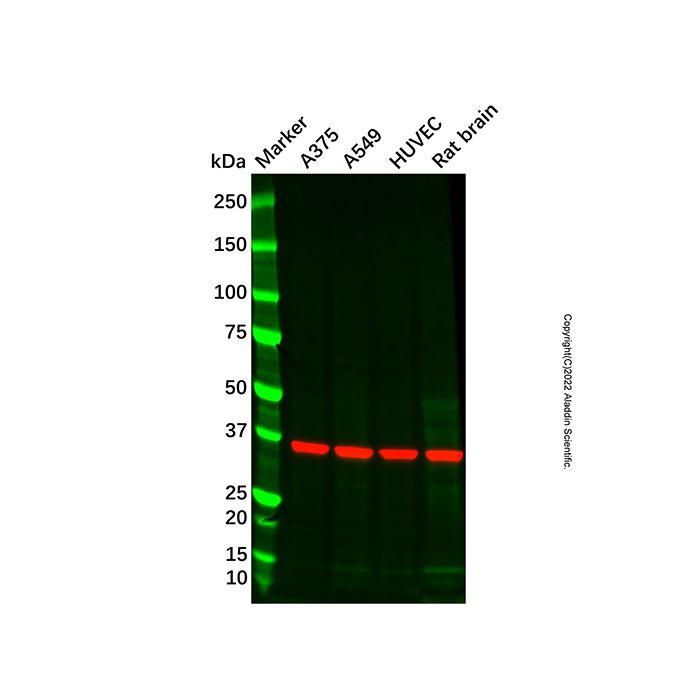
USP12 Antibody (Ab224766) - Western Blot All lanes: USP12 Antibody (Ab224766) at 1/1000 dilution Samples: Lysates at 20 µg per lane Secondary: Goat Anti-Rabbit IgG H&L (HRP) (Ab170144) at 1/20000 dilution Predicted band size: 43 kDa Observed band size: 36 kDa Exposure time: 37.0 s

 ZJ25F0623493


 危险品化学品经营许可证(带存储)