Multifunctional glycoprotein that acts as receptor for a broad range of ligands. Ligands can be of proteinaceous nature like thrombospondin, fibronectin, collagen or amyloid-beta as well as of lipidic nature such as oxidized low-density lipoprotein (oxLDL), anionic phospholipids, long-chain fatty acids and bacterial diacylated lipopeptides. They are generally multivalent and can therefore engage multiple receptors simultaneously, the resulting formation of CD36 clusters initiates signal transduction and internalization of receptor-ligand complexes. The dependency on coreceptor signaling is strongly ligand specific. Cellular responses to these ligands are involved in angiogenesis, inflammatory response, fatty acid metabolism, taste and dietary fat processing in the intestine (Probable). Binds long-chain fatty acids and facilitates their transport into cells, thus participating in muscle lipid utilization, adipose energy storage, and gut fat absorption (By similarity) (PubMed:18353783, PubMed:21610069). In the small intestine, plays a role in proximal absorption of dietary fatty acid and cholesterol for optimal chylomicron formation, possibly through the activation of MAPK1/3 (ERK1/2) signaling pathway (By similarity) (PubMed:18753675). Involved in oral fat perception and preferences (PubMed:22240721, PubMed:25822988). Detection into the tongue of long-chain fatty acids leads to a rapid and sustained rise in flux and protein content of pancreatobiliary secretions (By similarity). In taste receptor cells, mediates the induction of an increase in intracellulare calcium levels by long-chain fatty acids, leading to the activation of the gustatory neurons in the nucleus of the solitary tract (By similarity). Important factor in both ventromedial hypothalamus neuronal sensing of long-chain fatty acid and the regulation of energy and glucose homeostasis (By similarity). Receptor for thombospondins, THBS1 and THBS2, mediating their antiangiogenic effects (By similarity). As a coreceptor for TLR4:TLR6 heterodimer, promotes inflammation in monocytes/macrophages. Upon ligand binding, such as oxLDL or amyloid-beta 42, interacts with the heterodimer TLR4:TLR6, the complex is internalized and triggers inflammatory response, leading to NF-kappa-B-dependent production of CXCL1, CXCL2 and CCL9 cytokines, via MYD88 signaling pathway, and CCL5 cytokine, via TICAM1 signaling pathway, as well as IL1B secretion, through the priming and activation of the NLRP3 inflammasome (By similarity) (PubMed:20037584). Selective and nonredundant sensor of microbial diacylated lipopeptide that signal via TLR2:TLR6 heterodimer, this cluster triggers signaling from the cell surface, leading to the NF-kappa-B-dependent production of TNF, via MYD88 signaling pathway and subsequently is targeted to the Golgi in a lipid-raft dependent pathway (By similarity) (PubMed:16880211).
(Microbial infection) Directly mediates cytoadherence of Plasmodium falciparum parasitized erythrocytes and the internalization of particles independently of TLR signaling.
宿主种属
小鼠(Mouse)
特异性
Human CD36
种属反应性
人(Human)
免疫原
Human platelets
阳性对照
Flow Cytometry: Human peripheral blood platelets
偶联
AF555
Excitation(nm)
Green Laser(532nm)
Emission(nm)
568nm
Ex/Em(nm)
Ex:553nm;Em:568nm
克隆类型
重组抗体
Format
Whole IgG
轻链亚型
kappa
纯化方法
Protein A purified
浓度
5 μL/test
分子类型
抗体
产品线
生物产品
储存与运输
储存缓冲液
Liquid in PBS pH 7.4, containing 1% BSA and 0.05% Proclin300.
防腐剂
0.05% Proclin300
储存条件
2-8°C储存,避光,禁止冷冻
运输条件
低温运输,禁止冷冻
稳定性与储存
The antibody solution should be stored undiluted between 2°C and 8°C, and protected from prolonged exposure to light. Do not freeze.
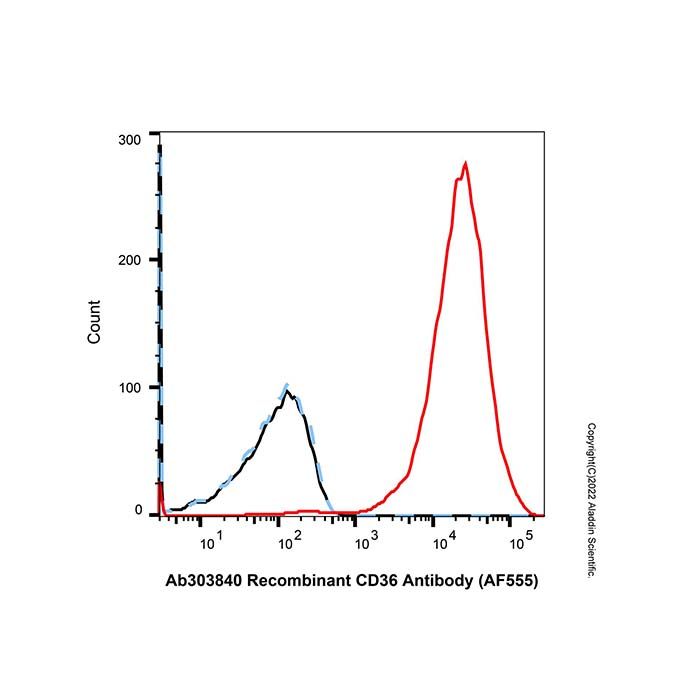
Flow cytometry analysis of CD36 expression by human peripheral blood platelets (red) compared to an isotype control (blue). Cells were stained with Recombinant CD36 Antibody (AF555) (Ab303840) at 5μL/test for 1 hour at 4°C. Blue - Mouse IgG (AF555) (Ab190246). Black - Unlabelled control, cells without incubation with primary antibody.
应用
应用名称
稀释比例
Flow Cytometry
5μl/test
For flow cytometric staining, the suggested use of this reagent is 5 µL per million cells in 100 µL staining volume or 5 µL per 100 µL of whole blood.

 ZJ26F0332908


 危险品化学品经营许可证(带存储)