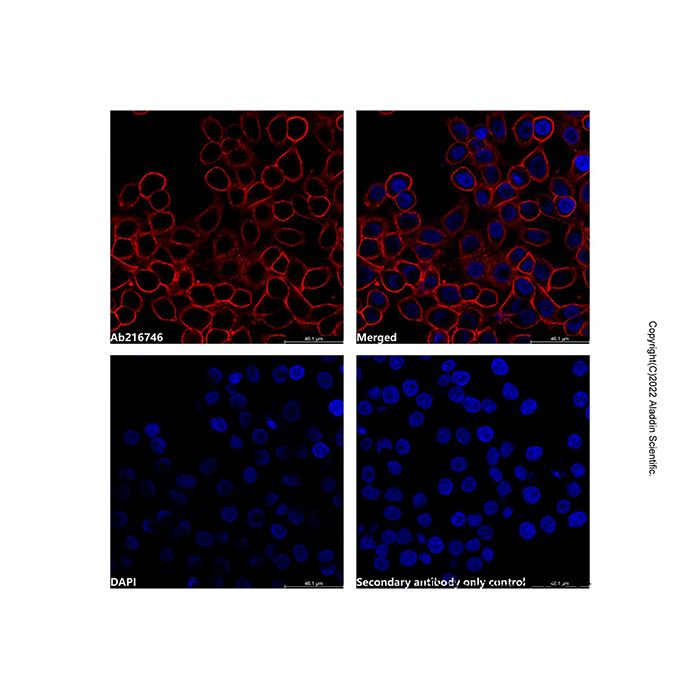
生物素抗体标记试剂盒(Sulfo-NHS-LC-Biotin)专为高效可靠的抗体标记而设计,仅需90分钟即可获得即用型标记抗体,且操作时间极短。试剂盒包含抗体标记所需的所有必要试剂,包括 Sulfo-NHS-LC-生物素试剂、缓冲液、离心柱管和纯化填料。盒内提供的 Sulfo-NHS-LC- 生物素试剂是一种中等长度、水溶性的生物素化试剂,适用于标记含有伯胺基的抗体、蛋白质及其他分子。NHS活化生物素可在pH 7–9的缓冲液中与伯氨基(-NH2)高效反应,形成稳定的酰胺键(图1)。试剂盒中的离心柱管和纯化填料可快速组装成3mL离心式纯化柱,用于从过量生物素试剂中纯化生物素化抗体。3mL纯化柱最适宜用于处理反应液体积约0.4-0.7mL的实验体系,回收率达70–95%。本试剂盒所含试剂足以完成10次、每次最多1.5mg抗体的生物素化反应。生物素化抗体可通过亲和素或链霉亲和素探针,应用于ELISA、Western Blot、免疫荧光/免疫细胞化学(IF/ICC)或流式细胞术等检测。Aladdin提供一系列高性能链霉亲和素偶联物,用于检测生物素化抗体的性能。

图1 Sulfo-NHS-LC-Biotin标记抗体原理图
Sulfo-NHS-LC-Biotin 特点
- 蛋白质标记——对抗体进行生物素化,便于通过链霉亲和素树脂或探针进行固定、纯化或检测
- 细胞表面标记——仅标记完整细胞的表面蛋白;因该带负电荷试剂无法穿透细胞膜
- 胺基反应性——可与伯氨基(-NH2)(如赖氨酸侧链或多肽氨基末端)发生反应
- 水溶性——带电荷的磺基NHS基团相比普通NHS酯类化合物提高了试剂的水溶性
- 不可逆结合——形成永久性酰胺键;间隔臂不可断裂
- 中等长度——间隔臂(添加至目标分子的总长度)为22.4埃;在足够长度(减少生物素结合的位阻效应)与适度分子量之间实现优异平衡
其他所需试剂
1. 离心机。
2. 用于标记的所需抗体(不含BSA或任何载体蛋白)。
3. PBS缓冲液(pH 7.2-7.4)。
4. 2mL 离心管。
注意事项
1. 纯化的抗体缓冲液中不得含有铵离子或者伯胺组分,例如Tris、甘氨酸、乙醇胺、三乙胺、谷胱甘肽或咪唑,所有这些物质都会显著抑制蛋白质标记。
2. 用于标记的抗体需经过纯化,不含有BSA或明胶等稳定剂。
3. 抗体浓度1-2mg/mL最佳,浓度低于1mg/mL, 标记效率可能会降低,浓度过高,抗体体积会过少,不利于纯化回收。
4. 待标记抗体体积应控制在0.4-0.7mL, 保证纯化柱的最佳去除效果。
5. Sulfo-NHS-LC-Biotin试剂对潮湿敏感。为防止产品受潮凝结,打开前请将试剂瓶平衡至室温。
6. 请严格按照操作步骤,在使用前立即溶解生物素试剂。NHS-酯基团极易水解失活,因此,根据标记抗体数量溶解适量生物素试剂,请勿配制储存用储备液。任何已溶解但未使用的试剂均应丢弃。配制后的生物素试剂请在10分钟内使用。
7. 本试剂盒中的纯化填料建议一次性使用。
使用说明
1. 试剂生物素用量计算:
生物素标记的程度取决于蛋白质上氨基的分布和大小,以及每单位蛋白浓度所用试剂的量。与浓缩蛋白溶液反应相比,稀释蛋白溶液的标记反应需要更高摩尔过量的生物素试剂才能达到相同的标记水平。使用 20 倍摩尔过量的生物素试剂标记浓度为 1-10 mg/mL 的抗体(IgG)足以满足大多数标记需求。可调整 Sulfo-NHS-LC-Biotin与蛋白质的摩尔比以获得所需的标记水平。
(1) 计算 20 倍摩尔过量所需的生物素试剂毫摩尔数:

(2) 计算需添加到反应体系中的生物素试剂体积:

其中,Sulfo-NHS-LC-生物素的分子量为 557。向一瓶 Sulfo-NHS-LC-Biotin试剂中加入 90 μL 超纯水,可得到浓度为 5.5 mg/mL、摩尔浓度为 10 mM 的溶液。
(3) 示例:对于0.5mL浓度为 2mg/mL 的 抗体(IgG分子量 150,000)溶液,将加入 13.5 μL 的 10mM Sulfo-NHS-LC-生物素。


2. 缓冲液配制:
(1) 1M NaHCO₃的配制。根据待标记抗体量配制适量的1M NaHCO₃溶液,如称取42mg NaHCO₃,加入0.5mL去离子水即得1M NaHCO₃溶液。NaHCO₃可维持标记反应体系的pH在7-9之间,提高标记效率。注意:NaHCO₃溶液须现用现配。
3. 抗体标记:
(1) 根据步骤1 的计算,将 1 mg 蛋白质溶解于 0.4-0.7mL 磷酸盐缓冲液(PBS)中。如果待标记抗体的浓度 ≥1 mg/mL 且处于合适的缓冲液中,则加入其体积 10% 的 1 M 碳酸氢钠缓冲液。用超纯水将1M NaHCO₃溶液稀释10倍,制备0.1M NaHCO₃缓冲液。
(2) 使用前,将Sulfo-NHS-LC-Biotin试剂自冰箱取出,恢复至室温。取1管生物素试剂,溶解于 90μL 超纯水中,配制10mM Sulfo-NHS-LC-Biotin溶液。
(3) 向蛋白质溶液中加入相应体积的Sulfo-NHS-LC-Biotin溶液(参见步骤 1 的计算)。
(4) 将反应物置于冰上孵育两小时,或在室温孵育 30-60 分钟。
注意:超过规定时间进行反应并无害处,但可能导致常规的蛋白质降解或微生物生长。
(5) 在孵育期间,进行下述步骤 4,准备用于纯化标记蛋白的离心柱。
4. 使用纯化柱纯化:
(1) 将一个空的离心柱放入一个 15mL 收集管中。
(2) 通过反复倒置试剂瓶重悬纯化树脂。然后取 3.0 mL悬液加入柱中,让树脂沉降。让柱缓冲液依靠重力从柱中排出。初始时,可能需要施加一些压力使最初的几滴缓冲液流出。以 1,000 × g 离心柱子 2 分钟,弃去储存缓冲液,将柱子放回同一个收集管中。
注意:纯化树脂以 20% 乙醇的悬液形式提供,树脂与乙醇的体积比为 3:1 (v/v)。
(3) 通过在树脂床顶部加入 2mL PBS,以 1,000 × g 离心 2 分钟来平衡柱子。弃去流出液,此步骤总共重复 3 次。
注意:使用定角转子时,在柱子背对转子中心的一侧做标记。在后续所有离心步骤中,将柱子放入离心机时,标记面应背对转子中心。
(4) 将柱子放入一个新的 15mL 收集管中,将待纯化的生物素化蛋白样品直接加到树脂床的中心。让样品被树脂吸收。
注意:对于体积 < 400μL 的样品,在吸收的样品顶部加入 100μL 超纯水,以提高蛋白回收率。
(5) 以 1,000 × g 离心柱子 2 分钟。收集到的流出液即为纯化的生物素化蛋白样品。在适当条件下储存蛋白溶液。
5. 测定蛋白质浓度(可选)
通过检测280nm吸光度检测抗体浓度。
6. 保存与使用
将标记的抗体储存于 4°C。如果纯化后抗体偶联物的最终浓度低于 1 mg/mL,可加入牛血清白蛋白(BSA)或其他稳定蛋白,使其浓度达到 1-10 mg/mL。偶联物在 4°C 下可稳定保存数月。如需长期储存,请将溶液分装成单次使用的小份,于 -20°C 冷冻。避免反复冻融。
The Sulfo-NHS-LC-Biotinylation Kit is designed for efficiency and reliability, delivering ready-to-use labeled antibody in just 90 minutes, with minimal hands-on time. The kit includes all necessary reagents for antibody labeling, including Sulfo-NHS-LC-Biotin reagent, buffers, purification resin, and empty spin columns. The Sulfo-NHS-LC-Biotin reagent included in the kit is an intermediate-length, water-soluble biotinylation reagent for labeling antibodies, proteins, and other molecules that have primary amines. NHS-activated biotins react efficiently with primary amino groups (-NH2) in pH 7-9 buffers to form stable amide bonds (Fig 1). The included empty spin columns and purification resin can be quickly assembled into 3 mL centrifugal purification columns for the rapid purification of biotinylated antibodies from excess biotin reagent. The 3 mL purification column is optimally suited for processing reaction mixtures with a volume of approximately 0.4–0.7 mL, achieving a recovery rate of 70–95%.The reagents supplied in this kit are sufficient for performing 10 biotinylation reactions, each capable of labeling up to 1.5 mg of antibody. The biotinylated antibody can be detected in ELISA, Western Blot, IF/ICC or Flow Cytometry application using avidin or streptavidin probes. Aladdin offers a series of high-performance streptavidin conjugates designed for detecting the performance of biotinylated antibodies.
Figure 1 Reaction of Sulfo-NHS-LC-Biotin with antibody
Features of Sulfo-NHS-LC-Biotin:
- Protein labeling—biotinylate antibodies to facilitate immobilization, purification or detection using streptavidin resins or probes
- Cell surface labeling—biotinylates only surface proteins of whole cells because the negatively charged reagent does not permeate cell membranes
- Amine-reactive—reacts with primary amines (-NH2), such as lysine side-chains, or the amino-termini of polypeptides
- Soluble—charged sulfo-NHS group increases reagent water solubility compared to ordinary NHS-ester compounds
- Irreversible—forms permanent amide bonds; spacer arm cannot be cleaved
- Medium length—spacer arm (total length added to target) is 22.4 angstroms; provides excellent balance between adequate length (minimal steric hindrance for biotin binding) and modest mass
Required materials not supplied
1. Microcentrifuge capable of 1,000 xg.
2. Desired antibody for labeling (free of BSA or any carrier protein).
3. PBS buffer (pH 7.2-7.4).
4. 2mL tubes.
Matters needing attention
1. The purified antibody should be in a buffer that does not contain primary amines (for example, ammonium ions, Tris, glycine, ethanolamine, triethylamine, glutathione) or imidazole. All of these substances significantly inhibit protein labeling.
2. Impure antibodies or antibodies stabilized with bovine serum albumin (BSA) or gelatin will not be labeled well.
3. An antibody concentration of 1–2 mg/mL is optimal. Concentrations below 1 mg/mL may reduce labeling efficiency, while excessively high concentrations may result in too small a volume of antibody, which is unfavorable for purification recovery.
4. The volume of the antibody to be labeled should be controlled between 0.4 mL and 0.7 mL to ensure optimal removal efficiency using the purification column.
5. The Sulfo-NHS-LC-Biotin reagent is moisture-sensitive. To prevent condensation and moisture absorption, allow the vial to equilibrate to room temperature before opening.
6. Strictly follow the operating procedure and dissolve the biotin reagent immediately before use. Its NHS-ester group is highly susceptible to hydrolysis and inactivation. Therefore, dissolve an appropriate amount of biotin reagent based on the number of antibodies to be labeled, and do not prepare stock solutions for storage. Any dissolved but unused reagent should be discarded. Prepared biotin reagent should be used within 10 minutes.
7. The purification resin included in this kit is recommended for single use only.
Instructions for Use
1. Calculations
The extent of biotin labeling depends on the size and distribution of amino groups on the protein and the amount of reagent used per protein concentration. Compared to reactions involving concentrated protein solutions, labeling reactions with dilute protein solutions require a greater fold molar excess of biotin reagent to achieve the same incorporation level. Using a 20-fold molar excess of biotin reagent to label antibody (IgG) at 1-10 mg/mL is sufficient for most labeling requirements. Adjust the molar ratio of Sulfo-NHS-LC-Biotin to protein to obtain the level of incorporation desired.
(1) Calculate millimoles of Sulfo-NHS-LC-Biotin to add to the reaction for a 20-fold molar excess:
(2) Calculate microliters of 10mM Sulfo-NHS-LC-Biotin (prepared in Step 3.2) to add to the reaction:
- Molecular weight of Sulfo-NHS-LC-Biotin is 557.
- Adding 90 μL of ultrapure water to one vial of Sulfo-NHS-LC-Biotin reagent yields a solution with a concentration of 5.5 mg/mL and a molarity of 10 mM.
(3) Example: For 0.5mL of a 2mg/mL IgG (150,000 MW) solution, 13.5 μL of 10mM Sulfo-NHS-LC-Biotin will be added.
2. Prepare the reagents
(1) Prepare a 1 M sodium bicarbonate solution: Prepare an appropriate amount of 1M NaHCO₃ solution based on the sample volume. For example, weigh 42mg of NaHCO₃ and add 0.5mL of ultrapure water to obtain a 1M NaHCO₃ solution. NaHCO₃ can maintain the pH of the labeling reaction system between 7-9, thereby improving labeling efficiency.
Note: The NaHCO₃ solution must be prepared fresh before each use.
3. Label the antibody
(1) Dissolve 1 mg protein in 0.4-0.7mL of phosphate-buffered saline (PBS) according to the calculation made in step 1. If the antibody to be labeled has a concentration of ≥1 mg/mL and is in an appropriate buffer, add a 10% volume of 1 M sodium bicarbonate buffer. Prepare 0.1 M sodium bicarbonate buffer by diluting the 1 M solution 10-fold with ultrapure water.
(2) Immediately before use, prepare 10mM Sulfo-NHS-LC-Biotin by dissolving one vial of Sulfo-NHS-LC-Biotin reagent in 90μL ultrapure water.
(3) Add the appropriate volume of Sulfo-NHS-LC-Biotin solution (see calculations in step 1) to the protein solution.
(4) Incubate reaction on ice for two hours or at room temperature for 30-60 minutes.
Note: There is no harm in reacting longer than the specified time other than the possibility of ordinary protein degradation or microbial growth.
(5) During the incubation period, proceed to steps 4 below, to prepare a spin column for the purification of the labeled protein.
4. Purification with Purification Column
(1) Place an empty spin column in a 15mL collection tube.
(2) Suspend the purification resin by repeated inversion of the reagent bottle. Then add 3.0 mL of the suspension into the column and allow the resin to settle. Allow the column buffer to drain from the column by gravity. Initially, some pressure may be required to cause the first few drops of buffer to elute. Centrifuge the column at 1,000 × g for 2 minutes, discard the storage buffer and return column to the same collection tube.
Note: The purification resin is supplied as a slurry in 20% ethanol, with a resin-to-ethanol volume ratio of 3:1 (v/v).
(3) Equilibrate the column by adding 2mL of PBS to the top of the resin bed and centrifuging at 1,000 × g for 2 minutes. Discard the flowthrough and repeat this step a total of 3 times.
Note: When using a fixed-angle rotor, place a mark on the side of the column that faces away from the rotor center. For all subsequent centrifugation steps, place the column in the microcentrifuge with the mark facing away from the rotor center.
(4) Place column into a new 15mL collection tube and apply the protein sample directly onto the center of the resin bed. Allow sample to absorb into the resin.
Note: For samples < 400μL, add 100μL ultrapure water on top of the absorbed sample to increase protein recovery.
(5) Centrifuge the column at 1,000 × g for 2 minutes. The collected flowthrough solution is the purified protein sample. Store the protein solution in appropriate conditions.
5. Determine the protein concentration (Optional)
Determination of antibody concentration by measuring absorption at 280 nm.
6. Storage
Store the labeled antibody at 4°C. If the final concentration of purified antibody conjugate is less than 1 mg/mL, add bovine serum albumin (BSA) or other stabilizing protein to a concentration of 1-10 mg/mL. The conjugate should be stable at 4°C for several months. For long-term storage, divide the solution into single-use aliquots and freeze at -20°C. Avoid repeated freeze-thaw cycles.

 ZJ26F0333387


 危险品化学品经营许可证(带存储)