
计算溶液所需的质量、体积或浓度。
为什么选择此级别
,适用于对基线干扰要求严格的色谱和分析工作流程。
储存与运输
-20°C储存。超低温运输 。请查阅批次 COA 获取详细规格。
质量文档
SDS、COA、产品数据表及规格说明书均可下载。可通过批号查询获取批次 COA。
文献证明
在色谱分析、有机合成和交叉偶联反应领域已被 0 篇同行评审文献引用。
概述
Bryonolic acid is an active triterpenoid compound with immunomodulatory, anti-inflammatory, antioxidant and anticancer activities .
In Vitro
Bryonolic acid exerts anti-allergic activity by inhibiting homologous passive cutaneous anaphylaxis and delayed hypersensitivity. Bryonolic acid reduces nitric oxide by suppressing inducible nitric oxide synthase expression, indicating anti-inflammatory activity. In rat adrenal pheochromocytoma (PC12) cells, Bryonolic acid against N-methyl-D-aspartate (NMDA)-induced neurotoxicity, indicating it as a candidate neuroprotective agent for cerebral ischemic treatment. Bryonolic acid (1-200 μM) inhibits acyl-coA: cholesterol acyl transferase (ACAT) activity in rat liver microsomes in a concentration-dependent manner, blocking the biosynthesis of the cholesterol fatty acid ester tumour promoter. Bryonolic acid inhibits ACAT in intact cancer cells with an IC 50 of 12.6 µM. Bryonolic acid inhibits both clonogenicity and invasiveness in MCF-7 MB-231, U87 and 3T3-EA cells. MCE has not independently confirmed the accuracy of these methods. They are for reference only.
In Vivo
Bryonolic acid (500 mg/kg; i.p.; once) potently induces HO-1 in a manner dependent on the Nrf2-Keap1 pathway. MCE has not independently confirmed the accuracy of these methods. They are for reference only. Animal Model: Wild-type and Nrf2-/- miceDosage: 500 mg/kg Administration: i.p.; once Result: Induced HO-1 in a manner dependent on the Nrf2-Keap1 pathway.
规格
别名
苔藓酸
英文别名
3beta-Hydroxy-D-C-friedoolean-8-en-29-oic acid | ((2R,3R,4R)-3-(benzoyloxy)-4-fluoro-4-methyl-5-oxotetrahydrofuran-2-yl)methyl?benzoate | D:C-FRIEDOOLEAN-8-EN-29-OIC ACID, 3-HYDROXY-, (3.BETA.,20.BETA.)- | (2S,4aS,6aS,8aR,10S,12aS,14aS,14bR)-10-hydroxy-2,
英文名称
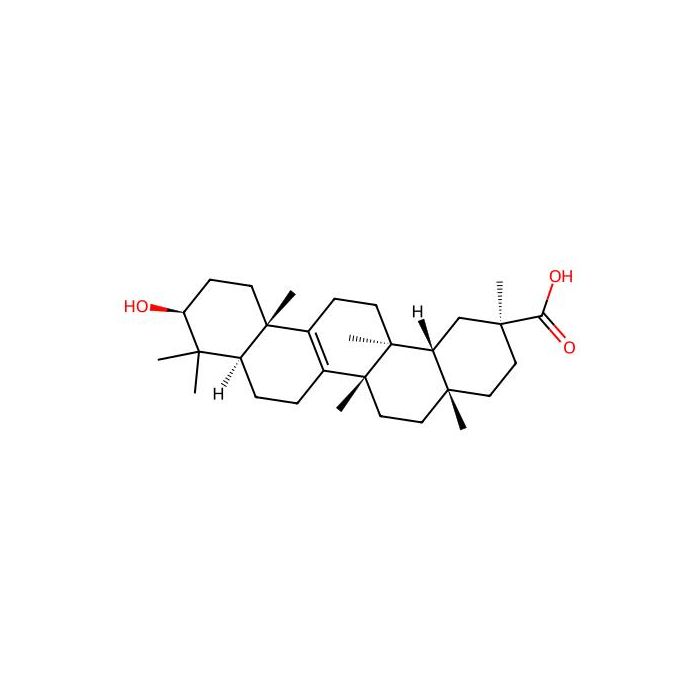
Bryonolic acid
生化机理
布洛诺酸是一种活性三萜类化合物,具有免疫调节、抗炎、抗氧化和抗癌活性。
储存条件
-20°C储存
运输条件
超低温运输
作用类型
抑制剂
名称和识别符
分子类型
小分子
IUPAC Name
(2S,4aS,6aS,8aR,10S,12aS,14aS,14bR)-10-hydroxy-2,4a,6a,9,9,12a,14a-heptamethyl-1,3,4,5,6,7,8,8a,10,11,12,13,14,14b-tetradecahydropicene-2-carboxylic acid
INCHI
1S/C30H48O3/c1-25(2)21-9-8-20-19(28(21,5)12-11-23(25)31)10-13-30(7)22-18-27(4,24(32)33)15-14-26(22,3)16-17-29(20,30)6/h21-23,31H,8-18H2,1-7H3,(H,32,33)/t21-,22+,23-,26+,27-,28+,29+,30-/m0/s1
InChi Key
BHVJSLPLFOAMEV-UHIFYLTQSA-N
Smiles
CC1(C2CCC3=C(C2(CCC1O)C)CCC4(C3(CCC5(C4CC(CC5)(C)C(=O)O)C)C)C)C
Isomeric SMILES
C[C@]12CC[C@](C[C@H]1[C@@]3(CCC4=C([C@]3(CC2)C)CC[C@@H]5[C@@]4(CC[C@@H](C5(C)C)O)C)C)(C)C(=O)O
关联CAS
PubChem CID
MeSH Entry Terms
3beta-hydroxy-D-C-friedoolean-8-en-29-oic acid;bryonolic acid
分子量
456.70
技术文档
高级数据
系统学分类
分类树(Taxonomy Tree)
| 界(kingdom) | 有机化合物 |
|---|---|
| 超类(Superclass) | 有机氧化合物 |
| 类(Class) | 有机氧化合物 |
| 亚类(Subclass) | 醇和多元醇 |
| 中间层级节点(Intermediate Tree Nodes) | 暂无 |
| 直接上位类(Direct Parent) | 环状醇及其衍生物 |
| 其他上位类(Alternative Parents) | 仲醇 一元羧酸及其衍生物 羧酸 有机氧化物 碳氢化合物衍生物 羰基化合物 |
| 分子骨架(Molecular Framework) | 脂肪族同多环化合物 |
| 取代基(Substituents) | 脂肪族同多环化合物 - 羰基 - 羧酰胺基 - 羧酸衍生物 - 环醇 - 烃衍生物 - 单羧酸或其衍生物 - 有机氧化物 - 醛基 |
| 描述(Description) | 该化合物属于环醇及其衍生物类有机化合物。这类化合物含有至少一个羟基取代的脂肪族环。 |
| 外部描述符(External Descriptors) | hydroxy monocarboxylic acid - pentacyclic triterpenoid |
三维结构
交互式化学结构模型
化学和物理性质
分子量
456.700 g/mol
XLogP3
7.200
氢键供体数Hydrogen Bond Donor Count
2
氢键受体数Hydrogen Bond Acceptor Count
3
可旋转键计数Rotatable Bond Count
1
精确质量Exact Mass
456.36 Da
单同位素质量Monoisotopic Mass
456.36 Da
拓扑极表面积Topological Polar Surface Area
57.500 Ų
重原子数Heavy Atom Count
33
形式电荷Formal Charge
0
复杂度Complexity
902.000
同位素原子数Isotope Atom Count
0
定义的原子立体中心计数Defined Atom Stereocenter Count
8
未定义的原子立体中心计数Undefined Atom Stereocenter Count
0
定义的键立体中心计数Defined Bond Stereocenter Count
0
未定义的键立体中心计数Undefined Bond Stereocenter Count
0
所有立体化学键的总数The total count of all stereochemical bonds
0
共价键合单元计数Covalently-Bonded Unit Count
1
安全和危险性(GHS)
质检证书(CoA,COO,BSE/TSE 和分析图谱)
C of A & Other Certificates(BSE/TSE, COO):
输入批号以搜索分析图谱:
溶液计算器
常见问题
本产品应如何储存?
请于?20 °C条件下保存。需冷冻保存以维持规定的有效期。
本产品如何运输?
本产品采用保温箱配冰袋运输。收货后请立即拆包,并按上述储存条件保存。
本产品的 CAS 号、分子式和分子量是多少?
本产品的 CAS 号为 24480-45-3,分子式为 C30H48O3,分子量为 456.70 g/mol。InChIKey BHVJSLPLFOAMEV-UHIFYLTQSA-N。
如何获取批次专用COA?
每个订单都会随附分析证书(COA),您也可以从账户订单历史中下载。如需订购前的COA,请联系您的客户代表,或使用PDP上的"申请COA"按钮——我们将提供代表性批次的COA。
产品仅提供给经过验证的企业、机构和合格的专业人员用于研发。不适用于人类、动物、诊断或治疗。
Copyright © 2023至今 上海阿拉丁生化科技股份有限公司 保留所有权利。


 危险品化学品经营许可证(带存储)