储存缓冲液:20% (v/v) Ethanol
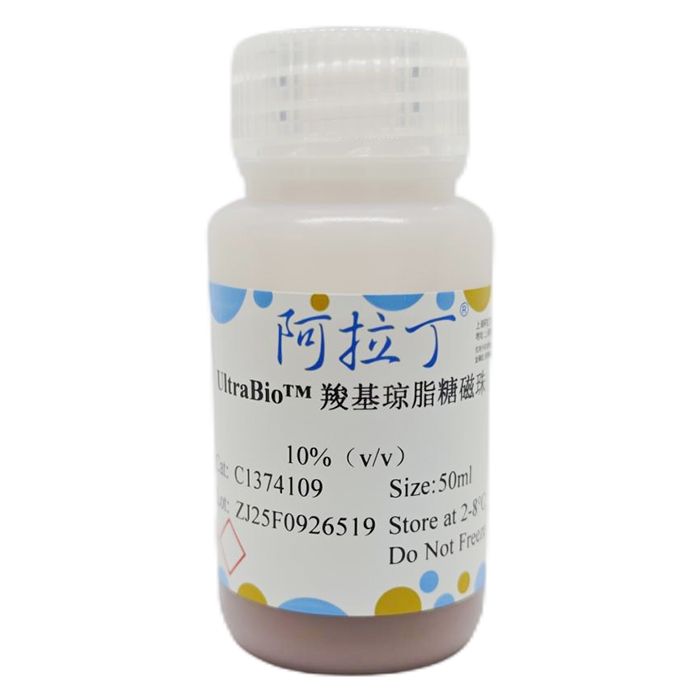
UltraBio™ 羧基琼脂糖磁珠以交联琼脂糖为基质,拥有良好的刚性、磁响应性和单分散性。羧基琼脂糖磁珠表面修饰有丰富的羧基,能够与含伯胺基的生物配体,如:蛋白质、抗体、寡聚核 苷酸和药物分子等通过共价偶联的方法实现结合,是一种分子生物学和医学研究的重要载体工具。
本产品每毫升磁珠悬液含约10%琼脂糖磁珠沉淀。
包装规格:10%(v/v)悬液
参数
| 指标
| 基质
| 琼脂糖
| 配基
| 羧基 | 含量
| Slurry: 10%
| 粒径
| 50 μm (20-80)
| 配基密度
| 30~50 µmol/mL (100%, v/v) | 保存
| 2-8℃ (20% 乙醇) |
|
使用说明:
一、偶联准备
1、离心管、磁力架
2、反应缓冲液:0.1M MES, 0.15M NaCl, 0.05% Tween 20, pH 6.0
3、清洗缓冲液:50mM Tris-HCl, 0.15M NaCl, pH 7.2
4、封闭液:0.1M Tris-HCl, pH 8.3
5、需要偶联的目标蛋白、抗体等生物配体
6、偶联活化剂(EDC-HCl溶液):用反应缓冲液配置为20mg/mL浓度,现配现用。
二、操作流程
1、将磁珠混合均匀,取1mL 磁珠 (10%, V/V) 加入到2mL离心管中,磁性分离去除上清液。
注:“磁性分离”指将离心管置于外加磁场中,至磁珠吸附完全,约需要30s。
2、加入500 µL反应缓冲液,混合重悬磁珠,磁性分离去除上清液(重复3次)。
3、加入200~400 µL反应缓冲液,混合重悬磁珠。
4、加入200 µL现配偶联试剂(EDC-HCl溶液),室温旋转混合30 min。
5、加入200~400 µg抗体或者蛋白质溶液(提前用 500 µL 反应缓冲液溶解),室温旋转混合 12~16h,磁性分离去除上清液。
6、加入1 mL封闭缓冲液,混合重悬磁珠,25 ℃旋转混合2h,磁性分离去除上清液。
7、加入1 mL清洗缓冲液,混合重悬磁珠,磁性分离去除上清液(重复3~5次)。
8、将上述磁珠分散于0.5 mL PBS,pH 7.4短期保存,或分散于PBS,pH 7.4,0.1%BSA, 0.02% NaN3长期保存。
注意事项:
1、偶联过程中不应含有除目标配体外含伯胺基团的物质,如:甘氨酸、BSA、Tris-HCl等,请注意您的样品溶液是否含有上述物质。
2、琼脂糖磁珠使用和保存过程中应避免冻融。
3、琼脂糖磁珠不可干燥。
4、不同抗体和蛋白与羧基脂糖磁珠的结合能力不同,客户可自行优化加入不同的抗体或者蛋白量。
5、偶联过程无需移除EDC溶液,可适当提高EDC溶液浓度来提高偶联效率。
UltraBio™ Carboxyl Magnetic Agarose Beads utilize cross-linked agarose as the matrix, offering excellent rigidity, magnetic responsiveness, and monodispersity. The beads are surface-modified with abundant carboxyl groups, enabling covalent coupling with biological ligands containing primary amine groups, such as proteins, antibodies, oligonucleotides, and drug molecules. This product serves as a vital carrier tool for molecular biology and medical research.
Parameter
| Specification
| Matrix
| Agarose
| Ligand
| Carboxyl
| Content
| Slurry: 10%
| Particle Size
| 50 μm (20-80)
| Ligand Density
| 30~50 μmol/mL (100%, v/v)
| Storage
| 2-8°C (in 20% Ethanol) |
|
Instructions for Use:
I. Coupling Preparation
Equipment: Microcentrifuge tubes, Magnetic separation rack.
Reaction Buffer: 0.1 M MES, 0.15 M NaCl, 0.05% Tween 20, pH 6.0
Wash Buffer: 50 mM Tris-HCl, 0.15 M NaCl, pH 7.2
Blocking Solution: 0.1 M Tris-HCl, pH 8.3
Target Ligand: Biological ligand for coupling (e.g., target protein, antibody).
Coupling Activator (EDC·HCl Solution): Prepare fresh at a concentration of 20 mg/mL in Reaction Buffer.
II. Coupling Procedure
Resuspend the magnetic beads thoroughly. Transfer 1 mL of bead slurry (10%, V/V) to a 2 mL microcentrifuge tube. Perform magnetic separation and discard the supernatant.
Add 500 µL Reaction Buffer. Resuspend the beads thoroughly. Perform magnetic separation and discard the supernatant. Repeat this wash step twice more (3 washes total).
Add 200-400 µL Reaction Buffer. Resuspend the beads thoroughly.
Add 200 µL freshly prepared EDC·HCl Solution (20 mg/mL). Incubate with end-over-end rotation at room temperature for 30 minutes.
Add 200-400 µg of antibody or protein solution (pre-dissolved in 500 µL Reaction Buffer). Incubate with end-over-end rotation at room temperature for 12-16 hours. Perform magnetic separation and discard the supernatant.
Add 1 mL Blocking Solution. Resuspend the beads thoroughly. Incubate with end-over-end rotation at 25°C for 2 hours. Perform magnetic separation and discard the supernatant.
Add 1 mL Wash Buffer. Resuspend the beads thoroughly. Perform magnetic separation and discard the supernatant. Repeat this wash step 3-5 times.
Resuspend the coupled beads in 0.5 mL PBS, pH 7.4 for short-term storage OR in PBS, pH 7.4, containing 0.1% BSA and 0.02% NaN₃ for long-term storage.
Precautions:
Avoid Primary Amines: The coupling reaction should NOT contain substances with primary amine groups other than the target ligand (e.g., glycine, BSA, Tris-HCl). Please verify if your sample solution contains such interfering agents.
Avoid Freeze-Thaw: Beads should be protected from freeze-thaw cycles during use and storage.
Do Not Dry: UltraBio™ Carboxyl Magnetic Agarose Beads must not be allowed to dry out.
Ligand Optimization: The binding capacity of UltraBio™ Carboxyl Magnetic Agarose Beads varies for different antibodies and proteins. Users may need to optimize the amount of antibody or protein added.
EDC Handling: It is not necessary to remove the EDC solution after the activation step (Step 4) before adding the ligand. The coupling reaction (Step 5) proceeds in the presence of EDC. Increasing the EDC concentration may improve coupling efficiency.

 ZJ25F0926520


 危险品化学品经营许可证(带存储)