储存缓冲液:Purified Water, 0.05% ProClin 300
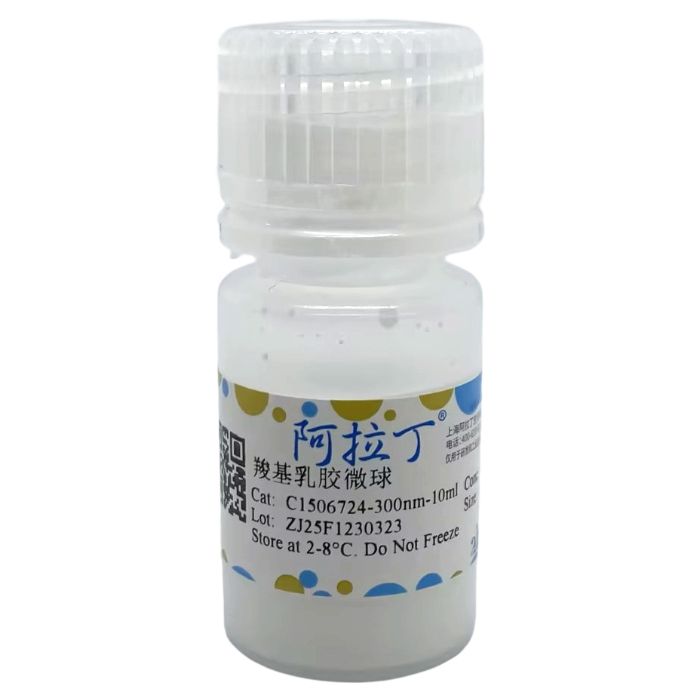
阿拉丁羧基乳胶微球是通过乳液聚合制备得到的聚苯乙烯微球,尺寸范围80~350 nm,表面修饰有适量的羧基基团,可方便地与抗体或带有氨基的活性物质进行共价偶联,得到稳定的微球-配基复合物,可广泛应用于粒子增强免疫比浊试剂产品。
产品名称
| 货号 | 粒径 | 浓度 | 羧基含量参考值 | PA参考值 | 应用方向 |
羧基乳胶微球
| C1506724-80nm
| 80nm
| 10% | 310 | 34 | 免疫比浊 |
羧基乳胶微球
| C1506724-100nm
| 100nm
| 10%
| 220 | 39 | 免疫比浊 |
羧基乳胶微球
| C1506724-120nm
| 120nm
| 10%
| 210 | 34 | 免疫比浊 |
羧基乳胶微球
| C1506724-140nm
| 140nm
| 10%
| 190 | 32 | 免疫比浊 |
羧基乳胶微球
| C1506724-160nm
| 160nm
| 10%
| 160 | 34 | 免疫比浊 |
羧基乳胶微球
| C1506724-180nm
| 180nm
| 10%
| 150 | 30 | 免疫比浊 |
羧基乳胶微球
| C1506724-200nm
| 200nm
| 10%
| 130 | 32 | 免疫比浊 |
羧基乳胶微球
| C1506724-250nm
| 250nm
| 10%
| 75 | 48 | 免疫比浊 |
羧基乳胶微球
| C1506724-300nm
| 300nm
| 10%
| 85 | 33 | 免疫比浊 |
羧基乳胶微球
| C1506724-350nm
| 350nm
| 10%
| 60 | 45 | 免疫比浊 |
注:
① 羧基含量通过电导滴定法测定得到,单位为μeq/g。
② PA为Parking Area缩写,代表微球表面电荷密度,数值越小表示单个羧基所占表面积越小,羧基密度越高。
③ 实际羧基含量和PA数据每批次有所不同,一般为参考值的±10%以内。
产品特点
粒径均一,批间差小
单批次可达100L,满足大部分生产需求
可提供定制化服务
产品参数
材质:聚苯乙烯共聚物
固含量:10% w/v
粒径范围:80~350nm
均一度:CV≤3%
分散体系:Purified Water, 0.05% ProClin 300
使用说明
一步法标记方案
1、溶液配制
| 名称 | 详情 |
| 反应缓冲液 | 50mM PB, pH 7.0 |
| EDC溶液 | 10mg/mL in PB, pH 6.0 |
| 封闭液 | 50mM PB, pH 7.4, 1% BSA |
| 保存液 | 50mM Tris-HCl, pH 8.2 |
2、建议标记方案
(1) 使用前建议超声分散。
(2) 使用反应缓冲液将微球稀释10倍至 1%(w/v)。
(4) 加入20μL EDC溶液,摇匀。
(5) 在混匀器上反应2小时。
(6) 用50mM PB,pH 7.4换液2次,加入1mL的封闭液,反应1小时。
(7) 用保存液换液2次,加入1mL的封闭液,2~8℃储存。
两步法标记方案
1、溶液配制
| 名称 | 详情 |
| 反应缓冲液 | 50mM PB, pH 7.0 |
| EDC溶液 | 10mg/mL in PB, pH 6.0 |
| 封闭液 | 50mM PB, pH 7.4, 1% BSA |
| 保存液 | 50mM Tris-HCl, pH 8.2 |
2、建议标记方案
(1) 使用前建议超声分散。
(2) 使用反应缓冲液将微球稀释10倍至1%(w/v)。
(3) 加入20μL EDC溶液,摇匀,在混匀器上反应15分钟。
(4) 用反应缓冲液换液2次。
(5) 微球用1mL反应缓冲液分散后,加入200~800 μg的抗体,摇匀,在混匀器上反应2小时。
(6) 用50mM PB,pH 7.4换液2次,加入1mL的封闭液,反应1小时。
(7) 用保存液换液2次,加入1mL的封闭液,2~8℃储存。
注意事项
1、该系列产品建议阴凉、密闭保存,切勿冷冻。
2、使用前建议用超声或旋涡混匀器分散处理,确保微球均匀分散。
Aladdin Carboxyl Latex Beads are polystyrene microspheres prepared by emulsion polymerization, with a size range of 80–350 nm. The surface is modified with an appropriate amount of carboxyl groups, allowing convenient covalent conjugation with antibodies or other active substances containing amino groups, resulting in stable microsphere-ligand complexes. They are widely applicable in particle-enhanced immunoturbidimetric assay reagents.
Catalog Number
| Particle Size
| Concentration
| Carboxyl Content Reference Value (μeq/g)
| PA Reference Value
| Application |
C1506724-80nm
| 80nm
| 10% | 310 | 34 | Immunoturbidimetry |
C1506724-100nm
| 100nm
| 10%
| 220 | 39 | Immunoturbidimetry |
C1506724-120nm
| 120nm
| 10%
| 210 | 34 | Immunoturbidimetry |
C1506724-140nm
| 140nm
| 10%
| 190 | 32 | Immunoturbidimetry |
C1506724-160nm
| 160nm
| 10%
| 160 | 34 | Immunoturbidimetry |
C1506724-180nm
| 180nm
| 10%
| 150 | 30 | Immunoturbidimetry |
C1506724-200nm
| 200nm
| 10%
| 130 | 32 | Immunoturbidimetry |
C1506724-250nm
| 250nm
| 10%
| 75 | 48 | Immunoturbidimetry |
C1506724-300nm
| 300nm
| 10%
| 85 | 33 | Immunoturbidimetry |
C1506724-350nm
| 350nm
| 10%
| 60 | 45 | Immunoturbidimetry
|
Note:
① The carboxyl group content is determined by conductometric titration and is expressed in μeq/g.
② PA stands for Parking Area, representing the surface charge density of the microspheres. A smaller value indicates a smaller surface area occupied per carboxyl group, corresponding to a higher carboxyl group density.
③ The actual carboxyl group content and PA values may vary between batches, typically within ±10% of the reference values.
Product Features
Uniform particle size with low batch-to-batch variation.
Single-batch production capacity up to 100 L, meeting most production demands.
Customized services are available.
Product Parameters
Material: Polystyrene copolymer
Solid Content: 10% w/v
Particle Size Range: 80–350 nm
Uniformity: CV ≤ 3%
Dispersion Medium: Purified Water, 0.05% ProClin 300
Instructions for Use
One-Step Labeling Protocol
1. Solution Preparation
| Name | Details
|
Reaction Buffer
| 50mM PB, pH 7.0 |
EDC Solution
| 10mg/mL in PB, pH 6.0 |
Blocking Buffer
| 50mM PB, pH 7.4, 1% BSA |
Storage Buffer
| 50mM Tris-HCl, pH 8.2 |
2. Recommended Labeling Protocol
(1) Ultrasonic dispersion is recommended before use.
(2) Dilute the microspheres 10-fold to 1% (w/v) using Reaction Buffer.
(3) Add 0.2–0.8 mg of antibody per mL of microspheres. Mix well.
(4) Add 20 μL of EDC Solution. Mix well.
(5) React on a mixer for 2 hours.
(6) Replace the solution twice with 50 mM PB, pH 7.4. Add 1 mL of Blocking Buffer and react for 1 hour.
(7) Replace the solution twice with Storage Buffer. Resuspend in 1 mL of Storage Buffer and store at 2–8°C.
Two-Step Labeling Protocol
1. Solution Preparation
| Name | Details
|
Reaction Buffer
| 50mM PB, pH 7.0 |
EDC Solution
| 10mg/mL in PB, pH 6.0 |
Blocking Buffer
| 50mM PB, pH 7.4, 1% BSA |
Storage Buffer
| 50mM Tris-HCl, pH 8.2 |
2. Recommended Labeling Protocol
(1) Ultrasonic dispersion is recommended before use.
(2) Dilute the microspheres 10-fold to 1% (w/v) using Reaction Buffer.
(3) Add 20 μL of EDC Solution. Mix well and react on a mixer for 15 minutes.
(4) Replace the solution twice with Reaction Buffer.
(5) After dispersing the microspheres in 1 mL of Reaction Buffer, add 200–800 μg of antibody. Mix well and react on a mixer for 2 hours.
(6) Replace the solution twice with 50 mM PB, pH 7.4. Add 1 mL of Blocking Buffer and react for 1 hour.
(7) Replace the solution twice with Storage Buffer. Resuspend in 1 mL of Storage Buffer and store at 2–8°C.
Precautions
1. This product series should be stored in a cool, sealed environment. Do not freeze.
2. Before use, disperse the microspheres evenly using ultrasonication or a vortex mixer to ensure uniform dispersion.

 ZJ25F1230321


 危险品化学品经营许可证(带存储)