背景介绍:
铜(Cu)是人体必需的微量元素之一,是多种金属酶的重要辅基,参与辅助造血、骨骼发育、神经系统及脑部发育;铜缺乏可引发贫血、代谢紊乱,并造成机体免疫功能下降。酸性条件下,组织结合态铜解离,解离出的铜离子与络合剂 3,5‑二溴‑PAESA 反应生成紫色络合物,产物在 580 nm 处具有特征吸收峰;在一定浓度范围内,吸光度与铜含量成正比,据此定量检测组织铜含量。
该试剂盒仅用于科研领域,不适用于临床诊断或其他用途。
注意事项:
1. 37 ℃显色 5 分钟,显色完毕后,须在 20 分钟内完成吸光度检测; 样本较多时建议分批操作。
2. 当净吸光度 ΔA>0.65 时,提示样本超出线性范围,建议对测样本适度稀释后复测, 计算结果时代入稀释系数进行校正;也可适当降低上样量。
3. 当净吸光度 ΔA<0.01,接近基线水平时,可适当增大样本上样量重测,注意维持反应体系总体积不变,计算时对上样量做校正。
4. 为确保正式实验结果可靠,建议选取 2‑3 份预期铜含量高低不同的样本进行预测定,确定合适上样范围。
5. 2-8 ℃ 条件下可稳定保存一年。夏季运输需注意冷藏,禁止冷冻。试剂开瓶后,2-8 ℃可稳定保存 1 个月。
组分货号 | 组分名称 | 物理外观 | 50T | 储存 | 单次测试使用量 |
C1524797A | 试剂 一 | 红色溶液 | 56 mL | 2-8 ℃, 避光 | 按需 |
C1524797B | 试剂 二 | 无色透明液体 | 4 mL | 2-8 ℃, 避光 | 按需 |
C1524797C | 铜标准品 (10 mM) | 淡蓝色液体 | 1 mL | 2-8℃ | 60 µL |
注1:试剂一若有不溶物析出属正常现象,室温充分溶解后使用即可。
注2:显色剂工作液现配现用,按体积比 14:1 取试剂一与试剂二混匀,请勿将整瓶试剂直接混合。
使用说明:
1. 自备仪器、试剂、样本与耗材
(1) 所需仪器:酶标仪或可见分光光度计(能测 580 nm处的吸光度)。
(2) 所需样本:血清血浆样本、组织样本。
(3) 其它:96孔板或微量玻璃比色皿、可调节式移液枪及枪头、10 mL离心管/试管、匀浆器、去离子水、分析天平。
2. 试剂准备
(1) 检测前,将试剂盒所有试剂平衡至室温,待试剂完全澄清、无浑浊后使用。
(2) 显色剂工作液:
将试剂一与试剂二工作液按14:1 (v/v) 的体积比混匀,现用现配。
(3) 标准曲线设置: 以 10 mM 铜离子标准品作为原始母液, 首先进行一级稀释配制 1 mL 中间储备液:取 10 μL 10 mM 母液,加入 990 μL 去离子水混匀,配制得到 100 μM 中间储备液。按下表,采用平行稀释法,以 100 μM 铜离子中间储备液作为母液,配制系列标准溶液,浓度依次为:100、80、60、40、20、10、5、0 μmol/L。
注:一级稀释液体积可根据实验用量进行调整。
| 序号 | 标准品体积(μL)(母液 100 μM) | 去离子水体积 (μL) | 标准品浓度 (μM) |
| 标品1 | 100 | 0 | 100 |
| 标品2 | 80 | 20 | 80 |
| 标品3 | 60 | 40 | 60 |
| 标品4 | 40 | 60 | 40 |
| 标品5 | 20 | 80 | 20 |
| 标品6 | 10 | 90 | 10 |
| 标品7 | 5 | 95 | 5 |
| 标品8 | 0 | 100 | 0 |
注:中间储备液与标准系列请现配现用;低浓度标准点易受移液误差影响,建议定期校准移液器。
3. 样本处理
(1) 样本要求:血浆样本禁止使用 EDTA、柠檬酸盐等含有螯合剂的抗凝剂。推荐肝素作为抗凝剂。
注:当实验必须用血浆时选用,要做肝素浓度对照, 因为高浓度肝素会进一步降低铜检测结果。血清推荐首选,无抗凝剂干扰。
(2) 血清血浆样本:直接进行测定。
(3) 组织样本:按组织样本质量 (g):超纯水体积 (mL) = 1: 9 的比例进行冰浴匀浆,例如,0.1 g 组织,加入0.9 mL 超纯水匀浆。4°C,10000 × g,离心10分钟,取上清液置于冰盒上待测,留取部分上清用于蛋白浓度测定。
注:在正式检测前,建议选择2-3个预期差异大的样本稀释成不同浓度进行预实验。
4. 测定步骤
在96孔板或微量玻璃比色皿中依次加入下列试剂:
试剂 | 标准孔 (µL) | 测定孔 (µL) | 空白孔 (µL) |
不同浓度的标准品(μL) | 60 | 0 | 0 |
去离子水(μL) | 0 | 0 | 60 |
待测样本(μL) | 0 | 60 | 0 |
显色剂工作液(μL) | 920 | 920 | 920 |
37 ℃孵育 5 分钟,显色完毕后,须在 20 分钟内完成吸光度检测。 酶标仪 580 nm 读取各孔 OD 值,记为 A测定、A标准、A空白;计算 ΔA 测定 = A测定 − A空白,ΔA标准 = A标准 − A空白。
注:标准组和空白组只需测定1-2次;每块板应重新绘制标准曲线,禁止跨板复用标曲。
5. 结果计算
标准品拟合曲线:y = ax + b
(1) 血清(浆)中铜离子浓度计算公式:
铜离子含量(μmol/L) = (ΔA₅₈₀ - b) ÷ a × f
(2) 组织样本中铜离子浓度计算公式:
铜离子含量 (μmol/gprot) = (ΔA₅₈₀ - b) ÷ a ÷ Cₚᵣ × f
注解:
y:标准孔OD值-空白孔OD值(标准孔扣除空白后的净吸光∆A标准);
x:标准品的浓度;
a:标准曲线斜率;
b:标准曲线截距;
ΔA₅₈₀:样本孔扣除溶剂空白后的净吸光值;
Cₚᵣ :组织提取液蛋白浓度(gprot/L);
f:样本加入检测体系之前的前处理稀释倍数(不含检测孔内加样稀释)。
6. 结果展示
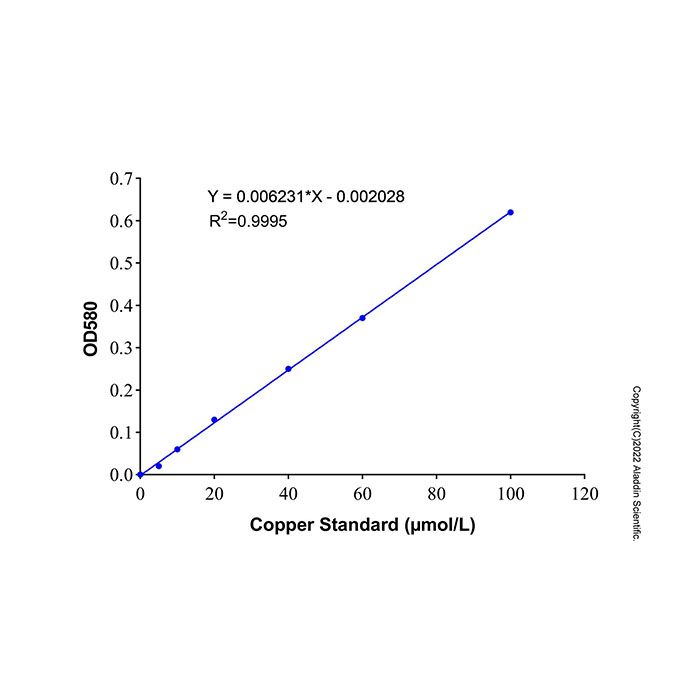
典型标准曲线

注:典型标准曲线,不同仪器会存在偏差,仅供参考。
Background Introduction:
Copper (Cu) is an essential trace element for human body and serves as an important prosthetic group for multiple metalloenzymes. It participates in hematopoiesis, bone development, nervous‑system and brain development. Copper deficiency may lead to anemia, metabolic disorders and decreased organism immune function. Under acidic conditions, tissue‑bound copper dissociates. The released copper ions react with the complexing agent 3,5‑dibromo‑PAESA to form a purple complex, which has a characteristic absorption peak at 580 nm. Within a certain concentration range, absorbance is proportional to copper content for quantitative determination of tissue copper content.
This kit is for research use only. Not for clinical diagnosis or other clinical purposes.
Precautions
1. After color development at 37 °C for 5 min, absorbance measurement shall be finished within 20 min starting from the end of color‑reaction. Batch testing is recommended if a large number of samples are to be measured.
2. If net absorbance ΔA>0.65, the sample is indicated to be out of the linear range. It is recommended to appropriately dilute the test sample and retest, and apply the dilution factor for correction in result calculation; alternatively, reduce the sample loading volume suitably.
3. If net absorbance ΔA<0.01 (close to baseline), increase sample loading volume for re‑measurement. Keep total reaction volume unchanged and correct calculation according to actual sample volume used.
4.To guarantee reliable results in formal experiments, it is recommended to perform preliminary assay with 2‑3 samples of different expected copper contents to determine proper sample loading range.
5. Stable for 1 year when stored at 2‑8 ℃. Refrigeration is required for summer transportation. Do not freeze. After opening, reagents are stable for 1 month at 2‑8 ℃.
Component No. | Component Name | Appearance | 50T | Storage | Quantity Per Test |
C1524797A | Reagent I | Red solution | 56 mL | 2-8℃, Protect from light | As needed |
C1524797B | Reagent II | Colorless clear liquid | 4 mL | 2-8℃, Protect from light | As needed |
C1524797C | Copper Standard (10 mM) | Light‑blue liquid | 1 mL | 2-8℃ | 60 µL |
Note 1: If insoluble precipitate forms in Reagent I, this is a normal phenomenon. Allow complete dissolution at room temperature before use.
Note 2: Prepare the chromogenic working solution fresh before use: mix Reagent I and Reagent II at a volume ratio of 14:1. Do not mix the entire contents of the stock bottles directly.
Instructions for Use
1. Self‑prepared Instruments, Reagents, Samples and Consumables
(1) Required instruments: Microplate reader or visible spectrophotometer capable of measuring absorbance at 580 nm.
(2) Applicable samples: Serum, plasma and tissue samples.
(3) Others: 96‑well plates or micro glass cuvettes, adjustable pipettes and pipette tips, 10 mL centrifuge tubes/test tubes, tissue homogenizer, deionized water, analytical balance.
2. Reagent Preparation
(1) Equilibrate all kit reagents to room temperature before testing. Use only after the reagents become completely clear and free of turbidity.
(2) Preparation of chromogenic working solution:
Mix Reagent I and Reagent II working solution thoroughly at volume ratio of 14:1 (v/v). Prepare freshly before use.
(3) Standard curve setup:
Using 10 mM copper ion standard as the stock solution, perform primary dilution to prepare 1 mL intermediate stock solution: pipette 10 μL of 10 mM stock solution and mix with 990 μL deionized water to obtain 100 μM intermediate stock solution. Prepare serial standard solutions by parallel dilution method using the 100 μM copper‑ion intermediate stock solution. The corresponding concentrations are: 100, 80, 60, 40, 20, 10, 5, 0 μmol/L.
Note: The volume of primary diluted solution may be adjusted according to experimental consumption.
| No. | Volume of Stock Solution (μL) (100 μM stock) | Volume of Deionized Water (μL) | Final Standard Concentration (μM) |
| Standard 1 | 100 | 0 | 100 |
| Standard 2 | 80 | 20 | 80 |
| Standard 3 | 60 | 40 | 60 |
| Standard 4 | 40 | 60 | 40 |
| Standard 5 | 20 | 80 | 20 |
| Standard 6 | 10 | 90 | 10 |
| Standard 7 | 5 | 95 | 5 |
| Standard 8 | 0 | 100 | 0 |
Note: The intermediate stock solution and serial standards shall be freshly prepared before use. Low‑concentration standard points are susceptible to pipetting errors; regular calibration of pipettes is recommended.
3. Sample Pretreatment
(1) Sample requirements: For plasma samples, anticoagulants containing chelating agents such as EDTA and citrate shall not be used. Heparin is the recommended anticoagulant.
Note: Heparin‑anticoagulated plasma may be adopted only when plasma is required for the experiment. A heparin‑concentration control shall be included, as high‑concentration heparin may further lower measured copper values. Serum is the recommended first‑choice sample free of anticoagulant interference.
(2) Serum and plasma samples: Use directly for measurement.
(3) Tissue samples: Perform ice‑bath homogenization at the ratio of tissue weight (g) to ultrapure water volume (mL) = 1: 9. For example, add 0.9 mL ultrapure water to 0.1 g tissue for homogenization. Centrifuge at 10000×g for 10 min at 4 °C. Transfer the supernatant onto ice for subsequent assay. Reserve an aliquot of supernatant for protein concentration determination.
Note: Prior to formal detection, select 2‑3 samples with expected large differences, dilute to different concentrations and perform pre‑experiment.
4. Assay Procedure
Add the following reagents sequentially into a 96‑well plate or micro glass cuvette:
Reagent | Standard Well (µL) | Sample Well (µL) | Blank Well (µL) |
Standard solutions of various concentrations (μL) | 60 | 0 | 0 |
Deionized water (μL) | 0 | 0 | 60 |
Test sample (μL) | 0 | 60 | 0 |
Chromogenic working solution (μL) | 920 | 920 | 920 |
Incubate at 37 °C for 5 min. Upon completion of color development, absorbance measurement must be finished within 20 minutes. Read the OD value of each well with microplate reader at 580 nm, denoted as Asample, Astandard and Ablank.
Calculate:
ΔA sample = Asample - Ablank ΔA standard = Astandard - Ablank
Note: The standard group and blank group are recommended to be measured 1‑2 times. A new standard curve shall be generated for each microplate. Do not reuse standard curves across different plates.
5. Result Calculation
Fitted standard‑curve equation: y = ax + b
(1) Calculation of copper ion concentration in serum (plasma):
Copper ion content (μmol/L) = ( ΔA580 - b) ÷ a × f
(2) Calculation of copper ion concentration in tissue samples:
Copper ion content (μmol/gprot) = ( ΔA 580 - b) ÷ a ÷ Cₚᵣ
Nomenclature:
y: net absorbance of standard well after blank subtraction (ΔA standard);
x: concentration of standard solution;
a: slope of standard curve;
b: intercept of standard curve;
ΔA₅₈₀: net absorbance of sample well after solvent‑blank subtraction;
Cₚᵣ : protein concentration of tissue extract (gprot/L);
f: dilution factor from pre‑treatment of sample (excluding dilution introduced in assay well).
6. Results Presentation
Typical standard curve

Note: Typical standard curve. Deviations may vary among different instruments, for reference only.



 危险品化学品经营许可证(带存储)