肌酐在肌酐酶的催化下生成肌酸,肌酸在肌酸酶的催化下生成肌氨酸和尿素,肌氨酸再经肌氨酸氧化酶催化生成甘氨酸、甲醛和过氧化氢。过氧化氢与显色剂在过氧化物酶的催化下反应生成粉红色化合物,可通过测定515 nm波长下的OD值变化,来测定计算出肌酐的含量。
组份表:
| C1525442 | 组件 | 物理外观 | 48T | 96T | 储存 | 单次测试使用量 | | C1525442A | 试剂一 | 黄色液体 | 10 mL | 20 mL | 2-8℃. 避光 | 每次反应需使用180 uL | | C1525442B | 试剂二 | 粉色液体 | 3.5 mL | 7 mL | 2-8℃. 避光 | 每次反应需使用60 uL | | C1525442C | 1 mM 标准品 | 无色透明液体 | 1.5 mL | 1.5 mL×2 | 2-8℃. 避光 | 按照需求使用 |
|
实验器材:
研钵(匀浆机)、天平、冰盒(制冰机)、台式离心机、可调式移液枪、水浴锅(烘箱、培养 箱、 金属浴)、96 孔板、离心管、酶标仪、蒸馏水(去离子水、超纯水均可)。
试剂准备:
1. 检测前,试剂盒中的试剂平衡至室温。
2. 不同浓度标准品的稀释:
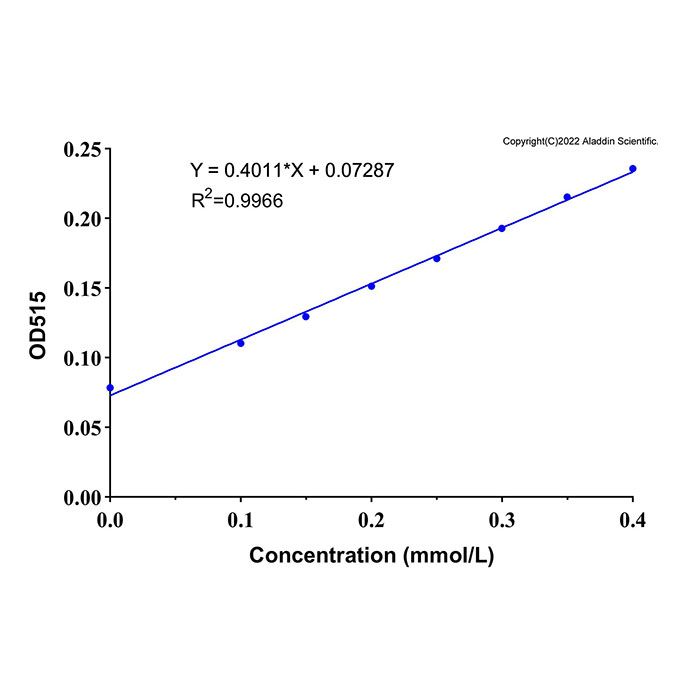
| 编号 | ① | ② | ③ | ④ | ⑤ | ⑥ | ⑦ | ⑧ | | 标准品浓度 (mmol/L) | 0 | 0.1 | 0.15 | 0.2 | 0.25 | 0.3 | 0.35 | 0.4 | | 1 mM 标准品 (μL) | 0 | 20 | 30 | 40 | 50 | 60 | 70 | 80 | | 双蒸馏水 (μL) | 200 | 180 | 170 | 160 | 150 | 140 | 130 | 120 |
|
样本准备:
血清血浆等液体样本:直接测定。
样本的稀释: 在正式检测前,需选择2-3个预期差异大的样本稀释成不同浓度进行预实验。根据预实 验的结果,结合本试剂盒的线性范围:0-400 μmol/L,可参考下表进行稀释(仅供参考):
| 样本 | 稀释倍数 | 样本 | 稀释倍数 | | 人尿液 | 40-60 | 大鼠血清 | 不稀释 | | 人血清 | 不稀释 | 猪血清 | 不稀释 | | 小鼠血清 | 不稀释 |
|
|
注:稀释液为生理盐水(0.9 % NaCl)。 |
实验关键点:
1. 样本加入板孔中时,应触底加入。 2. 样本数量较多时建议使用排枪加液,没有排枪时建议测定孔控制在20个以内。
操作步骤:
1. 标准孔:取12 μL不同浓度标准品,加入到对应的标准孔中;样本孔:取12 μL待测样 本,加入到样本孔中。
2. 向1中各孔加入180 μL试剂一。
3. 37 °C条件下孵育5 min,,酶标仪515 nm处,测定各孔OD值为A1。
4. 向标准、测定各孔中加入60 μL试剂二。 5. 37 °C条件下孵育5 min,酶标仪515 nm 处,测定各孔OD值为A2。
| 标准孔 | 测定孔 | | 不同浓度标准品 (μL) | 12 | -- | | 样本 (μL) | -- | 12 | | 试剂一 (μL) | 180 | 180 | | 37℃ 孵育 5 min,酶标仪 515 nm 处,测定各孔 OD 值为 A₁ | | 试剂二 (μL) | 60 | 60 | | 37℃ 孵育 2 min,37℃ 孵育 5 min,酶标仪 515 nm 处,测定各孔 OD 值为 A₂,各孔 ΔA = A₂ - A₁ |
|
结果计算:
标准品拟合曲线:y = ax + b
血清(浆)、尿液中肌酐含量计算公式:Cr含量(μmol/L) = (ΔA515- b) ÷ a × 1000* × f
注解:
y:标准品ΔA–空白ΔA(标准品浓度为0时的ΔA)
x:标准品的浓度
a:标曲的斜率
b:标曲的截距
ΔA515:样本ΔA–空白ΔA
*:标曲中浓度单位为mmol/L,将单位换算成μmol/L
f:待测样本加入检测体系前的稀释倍数
Creatinine is converted to creatine under the catalysis of creatinine amidohydrolase, and creatine is further converted to sarcosine and urea by creatine amidohydrolase. Sarcosine is then oxidized by sarcosine oxidase to produce glycine, formaldehyde, and hydrogen peroxide. Hydrogen peroxide reacts with a chromogenic reagent in the presence of peroxidase to form a pink compound. The change in optical density (OD) at 515 nm can be measured to determine and calculate the creatinine concentration.
Kit Contents
| C1525442 | Components | Appearance | 48T | 96T | Storage | Quantity Per Test |
| C1525442A | Reagent 1 | Yellow liquid | 10 mL | 20 mL | 2-8℃. Store in the dark | 180 uL for 1 reaction |
| C1525442B | Reagent 2 | Pink liquid | 3.5 mL | 7 mL | 2-8℃. Store in the dark | 60 uL for 1 reaction |
| C1525442C | 1 mM
Standard Sample | Colorless liquid | 1.5 mL | 1.5 mL×2 | 2-8℃. Store in the dark | As needed |
Experimental Instruments:
Mortar/homogenizer, analytical balance, ice box/ice maker, tabletop centrifuge, adjustable pipette, water bath incubator/drying oven/cell incubator/metal bath, 96-well plate, centrifuge tubes, microplate reader, distilled water (deionized water or ultrapure water is acceptable).
Reagent Preparation:
1. Before testing, the reagents in the kit should be equilibrated to room temperature.
2. Dilution of different concentration standards:
| Number | ① | ② | ③ | ④ | ⑤ | ⑥ | ⑦ | ⑧ |
| Standard concentration (mmol/L) | 0 | 0.1 | 0.15 | 0.2 | 0.25 | 0.3 | 0.35 | 0.4 |
| 1 mM Standard Sample (μL) | 0 | 20 | 30 | 40 | 50 | 60 | 70 | 80 |
| Double-distilled water (μL) | 200 | 180 | 170 | 160 | 150 | 140 | 130 | 120 |
Sample Preparation:
Serum and plasma liquid samples: Direct determination. Sample dilution: Before the formal test, select 2-3 samples with expected significant differences and dilute them into different concentrations for a preliminary experiment. Based on the results of the preliminary experiment and in combination with the linear range of this kit: 0 - 400 μmol/L, you can refer to the following table for dilution (for reference only):
| Sample | Dilution factor | Sample | Dilution factor |
| Human urine | 40-60 | Rat serum | No dilution |
| Human serum | No dilution | Pig serum | No dilution |
| Mouse serum | No dilution |
|
|
Note: The diluent is physiological saline (0.9% NaCl).
Key points of the experiment:
1. When adding the sample to the wells of the plate, it should be added to the bottom.
2. If the sample quantity is large, it is recommended to use a pipette for dispensing. If there is no pipette, it is suggested to limit the number of wells to no more than 20.
Operation steps:
1. Standard wells: Take 12 μL of samples of different concentrations and add them to the corresponding standard wells; Sample wells: Take 12 μL of the sample to be tested and add it to the sample wells.
2. Add 180 μL of reagent one to each well in 1.
3. Incubate at 37 °C for 5 minutes, and measure the OD value of each well at 515 nm using an enzyme detector, which is A1. 4. Add 60 μL of reagent two to each of the standard and test wells. 5. Incubate at 37 °C for 5 minutes, and measure the OD value of each well at 515 nm, which is A2.
| Standard well | Measurement well |
| Different concentrations of standard substances (μL) | 12 | -- |
| Sample (μL) | -- | 12 |
| Reagent 1 (μL) | 180 | 180 |
Mix, incubate at 37 ℃ for 5 minutes, read the absorbance value A1 at 515 nm.
|
| Reagent 2 (μL) | 60 | 60 |
| Mix, incubate at 37 ℃ for 5 minutes, read the absorbance value A2 at 515 nm. ΔA = A₂ - A₁. |
Result calculation:
Standard curve: y = ax + b
Formula for calculating creatinine content in serum (plasma) and urine: Cr content (μmol/L) = (ΔA515 - b) ÷ a × 1000 × f
Notes:
y: ΔA of the standard sample minus ΔA of the blank (ΔA at the standard sample concentration of 0)
x: Concentration of the standard sample
a: Slope of the calibration curve
b: Intercept of the calibration curve
ΔA515: Sample ΔA minus blank ΔA
*: The concentration unit in the calibration curve is mmol/L, convert it to μmol/L
f: Dilution factor of the sample before adding to the detection system


 ZJ26F0738042


 危险品化学品经营许可证(带存储)