粪便的化学检查有酸碱度反应、隐血试验、胆色素和脂肪测定等,其中隐血试验最具有重要的临床应用价值,上消化道出血量小于5ml粪便中无可见的血液,且红细胞破坏,显微镜检查也未见红细胞,而需要用化学法、免疫法、转铁蛋白法、血红蛋白荧光测定法等才能证实的出血,称为隐血,检查粪便隐血的试验称为粪便隐血试验(fecal occult blood test,FOBT),化学法常用试剂有邻联甲苯胺、匹拉米洞、愈创木脂、无色孔雀绿、米土尔等。
粪便隐血定性检测试剂盒(匹拉米洞法)的检测原理是血红蛋白中的亚铁血红素具有类似过氧化物酶的活性,能催化H2O2作为电子受体使色原底物匹拉米洞氧化而显紫色或紫蓝色,其颜色深浅与血红蛋白含量成正比,根据显色的快慢可以半定量血红蛋白即隐血含量,因此也可称作粪便隐血半定量试验,多用于人或动物粪便血红蛋白检查,应注意的是正常人或动物消化道也会微量出血或受到刺激后出血或模型动物饲料含有鱼粉、铁剂等,都可能导致试验结果出现假阳性,本法特点是灵敏度中、假阳性中,可检出Hb 1~5mg/L,可联合使用高灵敏度、高特异性的邻联甲苯胺法。该试剂盒仅用于科研领域,不适用于临床诊断或其他用途。
产品组分表:
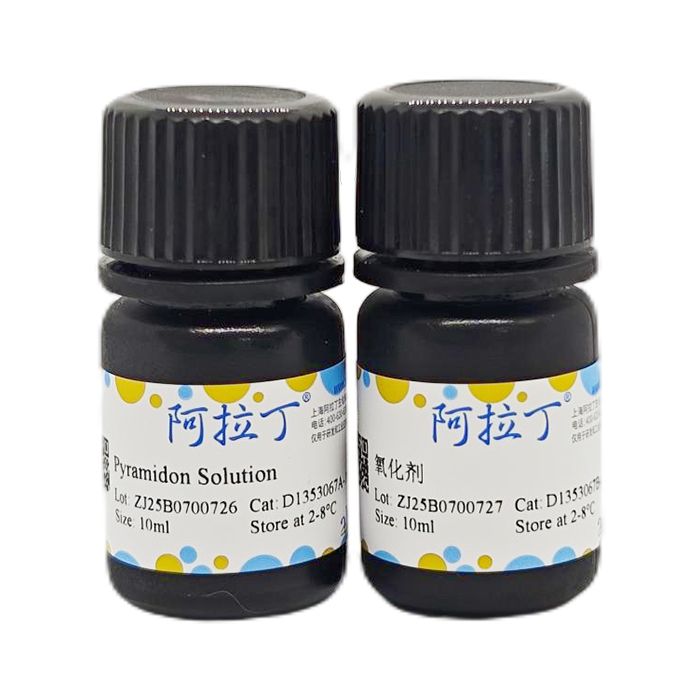
| D1353067 | Component | 100 T | 300 T | Storage | | D1353067A | Pyramidon Solution | 10 ml | 30 ml | 2-8℃. Store in the dark. | | D1353067B | 氧化剂 | 10 ml | 30 ml | 2-8℃. Store in the dark. |
|
自备材料:
1、粪便标本、木片或牙签、消毒棉或白瓷板、滴管或移液器
操作步骤(仅供参考):
1、粪便标本应尽快收集并及时检测,避免长时间放置使反应的灵敏度降低,避免接触水。
2、用取样木片或牙签挑取少量粪便10~50mg(绿豆大小),涂在消毒棉或白瓷板上。
3、滴加 Pyramidon Solution 2滴(约0.1ml)于粪便不同位置。
4、滴加 氧化剂2滴(约0.1ml),立即计时并观察颜色变化。
5、于2min内判读完毕,如2min内有紫色出现,提示粪便含有血红蛋白(Hb)或粪便隐血试验阳性。
结果判读:
颜色变化 | 判读 | 加入试剂后立即呈现深紫色 | (4+) | 加入试剂后立即呈现紫色,并逐渐呈深紫色 | (3+) | 加入试剂后初显浅紫色,逐渐呈明显紫色 | (2+) | 10s后由无色渐变为浅紫色或紫色 | (+) | 2min 内不显色 | 阴性 |
|
注意事项:
1、在粪便标本采集、运送过程中和使用试剂进行检测时,操作人员应做好个人防护,避免人体接触,以防止可能产生的污染和自身感染。
2、正常人或动物消化道也会微量出血或受到刺激后出血,导致本法有时会出现假阳性。
3、对无任何明显症状但怀疑可能有少量出现的情况,建议至少连续3天取样,并从不同样本部位取材做两次实验。
4、应提前3天以上禁止食用动物血、肉、肝脏及富含叶绿素食物、铁剂、中药或其他特殊药物,以免出现假阳性反应。
5、对于结肠炎模型的实验动物,饲料成分不应含有鱼粉、铁剂或其他特殊药物,以免出现假阳性反应。
6、Pyramidon Solution 含有乙酸,刺激性比较大,应在通风橱里操作,本溶液颜色可随配置时间的长短而发生变化,但不影响其检测的灵敏度。
7、氧化剂应注意密封4℃保存,6个月之后效率可能会下降,可考虑市售过氧化氢(30%)或过氧化脲配置1~3%的溶液。
8、如有必要可用血液或血红蛋白溶液做梯度对照实验。
9、该试剂盒不能与氧化剂共同存放,并避免阳光直射及高低温储存环境。
附表:
表1 粪便隐血试验化学法的干扰因素与评价
干扰因素 | 假阴性 | 假阳性 | 标本 | 粪便标本陈旧灵敏度降低,血液在肠道停留过久,血红蛋白被细菌降解,血红素消失。 | 粪便隐血来源于非消化道出血如齿龈出血、鼻出血、月经血等。 | 食物和药物 | 含有大量维生素C或其他具有还原作用的食品或药物 | 含血红蛋白的动物血,如鱼、肉、肝脏;含过氧化物酶的叶绿素新鲜蔬菜;食用铁剂、铋剂;引起胃肠道出血的药物如阿司匹林、皮质固醇、非固醇类抗炎药、引起肠炎药物、秋水仙素、萝芙木碱、中药等 | 器材和试剂 | 过氧化氢浓度低或失效、试剂 保存温度和湿度不当如冰冻、 受光、受热等失效 | 器材污染铜离子、铁离子、消毒剂、溴、铁、硼酸、过氧化酶等 | 操作 | 试验反应时间不足、显色判断 不准确 | 试验前在标本中加水降低了灵敏度,实际上是增高了假阳性 |
|
表2 粪便隐血试验化学法的方法学评价
方法 | 特点 | 评价 | 邻联甲苯胺法 | 高灵敏度 假阳性高 | Hb 0.2~1.0mg/L,消化道有1~5ml出血即可检出。灵敏度过高方法,粪便有微量出血即呈阳性反应,故高灵敏度试验阴性时,即确认隐血为阴性。 | 匹拉米洞法 | 中灵敏度 中特异性 | Hb 6~10mg/L,消化道有20ml出血时可检出。受食物、药物影响因素少,假阳性低,故如低灵敏度试验阳性时,即可确定为隐血阳性。 |
|
不同浓度血红蛋白的显色效果对比不同浓度血红蛋白的显色效果对比

(从左至右血红蛋白溶液浓度依次为10μg/ml、50μg/ml、200μg/ml)
物理外观:Liquid
是否无菌:否
Stool chemical examinations include pH reaction, occult-blood test, bile pigment assay, fat measurement and so on. Among them, the fecal occult-blood test has the most important clinical research value. Occult blood refers to gastrointestinal bleeding less than 5 mL, where no visible blood appears in stool and red blood cells are degraded so that none can be found under microscopy. Such bleeding can only be detected by chemical methods, immunoassays, transferrin assays, hemoglobin fluorescence measurement and other techniques. The corresponding assay is the fecal occult-blood test (FOBT). Common chemical chromogenic substrates include o-tolidine, pyramidon, guaiac, leucomalachite green, metol, etc.
The detection principle of the Fecal Occult Blood Qualitative Detection Kit (Pyramidon Method): Heme in hemoglobin has peroxidase-like activity. It catalyzes hydrogen peroxide as an electron acceptor and oxidizes the chromogenic substrate pyramidon to produce purple or violet-blue color. Color intensity is proportional to hemoglobin concentration. Hemoglobin / occult-blood content can be semi-quantitatively judged by the speed of color development; hence this assay is also called a semi-quantitative fecal occult-blood test. It is applied to hemoglobin detection in human or animal stool.
Note: Micro-bleeding or irritation-induced bleeding can occur in normal human/animal digestive tracts. Fish meal, iron supplements and other substances in model-animal feed may produce false-positive results. This method shows moderate sensitivity and moderate false-positive rate, and can detect hemoglobin at 1-5 mg/L. It may be combined with the high-sensitivity, high-specificity o-tolidine method.
This kit is for research-only use. It is NOT intended for clinical diagnosis or other clinical applications.
Kit Contents
D1353067 | Components | 100 T | 300 T | Storage |
D1353067A | Pyramidon Solution | 10 mL | 30 mL | 2-8 ℃, protect from light |
D1353067B | Oxidizing Agent | 10 mL | 30 mL | 2-8 ℃, protect from light |
Materials to Be Prepared by User
Stool specimens, wood stick / toothpick, absorbent cotton / white porcelain plate, dropper / pipette
Operating Procedure (for reference only)
1. Collect stool specimens and perform detection promptly. Longterm storage reduces assay sensitivity. Avoid contact with water.
2. Use a wood stick or toothpick to take a small stool sample (1050 mg, about mungbean size), and smear it onto absorbent cotton or a white porcelain plate.
3. Add 2 drops (~0.1 mL) of Pyramidon Solution to different positions of the stool smear.
4. Add 2 drops (~0.1 mL) of oxidizing agent. Start timing immediately and observe color change.
5. Complete interpretation within 2 min. Purple color appearing within 2 min indicates the presence of hemoglobin (Hb), i.e. positive occult-blood result.
Result Interpretation
Color Change | Interpretation |
Deep purple appears immediately after reagent addition | (4+) |
Purple appears immediately and deepens gradually | (3+) |
Light purple appears at first, then turns distinct purple | (2+) |
Colorless turns light purple / purple after 10 s | (+) |
No color development within 2 min | Negative |
Notes
1. Wear appropriate personal protection during specimen collection, transport and testing. Prevent human exposure to avoid contamination and infection risks.
2. Micro-bleeding or irritation-related bleeding in normal human/animal gastrointestinal tracts may cause false-positive results.
3. For suspected low-grade bleeding without obvious symptoms: collect samples on at least 3 consecutive days; perform duplicate tests on material taken from different parts of each specimen.
4. Withhold animal blood, meat, liver, high-chlorophyll food, iron supplements, traditional Chinese medicines and special medications for ≥3 days before sampling to prevent false-positive reactions.
5. For colitis-model experimental animals: ensure feed contains no fish meal, iron supplements or special drugs to avoid false-positive interference.
6. Pyramidon Solution contains acetic acid and is highly irritant. Perform operations inside a fume hood. Solution color may change with storage time, which does not impair detection sensitivity.
7. Seal oxidizing agent and store at 4 ℃. Its activity may decrease after 6 months. Alternatively, prepare 1-3 % working solution using commercial 30 % hydrogen peroxide or urea hydrogen peroxide.
8. Gradient controls with blood or hemoglobin solution may be used if necessary.
9. Do not store this kit together with oxidizing agents. Avoid direct sunlight, high-temperature and freezing conditions.
Table 1 Interference Factors and Performance of Chemical Fecal Occult-Blood Tests
Interference Factor | False-Negative | False-Positive |
Specimen | Old stool reduces sensitivity. When blood stays in the gut for a long time, bacteria degrade hemoglobin and destroy heme. | Blood originating outside the gastrointestinal tract: gingival bleeding, epistaxis, menstrual blood, etc. |
Food & Drugs | Large doses of vitamin C or other reducing food / drugs | Animalbloodcontaining food (fish, meat, liver); fresh vegetables rich in peroxidase-active chlorophyll; iron supplements, bismuth agents; gastrointestinal-irritating drugs (aspirin, corticosteroids, non-steroidal antiinflammatory drugs, colitis-inducing drugs, colchicine, rauwolfia alkaloids, herbal medicines, etc.) |
Instruments & Reagents | Low / expired hydrogenperoxide concentration; improper reagent storage (frozen, lightexposed, overheated) leads to reagent inactivation | Instrument contamination with copper ions, iron ions, disinfectants, bromine, iron, boric acid, peroxidase, etc. |
Operation | Insufficient reaction time, misjudged color readout | Adding water to specimens before assay lowers sensitivity and increases false-positive probabilit |
Table 2 Methodological Evaluation of Chemical Fecal OccultBlood Assays
Method | Characteristics | Evaluation |
o-Tolidine Method | High sensitivity, high false-positive rate | Detectable Hb: 0.2-1.0 mg/L; detects bleeding of 1-5 mL in digestive tract. Excessively sensitive. Positive signal arises from trivial gastrointestinal micro-bleeding. A negative high-sensitivity result reliably rules out occult blood. |
Pyramidon Method | Moderate sensitivity, moderate specificity | Detectable Hb: 6-10 mg/L; detects bleeding of ~20 mL in digestive tract. Less susceptible to food and drug interference, lower falsepositive rate. A positive result from this moderatesensitivity assay strongly confirms true fecal occult blood. |

Image note: Colordevelopment comparison for serial hemoglobin concentrations. Hemoglobin concentrations (lefttoright): 10 μg/mL, 50 μg/mL, 200 μg/mL.

 ZJ26F0737534


 危险品化学品经营许可证(带存储)