
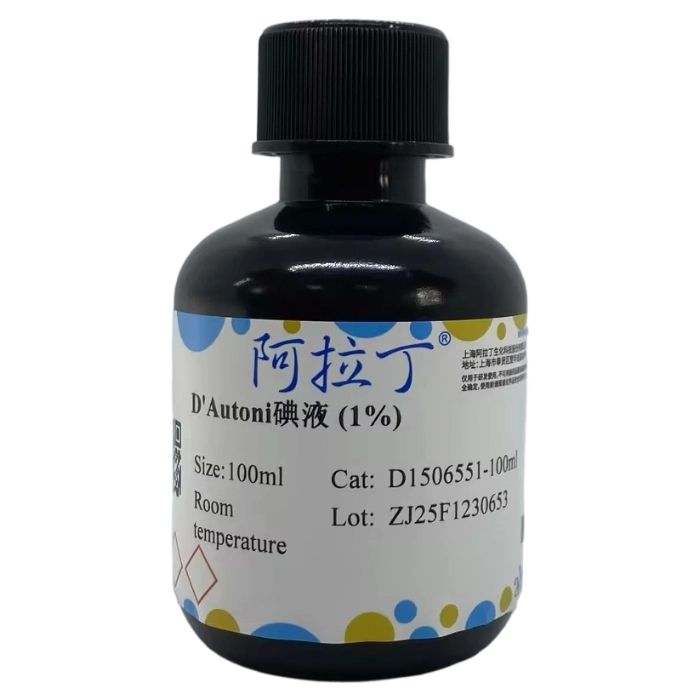
D'Autoni碘液 (1%) 是碘和碘化钾的水溶液,与Lugol's碘液相似,多用于粪便检查蠕虫卵、原虫的包囊和滋养体;D'Autoni 碘液中碘的有效含量为1%,操作简单,可连续多天采样检查,提高检出率,但结果阴性不完全排除有寄生虫感染。该试剂仅用于科研领域,不适用于临床诊断或其他用途。
操作步骤(仅供参考):
1、根据实验具体要求操作或参考如下步骤。
2、滴1滴生理盐水与载玻片左半侧的中央,置1滴碘液与玻片右半侧的中央。
3、用小木棍或火柴杆挑起粪便约2mg(火柴头大小),加入生理盐水滴中,并加入相似量粪便到碘液滴中。混合粪便与液滴以形成悬液。
4、用盖玻片盖住液滴,操作时应首先盖好玻片,使之与玻片成一角度,然后接触液滴边缘,并轻轻放下盖玻片到玻片上,以避免气泡产生。
5、低倍镜检查,如需鉴定,在高倍镜下,以上下或横向移动方式检查,使全部盖玻片范围都能被检查到;当见到生物体或可疑物时,调至高倍镜以观察其细微的状态。
注意事项:
1、涂片之前应事先在背面做好圆圈标记,以便判断后续试验的位置。
2、涂片过厚易致粪渣遮住虫体,过薄易存在空白区域。
3、应注意虫卵与粪便中的异物鉴别。
4、气温越接近体温,滋养体的活动越明显,必要时可略加温,一般在 15min检查完毕。
5、为了您的安全和健康,请穿实验服并戴一次性手套操作。
D'Autoni Iodine Solution (1%) is an aqueous solution of iodine and potassium iodide. Similar to Lugol's Iodine Solution, it is mostly used in stool examinations to detect helminth eggs, protozoan cysts, and trophozoites. The effective iodine content in D'Autoni Iodine Solution is 1%. It features simple operation, and allows for consecutive multi-day sample collection and testing to improve the detection rate; however, a negative result does not completely rule out parasitic infection. This reagent is for research use only and is not suitable for clinical diagnosis or other purposes.
Operating Procedures (for reference only):
1. Operate according to the specific requirements of the experiment or refer to the following steps.
2. Place 1 drop of physiological saline at the center of the left half of a glass slide, and place 1 drop of iodine solution at the center of the right half of the slide.
3. Use a small wooden stick or matchstick to pick up approximately 2 mg of stool (about the size of a match head), add it to the drop of physiological saline, and then add a similar amount of stool to the drop of iodine solution. Mix the stool with the drops to form a suspension.
4. Cover the drops with a coverslip. During operation, first hold the coverslip at an angle to the glass slide, then bring it into contact with the edge of the drops, and gently lower the coverslip onto the slide to avoid air bubble formation.
5. Examine under a low-power microscope. If identification is required, switch to a high-power microscope and examine by moving the slide up and down or horizontally to ensure the entire area covered by the coverslip is inspected. When organisms or suspicious substances are observed, adjust to high-power magnification to view their detailed morphology.
Precautions:
1. Before preparing the smear, mark a circle on the back of the glass slide in advance to identify the position for subsequent testing.
2. If the smear is too thick, fecal residues may cover the parasites; if it is too thin, blank areas are likely to appear.
3. Attention should be paid to distinguishing helminth eggs from foreign objects in the stool.
4. The closer the temperature is to body temperature, the more obvious the movement of trophozoites will be. If necessary, slight heating can be applied, and the examination should generally be completed within 15 minutes.
5. For your safety and health, please wear a lab coat and disposable gloves during operation.
