产品介绍
在生命活动的代谢过程中不断产生各种自由基,而自由基的积累会使机体产生氧化损伤 而引起衰老、肿瘤、中风、心肌炎和糖尿病等慢性疾病,在众多自由基中 2,2-二苯基-1- 苦基苯肼 (DPPH)是一种较稳定的自由基,当有自由基清除剂存在时颜色由紫色向黄色转变,吸光度随之变小。DPPH自由基清除率检测试剂盒 (微板法) 又称氮自由基清除能力检测试剂盒或氮自由基清除率检测试剂盒,其检测原理是DPPH自由基是一种较稳定的含氮自由基, 含一个单电子,溶于乙醇后溶液呈紫色,在 517 nm 下有强吸收,如果有其他物质提供一个电子与此单电子配对,溶液会褪色,褪色程度与接受电子的量呈正比,通过吸光度下降的程度来反应样品的氮自由基清除能力,主要用于检测血清、植物组织、抗氧化类食品、保健品及药品等样本。
本试剂盒可采用分光光度法进行检测,具有检测灵敏度高、线性范围宽、样品用量少等特点。在样品体积为50 µL 时,采用分光光度法检测在 5-50 μg/mL 浓度范围内清除速率有良好的线性关系,当维生素 C (VC) 标准工作液浓度大于 50 μg/mL , 清除率大于 90% 。
组分货号 | 组分名称 | 物理外观 | 100 T | 储存 | 单次测试使用量 |
D1529083A | 提取液 | 液体 | 100.0 mL | 2-8 ℃ .
| 按需 |
D1529083B | DPPH粉剂 | 粉末 | 1.5 mg | 2-8 ℃.Store in the dark. | 按需 |
D1529083C | 维生素 C | 粉末 | 10.0 mg | 2-8 ℃.Store in the dark. | 按需 |
自备材料:
1. 植物组织 (芹菜、绿豆、玉米等叶片)、血液、蒸馏水、无水乙醇等。
2. 研钵或匀浆器、粉碎机或超声破碎机、离心机、离心管、恒温水浴锅、恒温干燥箱 、电子天平、50 mL容量以上棕色空瓶、酶标仪 、96 孔板。
使用方法
1. 准备样品:
1) 植物样品:取新鲜植物样本,清洗干净,研钵研碎 (粉碎) ,干燥箱烘干后过筛,称取 0.05 g 样品,加入 0.8 mL提取液,40℃水浴浸提 30-60 min,10000 rpm 离心10 min,上清液待用,4℃保存备用 (亦可参考相关资料提取方法提取)。
2) 血浆 、血清和尿液样品:血浆 (用肝素或枸橼酸钠抗凝,不宜使用 EDTA 抗凝) 4℃ 5000 rpm 离心 10 min,取上清液待用;血清或尿液样品可直接测定。
3) 细胞样品:按每5×10⁶ 个细胞加入 1.0 mL提取液,超声破碎 (功率 200 W, 超声 3 s,间隔 10 s,重复 30 次),10000 rpm 离心 10 min,取上清液待用。
4) 果汁、葡萄酒等样品:按样品:提取液=1:9 的比例震荡混匀,10000 rpm 离心 10 min,上清液待用,4℃保存备用。
5) 高活性样品:如果样品中有效浓度较高,可用提取液进行恰当的稀释。
2. 标准曲线的测定
1)配制维生素C溶液:将一支10 mg 维生素 C 充分溶解于 1 mL 提取液中,即成 10 mg/mL 维生素 C 溶液;可分成 0.1 mL 的小份,-20℃保存。
2) 配制 VC标准工作液:如需测线性关系,建议用提取液将 10 mg/mL维生素 C 溶液稀释至 50、40、30、20、10、5 μg/mL的维生素C标准工作液,进行线性测定;如需清除率大于90%的阳性对照,建议选用大于 50 μg/mL 的维生素 C标准工作液。
3. DPPH 溶液
取出一只DPPH 粉剂 ,用前甩几下使试剂落入底部,多次加入1.0 mL 无水乙醇充分溶解后,全部转移至准备好的空瓶中,通过多次润洗试剂盒内样品瓶,确保期内粉末完全溶解,并转移到新的瓶子中,混匀后作为工作液待用(总溶解体积为25 mL),全程避光操作。若溶解不充分,可进行超声辅助溶解;用不完的试剂 4℃避光保存 (配制好的工作液最好一个月内用完)。
4. 样本测定
1) 酶标仪开机预热 30 min 以上,调节波长 517 nm。
2) 加样:按照下表设置空白管、样本测定管、样本对照管、阳性对照管 ,溶液应按照顺序依次加入,混匀,室温避光静置 30 min。
加入物 (mL) | 空白管 | 样本测定管 | 样本对照管 | 阳性对照管(标准管) |
提取液 | 0.05 | - | - | - |
待测样品上清 | - | 0.05 | 0.05 | - |
VC 标准工作液 | - | - | - | 0.05 |
无水乙醇 | 0.225 | 0.225 | 0.45 | 0.225 |
DPPH 溶液 | 0.225 | 0.225 | - | 0.225 |
3) OD 值测定:取 96 孔板,将各管溶液依次吸取 300 μL 加至 96 孔板中,用酶标仪检测各管吸光度值,依次记为 A₁、A₂、A₃ 、A₄。
5. 结果计算
1) 阳性对照的自由基清除率计算公式:DPPH 清除率(%)= ( A₁ - A₄ )/ A₁×100%
2) 样本的自由基清除率计算公式:DPPH 清除率(%)=[ A₁-( A₂ - A₃) ]/ A₁×100%
注: A₁=空白管的吸光度值
A₂=样本测定管的吸光度值
A₃=样本对照管的吸光度值
A₄=阳性对照管的吸光度值
注意事项
1) 正式测定之前建议选择 2-3 个预期差异较大的样本做预实验。
2) 实验材料应尽量新鲜,当天提取当天测定。
3) 不同批次生产的 DPPH 溶液初始吸光度值可能有差异,根据具体测定结果为主。
4) 样品中不宜添加 Triton、DTT 等可能影响氧化还原反应的成分。
5) 为了您的安全和健康,请穿实验服并戴一次性手套操作。
6) 试剂开封后或溶解后请尽快使用,以防影响后续实验效果。
附录:
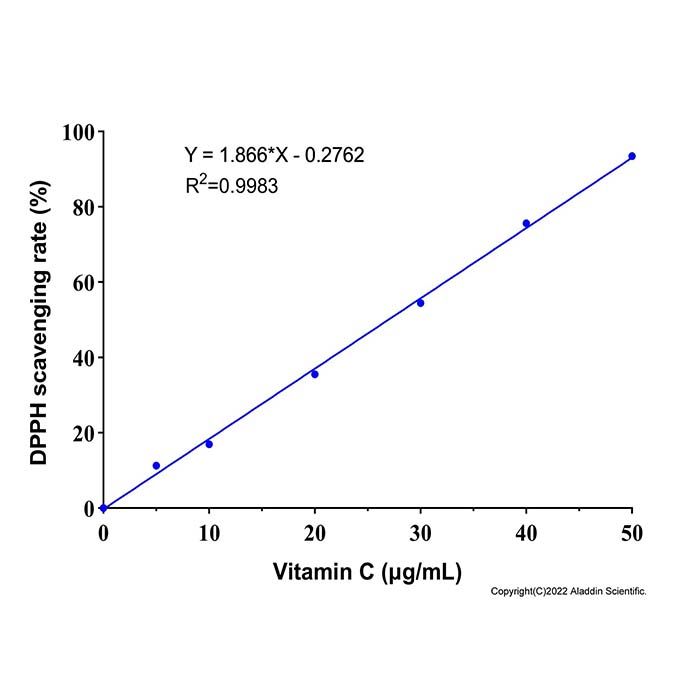
参考标准曲线如下:在室温条件下按说明书操作,对系列 VC 标准工作液 (60、50、 40、30、20、10 、5 μg/mL) 进行吸光度的测定,以 VC 标准工作液浓度为横坐标X,以 DPPH清除率%为Y,建立标准曲线,其数值及标准曲线如下(仅供参考):
| 检测样品 | 初始吸光度值 | 调零吸光度值 | DPPH清除率% |
| 无水乙醇调零管 | 0.034 | - | - |
| 空白管 | 0.6836 | 0.6496 | 0 |
| VC 标准品 5 μg/mL | 0.6102 | 0.5762 | 11.27% |
| VC 标准品 10 μg/mL | 0.5731 | 0.5391 | 16.98% |
| VC 标准品 20 μg/mL | 0.4527 | 0.4187 | 35.53% |
| VC 标准品 30 μg/mL | 0.3297 | 0.2957 | 54.47% |
| VC 标准品 40 μg/mL | 0.1924 | 0.1584 | 75.61% |
| VC 标准品 50 μg/mL | 0.0767 | 0.0427 | 93.42% |
| VC 标准品 60 μg/mL | 0.0663 | 0.0323 | 95.03% |

注: 无水乙醇调零管主要用于标准曲线的调零计算,加样体积为 (提取液 0.05 mL 混合无水乙醇0.45 mL) ,同等条件操作检测,减少实验误差。
Product Introduction
During metabolic processes of vital activities, various free radicals are continuously generated. Accumulation of free radicals can cause oxidative damage to organisms, further resulting in chronic diseases such as aging, tumors, stroke, myocarditis and diabetes. Among diverse free radicals, 2,2‑diphenyl‑1‑picrylhydrazyl (DPPH) is a relatively stable free radical. In the presence of free‑radical scavengers, its color changes from purple to yellow, accompanied by a decrease in absorbance. The DPPH radical scavenging capacity assay kit (microplate method), also known as nitrogen‑centered radical scavenging capacity detection kit or nitrogen‑centered radical scavenging rate assay kit, is based on the following principle: DPPH radical is a stable nitrogen‑centered free radical bearing one unpaired electron. It forms a purple solution when dissolved in ethanol and exhibits strong absorbance at 517 nm. When other substances donate an electron to pair with this unpaired electron, the solution decolorizes, and the degree of decolorization is proportional to the amount of accepted electrons. The nitrogen‑centered radical‑scavenging capacity of samples is reflected by the decrease in absorbance. This kit is mainly applied to samples including serum, plant tissues, antioxidant‑containing foods, health‑care products and pharmaceuticals.This kit can also be measured by spectrophotometry, featuring high detection sensitivity, wide linear range and low sample consumption. With a sample volume of 50 µL, spectrophotometric measurement shows favorable linearity for scavenging rate within the concentration range of 5‑50 μg/mL. When the concentration of vitamin C working standard solution exceeds 50 μg/mL, the scavenging rate is higher than 90 %.
Component No. | Component Name | Appearance | 100 T | Storage | Quantity Per Test |
D1529083A | Extraction Buffer | Liquid | 100.0 mL | 2-8 ℃ . | As needed |
D1529083B | DPPH Powder | Powder | 1.5 mg | 2-8 ℃.Store in the dark. | As needed |
D1529083C | Vitamin C | Powder | 10.0 mg | 2-8 ℃.Store in the dark. | As needed |
Materials to be Supplied by User
1) Plant tissues (celery, mung bean, maize leaves, etc.), blood, distilled water, absolute ethanol, etc.
2) Mortar or tissue homogenizer, grinder or ultrasonicator, centrifuge, centrifuge tubes, constant‑temperature water bath, constant‑temperature drying oven, electronic balance, two empty brown bottles with volume ≥ 50 mL, microplate reader, 96‑well plate.
Operating Procedure
1. Sample Preparation
1) Plant samples: Take fresh plant samples and clean thoroughly. Grind or crush samples with a mortar. Dry in a drying oven and sieve. Weigh 0.05 g sample, add 0.8 mL nitrogen‑centered radical extraction buffer, perform water‑bath extraction at 40 °C for 30‑60 min, centrifuge at 10000 rpm for 10 min. Collect supernatant for subsequent use and store at 4 °C (alternative extraction protocols from references may also be adopted).
2) Plasma, serum and urine samples: For plasma (anticoagulated with heparin or sodium citrate; EDTA anticoagulation is not recommended), centrifuge at 5000 rpm for 10 min at 4 °C and collect supernatant. Serum or urine samples can be assayed directly.
3) Cell samples: Add 1.0 mL nitrogen‑centered radical extraction buffer per 5×10⁶ cells. Perform sonication (power 200 W, sonicate 3 s, interval 10 s, repeat 30 cycles). Centrifuge at 10000 rpm for 10 min and collect supernatant.
4) Fruit juice, wine and similar samples: Vortex and mix thoroughly at sample‑to‑extraction buffer ratio of 1:9. Centrifuge at 10000 rpm for 10 min, collect supernatant and store at 4 °C.
5) High‑activity samples: If the effective concentration of the sample is too high, appropriately dilute the sample with extraction buffer.
2. Standard Preparation
1) Prepare Vitamin C solution: Fully dissolve one vial of 10 mg vitamin C in 1 mL extraction buffer to obtain 10 mg/mL vitamin C solution. Aliquot into 0.1 mL portions and store at −20 °C.
2) Preparation of Vc standard working solution: If linear‑relationship measurement is required, dilute the 10 mg/mL vitamin C solution with sample extract to prepare vitamin C standard working solutions at concentrations of 50, 40, 30, 20, 10 and 5 μg/mL for linear assay. For a positive control with a DPPH‑scavenging rate higher than 90 %, use vitamin C standard working solution at concentrations above 50 μg/mL.
3. Preparation of DPPH Solution
Take one vial of DPPH powder. Tap the EP tube several times before use to settle powder to the bottom. Add 1.0 mL absolute ethanol in portions for complete dissolution. Transfer all liquid into the pre‑prepared brown bottle. Rinse the original vial repeatedly to ensure complete transfer of residual powder. Mix well to obtain working solution (final total volume: 25 mL). Perform all operations away from light. Sonication can assist incomplete dissolution. Unused working solution should be stored at 4 °C protected from light (use the prepared working solution within one month).
4. Sample Assay
1) Power‑on the microplate reader and pre‑warm for ≥30 min, set wavelength to 517 nm.
2) Pipette reagents: set blank wells, sample assay wells, sample control wells, positive‑control wells according to the table below. Add reagents sequentially, mix thoroughly, incubate at room temperature in the dark for 30 min.
Additive (mL) | Blank well | Sample well | Sample control well | Positive‑control well (Standard well) |
Extraction Buffer | 0.05 | - | - | - |
Supernatant of test sample | - | 0.05 | 0.05 | - |
Vitamin C working standard solution | - | - | - | 0.05 |
Absolute ethanol | 0.225 | 0.225 | 0.45 | 0.225 |
DPPH solution | 0.225 | 0.225 | - | 0.225 |
3) OD Value Measurement: Transfer 300 μL of each solution sequentially into a 96‑well plate. Measure the absorbance of each well using a microplate reader, and record the values as A₁, A₂, A₃ and A₄ respectively.
5. Data Analysis
1) Formula for radical‑scavenging rate of positive control: DPPH scavenging rate (%)=( A₁ - A₄ )/ A₁×100%
2) Formula for radical‑scavenging rate of sample: DPPH scavenging rate (%)=[ A₁-( A₂ - A₃) ]/ A₁×100%
Notes:
A₁ = Absorbance of blank well
A₂ = Absorbance of sample assay well
A₃ = Absorbance of sample control well
A₄ = Absorbance of positive‑control well
Precautions
1. It is recommended to perform a preliminary test with 2‑3 samples expected to have large differences before formal measurement.
2. Experimental materials should be as fresh as possible; perform extraction and assay on the same day.
3. The initial absorbance of DPPH solution prepared in different batches may vary; results shall be subject to actual measured values.
4. Avoid adding components such as Triton and DTT to samples, as they may interfere with redox reactions.
5. For personal safety and health, wear a lab coat and disposable gloves during operation.
6. Use opened or dissolved reagents as soon as possible to avoid compromised experimental performance.
Appendix:
Reference Standard Curve: Proceed according to the instructions at room temperature. Measure the absorbance of serial vitamin C working standard solutions (60, 50, 40, 30, 20, 10, 5 μg/mL). Construct the standard curve with the concentration of vitamin C working standard solution as the abscissa X and DPPH scavenging rate (%) as the ordinate Y. The data and standard curve shown below are for reference only.
Test sample
| Raw absorbance
| Zero‑adjusted absorbance
| DPPH scavenging rate (%) |
Absolute‑ethanol zero‑adjustment well
| 0.034 | - | - |
Blank well
| 0.6836 | 0.6496 | 0 |
| Vitamin C standard 5 μg/mL | 0.6102 | 0.5762 | 11.27% |
| Vitamin C standard 10 μg/mL | 0.5731 | 0.5391 | 16.98% |
| Vitamin C standard 20 μg/mL | 0.4527 | 0.4187 | 35.53% |
| Vitamin C standard 30 μg/mL | 0.3297 | 0.2957 | 54.47% |
| Vitamin C standard 40 μg/mL | 0.1924 | 0.1584 | 75.61% |
| Vitamin C standard 50 μg/mL | 0.0767 | 0.0427 | 93.42% |
| Vitamin C standard 60 μg/mL | 0.0663 | 0.0323 | 95.03% |

Note: The absolute‑ethanol zero‑adjustment well is used for zero‑offset calculation of the standard curve. Its composition consists of 0.05 mL extraction buffer mixed with 0.45 mL absolute ethanol. Perform measurement under identical conditions to reduce experimental error.

 ZJ26F0939415


 危险品化学品经营许可证(带存储)