

 B2313414
计算溶液所需的质量、体积或浓度。
为什么选择此级别
,适用于对基线干扰要求严格的色谱和分析工作流程。
储存与运输
2-8°C储存,避光。低温运输 。请查阅批次 COA 获取详细规格。
质量文档
SDS、COA、产品数据表及规格说明书均可下载。可通过批号查询获取批次 COA。
文献证明
在色谱分析、有机合成和交叉偶联反应领域已被 0 篇同行评审文献引用。
概述
一、产品属性
保质期: 24个月
反应时间: 较长(最多 45分钟, 20-37°C)
批间差: <10%
沸点:100℃
酸碱度范围: 9.0-9.8
密度(20℃):1.0302 g/cm³
溶解性:易溶于水
外观:无色至淡黄色液体
气味:无味
孵育温度:20-37℃
对光线敏感,对热敏感
二、保存及运输条件:
1. 保持容器密闭
2. 储存温度2 °C - 8 °C,避光
3. 不与氧化剂一起储存
4. 从损坏的瓶子中污染或泄漏的基质溶液不可再使用,须销毁
5. 使用带有冷袋的单独的容器进行运输。
6.自发的衰竭会增加背景;如果室温储存会增加衰竭的速度;因此应避免室温储存或者运输;
但是室温不会影响本产品的活性。过了复测日期之后,本产品仍可能有效,但是一些应用,特别是含有视觉评估的应用,可能会受到背景增加的影响。
三、有效成分及生化机理
在不同的缓冲溶液(pH = 9.5)中,根据需要添加本产品,有效成分对硝基苯磷酸酯(pNPP)被溶解。碱性磷酸酶将磷酸残基转移到受体上。在碱性条件下,由于形成的硝基苯酚会出现黄色。
四、生物安全信息
根据法规(EC) No 1272/2008,本产品不属于危险类别;
五、主要优点
1. 信号产量比得上竞争者的即用溶液
2.广泛的测量范围
3.非常低的背景信号
4. 长期储存期间极低的空白漂移(24个月内<0.15 AU)
5.使用本产品比其他通用反应终止液,本产品的反应后颜色稳定性高
六、使用说明
关于分装的建议
•在没有灰尘和黑暗的房间工作。
•尽可能冷藏本产品
•避免溶液与任何金属部件接触。
•仔细清洁所有的仪器和容器。
•装瓶时戴无粉手套。
•立即关闭瓶子,尽量减少光线和灰尘的影响。
•使用由高密度聚乙烯或聚丙烯制成的不透光的瓶子。
七、使用的一般说明
只有熟悉免疫学方法基础的合格实验室工作人员才能使用该产品。
本产品可用于ELISA的定性和定量;
使用96孔微量滴定板时,每孔加100 μL孵育后底物,并且按照推荐的方法洗涤。在底物孵育后,可以停止反应并进行光度测量。使用较高的孵育温度(37°C)可能会缩短孵育时间。
使用专用的终止液可停止反应。使用其他的常见的终止液不能安全地排除信号的增加。而加入本终止溶液不会改变光谱的一般形状。反应液和终止液应在405 nm处测量;背景校正: 应在620 nm处测量。
1、Product attribute
Shelf life: 24 months
Reaction time:long (up to 45 minutes) at 20-37°C
Lot-to-lot variation:<10%
Boiling point : 100℃
pH-Value (at 20 °C): 9.0-9.8
Density (20℃) : 1.0302 g/cm³
Water solubility: easily soluble
Appearance: colourless to light yellow liquid
Odour: odourless
Incubation temperature: 20-37 °C
Light sensitive
Heat sensitive
2、Requirements for storage rooms and vessels
1.Keep container tightly closed.
2.Keep cool. protected from light
3. Do not store together with: Oxidizing agent.
4. Contaminated or leaked out substrate solution from damaged bottles should not be used anymore and has to be destroyed.
5. Use isolated containers with some cool bags for transport.
6. Spontaneous decay will increase the background. If stored at room temperature, the velocity of the decay will increase. Thus, both storage and transport at room temperature should be avoided. Nevertheless, the activity of the solution is not affected by storage at room temperature. The solution still works beyond the expiry date, but some applications, especially those including visual evaluation, may be hampered by increased background.
3、Effective Components and Principle of Function
In different buffer solutions (pH = 9.5), with supplementation if required, the effective component
para nitrophenyl phosphate (pNPP) is dissolved.
Alkaline Phosphatase transfers the phosphate residue to an acceptor. Under alkaline conditions a yellow colour occurs, resulting from the formed nitrophenol.
4、Biosafety information
This mixture is not classified as hazardous in accordance with Regulation (EC) No 1272/2008;
5、Advantage
1. Signal yield comparable to competitor ready-to-use solutions
2. Broad measurement range
3. Very low background signals
4. Very low blank drift during long-term storage (<0.15 AU within 24 months)
5. High colour stability after reaction stop with this product and other commonly used stopping solutions
6、Instruction for usage
For bottling consider the following instructions:
• Work in a dust free and darkened room.
• Keep the solution as cool as possible.
• Avoid contact of the solutions with any metal parts
• Clean all instruments and vessels very extensively.
• Wear powder-free gloves during bottling.
• Close the bottles immediately to minimize the influence of light and dust.
• Use clean bottles that are impermeable to light made from HDPE or PP.
7、 General Instructions for the Use in Blotting Systems
Only qualified laboratory staff, who are familiar with the basics of immunological methods, are allowed to use these solutions.
The substrate solutions can be used in qualitative and quantitative ELISA procedures.
When using 96-well microtiter plates, adding 100 μL of substrate per well after incubation and washing is recommended. After substrate incubation the reaction can be stopped and the photometric measurement can be carried out. Using higher incubation temperatures (37° C) may shorten the incubation time.
The reaction can be stopped by using the special developed solution stop. The use of other commercially available stop solutions cannot safely exclude a further increase of the signal. Addition of a stopping solution does not change the general shape of the spectrum. The unstopped and the stopped solution should be measured at 405 nm and the background correction: should be measured at 620 nm.
规格
规格或纯度
slow
英文名称
ELISA Substrates for alkaline phosphatase (AP)
储存条件
2-8°C储存,避光
运输条件
低温运输
产品线
生物产品
名称和识别符
分子类型
生物试剂/缓冲液
技术文档
高级数据
产品属性
| pH | 9.0-9.8 |
|---|
化学和物理性质
溶解性
易溶于水
密度
1.0302 g/cm³
敏感性
对光线&热敏感
质检证书(CoA,COO,BSE/TSE 和分析图谱)
技术文档和文章
Enzyme Probes
目录: 技术文章
碱性磷酸酶底物检测系统
目录: 技术文章
溶液计算器
产品仅提供给经过验证的企业、机构和合格的专业人员用于研发。不适用于人类、动物、诊断或治疗。
Copyright © 2023至今 上海阿拉丁生化科技股份有限公司 保留所有权利。


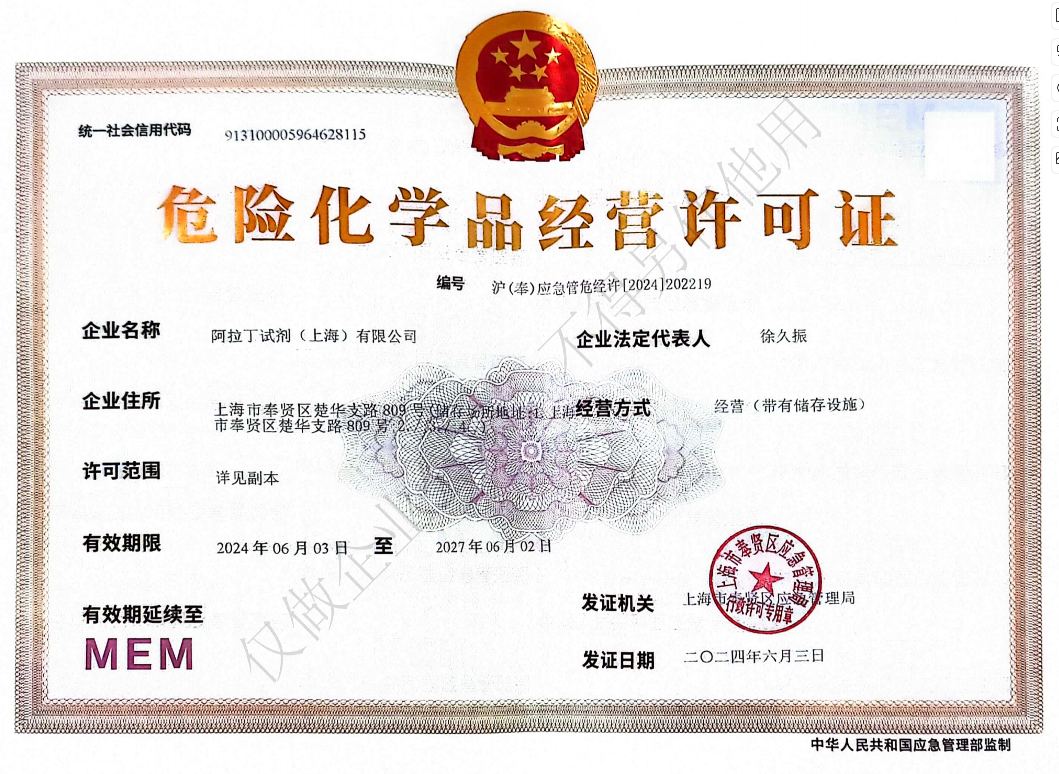 危险品化学品经营许可证(带存储)