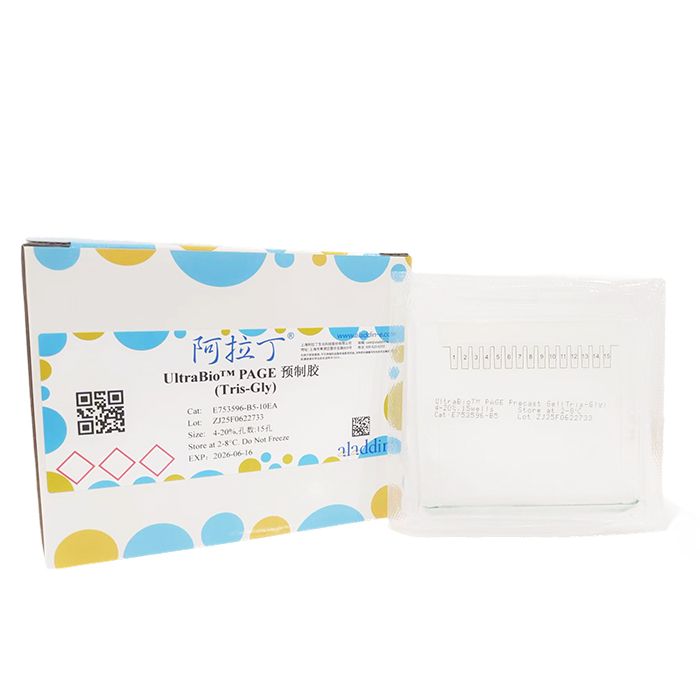
UltraBio™ PAGE预制胶 (Tris-Gly) 是一款安全、快捷、高性能的预制聚丙烯酰胺凝胶,常用于PAGE和Western blot检测。
1、采用自动化的灌胶生产技术,确保了产品质量的高稳定性和重复性。
2、采用镀膜塑料胶板,有效减少蛋白非特异性吸附,使蛋白条带更为敏锐,清晰。
3、电泳时间短,使用超快电泳缓冲液,在250V电压下,电泳20min即可完成。
4、胶夹打开极为轻松,塑料板可以用螺丝刀撬开。
5、凝胶中不含SDS,可用于变性和非变性电泳。
6、兼容市场上主流的mini电泳槽,如Bio-Rad,天能和君意东方等。
7、提供多种浓度的均一胶和梯度胶。均一胶可选浓度:10%,12%,15%。梯度胶可选浓度:4-15%,4-20%,8-16%,8-20%。
注:使用荧光上样缓冲液处理过的样品,无需剥胶,无需经过染色脱色处理,即可直接在紫外灯或者LED灯下观察到蛋白条带。配合超快电泳缓冲液使用,可在半个小时内完成样品处理、电泳、拍照的全部过程,获得理想的电泳结果。
基本信息:
胶板尺寸:宽×高×厚度为100*89*4.8mm
凝胶厚度:1.0mm
凝胶尺寸:宽×高×厚度为84*74*1mm
孔数:10孔,15孔
Acr-Bis:29:1
最大上样量:50μL,30μL
浓缩胶:4%,1.5cm
包装:10片/盒
每种预制胶的指标请参考下表:
| 货号 | 浓度 | 孔数 | 最大上样量 | 电泳/转膜
缓冲液体系
| 建议电压 |
E753596-A1
| 10% | 10孔 | 50μL | Tris-Glycine
| 180V |
E753596-A2
| 12%
| 10孔
| 50μL
| Tris-Glycine
| 180V
|
E753596-A3
| 15%
| 10孔
| 50μL
| Tris-Glycine
| 180V
|
E753596-A4
| 4-15% | 10孔
| 50μL
| Tris-Glycine
| 180V
|
E753596-A5
| 4-20% | 10孔
| 50μL
| Tris-Glycine
| 180V
|
E753596-A6
| 8-16% | 10孔
| 50μL
| Tris-Glycine
| 180V
|
E753596-A7
| 8-20% | 10孔
| 50μL
| Tris-Glycine
| 180V
|
E753596-B1
| 10%
| 15孔 | 30μL | Tris-Glycine
| 180V
|
E753596-B2
| 12%
| 15孔
| 30μL
| Tris-Glycine
| 180V
|
E753596-B3
| 15%
| 15孔
| 30μL
| Tris-Glycine
| 180V
|
E753596-B4
| 4-15%
| 15孔
| 30μL
| Tris-Glycine
| 180V
|
E753596-B5
| 4-20%
| 15孔
| 30μL
| Tris-Glycine
| 180V
|
E753596-B6
| 8-16%
| 15孔
| 30μL
| Tris-Glycine
| 180V
|
E753596-B7
| 8-20%
| 15孔
| 30μL
| Tris-Glycine
| 180V |
使用说明:
预制胶本身都不含SDS,可根据电泳缓冲液的不同用于变性电泳和非变性电泳
非变性胶(Native-PAGE)
1、非变性胶的蛋白迁移率受到蛋白分子量、蛋白空间结构等多种因素影响。
2、将UltraBio™ PAGE预制胶 (Tris-Gly) 从包装袋中取出,撕掉底部密封胶带。
3、将预制胶固定在电泳槽中。
4、准备非变性电泳缓冲液:取1L 1×Tris-甘氨酸-Native电泳缓冲液(货号T767966)。
5、阴极加满电泳液,阳极的电泳液最低须加到1/3液面处,最高不可漫过胶板,再缓慢地将梳子拔出。
6、上样前请使用移液器吸取电泳缓冲液轻轻吹打加样孔,去除加样孔内残余的胶液。
7、上样:将非变性蛋白样品与非变性非还原性蛋白上样缓冲液(货号S301935)进行4:1混合均匀。注意枪头不要戳破凝胶,不要过度插入梳孔使胶板变形造成漏液。
8、电泳条件:180V,60min,当溴酚蓝指示带电泳至胶板底部,或实验预定位置时,即可结束电泳。
9、电泳结束,取出凝胶。用螺丝刀在板子侧边缘慢慢撬开板子,打开胶盒,轻轻取出凝胶。
10、酸性蛋白(等电点pI<7)正常上样电泳即可。反之,碱性蛋白(等电点pI>7)带正电荷,需将电极插反(红插黑,黑插红),这时上样孔成为正极,样品向下电泳。
变性胶(SDS-PAGE)
1、请参考下面的分离图谱选择合适浓度的预制胶,以帮助您进行更好的蛋白电泳条带分离。
2、将UltraBio™ PAGE预制胶 (Tris-Gly) 从包装袋中取出,撕掉底部密封胶带。
3、将预制胶固定在电泳槽中。
4、准备变性电泳缓冲液:取1L 1×Tris-甘氨酸-SDS电泳缓冲液(货号T767967)。
5、阴极加满电泳液,阳极的电泳液最低须加到1/3液面处,最高不可漫过胶板,再缓慢地将梳子拔出。
6、上样前请使用移液器吸取电泳缓冲液轻轻吹打加样孔,去除加样孔内残余的胶液。
7、上样:将蛋白样品与5×SDS变性电泳上样缓冲液(货号S301935)进行4:1混合均匀,加热处理。注意枪头不要戳破凝胶,不要过度插入梳孔使胶板变形造成漏液。
8、电泳条件:180V,60min,当溴酚蓝指示带电泳至胶板底部,或实验预定位置时,即可结束电泳。
9、电泳结束,取出凝胶。用螺丝刀在板子侧边缘慢慢撬开板子,打开胶盒,轻轻取出凝胶。
预制胶分离图谱(变性):

UltraBio™ PAGE预制胶 (Tris-Gly) 可以兼容大部分的mini SDS-PAGE电泳槽,包括
a.Bio-Rad Mini-PROTEAN (II/3/TetraS ystem);
b.Hoefer Mighty Small (SE250/SE260/SE280);
c.北京六一DYCZ-25E、DYCZ-24K、DYCZ-24KS、DYCZ-24KF;
f.君意东方JY-SCZ2+;
g.天能VE180;
或其它胶板宽度在10厘米的电泳槽。
在Bio-Rad电泳槽中的应用:
Bio-Rad Mini-PROTEAN系列电泳槽的U型密封条顶部有凸起结构,而本预制胶的短玻板是凹形结构,因此该部位是平的,电泳前需将具有凸起结构的密封条取出后反过来安装,是平滑面朝外,从而防止漏液(如下图所示)。另有厚度约为0.5mm的塑料垫片,请根据您电泳槽的实际宽度进行相应的增加。
a.将Bio-Rad电泳槽中的U型密封条(如图绿色部分)拉出,注意这时的密封条两端是有凸起的,凸起的这面为正面,无凸起的为反面。
b.将密封条旋转180度(正面朝里,反面朝外),重新装回电泳槽中,注意把密封圈周边压实,防止发生漏液。
c.放置好预制胶进行正常的电泳操作即可。

注意事项:
1、UltraBio™ PAGE预制胶 (Tris-Gly) 使用的是中性的Tris-Gly缓冲系统。
2、如果需要蛋白条带更加清晰、平直,可降低电压至150V,适当延长电泳时间。
3、电压为180V电泳时,1块胶的初始电流在75mA左右,2块胶的初始电流在150mA左右,随时间增加电流逐步降低。
4、电泳缓冲液不建议重复使用。因为经过电泳之后,缓冲液中的离子强度、缓冲能力都发生了变化,不能确保电泳效果。
5、湿转时120V恒压转膜60-90min。为达到更好的转膜效果,可以根据预制胶上残留的预染marker及膜上的预染marker确定转膜效率,并对转膜条件进行适当调整。目的蛋白的分子量,凝胶浓度及转膜液中的甲醇浓度都会影响转膜效率。大蛋白尽量选择低浓度的胶。
| 蛋白分子量 | 100kDa以上 | 10-100kDa | 10kDa以下 |
| 建议甲醇浓度 | 5% | 10% | 20-30% |
6、仅限于专业人员的科学研究用,不得用于临床诊断或治疗,不得用于食品或药品,不得存放于普通住宅内。
7、为了您的安全和健康,请穿实验服并戴一次性手套操作。
特别说明:
1、在常规蛋白质或菌液样本中,该胶均一性与分辨率均符合我司质检标准,可正常使用。
2、在全细胞裂解液等复杂样本中,若各泳道样本浓度差异较大,可能出现泳道宽窄不一的现象,这与样本本身的物理性质及上样方式有关。
3、不同品牌的预制胶在配方设计上各有侧重,我司该型号胶在条带整齐度和防漏样方面表现较好,而其他品牌可能在泳道控制上更优。
4、若主要用于蛋白鉴定或菌液样本,该批次产品可继续使用;若主要用于全细胞裂解液,建议优化上样浓度或考虑使用我司另一款针对复杂样本优化的型号(如U776776系列)。
UltraBio™ PAGE Precast Gel (Tris-Gly) is a safe, rapid and high-performance Precast polyacrylamide gel for PAGE and Western blot assays.
1. Manufactured by automated gel-casting technology to guarantee high batch-to-batch consistency and reproducibility.
2. Coated plastic gel cassettes reduce non-specific protein adsorption for sharper, well-defined protein bands.
3. Short electrophoresis runtime. Use ultra-fast running buffer; separation can be completed within 20 min at 250 V.
4. Cassettes are easy to pry open; plastic plates may be separated using a screwdriver.
5. Gels contain no SDS, compatible with both denaturing and non-denaturing electrophoresis.
6. Compatible with most commercial mini-gel electrophoresis systems, including Bio-Rad, Tanon, Junyi-Dongfang and others.
7. Multiple homogeneous-gel and gradient-gel formulations available.
l Homogeneous gels: 10 %, 12 %, 15 %
l Gradient gels: 4-15 %, 4-20 %, 8-16 %, 8-20 %
Note: Samples prepared with fluorescent loading dye can be visualized directly under UV or LED light without gel stripping, staining or destaining. Combined with ultra-fast running buffer, sample preparation, electrophoresis and imaging can be finished within half an hour for satisfactory results.
General Specifications
Cassette dimensions (W×H×T): 100 × 89 × 4.8 mm
Gel thickness: 1.0 mm
Gel dimensions (W×H×T): 84 × 74 × 1 mm
Well formats: 10-well, 15-well
AcrBis ratio: 29:1
Maximum loading volume: 50 μL, 30 μL
Stacking gel: 4 %, height 1.5 cm
Packaging: 10 gels per box
Product Specifications Table
Cat.No. | Gel Concentration | Well Format | Max. Loading Volume | Electrophoresis / Transfer Buffer System | Recommended Voltage |
E753596A1 | 10 % | 10-well | 50 μL | Tris-Glycine | 180 V |
E753596A2 | 12 % | 10-well | 50 μL | Tris-Glycine | 180 V |
E753596A3 | 15 % | 10-well | 50 μL | Tris-Glycine | 180 V |
E753596A4 | 4-15 % | 10-well | 50 μL | Tris-Glycine | 180 V |
E753596A5 | 4-20 % | 10-well | 50 μL | Tris-Glycine | 180 V |
E753596A6 | 8-16 % | 10-well | 50 μL | Tris-Glycine | 180 V |
E753596A7 | 8-20 % | 10-well | 50 μL | Tris-Glycine | 180 V |
E753596B1 | 10 % | 15-well | 30 μL | Tris-Glycine | 180 V |
E753596B2 | 12 % | 15-well | 30 μL | Tris-Glycine | 180 V |
E753596B3 | 15 % | 15-well | 30 μL | Tris-Glycine | 180 V |
E753596B4 | 4-15 % | 15-well | 30 μL | Tris-Glycine | 180 V |
E753596B5 | 4-20 % | 15-well | 30 μL | Tris-Glycine | 180 V |
E753596B6 | 8-16 % | 15-well | 30 μL | Tris-Glycine | 180 V |
E753596B7 | 8-20 % | 15-well | 30 μL | Tris-Glycine | 180 V |
Instructions for Use
These Precast gels contain no SDS. They can be used for denaturing or nondenaturing electrophoresis depending on the running buffer selected.
1. Non-denaturing PAGE (Native-PAGE)
1. Protein mobility in native-PAGE is affected by molecular weight, tertiary structure and other factors.
2. Remove the UltraBio™ PAGE Precast Gel (Tris-Gly) from its pouch and peel off the bottom sealing tape.
3. Mount the gel cassette into the electrophoresis cell.
4. Prepare native running buffer: use 1 L of 1 × Tris-Glycine Native Running Buffer (Cat.No. T767966).
5. Fill the cathode (inner) chamber completely with running buffer. Fill the anode (outer) chamber to a minimum of 1/3 volume; do not overfill above the cassette. Slowly pull out the comb.
6. Prior to sample loading, rinse each well by pipetting running buffer upanddown to remove residual gel debris.
7. Sample loading: mix native protein sample with nonreducing native loading buffer (Cat.No. S301935) at 4:1 ratio. Avoid piercing the gel with pipette tips and do not insert tips too deeply to prevent cassette deformation and buffer leakage.
8. Electrophoresis condition: 180 V, 60 min. Stop electrophoresis when bromophenol blue tracking dye reaches the gel bottom or your target position.
9. After electrophoresis, take out the cassette. Pry open the plastic cassette along the side edge using a screwdriver and carefully retrieve the gel.
10. Acidic proteins (pI < 7): load and run normally. For basic proteins (pI > 7, positivelycharged), reverse electrode connections (red to black, black to red). Wells will then act as the positive pole and samples migrate downwards.
2. Denaturing SDS-PAGE
1. Select an appropriate gel percentage according to the denaturing separation profile for optimal band resolution.
2. Remove the UltraBio™ PAGE Precast Gel (Tris-Gly) from its pouch and peel off the bottom sealing tape.
3. Mount the gel cassette into the electrophoresis cell.
4. Prepare denaturing running buffer: use 1 L of 1 × Tris-GlycineSDS Running Buffer (Cat.No. T767967).
5. Fill the cathode (inner) chamber completely with running buffer. Fill the anode (outer) chamber to a minimum of 1/3 volume; do not overfill above the cassette. Slowly pull out the comb.
6. Prior to sample loading, rinse each well by pipetting running buffer upanddown to remove residual gel debris.
7. Sample loading: mix protein sample with 5×SDS denaturing loading buffer (Cat.No. S301935) at 4:1 ratio and heattreat the mixture. Avoid piercing the gel with pipette tips and do not insert tips too deeply to prevent cassette deformation and buffer leakage.
8. Electrophoresis condition: 180 V, 60 min. Stop electrophoresis when bromophenol blue tracking dye reaches the gel bottom or your target position.
9. After electrophoresis, take out the cassette. Pry open the plastic cassette along the side edge using a screwdriver and carefully retrieve the gel.
Denaturing Separation Profile of Precast Gels:
Special setup for BioRad MiniPROTEAN cells
The Ushaped gasket of BioRad MiniPROTEAN cells has raised ridges on one side; our Precast gel short plate is recessed. To achieve a flat sealing surface and prevent leakage:
a. Pull out the Ushaped green gasket. The side with raised bumps is the front side; the smooth side is the reverse side.
b. Rotate the gasket 180°, install it with smooth surface facing outwards. Press the gasket firmly all around to eliminate leaks.
c. Insert Precast gel and perform electrophoresis normally.
Optional ~0.5 mm plastic shims may be added depending on actual cell width.

Important Notes
1. UltraBio™ PAGE Precast Gel (Tris-Gly) uses a neutral Tris-Gly buffer system.
2. For sharper, straighter bands, reduce voltage to 150 V and extend runtime appropriately.
3. At 180 V, initial current is approximately 75 mA for one gel and ~150 mA for two gels; current gradually decreases during the run.
4. Do not reuse running buffer. Ionic strength and buffering capacity degrade after electrophoresis and may compromise results.
5. For wetblot transfer: 120 V constant voltage for 6090 min. Optimize transfer conditions by checking prestained marker on gel and membrane. Target protein molecular weight, gel percentage and methanol concentration in transfer buffer all affect transfer efficiency. Use lowerpercentage gels for largemolecularweight proteins.
Protein Molecular Weight | > 100 kDa | 10-100 kDa | < 10 kDa |
Recommended Methanol Concentration | 5 % | 10 % | 20-30 % |
6. For researchuse only by trained personnel. Not for clinical diagnosis, therapy, food or pharmaceutical applications. Do not store in residential premises.
7. Wear laboratory coat and disposable gloves for personal safety.
Special Remarks
1. For routine protein samples or bacterial lysates, gel homogeneity and resolution meet internal QC specifications.
2. When loading complex samples such as wholecell lysates with large well-to-well concentration differences, uneven lane width may occur. This arises from sample properties and loading technique.
3. Precast gels from different vendors have different design priorities. This product performs well in band straightness and sample retention, while other brands may excel in lane uniformity.
4. This batch is suitable for protein identification or bacterial lysate samples. For wholecell lysate work, optimize sample loading concentration or consider our U776776 series optimized for complex biological samples.

 ZJ26F0939534


 危险品化学品经营许可证(带存储)