
计算溶液所需的质量、体积或浓度。
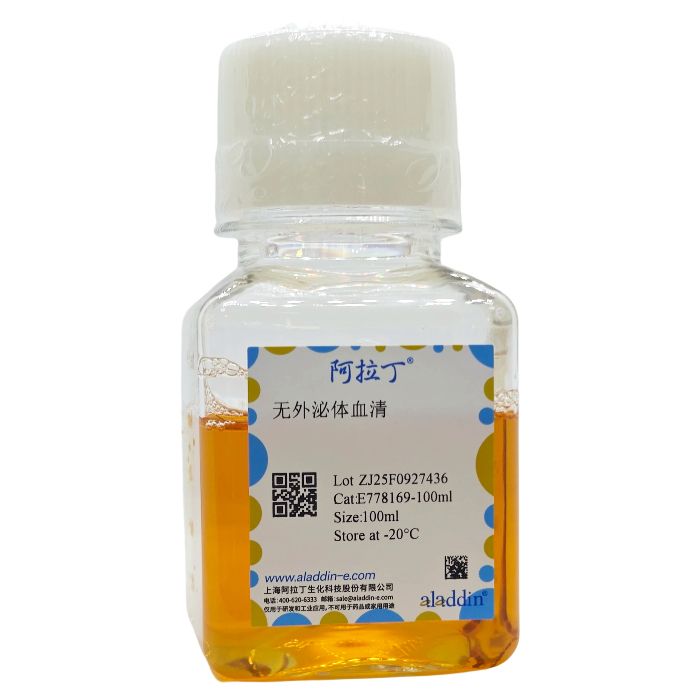
无外泌体血清
有货
BioReagent,无菌,用于细胞培养 级 ,适用于对基线干扰要求严格的色谱和分析工作流程。
-20°C储存,避免反复冻融。超低温运输 。请查阅批次 COA 获取详细规格。
SDS、COA、产品数据表及规格说明书均可下载。可通过批号查询获取批次 COA。
在色谱分析、有机合成和交叉偶联反应领域已被 0 篇同行评审文献引用。
对于大多数细胞来说,体外培养时所用的标准培养基都必须在基础培养基的基础上外加胎牛血清(FBS)作为生长添加物。但是,常用的 FBS 通常来源于牛血清,其中含有大量的牛外泌体、外源性细胞外囊泡等。血清中所含的外泌体会对外泌体研究结果产生巨大的干扰效果。
为了解决上述问题,阿拉丁推出无外泌体胎牛血清(Exosome-Free FBS)可以完全满足外泌体研究中对细胞培养条件的要求。采用高品质胎牛血清为源血清,经过特定方法处理后,胎牛血清内源外泌体去除率达 97%以上;与含正常源血清(FBS)的培养基相比,其对细胞的生长和存活都具有同等甚至更好的促进作用。
产品特点:
品质优异:源自高品质胎牛血清,胎牛血清内源外泌体去除率达97%以上。
质量稳定:严格的质量控制,保证产品批间稳定性。
产品数据:

293细胞在常规胎牛血清和去外泌体血清中生长情况基本一致

β-actin为内参, 相比于未处理的血清, 去外泌体血清的TSG101含量显著降低
操作流程:
1. 将本产品从-20°C 或- 80°C 冷冻环境中取出后,置于 4℃冰箱中溶解 1 天进行化冻。
2. 经反复实验验证使用 10%的无外泌体血清培养 293T 细胞,效果非常好,部分细胞也会使用 5%的无外泌体血清或者 20%的无外泌体血清,可根据具体细胞选择合适的无外泌体血清浓度。
3. 建议在更换无外泌体血清时,按 1:1~1:4 到完全替换为无外泌体血清。如配制 10mL 完全培养基,先加 5 mL 旧完全培养基,再加 5mL 无外泌体血清配制的完全培养基,逐步替换为 2mL 旧完全培养基和 8mL 无外泌体血清配制的完全培养基,直到完全替换为无外泌体血清配制的完全培养基。
注意事项和免责说明:
1. 如果不能短期内使用完毕,解冻后请适当分装。在分装血清时须使分装瓶预留一定体积空间,否则易导致分装瓶冻裂而发生污染。
2. 瓶装血清解冻需采用缓慢解冻法:将-20℃或-80℃低温冰箱中保存的血清放入 4℃冰箱中解冻约 1 天,待全部解冻后再分装。在解冻过程中每隔约 2h 可轻轻摇晃均匀(尽量避免产生气泡),使温度与成分均一,减少沉淀的发生。切勿直接将血清从-20℃或更低温度进入 37℃水浴解冻,这样因温度改变太大,容易造成蛋白质凝集而出现沉淀,从而使用血清的质量下降。
3. 血清中的聚状沉淀物主要是解冻后血清中纤维蛋白及 4℃长时间保存后血清中的脂蛋白变性造成的,絮状物不会影响血清本身的质量,可不用处理。如果必须要处理,可 400g 离心 5min 去除。但不宜过滤去除,架状物可能阻塞滤膜。
4. 请勿将血清在 37℃放置过长时间,否则血清会逐渐变浑浊,同时血清中的有效成分也会逐渐失活而影响血清质量。
5. 更换不同来源或不同批次的血清时出现的细胞生长不适应和血清的品质无关。对于新来源或新批次的血清,通常细胞适应 1-2 代后就会恢复正常的生长。
6. 为了您的安全和健康,请穿实验服并戴一次性手套操作。
7. 本产品仅限于专业人员的科学研究用,不得用于临床诊断或治疗,不得用于食品或药品。
Product Introduction:
For most cells, the standard medium used for in vitro culture must be supplemented with fetal bovine serum (FBS) as a growth additive on the basis of the basal medium. However, commonly used FBS is usually derived from bovine serum, which contains a large number of bovine exosomes, exogenous extracellular vesicles, etc. The exosomes contained in the serum can cause significant interference to the results of exosome research.
To solve the above problems, Aladdin has launched Exosome-Free Fetal Bovine Serum, which can fully meet the requirements for cell culture conditions in exosome research. Using high-quality fetal bovine serum as the source serum, after treatment with specific methods, the removal rate of endogenous exosomes in fetal bovine serum reaches more than 97%; compared with the medium containing normal source serum (FBS), it has an equal or even better promoting effect on cell growth and survival.
Product Features:
Excellent Quality: Derived from high-quality fetal bovine serum, with a removal rate of endogenous exosomes in fetal bovine serum reaching over 97%.
Stable Quality: Strict quality control ensures batch-to-batch stability of the product.
Product Data:

The growth status of 293 cells in regular fetal bovine serum and exosome-depleted serum is basically the same.
With β-actin as the internal reference, the content of TSG101 in exosome-depleted serum is significantly lower than that in untreated serum.
Operating Procedures:
1.Take the product out of the -20°C or -80°C freezing environment and place it in a 4°C refrigerator to thaw for 1 day.
2.Repeated experiments have verified that using 10% exosome-free serum to culture 293T cells yields excellent results. For some cells, 5% or 20% exosome-free serum may also be used. The appropriate concentration of exosome-free serum can be selected according to the specific cell type.
3.It is recommended that when replacing with exosome-free serum, gradually transition to complete replacement at a ratio of 1:1 to 1:4. For example, to prepare 10 mL of complete medium, first add 5 mL of the old complete medium and 5 mL of the complete medium prepared with exosome-free serum. Then gradually switch to 2 mL of the old complete medium and 8 mL of the complete medium prepared with exosome-free serum, until completely replacing with the complete medium prepared with exosome-free serum.
Notes and Disclaimer:
1.If the product cannot be used up in a short period of time, please aliquot it appropriately after thawing. When aliquoting the serum, a certain volume of space must be reserved in the aliquot containers; otherwise, the containers may crack due to freezing, leading to contamination.
2.Bottled serum should be thawed slowly: Place the serum stored in a -20°C or -80°C refrigerator into a 4°C refrigerator to thaw for approximately 1 day, and aliquot it after complete thawing. During the thawing process, gently shake the serum evenly every 2 hours or so (try to avoid generating bubbles) to ensure uniform temperature and composition, and reduce the occurrence of precipitation. Do not directly thaw the serum from -20°C or lower temperatures in a 37°C water bath, as such a drastic temperature change may cause protein aggregation and precipitation, thereby reducing the quality of the serum.
3.The flocculent precipitates in the serum are mainly caused by fibrin in the thawed serum and lipoprotein denaturation in the serum after long-term storage at 4°C. The flocculates do not affect the quality of the serum itself and can be left untreated. If treatment is necessary, centrifuge at 400g for 5 minutes to remove them. However, filtration is not recommended for removal, as the flocculates may clog the filter membrane.
4.Do not leave the serum at 37°C for an extended period, as the serum will gradually become turbid, and the active ingredients in the serum will gradually inactivate, affecting its quality.
5.The cell growth adaptation issues that occur when switching to serum from different sources or batches are not related to the quality of the serum. For serum from a new source or batch, cells usually recover normal growth after adapting for 1-2 generations.
6.For your safety and health, please wear a lab coat and disposable gloves during operation.
7.This product is intended solely for scientific research by professionals and shall not be used for clinical diagnosis or treatment, nor for food or pharmaceutical purposes.
通过匹配包装上的批号来查找并下载产品的 COA,每批产品都进行了严格的验证,您可放心使用!
| 批号(Lot Number) | 证书类型 | 货号 |
|---|---|---|
 ZJ26F0939266 |
分析证书 | E778169 |
| ZJ26F0939265 |
分析证书 | E778169 |
我们的级别选择指南涵盖了目录中所有的变体的纯度、稳定剂状态和应用适用性。
查看 BioReagent 级别指南 → 查看 for Cell culture 级别指南 → 查看 Sterile 级别指南 →

 危险品化学品经营许可证(带存储)