铁是人体必需的元素之一,对人体的新陈代谢和身体健康具有重要作用,血液中铁的含量不足,就会造成缺铁性贫血。铁存在于人体所有的细胞内,各组织、器官包括各内分泌腺都含有铁。肝脏、脾脏和肺组织内含量较为丰富。成人体内含铁3~5克,大部分都以蛋白质复合物形式存在,极少部分以离子的形态存在。亚铁离子是血红素和血红蛋白中的关键元素,同时也在许多生化反应中起到重要作用。本试剂盒采用比色法对动植物组织、血清(浆)或其他液体中的亚铁离子进行定量,样本中的Fe²⁺在酸性条件下与三吡啶基三嗪(TPTZ)形成蓝色配合物,在593nm处有吸收峰,通过测定该波长吸光度即可计算Fe²⁺的含量。
| F1515875 | 组分 | 48T | 96T | 储存条件 | | F1515875A | 缓冲液 | 15 mL | 30 mL | 2-8℃. 避光保存 | | F1515875B | 显色液 | 7 mL | 14 mL | 2-8℃. 避光保存 | | F1515875C | 亚铁离子标准品(40mM) | 0.5 mL | 1 mL | 2-8℃. 避光保存 | | F1515875D | 标准品稀释液 | 5 mL | 10 mL | 2-8℃. 避光保存 | | F1515875E | 提取液 | 15 mL | 30 mL | 2-8℃. 避光保存 |
|
使用方法
1. 样品准备
(1) 组织:按照每0.01 g组织加入0.1 mL提取液的比例,用匀浆器或研钵冰浴匀浆。然后冰浴15分钟,每 3min上下颠倒混匀一次,以充分裂解细胞。10000g,4℃离心 10 min,收集上清液,置冰上待测。
(2) 血清(浆)等液体样本:取55 μL 样本,加入165 μL缓冲液混合均匀(即稀释 4 倍),置冰上待测。如果样本浑浊,5000 g,4℃离心 5 min,取上清液,置冰上待测。
注:本试剂盒提取液不能使用 BCA 蛋白定量,如需测定蛋白浓度,推荐使用阿拉丁即用型Bradford蛋白定量试剂盒 (去垢剂兼容型) (B1509656)。为确保样品数值在标准曲线范围内,建议进行预实验将样品设置多个稀释倍数,以确定样品中亚铁离子的大致浓度,如果数值不在标准曲线范围内,请调整样品的稀释倍数或者样品的量。样本稀释液为缓冲液,血清(浆)等液体样本在样本处理过程中已稀释 4 倍,通常无需再进一步稀释。
2. 绘制标准曲线
将40 mmol/L(40000 μmol/L)标准品用标准品稀释液进行稀释得到100、50、25、12.5、6.25、3.125、1.5625 μmol/L的标准品,现配现用。
标准品稀释可参考下表:
| 序号 | 稀释前浓度(μmol/L) | 标准品体积(μL) | 标准品稀释液体积(μL) | 稀释后浓度(μmol/L) | | 1 | 40000 | 10 | 990 | 400 | | 2 | 400 | 150 | 450 | 100 | | 3 | 100 | 300 | 300 | 50 | | 4 | 50 | 300 | 300 | 25 | | 5 | 25 | 300 | 300 | 12.5 | | 6 | 12.5 | 300 | 300 | 6.25 | | 7 | 6.25 | 300 | 300 | 3.125 | | 8 | 3.125 | 300 | 300 | 1.5625 |
|
备注:下述实验中每个标准管需200μL标准品(注意不要在此步骤直接检测吸光度)。
3. 样品测定
(1) 酶标仪预热 30 min 以上,调节波长到 593 nm。
(2) 按下表设置反应体系加样。设置不加样品的空白对照管。
| 试剂名称(μL) | 空白对照管 | 标准品管 | 测定样品管 | | 样品(μL) | 0 | 0 | 200 | | 标准品(μL) | 0 | 200 | 0 | | 缓冲液(μL) | 200 | 0 | 0 | | 显色液(μL) | 100 | 100 | 100 |
|
(3) 混匀,37°C 孵育20 min,取200 μL上清液于酶标板各对应孔中,在酶标仪593 nm处测定各孔OD值。空白孔记为A空白,标准孔记为A标准,测定孔记为A测定。
计算:ΔA测定= A测定 - A空白 ,Δ A标准 = A标准 - A空白 。
4. 亚铁离子含量计算
(1) 标准曲线的绘制:
以标准溶液浓度为x轴,Δ A标准 为 y 轴,绘制标准曲线,得到标准方程,将 ΔA测定 带入方程得到样品浓度Cₛₐₘₚₗₑ (μmol/L)。
(2) 亚铁离子浓度计算:
血清(浆)等液体样本:Fe²⁺含量 (μmol/L) = Cₛₐₘₚₗₑ × 4 × f;
组织样本:
a. 以组织湿重进行计算: Fe²⁺ 含量 (μmol/kg wet weight) = Cₛₐₘₚₗₑ × f ÷ (m/V);
b. 按蛋白浓度计算:亚铁离子(nmol/mg 蛋白)= Cₛₐₘₚₗₑ × f ÷ Cₚᵣ
注:
f:样本加入检测体系前的稀释倍数;
m:组织湿重质量(g);
V:样本提取液加入量(mL);
Cₚᵣ:样本蛋白质浓度,mg/mL。
注意事项
1. 操作过程中,样品与试剂等避免与铁器接触,以防污染。
2. 建议使用新鲜样本。亚铁离子易被氧化,样本放置时间较长或反复冻融会造成结果不准确。
3. 所测样本的值高于标准曲线的上限,应稀释样品后重新测定。
4. 正式检测前,建议选择 2-3 个预期差异较大的样本进行预实验。
5. 为了您的安全和健康,请穿实验服并戴一次性手套操作。
结果展示
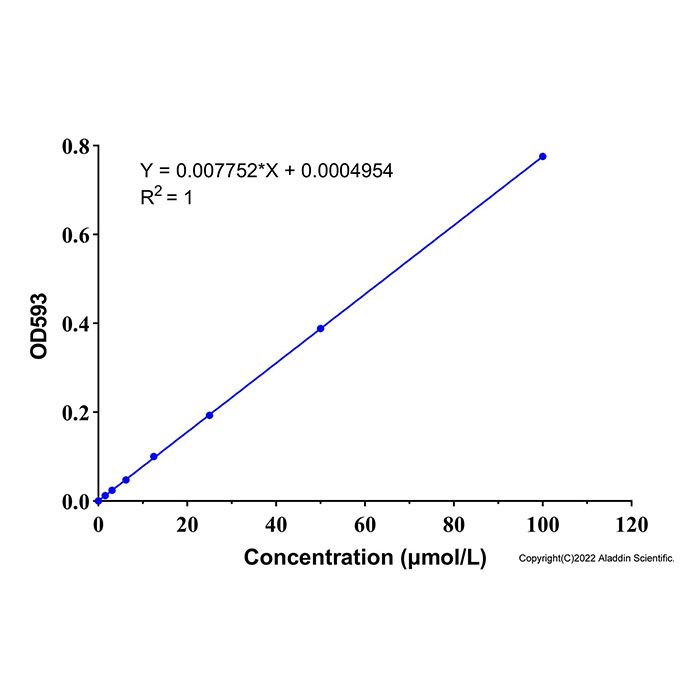
典型标准曲线:

Iron is one of the essential elements for the human body and plays an important role in metabolism and overall health. Insufficient iron levels in the blood can lead to iron deficiency anemia. Iron is present in all cells of the human body, including various tissues, organs, and endocrine glands. The liver, spleen, and lung tissues are relatively rich in iron. The adult body contains 3–5 g of iron, most of which exists as protein complexes, with a very small portion in ionic form. Ferrous ions (Fe²⁺) are key components of heme and hemoglobin and also play important roles in many biochemical reactions. This kit employs a colorimetric method for the quantitative determination of Fe²⁺ in animal and plant tissues, serum/plasma, or other liquids. Under acidic conditions, Fe²⁺ in the sample reacts with tripyridyltriazine (TPTZ) to form a blue complex that has a maximum absorbance at 593 nm. The concentration of Fe²⁺ is then determined by measuring the absorbance at this wavelength.
| F1515875 | Component | 48T | 96T | Storage conditions | | F1515875A | Buffer Solution | 15 mL | 30 mL | 2-8℃. Store in the dark | | F1515875B | Chromogenic Solution | 7 mL | 14 mL | 2-8℃. Store in the dark | | F1515875C | Ferrous Ion Standard(40mM) | 0.5 mL | 1 mL | 2-8℃. Store in the dark | | F1515875D | Standard diluent | 5 mL | 10 mL | 2-8℃. Store in the dark | | F1515875E | Extraction Buffer | 15 mL | 30 mL | 2-8℃. Store in the dark |
|
Protocol
1. Sample Preparation
(1) Tissue: Add 0.1 mL of extraction buffer per 0.01 g of tissue. Homogenize using a homogenizer or mortar and pestle on ice. Then incubate on ice for 15 minutes, inverting and mixing every 3 minutes to ensure complete cell lysis. Centrifuge at 10,000 × g for 10 minutes at 4°C. Collect the supernatant and keep on ice.
(2) Serum/plasma or other liquid samples: Mix 55 μL of sample with 165 μL of Buffer Solution (i.e., 4‑fold dilution) and keep on ice. If the sample is turbid, centrifuge at 5,000 × g for 5 minutes at 4°C and collect the supernatant for analysis.
Note: The extraction buffer provided with this kit is not compatible with BCA protein assays. For protein concentration determination, we recommend Aladdin’s Ready‑to‑Use Bradford Protein Assay Kit (Detergent Compatible) (B1509656). To ensure that the sample values fall within the standard curve range, it is recommended to perform a preliminary experiment with multiple dilution factors for the sample to determine the approximate concentration of ferrous ions. If the values are not within the standard curve range, please adjust the dilution factor or the amount of sample. The sample diluent is Buffer Solution; serum/plasma or other liquid samples have already been diluted 4‑fold during sample processing and usually do not require further dilution.
2. Standard Curve Preparation
Dilute the 40 mmol/L (40,000 μmol/L) standard with standard diluent to obtain the following concentrations: 100, 50, 25, 12.5, 6.25, 3.125, 1.5625 μmol/L. Prepare fresh before use.
A recommended dilution scheme is shown below:
| No. | Pre‑dilution Conc. (μmol/L) | Std. Volume (μL) | Standard diluent Volume (μL) | Final Conc. (μmol/L) | | 1 | 40000 | 10 | 990 | 400 | | 2 | 400 | 150 | 450 | 100 | | 3 | 100 | 300 | 300 | 50 | | 4 | 50 | 300 | 300 | 25 | | 5 | 25 | 300 | 300 | 12.5 | | 6 | 12.5 | 300 | 300 | 6.25 | | 7 | 6.25 | 300 | 300 | 3.125 | | 8 | 3.125 | 300 | 300 | 1.5625 |
|
Note: Each standard tube requires 200 μL of diluted standard for the subsequent assay (do not measure absorbance at this step).
3. Sample Measurement
(1) Pre‑warm the microplate reader for at least 30 min. Set the wavelength to 593 nm.
(2) Prepare the reaction mixtures as shown below. Include a blank control (no sample).
| Reagent (μL) | Blank | Standard | Sample | | Sample (μL) | 0 | 0 | 200 | | Standard (μL) | 0 | 200 | 0 | | Buffer Solution (μL) | 200 | 0 | 0 | | Chromogenic Solution (μL) | 100 | 100 | 100 |
|
(3) Mix thoroughly and incubate at 37°C for 20 minutes. Transfer 200 μL of the supernatant to the corresponding wells of a microplate. Measure the absorbance of each well at 593 nm. Record the blank absorbance as Abₗₐₙₖ, the standard as Aₛₜₐₙdₐᵣd, and the sample as Aₛₐₘₚₗₑ. Calculate: ΔAₛₐₘₚₗₑ = Aₛₐₘₚₗₑ – Abₗₐₙₖ , ΔAₛₜₐₙdₐᵣd = Aₛₜₐₙdₐᵣd – Abₗₐₙₖ.
4. Calculation of Fe²⁺ Content
(1) Standard curve: Plot the standard concentration (x‑axis) against ΔAₛₜₐₙdₐᵣd (y‑axis) to obtain the linear equation. Substitute ΔAₛₐₘₚₗₑ into the equation to calculate the sample concentration Cₛₐₘₚₗₑ (μmol/L).
(2) Fe²⁺ concentration calculation:
For serum/plasma or other liquid samples: Fe²⁺ content (μmol/L) = Cₛₐₘₚₗₑ × 4 × f
For tissue samples:
Based on tissue wet weight: Fe²⁺ content (μmol/kg wet weight) = Cₛₐₘₚₗₑ × f ÷ (m / V)
Based on protein concentration: Fe²⁺ content (nmol/mg protein) = Cₛₐₘₚₗₑ × f ÷ Cₚᵣ
Note:
f = dilution factor before measurement;
m = tissue wet weight (g);
V = volume of Extraction Buffer added (mL);
Cₚᵣ = protein concentration of the sample (mg/mL).
Precautions:
1. Avoid contact of samples and reagents with iron materials to prevent contamination.
2. Fresh samples are recommended. Fe²⁺ is easily oxidized; prolonged storage or repeated freeze‑thaw cycles may compromise accuracy.
3. If the sample reading exceeds the highest standard, dilute the sample and repeat the assay.
4. Before formal testing, a preliminary experiment using 2–3 samples with expected large differences is recommended.
5. For your safety and health, wear a lab coat and disposable gloves during operation.
Results Presentation
Typical standard curve:

 ZJ26F0737306


 危险品化学品经营许可证(带存储)