产品介绍
游离胆固醇(Free Cholesterol,FC)是构成细胞膜的主要成分,也是合成肾上腺皮质激素、性激素、胆汁酸及维生素D等生理活性物质的重要原料。游离胆固醇浓度可作为脂代谢的指标。
检测原理:游离胆固醇在胆固醇氧化酶的作用下生成4-胆甾烯酮和过氧化氢。过氧化氢在4-氨基安替吡啉和酚存在时,经过氧化物酶催化,反应生成红色醌类化合物,在510 nm处有吸收峰,其颜色深浅与游离胆固醇含量成正比。
产品组分
F1525333 | 组件 | 物理外观 | 50 T | 100 T | 储存 | 单次测试使用量 |
F1525333A | 酶工作液 | 液体 | 0.3 mL | 0.6 mL | -20℃.避光 | 6 μL |
F1525333B | 显色工作液 | 液体 | 10 mL | 20 mL | -20℃.避光 | 194 μL |
F1525333C | 胆固醇标准品 (5 mmol/L) | 液体 | 0.5 mL | 1 mL | -20℃.避光 | 5 μL |
自备仪器和试剂
酶标仪(能测510 nm处的吸光度)、96孔板、低温离心机、匀浆器、异丙醇。
使用方法
1. 样本处理
(1)组织样品:按照组织质量(g):异丙醇体积(mL)为1:5~10的比例(建议称取约0.1 g组织,加入1 mL异丙醇)进行冰浴匀浆。8000g,4℃离心 10 min,取上清置冰上待测。
(2)细菌或细胞样品:按照细胞数量(104个):异丙醇体积(mL)为500~1000:1的比例(建议500万细胞加入1 mL异丙醇),冰浴超声波破碎细胞(功率 300w,超声2秒,间隔3秒,总时间3 min)。然后8000 g,4℃,离心10 min,取上清置于冰上待测。
(3)血清(浆)样品:直接测定。
2、样品测定
根据标准孔和样品孔数量配制反应工作液。每孔需要200 μL的反应工作液,包含6 μL酶工作液和194 μL显色工作液。为了避免酶工作液直接接触异丙醇影响反应效果,实验时应预先配制200 μL反应工作液,加样时先加5 μL待测样本,最后加200 μL的反应工作液。按照下表进行样品测定,混匀后37℃孵育15 min,于510 nm测定吸光值。
试剂 | 空白孔(μL) | 标准孔(μL) | 测定孔(μL) |
异丙醇 | 5 | 0 | 0 |
5 mmol/L胆固醇 | 0 | 5 | 0 |
样本 | 0 | 0 | 5 |
反应工作液 | 200 | 200 | 200 |
3. 结果计算
空白孔、测定孔的和标准孔的OD值分别为 A空白 、 A测定 和 A标准 。ΔA测定 = A测定 - A空白 ,ΔA标准 = A标准 - A空白 。带入以下简洁计算公式计算样本中游离胆固醇的含量。
(1)按蛋白浓度计算:
FC含量(μmol/mg prot)=Cₛₜₐₙdₐᵣd × ΔA测定 ÷ ΔA标准 ÷Cpr×n
(2)按样本鲜重计算:
FC 含量(μmol/g)= Cₛₜₐₙdₐᵣd × ΔA测定 ÷ ΔA标准 ÷W× V样总 ×n
(3)按细胞或细菌数量计算:
FC 含量(μmol/10⁴)= Cₛₜₐₙdₐᵣd × ΔA测定 ÷ ΔA标准 ÷N× V样总 ×n
(4)按液体体积计算:
FC 含量(μmol/mL)= Cₛₜₐₙdₐᵣd × ΔA测定 ÷ ΔA标准 ×n
注: Cₛₜₐₙdₐᵣd :5 μmol/mL;Cpr:样本蛋白浓度,mg/mL; V样 :加入反应体系中样本体积,0.005 mL;W:样本鲜重,g; V样总 :样品制备加入异丙醇的体积,1 mL;N:细胞或细菌数量,以 10⁴ 为单位(例如细胞数量为5×10⁻⁶, N=500);n:样本稀释倍数。
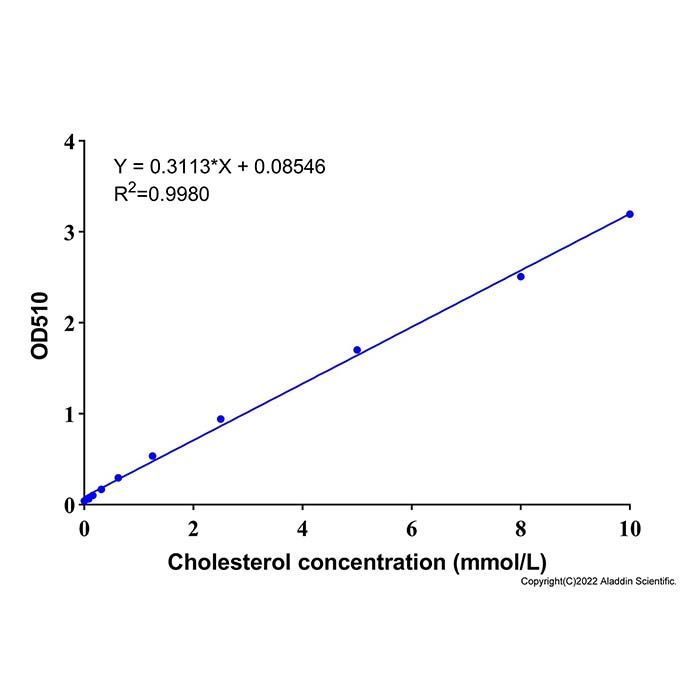
4. 结果展示
注意事项
1. 酶工作液冰上解冻,使用前后避免室温放置。
2. 正式检测前,建议选择2-3个预期差异较大的样本进行预实验。
3. 生化检测试剂普遍具有刺激性、生物毒性等,为了您的安全和健康,请在实验全程做好生物安全防护。
Product Introduction
Free Cholesterol (FC) is a major component of cell membranes and an important raw material for the synthesis of physiologically active substances such as adrenocortical hormones, sex hormones, bile acids, and vitamin D. The concentration of free cholesterol can serve as an indicator of lipid metabolism.
Detection principle: Free cholesterol is oxidized by cholesterol oxidase to produce 4-cholesten-3-one and hydrogen peroxide. In the presence of 4-aminoantipyrine and phenol, the hydrogen peroxide reacts under catalysis by peroxidase to form a red quinone compound, which has an absorption peak at 510 nm. The color intensity is directly proportional to the free cholesterol content.
Components
F1525333 | Components | Appearance | 50 T | 100 T | Storage | Quantity Per Test |
F1525333A | Enzyme Working Solution | Liquid | 0.3 mL | 0.6 mL | -20°C. Store in the dark | 6 μL |
F1525333B | Chromogenic Working Solution | Liquid | 10 mL | 20 mL | -20°C. Store in the dark | 194 μL |
F1525333C | Cholesterol Standard (5 mmol/L) | Liquid | 0.5 mL | 1 mL | -20°C. Store in the dark | 5 μL |
User-Prepared Instruments and Consumables
Microplate reader (able to measure absorbance at 510 nm), 96-well plate, refrigerated centrifuge, homogenizer, isopropanol.
Usage Protocol
1. Sample Preparation
1) Tissue samples: Homogenize on ice with isopropanol at a ratio of tissue mass (g) to isopropanol volume (mL) of 1:5–10 (recommend approximately 0.1 g tissue with 1 mL isopropanol). Centrifuge at 8,000 × g for 10 min at 4 °C. Collect the supernatant and keep on ice for testing.
2) Bacterial or cell samples: Add isopropanol at a ratio of cell number (10⁴ cells) to isopropanol volume (mL) of 500–1000:1 (recommend 5 × 10⁶ cells with 1 mL isopropanol). Disrupt cells by ultrasonic treatment on ice (power 300 W, sonicate for 2 s, pause for 3 s, total time 3 min). Then centrifuge at 8,000 × g for 10 min at 4 °C. Collect the supernatant and keep on ice for testing.
3) Serum (plasma) samples: Measure directly.
2. Sample Assay
According to the number of standard wells and sample wells, prepare the Reaction Working Solution. Each well requires 200 μL of Reaction Working Solution, consisting of 6 μL of Enzyme Working Solution and 194 μL of Chromogenic Working Solution. To avoid direct contact between the Enzyme Working Solution and isopropanol, which may affect the reaction, the 200 μL Reaction Working Solution should be prepared in advance. During sample addition, first add 5 μL of the test sample, and finally add 200 μL of the Reaction Working Solution. Perform sample measurement according to the table below, mix well, incubate at 37 °C for 15 min, and measure the absorbance at 510 nm.
Reagent | Blank well (μL) | Standard well (μL) | Sample well (μL) |
Isopropanol | 5 | 0 | 0 |
5 mmol/L Cholesterol | 0 | 5 | 0 |
Sample | 0 | 0 | 5 |
Reaction Working Solution | 200 | 200 | 200 |
3. Result Calculation
The OD values of the blank well, sample well, and standard well are recorded as Abₗₐₙₖ, Aₛₐₘₚₗₑ, and Aₛₜₐₙdₐᵣd, respectively.
ΔAsample = Aₛₐₘₚₗₑ – Abₗₐₙₖ ; Δ Aₛₜₐₙdₐᵣd = Aₛₜₐₙdₐᵣd – Abₗₐₙₖ .
Calculate the free cholesterol content in the sample using the following formulas:
1) Calculated by protein concentration:
FC content (μmol/mg prot) = Cₛₜₐₙdₐᵣd × ΔAₛₐₘₚₗₑ / Δ Aₛₜₐₙdₐᵣd / Cpr × n
2) Calculated by sample fresh weight:
FC content (μmol/g) = Cₛₜₐₙdₐᵣd × ΔAₛₐₘₚₗₑ / Δ Aₛₜₐₙdₐᵣd/ W × Vtotal × n
3) Calculated by cell or bacterial number:
FC content (μmol/10⁴)= Cₛₜₐₙdₐᵣd × ΔAₛₐₘₚₗₑ / Δ Aₛₜₐₙdₐᵣd/ N × Vtotal × n
4) Calculated by liquid volume:
FC content (μmol/mL) = Cₛₜₐₙdₐᵣd × ΔAₛₐₘₚₗₑ / Δ Aₛₜₐₙdₐᵣd/ × n
Note: Cₛₜₐₙdₐᵣd :5 μmol/mL : 5 μmol/mL; Cpr: sample protein concentration, mg/mL; Vₛₐₘₚₗₑ : volume of sample added to the reaction system, 0.005 mL; W: sample fresh weight, g;
Vtotal : volume of isopropanol added during sample preparation, 1 mL; N: number of cells or bacteria, in units of 10⁴ (e.g., for 5 × 10⁶ cells, N = 500); n: sample dilution factor.
4. Results Presentation

Precautions
1. Thaw the Enzyme Working Solution on ice. Avoid leaving it at room temperature before and after use.
2. Before formal testing, it is recommended to perform a preliminary experiment using 2–3 samples with expected large differences.
3. Biochemical assay reagents generally have irritancy and biological toxicity. For your safety and health, please take proper biological safety precautions throughout the experiment.

 ZJ26F0838363


 危险品化学品经营许可证(带存储)