
计算溶液所需的质量、体积或浓度。
FITC-DEAE-葡聚糖
只有 %1 左
产品规格与参数
|
Product specifications and parameters
|

FITC-DEAE-dextran is designed for special studies on membrane and transport properties in cells and tissues. Cationic (positively charged) diethylaminoethyl groups have been introduced into standard FITC-dextran. All batches are checked for molecular weight, degree of substitution, loss on drying and free FITC. Aladdin produce FITC-DEAE-dextrans from 4 kDa to 150 kDa. FITC-DEAE-dextrans are supplied as a yellow powder.Polysucrose are renamed from Ficoll™.
Structure
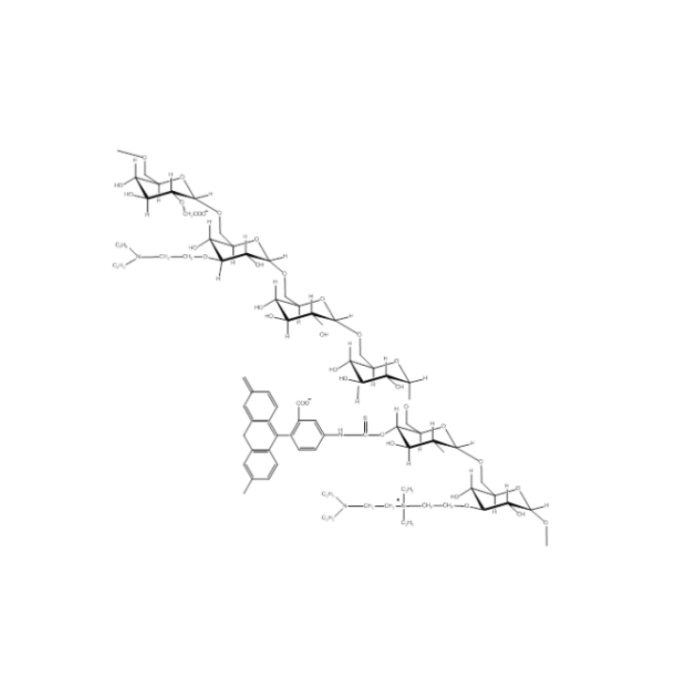
FITC-DEAE-dextrans are synthesized from well-characterised dextran fractions derived from Leuconostoc mesenteroides B512F. The degree of substitution for FITC lies between 0.001 – 0.008 and the limits for nitrogen content are 3-5% – corresponding to about one DEAE-substituent per three glucose units. The synthesis of DEAE-dextran introduces two types of DEAE-substituents into the dextran chain (see structure in datafile). The predominant substituent is the single tertiary group, but this reacts further particularly at higher degree of substitution to yield a “tandem” group containing a quaternary amine as well as the tertiary amine.
Spectral data
The excitation maximum for FITC-DEAE-dextran is 495 nm and the emission maximum is 520 nm. Maximum intensity is observed at pH 9.
Application
FITC-CM-dextran is mainly used for studying permeability and microcirculation. The diethylaminoethyl groups will impart an overall positive charge to the molecule, which may be valuable in gaining information on the permeability characteristics of cell membranes and tissues.
FITC-DEAE-dextrans will possess many of the properties shown by the parent DEAE-dextrans but will also display fluorescence to permit traceability. Some of the applications of DEAE-dextrans are given below: • As adjuvant for vaccines • Enhances uptake of protein and nucleic acids by cells – transfection techniques and viral infectivity • For stabilisation of proteins (enzymes) FITC-DEAE-dextrans have been used to study delivery of positively charged molecules into nucleated cells via the perforin pore (1). The permeability of FITC-DEAE-dextrans, FITC-dextran and FITC-dextran sulphate through nasal mucosa were compared in a study of absorption promoters (2).
Product description:
FITC-DEAE-dextran is designed for special studies on membrane and transport properties in cells and tissues. Cationic (positively charged) diethylaminoethyl groups have been introduced into standard FITC-dextran. All batches are checked for molecular weight, degree of substitution, loss on drying and free FITC. TdB Labs produce FITC-DEAE-dextrans from 4 kDa to 150 kDa. FITC-DEAE-dextrans are supplied as a yellow powder.
Structure
FITC-DEAE-dextrans are synthesized from well-characterised dextran fractions derived from Leuconostoc mesenteroides B512F. The degree of substitution for FITC lies between 0.001 – 0.008 and the limits for nitrogen content are 3-5% – corresponding to about one DEAE-substituent per three glucose units. The synthesis of DEAE-dextran introduces two types of DEAE-substituents into the dextran chain (see structure in datafile). The predominant substituent is the single tertiary group, but this reacts further particularly at higher degree of substitution to yield a “tandem” group containing a quaternary amine as well as the tertiary amine.
FITC-DEAE-dextrans are supplied as a yellow powder which is freely soluble in water or electrolyte solutions. The rate of dissolution will depend on the particle size and structure and it is advisable to add the powder slowly with vigorous stirring – for high molecular weight products the water may be heated. The DS (FITC) lies between 0.001 - 0.008 and the limits for nitrogen content are 3-5% - corresponding to about one DEAE-substituent per three glucose units. The synthesis introduces two types of DEAE-substituents into the dextran chain (see structure above). The predominant substituent is the single tertiary group, but this reacts further particularly at higher DS to yield a “tandem” group containing a quaternary amine as well as the tertiary amine.
The powder is stable at room temperature for more than three years providing it is stored in wellsealed containers in the dark. In solution, FITC-DEAE-dextran should not be stored at pH>8 for extended periods.

Storage and stability:
FITC-DEAE-dextran is stable for more than 6 years when stored dry in well-sealed containers at ambient temperature.
通过匹配包装上的批号来查找并下载产品的 COA,每批产品都进行了严格的验证,您可放心使用!
| 批号(Lot Number) | 证书类型 | 货号 |
|---|---|---|
 F2313412 |
分析证书 | F491442 |
| F2313426 |
分析证书 | F491442 |
| F2313403 |
分析证书 | F491442 |
| F2313407 |
分析证书 | F491442 |
| F2313413 |
分析证书 | F491442 |
| E2318102 |
分析证书 | F491442 |
| E2318104 |
分析证书 | F491442 |
| E2318114 |
分析证书 | F491442 |
| E2318103 |
分析证书 | F491442 |
| E2318116 |
分析证书 | F491442 |
| E2318099 |
分析证书 | F491442 |
| E2318091 |
分析证书 | F491442 |
| E2318105 |
分析证书 | F491442 |
| E2318112 |
分析证书 | F491442 |
| E2318095 |
分析证书 | F491442 |
| E2318113 |
分析证书 | F491442 |
| E2318110 |
分析证书 | F491442 |
| E2318108 |
分析证书 | F491442 |
| F2511106 |
分析证书 | F491442 |
| E2318098 |
分析证书 | F491442 |
| G2501061 |
分析证书 | F491442 |
| E2318101 |
分析证书 | F491442 |
| F2511098 |
分析证书 | F491442 |
| E2318106 |
分析证书 | F491442 |
| G2501055 |
分析证书 | F491442 |
| E2318109 |
分析证书 | F491442 |
| F2511138 |
分析证书 | F491442 |


 危险品化学品经营许可证(带存储)