
Application of Fatty Acid Methyl Ester Sulfonate (MES) in Household Detergent and Cleaning Formulations: Detergency, Hard-Water Tolerance, and Selection Criteria
Application of Fatty Acid Methyl Ester Sulfonate (MES) in Household Detergent and Cleaning Formulations: Detergency, Hard-Water Tolerance, and Selection Criteria
1 What Is MES?
MES, short for Methyl Ester Sulfonate, usually refers to α-sulfo fatty acid methyl ester salts. It is a class of anionic surfactants. In household and personal care formulations, the sodium salt is commonly used, namely sodium fatty acid methyl ester sulfonate. MES is generally produced from fatty acid methyl esters through sulfonation, neutralization, and related steps. The fatty acid methyl esters can be derived from oil and fat resources such as palm oil and coconut oil.
In household formulations, MES is mainly used in detergent and cleaning products, where it contributes to detergency, wetting, emulsification, dispersion, and the maintenance of washing performance under hard-water conditions. MES products may vary in carbon-chain length, active matter content, and physical form. When determining whether a particular MES raw material is suitable for use, key factors include active matter content, carbon-chain distribution, disodium salt content, free oil, pH, color, odor, low-temperature solubility, and batch-to-batch consistency.
As an anionic surfactant for detergent and cleaning applications, fatty acid methyl ester sulfonate (MES) is mainly used in laundry detergents, dishwashing products, kitchen cleaners, and hard-surface cleaners. Among these, laundry detergent is the most typical application area.
Evaluation Dimension | Positioning of MES |
Surfactant type | Anionic surfactant |
Common form in household formulations | Sodium fatty acid methyl ester sulfonate |
Main source | Fatty acid methyl esters, which may be derived from oil and fat resources |
Main applications | Primarily laundry detergents; also dishwashing, kitchen cleaning, and hard-surface cleaning |
Core functions | Detergency, wetting, emulsification, dispersion, and maintaining washing performance under hard-water conditions |
Usage approach | Used as part of a blended surfactant system in most cases |
Key selection points | Active matter, carbon-chain distribution, low-temperature stability, hydrolytic stability, and compatibility in blended systems |
2 Structural Features of MES and Their Performance Basis
2.1 Long Carbon Chains Contribute to Oil-Soil Removal
MES molecules contain long-chain hydrophobic groups. These hydrophobic chains can interact with hydrophobic soils such as oily stains and sebum, helping loosen and detach soils from fabrics, dishes, or hard surfaces and transfer them into the washing liquor.
Carbon-chain distribution directly affects the application performance of MES. In general, longer-chain components such as C16 and C18 are beneficial for removing oily soils and sebum and for performance in powdered detergent systems, but they also increase the risk of poor low-temperature solubility, crystallization, and reduced transparency in liquid formulations. Shorter-chain components such as C12 and C14 are more favorable for solubility and low-temperature adaptability, but detergency, foaming behavior, and overall formulation performance still need to be verified in the specific system.
2.2 Sulfonate Groups Provide Anionic Surfactant Properties
The sulfonate group in MES is its hydrophilic portion. It gives MES the typical properties of an anionic surfactant, including surface tension reduction, wetting, emulsification, dispersion, and detergency. Compared with ordinary fatty acid salts, MES is less likely to form obvious insoluble calcium or magnesium soaps in hard water, making it more favorable for maintaining washing performance under hard-water conditions.
2.3 Ester Groups Affect Biodegradability and Hydrolytic Stability
MES molecules contain ester groups. The ester structure provides MES with a good basis for biodegradability and also distinguishes it from surfactants such as LAS, or Linear Alkylbenzene Sulfonate, and AOS, or Alpha Olefin Sulfonate.
However, the ester group also brings requirements for hydrolytic stability. The hydrolysis of MES is affected by factors such as pH, temperature, storage time, carbon-chain structure, and the aggregation state of the system. Under conditions such as high temperature, relatively strong acidity or alkalinity, and long-term storage, MES may show a decrease in active matter, an increase in disodium salt content, color changes, odor changes, or reduced washing performance. Therefore, when MES is used in liquid detergents, highly alkaline cleaners, and concentrated systems, stability tests should be conducted for pH, temperature, low-temperature appearance, and long-term storage.
2.4 Relationship Between Structure, Performance, and Formulation Considerations
Structural Feature | Performance Contribution | Points to Note in Formulation |
Long-chain hydrophobic group | Enhances interaction with oily soils and sebum | When the proportion of long-chain components is high, the risks of low-temperature solubility issues, crystallization, and loss of transparency in liquid systems may increase |
Sulfonate hydrophilic group | Provides wetting, emulsification, dispersion, and detergency | Should be evaluated together with electrolytes, salt content, and system pH |
Ester group | Supports a good basis for biodegradability | Hydrolysis should be monitored under high temperature, relatively strong acidic or alkaline conditions, long-term storage, and changes in system aggregation state |
Carbon-chain distribution | Affects detergency, foam, solubility, and low-temperature stability | Active matter content alone is not sufficient; carbon-chain composition should also be considered |
3 How MES Works During the Cleaning Process
3.1 Wetting the Surface to Be Cleaned
At the beginning of washing, MES lowers the surface tension of the aqueous solution, allowing the washing liquor to more easily penetrate fabric fibers, dish surfaces, or small crevices on hard surfaces. Only after sufficient wetting can surfactants contact soils more effectively. In laundry powders, liquid laundry detergents, and hard-surface cleaners, wetting performance affects both cleaning speed and cleaning uniformity.
3.2 Detaching Oily Soils and Sebum
The hydrophobic chain of MES can enter oily soils or sebum, while the hydrophilic end remains in the aqueous phase. Under the combined action of mechanical force, temperature, and other formulation ingredients, the adhesion between the soil and the fabric or hard surface is weakened, allowing the soil to gradually detach. This mechanism makes MES suitable for cleaning sebum stains on fabrics, kitchen grease, dish grease, and mixed soils.
3.3 Emulsifying and Dispersing Soils
After soils are detached, they need to be stably dispersed in the washing liquor to prevent redeposition onto fabrics or hard surfaces. MES can participate in the emulsification of oily soils and the dispersion of particulate soils, keeping them suspended in the aqueous phase so that they can be removed during rinsing. In laundry detergents, anti-redeposition agents, builders, chelating agents, and nonionic surfactants are often needed to work together with MES.
3.4 Working Together with Other Ingredients to Complete Cleaning
MES is usually not used alone. Instead, it is used as part of a composite surfactant system. Different ingredients perform different functions, and together they determine the detergency, foam, stability, and user experience of the final product.
Formulation Component | Role in the Cleaning Process |
MES | Wetting, detergency, emulsification, dispersion |
Other anionic surfactants | Adjust detergency, foam, and cost |
Nonionic surfactants | Enhance low-temperature oil removal and emulsification |
Builders / chelating agents | Reduce the impact of hard-water ions |
Enzymes | Treat specific stains such as protein, starch, and oily soils |
Anti-redeposition agents | Reduce redeposition of soils onto fabrics |
4 What Formulation Problems Can MES Help Solve?
The value of MES in household formulations is mainly reflected in several clearly defined issues in detergent and cleaning systems.
Formulation Problem | Role MES Can Play | Points That Should Not Be Overlooked |
Reduced detergency in hard water | Helps the system maintain relatively stable washing performance in the presence of calcium and magnesium ions | Chelating agents and builders are still needed to manage hard-water issues |
Insufficient removal of oily soils and sebum | Improves the cleaning efficiency of oily soils through wetting, detachment, emulsification, and dispersion | Heavy grease and low-temperature washing still require support from nonionic surfactants, alkalis, or solvents |
Demand for renewable-source ingredients | Increases the proportion of oil- and fat-derived anionic surfactants and provides a good research basis for biodegradability | Confirmation should be based on actual raw material sources, biodegradation test results, regulatory requirements, and sustainable sourcing information |
Detergency enhancement in low-phosphate or phosphate-free systems | Enhances surfactant-based detergency after changes in the builder system | It cannot replace the functions of chelation, alkalinity, anti-redeposition, and enzymes |
Soap residue in soap-containing systems under hard-water conditions | Reduces soap scum, residue, and loss of detergency in hard water | Should be balanced together with the fatty acid salt ratio, foam, and hand feel |
5 Main Household Product Applications of MES
Application Area | Recommendation Level | Reasons for Suitability | Key Limitations |
Laundry powder / concentrated laundry powder | High | Good detergency, hard-water tolerance, and compatibility with powder systems | Powder flowability, moisture absorption, and processing suitability should be considered |
Soap powder / soap-containing detergent products | High | Can improve soap scum formation and detergency loss under hard-water conditions | Foam, hand feel, and the characteristics of soap-based products should be balanced |
Regular liquid laundry detergent | Medium | Can be used as a blended anionic surfactant to enhance detergency and hard-water performance | Low-temperature solubility, crystallization, and viscosity changes need to be verified |
Concentrated liquid laundry detergent / transparent liquid systems | Medium to low | Has application potential, but formulation difficulty is relatively high | Low-temperature performance, phase stability, and transparency risks are more prominent |
Dishwashing detergent | Medium | Can enhance oil removal, calcium soap dispersion, and hard-water stability | Should be blended with LAS, AES, AOS, betaines, or amine oxides to balance foam volume, foam stability, hand feel, rinsability, and low-temperature transparency |
Kitchen / hard-surface cleaning | Medium | Beneficial for wetting, oil removal, and soil dispersion | Hydrolysis and residue should be verified in high-pH and solvent-containing systems |
Mild personal care | Low | Not the key recommended direction of this article, although research and some application potential exist | Irritation, foam feel, low-temperature stability, skin compatibility, and regulatory compliance should be carefully verified |
6 Comparison Between MES and Common Surfactants
Comparative Surfactant | Main Differences | Suitable Use of MES | Points to Note |
LAS, Linear Alkylbenzene Sulfonate | LAS has high cost-effectiveness and mature application experience; MES can introduce fatty acid methyl ester-derived anionic surfactants and improve washing stability in hard water | Partial replacement of LAS in laundry powders and low-phosphate or phosphate-free detergent systems | Detergency, foam, cost, and storage stability need to be verified |
AOS, Alpha Olefin Sulfonate | AOS provides good foam and cleaning feel; MES is more oriented toward hard-water washing and laundry detergent systems | Blended with AOS to adjust detergency, foam, and surfactant-source structure | Foam, low-temperature appearance, viscosity, and system stability need to be verified |
AES, Alcohol Ether Sulfate | AES has better adaptability in liquid formulations, foam, and solubility; MES has application value in powder systems and hard-water washing | Provides part of the detergency function in laundry powders, concentrated powders, and some liquid laundry detergents | MES should not be used to fully replace the role of AES in liquid transparency, foam, viscosity, and low-temperature stability |
Fatty acid salts / soap-based surfactants | Fatty acid salts easily form calcium and magnesium soap deposits in hard water; MES has better hard-water tolerance | Used in soap-containing detergent systems to improve hard-water residue and detergency loss | Foam, hand feel, soap content, and product form should be balanced |
Nonionic surfactants | Nonionic surfactants play an important role in low-temperature oil removal, emulsification, and liquid stability; MES mainly provides anionic detergency, wetting, and dispersion | Blended with nonionic surfactants in liquid laundry detergents, kitchen cleaners, hard-surface cleaners, and concentrated systems | MES should not completely replace nonionic surfactants, especially for low-temperature oil removal, emulsification, and liquid stability |
7 Key Indicators for Selecting MES Raw Materials
Indicator | Key Focus | Impact on Household Formulations |
Active matter content | Determines the content of effective surfactant | Affects actual dosage, detergency, and effective cost |
Carbon-chain distribution | Pay attention to the proportions of C12, C14, C16, C18, and other components | Affects detergency, foam, low-temperature solubility, and crystallization risk |
Disodium salt content | Indicates the level of by-products | Affects surface activity, solubility, storage stability, and formulation appearance |
Free oil / unreacted matter | Focus on unsulfonated matter or oily residues | Affects odor, color, appearance, detergency stability, and long-term storage |
pH | Determines acid-base compatibility after the raw material is added to the formulation | Affects system stability, hydrolysis risk, and compatibility with the preservative system |
Water content | Indicates effective content and storage condition | Affects dosage calculation, transportation and storage, and powder flowability |
Inorganic salt content | Evaluates the effect of electrolytes on the system | Affects viscosity, phase stability, and low-temperature appearance in liquid systems |
Color and odor | Indicates the degree of refinement and batch consistency of the raw material | Affects the appearance, odor, and consumer acceptance of the final product |
Product form | Determines whether the material is a powder, flake, paste, or liquid | Affects charging, dissolution, mixing, storage, transportation, and production suitability |
Batch-to-batch consistency | Compares indicator fluctuations between batches | Affects consistency in large-scale production and long-term purchasing stability |
8 Representative Research Reagents Related to MES Detergent Formulation Studies and Performance Evaluation
Table 1 Fatty Acid Methyl Ester Raw Materials, Soap-Based Controls, and Neutralization-Related Products
Category | CAS No. | Aladdin Catalog No. | Name | Specification or Purity | Product Features and Applications |
Fatty acid methyl ester raw material | 112-62-9 | Methyl oleate | Chemically pure (CP), ≥60% (GC) | Used to study the effects of unsaturated fatty acid methyl esters on color, odor, and oxidative stability | |
Fatty acid methyl ester raw material | 112-39-0 | Methyl palmitate | ≥99% (GC) | Used for C16 carbon-chain source studies, and for evaluating the detergency, foam, and low-temperature solubility of fatty acid methyl ester sulfonates | |
Fatty acid methyl ester raw material | 111-82-0 | Methyl laurate | ≥99% | Used for C12 carbon-chain source studies, and for evaluating the solubility and cleaning performance of short-chain fatty acid methyl ester sulfonates | |
Fatty acid methyl ester raw material | 112-61-8 | Methyl stearate | ≥99% | Used for C18 carbon-chain source studies, and for evaluating low-temperature crystallization and oil-soil removal performance of long-chain fatty acid methyl ester sulfonates | |
Fatty acid methyl ester raw material | 124-10-7 | Methyl myristate | ≥98% (GC) | Used for C14 carbon-chain source studies, and suitable for experiments on the relationship between carbon-chain distribution and surface activity | |
Neutralization and alkalinity adjustment | 1310-73-2 | S580606 | Sodium hydroxide | ≥98%, pellets | Used for neutralization of fatty acid methyl ester sulfonates, formulation pH adjustment, and alkaline stability evaluation |
Soap-based control surfactant | 629-25-4 | Sodium laurate | ≥98% (T) | Used as a control in experiments on hard-water residue, calcium soap formation, and detergency performance of soap-based surfactants | |
Soap-based control surfactant | 822-16-2 | Sodium stearate | ≥96% | Used for comparative studies of hard-water stability and soap scum between long-chain fatty acid salts and fatty acid methyl ester sulfonates |
Table 2 Products Related to Surfactant Controls, Blending, and Performance Evaluation
Category | CAS No. | Aladdin Catalog No. | Name | Specification or Purity | Product Features and Applications |
Anionic surfactant control | 151-21-3 | Sodium dodecyl sulfate (SDS) | Molecular biology grade, ≥98.5% (GC) | Used as a control in experiments on anionic surface activity, foam, wetting, and micellar behavior | |
Anionic surfactant control | 25155-30-0 | Sodium dodecylbenzenesulfonate (SDBS) | Anion Active Matter, 85% | Used as a control for linear alkylbenzene sulfonate systems to evaluate detergency, hard-water effects, and blending performance | |
Anionic surfactant control | 68439-57-6 | Sodium α-olefin sulfonate | ≥92% | Used as a control for foam, detergency, and cleaning feel, and suitable for screening blended anionic surfactant systems | |
Anionic surfactant for blending | 9004-82-4 | Sodium polyoxyethylene lauryl ether sulfate | ≥25% | Used to evaluate foam, solubility, viscosity, and blending stability in liquid detergent systems | |
Nonionic surfactant for blending | 68515-73-1 | Decyl glucoside (APG) | Moligand™, 60% in H₂O | Used for studies on mild cleaning, foam adjustment, and nonionic blended systems | |
Nonionic surfactant for blending | 110615-47-9 | Lauryl glucoside | ≥40% | Used in alkyl glucoside blended systems to evaluate mild cleaning and foam performance | |
Amphoteric surfactant for blending | 61789-40-0 | Cocamidopropyl betaine | Active content 28%–32% in water | Used for foam stabilization, hand-feel adjustment, blending with anionic surfactants, and irritation evaluation | |
Amine oxide surfactant for blending | 1643-20-5 | N,N-Dimethyldodecylamine N-oxide (DDAO) | BioReagent, ≥99% | Used in blending studies for oil removal, foam, viscosity, and hard-surface cleaning |
Table 3 Products Related to Builders, Chelating Agents, Dispersants, Anti-Redeposition Agents, and Bleaching Systems
Category | CAS No. | Aladdin Catalog No. | Name | Specification or Purity | Product Features and Applications |
Anti-redeposition agent | 9004-32-4 | Sodium carboxymethyl cellulose (CMC) | Viscosity: 1000–1400 mPa·s, USP grade | Used to evaluate anti-redeposition, soil suspension, and the effect on system viscosity in fabric washing | |
Chelating agent | 51981-21-6 | Tetrasodium N,N-bis(carboxymethyl)-L-glutamate | Effective content ≥47% | Used in biodegradable chelating systems to evaluate hard-water ion control and detergency synergy | |
Chelating agent | 527-07-1 | Sodium D-gluconate | Pharmaceutical grade, PharmPure™ | Used for metal ion complexation, hard-water stabilization, and mild chelation studies in cleaning systems | |
Chelating agent / buffer salt | 68-04-2 | Trisodium citrate | Anhydrous, USP grade | Used for water conditioning, buffering, chelation, and formulation evaluation in low-phosphate detergent systems | |
Dispersant / anti-redeposition agent | 9003-04-7 | Sodium polyacrylate (PAAS) | Average Mw ~8000, 45% in H₂O | Used for dispersion, anti-redeposition, and hard-water soil stability studies in phosphate-free detergents | |
Phosphate-free builder | 1318-02-1 | Synthetic zeolite | Particle size ≤10.0 μm | Used for calcium and magnesium ion exchange, phosphate-free laundry powder building, and hard-water detergency evaluation | |
Inorganic builder | 1344-09-8 | Powdered instant sodium silicate | For synthetic detergent builder use | Used for building in powdered detergents, alkalinity buffering, corrosion inhibition, and particulate system studies | |
Alkaline builder | 6834-92-0 | S102095 | Anhydrous sodium metasilicate | SiO₂, 44%–47% | Used in highly alkaline cleaning and powdered detergent systems to evaluate the effects of alkalinity and hydrolytic stability |
Alkaline builder | 497-19-8 | Anhydrous sodium carbonate | BioReagent, ≥99% | Used for detergency alkalinity adjustment, hard-water treatment, and powdered builder system studies | |
Chelating agent | 164462-16-2 | Trisodium N-(1-carboxyethyl)iminodiacetate | ≥95% (T) | Used in biodegradable chelating systems to evaluate calcium and magnesium ion control and hard-surface cleaning performance | |
Oxygen bleaching system | 15630-89-4 | Sodium percarbonate | ≥13% active oxygen | Used in oxygen bleaching systems for laundry powders, compound stain cleaning, and surfactant compatibility stability evaluation |
Table 4 Products Related to Solubility Stability, Electrolytes, Solvents, and Enzymes
Category | CAS No. | Aladdin Catalog No. | Name | Specification or Purity | Product Features and Applications |
Hydrotrope | 1300-72-7 | Sodium xylene sulfonate solution | Mixture of isomers, 40 wt.% in H₂O | Used to study solubilization, transparency, low-temperature stability, and phase behavior in high-active liquid detergent systems | |
Inorganic salt / powder filler | 7757-82-6 | Sodium sulfate | Anhydrous, UltraBio™, ultra-pure grade, ≥99% (T) | Used for powdered detergent filling, particle flowability, and evaluating the effect of inorganic salts on surfactant systems | |
Electrolyte / viscosity modifier | 7647-14-5 | Sodium chloride | Anhydrous, ACS, ≥99% | Used to study viscosity, salt sensitivity, and phase stability in liquid surfactant systems | |
Solvent / co-solvent | 64-17-5 | E111991 | Ethanol | Moligand™, molecular biology grade, ≥99.8% | Used to evaluate co-solvency, low-temperature appearance, and fragrance compatibility in liquid cleaning systems |
Solvent / co-solvent | 57-55-6 | 1,2-Propanediol | AR, ≥99% | Used to study co-solvency, low-temperature stability, humectancy, and compatibility in liquid systems | |
Enzyme | 9001-62-1 | Lipase PS from Burkholderia cepacia | Recombinant, EnzymoPure™, ≥23,000 U/g, pH 7.0, 50 °C, expressed in Burkholderia cepacia | Used for enzymatic hydrolysis models of oily stains, fat-soil removal, and evaluation of surfactant-enzyme compatibility | |
Enzyme | 9001-92-7 | Asp-N protease, MS grade | Animal-free, carrier-free, biologically active, ActiBioPure™, EnzymoPure™, for protein sequencing, mass spectrometry grade (MS), recombinant, ≥97% (HPLC), ≥1800 U/mg protein | Used for protein degradation models, protein-stain decomposition mechanisms, and surfactant-enzyme compatibility studies | |
Enzyme | 9012-54-8 | Cellulase | Natural, EnzymoPure™, ≥4500 CNU-R/g | Used for fabric care, fiber surface treatment, anti-graying, and detergent-enzyme compatibility evaluation | |
Enzyme | 9000-90-2 | α-Amylase from human saliva | Biologically active, ActiBioPure™, natural, high-performance, EnzymoPure™, ≥90% (SDS-PAGE), >100 U/mg enzyme powder; ≥400 U/mg protein | Used for starch-stain decomposition, enzyme-wash system evaluation, and surfactant-enzyme stability studies |
Note: The above products are representative Aladdin research and formulation-study products, mainly used for MES formulation research and performance comparison. Fatty acid methyl esters can be used to study the effects of different carbon chains on MES performance. MES preparation involves professional sulfonation and neutralization processes, and related experiments require appropriate equipment and safety conditions. Before enzymes are used in actual formulations, suitable types should be selected according to the application scenario, and compatibility stability should be verified.
For specific product specifications, COA, and SDS information, please refer to the latest information on the Aladdin website. More product specifications, grades, and COA information can be searched on the Aladdin website by product name, CAS number, or catalog number.
References
[1] Lim Y S, Baharudin N B, Ung Y W. Methyl Ester Sulfonate: A High-Performance Surfactant Capable of Reducing Builders Dosage in Detergents[J]. Journal of Surfactants and Detergents, 2019, 22(3): 549–558.
[2] Tai X M, Song J Y, Du Z P, Liu X Y, Wang T Z, Wang G Y. The performance test of fatty acid methyl ester sulfonates and application in the dishwashing liquid detergent[J]. Journal of Dispersion Science and Technology, 2018, 39(10): 1422–1426.
[3] Yavrukova V I, Danov K D, Slavova T G, Stanimirova R D, Ung Y W, Suan A T K, Xu H, Petkov J T. Enhanced solubility of methyl ester sulfonates below their Krafft points in mixed micellar solutions[J]. Journal of Colloid and Interface Science, 2024, 660: 896–906.
[4] Abe Y, Watanabe H, Fujiwara M. Micellar Effects on the Hydrolysis Reaction of an Anionic Surfactant in Aqueous Solution[J]. Langmuir, 2018, 34(46): 13979–13992.
[5] Satsuki T. Methyl Ester Sulfonate[M]// Biobased Surfactants: Synthesis, Properties, and Applications. Elsevier, 2019.
More related articles are listed below:
Understanding Brij 35: A Deep Dive into Its Role as a Nonionic Surfactant
Structural Basis and Laboratory Applications of Sodium Cholate as an Anionic Biosurfactant
From Foxglove to the Lab Bench: How Digitonin Works as a Non-ionic Surfactant
Understanding n-Octyl-β-D-glucopyranoside: A Non-ionic Surfactant for Research and Biotechnology
n-Dodecyl-β-D-maltoside (DDM): Structure, Properties, and Applications as a Non-ionic Surfactant
Sodium Lauroyl Sarcosinate: Structure–Property–Application of an Amino-Acid–Based Anionic Surfactant
CTAB Demystified: Structure, Properties, and Practical Uses of a Classic Cationic Surfactant
Poloxamers Explained: A Comprehensive Guide to Non-Ionic Block Copolymer Surfactants
Tween 20 and Tween 80 as Non-Ionic Surfactants: Structure, Properties, and Applications
Saponins as Natural Non-ionic Surfactants: Structure, Function, and Applications
Non-ionic Detergents Explained: From Chemical Structure to Laboratory Use


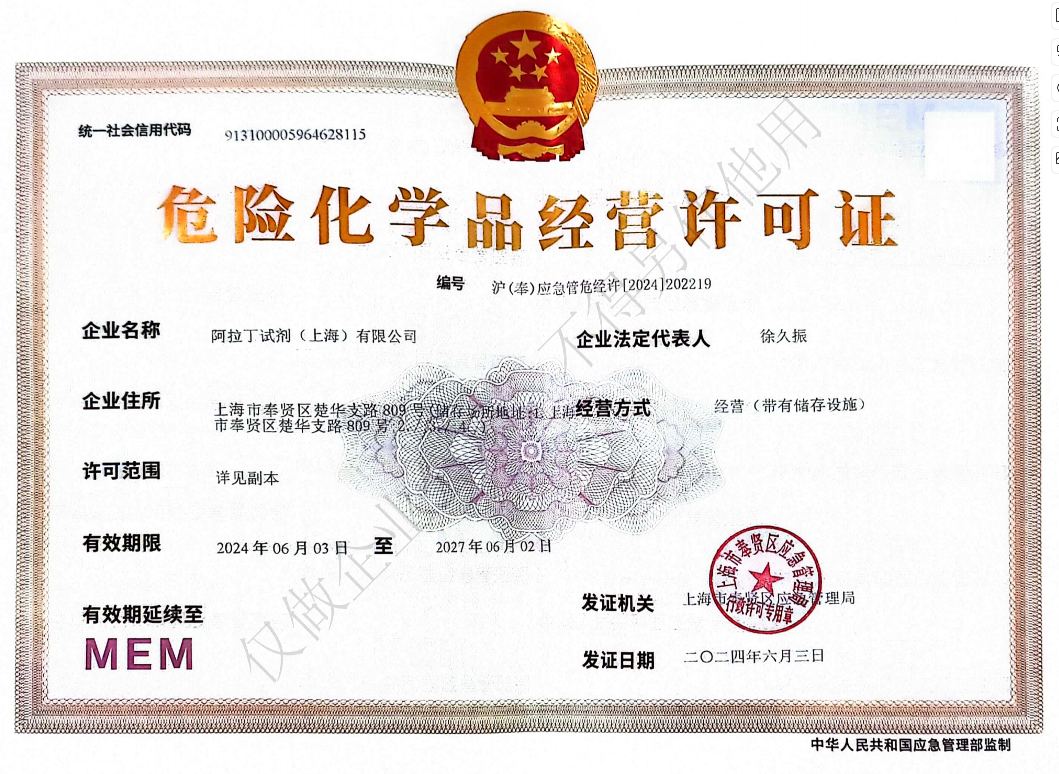 危险品化学品经营许可证(带存储)