
Copper Tripeptide GHK-Cu and Skin Repair: From Copper Coordination Chemistry to Extracellular Matrix Remodeling
Copper Tripeptide GHK-Cu and Skin Repair: From Copper Coordination Chemistry to Extracellular Matrix Remodeling
1. Chemical Basis of GHK-Cu: How the Tripeptide Binds Copper Ions
1.1 GHK Is a Short Peptide Composed of Three Amino Acids
The amino acid sequence of GHK is:
Gly–His–Lys
Glycine–Histidine–Lysine
The three amino acids are linked sequentially by two peptide bonds. Although GHK is a small molecule, it contains multiple nitrogen-containing groups capable of coordinating metal ions, among which the imidazole ring in the histidine side chain is particularly important.
When GHK binds Cu²⁺, the process can be simplified as:
GHK + Cu²⁺ ⇌ Cu(II)–GHK
This reaction is essentially a coordination complexation process rather than the formation of conventional covalent bonds.
1.2 Cu²⁺ Exists in a Coordination Environment That Allows Ligand Exchange
Structural studies have shown that GHK-Cu exists predominantly as a monomeric complex in solution. Cu²⁺ is primarily coordinated by three nitrogen donor sites in GHK: the N-terminal amino group, a deprotonated peptide-bond nitrogen, and the imidazole nitrogen of histidine; the remaining coordination positions may be occupied by water molecules or other ligands.[1]
This means that GHK-Cu is not a completely rigid and invariant structure.
Early equilibrium studies found that Cu²⁺ and GHK can form different coordination species under different pH and ligand conditions. GHK can also participate in competitive copper binding and exchange in systems containing ligands such as albumin and histidine.[2]
Therefore, GHK provides a relatively strong binding site for Cu²⁺ while retaining a certain degree of ligand-exchange capacity.
This property keeps copper ions in a coordination-controlled state rather than allowing them to exist as high concentrations of free Cu²⁺.
2. How GHK-Cu Is Prepared: Synthesis of the Tripeptide Followed by Copper Coordination
The preparation of GHK-Cu can be divided into two stages.
2.1 Synthesis of the GHK Tripeptide
GHK can be prepared using conventional peptide synthesis methods. Previous studies have employed solid-phase peptide synthesis (SPPS), in which amino-group protection, stepwise coupling, and deprotection are used to connect Gly, His, and Lys in a defined sequence.[3]
The basic reaction sequence can be summarized as:
Protected amino acids → Sequential peptide-bond formation → Gly–His–Lys → Deprotection and purification
Although GHK contains only three amino acids, histidine and lysine possess additional reactive side-chain sites. Therefore, the synthesis process still requires careful control of protecting groups, coupling selectivity, and final product purity.
2.2 Cu²⁺ Complexation
After purified GHK is obtained, it can be coordinated with an appropriate Cu(II) salt under aqueous conditions to form GHK-Cu.
From the perspective of raw-material manufacturing, copper complexation itself is not a lengthy multistep reaction. More critical factors to control include GHK purity, the molar ratio of copper to peptide, free copper content, pH, counterions, and the stability of the final complex.
Therefore, the quality of a GHK-Cu raw material depends not only on whether it “contains GHK and copper,” but also on the chemical state in which copper exists in the final system.
3. A Core Process Through Which GHK-Cu Participates in Skin Repair: Extracellular Matrix Remodeling
The extracellular matrix (ECM) of the skin dermis is composed mainly of collagen, together with various glycosaminoglycans, proteoglycans, and other structural proteins. Once formed, the ECM does not remain unchanged over the long term; rather, it undergoes continuous turnover involving synthesis, degradation, and rearrangement.
Following tissue injury, the repair process generally includes:
Degradation of damaged matrix → Cell migration and re-adhesion → Synthesis of new ECM → ECM rearrangement and maturation
Tissue repair does not simply mean continuously increasing collagen levels. Effective tissue remodeling involves both the removal of old structures and the establishment of new ones.
3.1 GHK-Cu Can Affect ECM Synthesis
A 1988 study of human skin fibroblasts found that GHK-Cu increased collagen synthesis.[4]
A subsequent study using a rat subcutaneous wound-chamber model further found that, following injection of GHK-Cu into the wound chamber, the levels of total protein, collagen, and glycosaminoglycans in wound tissue increased, while messenger RNA (mRNA) levels of type I and type III collagen were also elevated.[5]
These findings indicate that the effects of GHK-Cu on the ECM can occur at two levels:
Level | Changes Observed Experimentally |
Gene expression | Changes in type I and type III collagen mRNA |
Matrix formation | Increased accumulation of collagen and glycosaminoglycans |
Changes in the extracellular matrix are not limited to collagen. A rat wound model showed that GHK-Cu treatment promoted the accumulation of chondroitin sulfate and dermatan sulfate in wound tissue, while increasing decorin mRNA levels and decreasing biglycan mRNA levels. Experiments with dermal fibroblasts found that GHK-Cu promoted decorin expression, whereas no significant change in biglycan expression was observed.[6]
These results indicate that the effects of GHK-Cu on the extracellular matrix are not limited to simply increasing collagen content. They also involve glycosaminoglycan accumulation and regulation of the expression of different proteoglycans, thereby influencing ECM composition and remodeling.[6]
4. Matrix Degradation Is Also Part of the GHK-Cu-Related Repair Response
ECM formation represents only one part of tissue remodeling.
Old, damaged, or abnormally organized ECM must also be degraded through proteolytic systems. One important class of enzymes involved in this process is the matrix metalloproteinases (MMPs).
Fibroblast experiments have shown that GHK-Cu can increase matrix metalloproteinase-2 (MMP-2) mRNA levels and MMP-2 levels in the culture medium. At the same time, secretion of tissue inhibitor of metalloproteinases-1 and -2 (TIMP-1/TIMP-2) also increases.[7]
If skin repair is interpreted simply as “the more collagen, the better,” an increase in MMPs may appear to contradict increased collagen synthesis. However, from the perspective of ECM remodeling, these processes serve different functions:
ECM Remodeling Process | Primary Function |
Synthesis of collagen, glycosaminoglycans, and proteoglycans | Establishment of new extracellular matrix |
MMP-mediated proteolysis | Removal, cleavage, and reorganization of existing matrix |
TIMP regulation of MMP activity | Limitation of excessive matrix degradation |
Cellular rearrangement of the ECM | Formation of new tissue architecture |
5. GHK and GHK-Cu Also Alter the State of Repair-Related Cells
ECM remodeling is ultimately carried out by cells, and dermal fibroblasts are an important source of collagen and many other matrix components.
5.1 GHK-Cu Can Affect Fibroblasts and Their Growth-Factor Environment
In experiments with human dermal fibroblasts, researchers observed that GHK-Cu promoted the growth of both normal and irradiated fibroblasts. In irradiated fibroblasts, increased production of fibroblast growth factor 2 (FGF-2) and vascular endothelial growth factor (VEGF) was observed during the early stage of treatment.[8]
These studies indicate that the effects of GHK-Cu can extend beyond the ECM itself to the cells that produce the ECM. However, current experimental findings have not yet established a complete model involving a “GHK-Cu-specific receptor → single signaling pathway → ECM remodeling” sequence.
5.2 GHK Itself Also Has Cell-Regulatory Activity
GHK is not an inert carrier whose biological activity depends entirely on Cu²⁺.
In experiments using copper-free GHK in human keratinocytes and skin-equivalent models, researchers observed changes in integrin expression as well as in p63, PCNA, and other markers associated with the state and proliferation of epidermal basal cells.[9]
These findings suggest that GHK itself possesses biological activity; after binding Cu²⁺, it additionally acquires chemical properties associated with copper coordination and copper exchange.
6. GHK-Cu Can Regulate the Expression of Extracellular Matrix-Related Genes
Some effects of GHK-Cu have been observed at the messenger RNA level.
For example:
① In rat wound models, GHK-Cu treatment increased type I and type III collagen mRNA levels.[5]
② In rat wound models, GHK-Cu treatment increased decorin mRNA levels and decreased biglycan mRNA levels. In cultured dermal fibroblasts, GHK-Cu likewise promoted decorin expression, whereas no significant change in biglycan expression was observed.[6]
③ In dermal fibroblast experiments, GHK-Cu increased matrix metalloproteinase-2 mRNA levels, accompanied by increased MMP-2 levels in the culture medium.[7]
These results indicate that the effects of GHK-Cu on the extracellular matrix are reflected not only in changes in end products such as collagen, proteoglycans, and matrix-degrading enzymes, but also involve regulation of the expression of related genes, thereby contributing to ECM synthesis, degradation, and remodeling.[5-7]
6.1 GHK Also Has Broader Transcriptomic Effects
A study published in Genome Medicine in 2012 provided evidence from another perspective.
The researchers analyzed gene-expression patterns in tissues from severe emphysema and used the Connectivity Map to identify compounds capable of shifting these abnormal expression patterns in the opposite direction. GHK was identified through this screening process. Subsequent experiments in human lung fibroblasts showed that GHK altered the expression of multiple groups of genes and shifted some expression features toward patterns produced by TGF-β treatment. Actin cytoskeletal reorganization, changes in integrin β1 expression and localization, and altered collagen-gel contraction capacity were also observed.[10]
This study linked changes at three levels:
Changes in gene expression → Changes in cell adhesion and the cytoskeleton → Changes in the ability of fibroblasts to remodel the collagen matrix
It should be noted that this study used GHK rather than preformed GHK-Cu, and the study subjects were primarily lung tissue and lung fibroblasts.[10] Therefore, the study demonstrates that GHK has the ability to regulate cellular transcriptional programs, but it cannot be used directly to infer that topically applied GHK-Cu would produce exactly the same gene-expression changes in human facial skin.
7. Mechanistic Links from Molecular Effects to Tissue Repair
Current studies indicate that the effects of GHK-Cu mainly involve copper coordination, fibroblast function, expression of extracellular matrix-related genes, and extracellular matrix synthesis and degradation. Together, these changes point toward ECM turnover and remodeling during tissue repair.
Biological Level | Findings from Existing Studies |
Coordination chemistry | GHK forms a relatively high-affinity coordination complex with Cu²⁺ and is capable of ligand exchange.[1,2] |
Fibroblasts | GHK-Cu can promote collagen synthesis and affect the production of matrix metalloproteinase-2, its tissue inhibitors, and certain growth factors.[4,7,8] |
Keratinocytes | Copper-free GHK can affect integrins and markers associated with the state of epidermal basal cells.[9] |
Gene expression | GHK-Cu can increase mRNA levels of type I collagen, type III collagen, decorin, and matrix metalloproteinase-2; in rat wound models, biglycan mRNA levels are decreased.[5-7] |
Extracellular matrix composition | GHK-Cu can increase collagen and glycosaminoglycan accumulation and regulate the expression of different proteoglycans.[5,6] |
Tissue models | In rat wound models, GHK-Cu can increase ECM-related components in wound tissue, including collagen, glycosaminoglycans, and total protein.[5,6] |
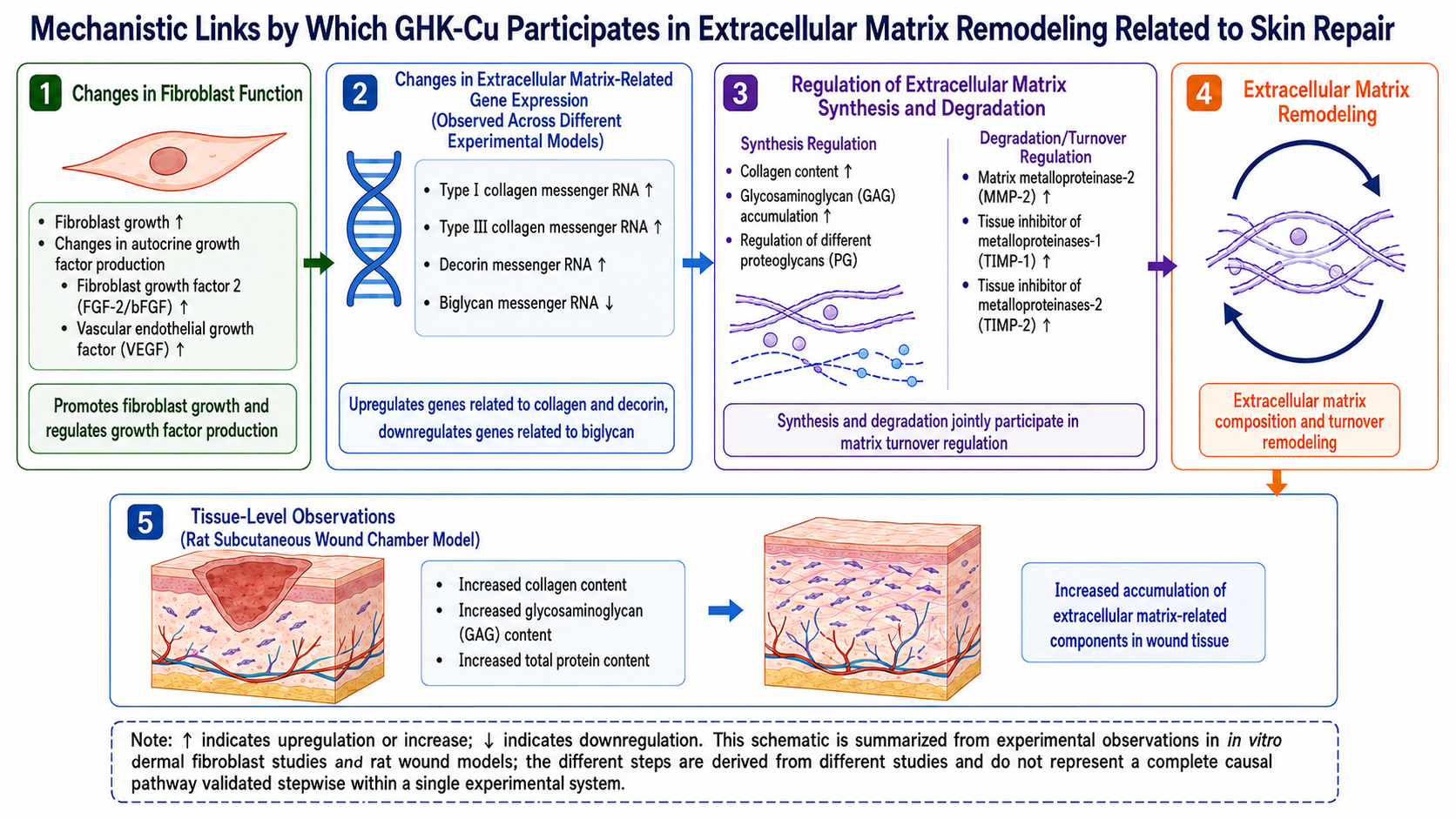
These findings can be summarized as the following mechanistic relationships:
GHK forms a coordination complex with Cu²⁺ and possesses ligand-exchange capacity
→ Following GHK-Cu treatment, changes can be observed in fibroblast growth, matrix synthesis, proteases, and growth factors
→ Expression of genes related to collagen, proteoglycans, matrix metalloproteinases, and other components is regulated
→ The synthesis, degradation, and composition of the extracellular matrix change
→ Contributing to extracellular matrix turnover and remodeling in wound tissue.
Existing studies provide evidence for corresponding changes at each of the above levels. However, the complete molecular pathway linking changes in copper coordination status to specific cellular receptors, intracellular signal transduction, gene transcription, and tissue remodeling has not yet been demonstrated step by step.
A schematic illustration of the role of GHK-Cu in extracellular matrix remodeling associated with skin repair is shown below:
8. From Basic Mechanisms to Topical Skincare Effects: Stability and Skin Delivery Must Also Be Considered
In cell experiments, GHK-Cu can directly contact fibroblasts. In topical skincare products, however, GHK-Cu must additionally pass through two stages: storage within the formulation and the skin barrier.
8.1 The Formulation Environment Affects the Stability of GHK-Cu
Preformulation studies have shown that GHK-Cu is highly hydrophilic and is relatively susceptible to degradation under alkaline and oxidative conditions. A certain degree of degradation also occurs under acidic conditions. In addition, compatibility between GHK-Cu and different formulation components varies.[13]
Therefore, pH, the oxidative environment, and formulation components can all affect the stability of GHK-Cu in a formulation.
For topical products, what matters is not only how much GHK-Cu is initially added, but also how much intact and stable GHK-Cu is retained during storage and use.
8.2 Skin Delivery Determines How Much GHK-Cu Can Reach Its Sites of Action
GHK-Cu is highly hydrophilic, while the stratum corneum constitutes an important permeability barrier of the skin. Therefore, skin delivery is an important factor affecting its topical application.[12,13]
An ex vivo human skin study showed that, when administered in the form of GHK-Cu, copper was retained within skin tissue, with a portion also permeating across the skin. It should be noted that the main parameter measured in this study was copper; therefore, these findings cannot establish that all copper detected after skin permeation remained in the form of intact GHK-Cu.[11]
Another ex vivo human skin study found that, under a 9-hour experimental condition, transdermal permeation of both the peptide and copper through intact skin was very low. Following microneedle pretreatment to create microchannels, delivery of both components increased markedly.[12] The commercial raw material used in this study had a GHK:Cu molar ratio of 2:1.
Although the two studies differed in their analytes and experimental conditions, they point to the same issue: the topical effects of GHK-Cu depend not only on the biological activity of the raw material itself, but also on its actual delivery to and retention within the skin.
9. Overview of Chemicals Related to GHK-Cu Synthesis, Copper Coordination, and Skin Repair Research
Table 1. Chemicals Related to Copper Coordination and the Basic Constituents of GHK
Category | CAS No. | Aladdin Cat. No. | Name | Grade or Purity | Product Features and Applications |
Copper coordination starting material | 10125-13-0 | Copper(II) chloride dihydrate | ACS | Water-soluble divalent copper source used for GHK copper complexation, screening of coordination ratios, and comparative studies of different copper sources. | |
Copper coordination starting material | 7758-99-8 | C657076 | Copper(II) sulfate pentahydrate | Animal-origin free, low endotoxin, for cell culture, ≥98% | Low-endotoxin, cell-culture-grade copper source that can be used for copper ion supplementation, studies of copper-dependent effects, and GHK-Cu-related control studies in cellular systems. |
Copper coordination starting material | 6046-93-1 | Copper(II) acetate monohydrate | ACS, ≥98% | A commonly used copper source for GHK-Cu preparation, suitable for GHK–Cu²⁺ complexation, optimization of complexation conditions, and copper peptide preparation studies. | |
Copper coordination starting material | 20427-59-2 | Copper(II) hydroxide | Chemical pure (CP), ≥94% | A divalent copper compound that can be used in copper complexation systems and for comparative studies of different copper sources and reaction conditions. | |
Copper coordination starting material | 1184-64-1 | Copper(II) carbonate | ≥98% | Can be used as a copper source in GHK-Cu preparation studies for copper salt screening and comparison of complexation conditions and product properties. | |
GHK constituent amino acid | 56-40-6 | Glycine | Moligand™, molecular biology grade, ≥99% (NT) | Starting material for the N-terminal glycine residue of GHK, used in tripeptide construction and studies of GHK structure and coordination. | |
GHK constituent amino acid | 71-00-1 | L-Histidine | Animal-origin free, USP, Moligand™, European Pharmacopoeia (Ph. Eur.), for cell culture | Starting material for the histidine residue of GHK. Its imidazole group participates in Cu²⁺ coordination and can be used in GHK construction and copper coordination chemistry studies. | |
GHK constituent amino acid | 56-87-1 | L-Lysine | Moligand™, ≥98%, Metal <500 ppm | Starting material for the C-terminal lysine residue of GHK, used in tripeptide construction, side-chain protection, and peptide synthesis method development. |
Table 2. Chemicals Related to GHK Peptide Building Blocks and Protecting Groups
Category | CAS No. | Aladdin Cat. No. | Name | Grade or Purity | Product Features and Applications |
Amino-protecting reagent | 24424-99-5 | Di-tert-butyl dicarbonate | ≥99% | Used for tert-butoxycarbonyl protection of amino groups and can be used in the preparation of protected amino acids and intermediates for solution-phase GHK peptide synthesis. | |
Protected amino acid building block | 4530-20-5 | Boc-Glycine | ≥99% | Protected glycine building block that can be used for N-terminal protection and subsequent peptide-bond formation in solution-phase GHK synthesis routes. | |
Protected amino acid building block | 29022-11-5 | Fmoc-Glycine | ≥98% | Glycine building block for solid-phase peptide synthesis, used for the selective introduction of the glycine residue into the GHK sequence. | |
Protected amino acid building block | 109425-51-6 | N-Fmoc-N′-trityl-L-histidine | ≥98% | Protected histidine building block in which the side-chain imidazole group is protected, used for the selective introduction of the histidine residue into the GHK sequence. | |
Protected amino acid building block | 71989-26-9 | Nα-Fmoc-Nε-Boc-L-lysine (Fmoc-Lys(Boc)-OH) | ≥98% | Doubly protected lysine building block used for the selective introduction of the lysine residue into the GHK sequence and for side-chain protection. | |
Side-chain protecting reagent | 76-83-5 | Triphenylmethyl chloride | ≥97% | Trityl-protecting reagent that can be used to protect reactive sites such as the histidine imidazole side chain and to prepare protected peptide building blocks. |
Table 3. Chemicals Related to GHK Peptide Coupling, Deprotection, and Reaction Systems
Category | CAS No. | Aladdin Cat. No. | Name | Grade or Purity | Product Features and Applications |
Acidic deprotection reagent | 76-05-1 | Trifluoroacetic acid (TFA) | For protein sequencing, ≥99% | Used for removal of acid-labile protecting groups, post-synthesis peptide processing, and crude peptide preparation; relevant to studies of GHK purification and salt-form control. | |
Peptide synthesis solvent | 68-12-2 | N,N-Dimethylformamide (DMF) | Anhydrous grade, ≥99.8% | A commonly used polar solvent for solid-phase peptide synthesis, used in the preparation of protected amino acid, coupling reagent, and deprotection systems. | |
Fmoc deprotection reagent | 110-89-4 | P1506346 | Piperidine (regulated precursor chemical) | Biotechnology grade, ≥99.5% | Used for removal of Fmoc protecting groups and can be used during the stepwise elongation of GHK peptide chains in solid-phase synthesis. |
Organic base for coupling systems | 7087-68-5 | N,N-Diisopropylethylamine | Distillation grade, ≥99.5% | A non-nucleophilic organic base used for basification and activation in peptide coupling reactions and in protected amino acid condensation systems. | |
Carbodiimide coupling reagent | 538-75-0 | N,N′-Dicyclohexylcarbodiimide (DCC) | ≥99% | Used for carboxyl-group activation and peptide-bond formation; can be combined with N-hydroxysuccinimide to form an activation system for solution-phase GHK synthesis. | |
Carbodiimide coupling reagent | 693-13-0 | N,N′-Diisopropylcarbodiimide (DIC) | ≥98.5% | Used for carboxyl-group activation and peptide-bond formation and can be combined with auxiliary reagents such as ethyl 2-cyano-2-(hydroxyimino)acetate for solid-phase peptide coupling. | |
Coupling auxiliary reagent | 2592-95-2 | H684271 | 1-Hydroxybenzotriazole (HOBT) | ≥99% | Used in peptide-coupling activation systems to facilitate peptide-bond formation and reduce certain coupling side reactions and the risk of racemization. |
Uronium-type coupling reagent | 148893-10-1 | O-(7-Azabenzotriazol-1-yl)-N,N,N′,N′-tetramethyluronium hexafluorophosphate (HATU) | ≥99% | Used for carboxyl-group activation of protected amino acids and peptide-bond formation and can be used in coupling reactions during solid-phase or solution-phase GHK synthesis. | |
Uronium-type coupling reagent | 94790-37-1 | O-(Benzotriazol-1-yl)-N,N,N′,N′-tetramethyluronium hexafluorophosphate (HBTU) | ≥99% | Used for conventional peptide-bond formation and solid-phase peptide synthesis and can be combined with organic bases and coupling auxiliary reagents to form activation systems. | |
Coupling auxiliary reagent | 3849-21-6 | Ethyl 2-cyano-2-(hydroxyimino)acetate | ≥98% | Used in peptide-coupling activation systems and can be combined with carbodiimide coupling reagents for peptide-bond formation while helping control racemization. | |
Carboxyl-activating reagent | 6066-82-6 | N-Hydroxysuccinimide (NHS) | ≥98% | Can be used together with DCC and related reagents to form activated esters for carboxyl-group activation and peptide-bond formation in solution-phase GHK synthesis. |
Note: The products listed above are representative Aladdin products related to scientific research. Their specific applications should be determined according to product specifications, batch COAs, and the intended reaction or evaluation system. Additional information on product specifications, grades, and COAs can be searched on the Aladdin website using the “product name/CAS number/catalog number.”
References
[1] Hureau C, Eury H, Guillot R, et al. X-ray and solution structures of CuII GHK and CuII DAHK complexes: influence on their redox properties. Chemistry—A European Journal. 2011;17(36):10151-10160. doi:10.1002/chem.201100751.
[2] Lau SJ, Sarkar B. The interaction of copper(II) and glycyl-L-histidyl-L-lysine, a growth-modulating tripeptide from plasma. Biochemical Journal. 1981;199(3):649-656. doi:10.1042/bj1990649.
[3] Liakopoulou-Kyriakides M, Pachatouridis C, Ekateriniadou L, Papageorgiou VP. A new synthesis of the tripeptide Gly-His-Lys with antimicrobial activity. Amino Acids. 1997;13:155-161. doi:10.1007/BF01373213.
[4] Maquart FX, Pickart L, Laurent M, Gillery P, Monboisse JC, Borel JP. Stimulation of collagen synthesis in fibroblast cultures by the tripeptide-copper complex glycyl-L-histidyl-L-lysine-Cu2+. FEBS Letters. 1988;238(2):343-346. doi:10.1016/0014-5793(88)80509-X.
[5] Maquart FX, Bellon G, Chaqour B, et al. In vivo stimulation of connective tissue accumulation by the tripeptide-copper complex glycyl-L-histidyl-L-lysine-Cu2+ in rat experimental wounds. Journal of Clinical Investigation. 1993;92(5):2368-2376. doi:10.1172/JCI116842.
[6] Siméon A, Wegrowski Y, Bontemps Y, Maquart FX. Expression of glycosaminoglycans and small proteoglycans in wounds: modulation by the tripeptide-copper complex glycyl-L-histidyl-L-lysine-Cu2+. Journal of Investigative Dermatology. 2000;115(6):962-968. doi:10.1046/j.1523-1747.2000.00166.x.
[7] Siméon A, Emonard H, Hornebeck W, Maquart FX. The tripeptide-copper complex glycyl-L-histidyl-L-lysine-Cu2+ stimulates matrix metalloproteinase-2 expression by fibroblast cultures. Life Sciences. 2000;67(18):2257-2265. doi:10.1016/S0024-3205(00)00803-1.
[8] Pollard JD, Quan S, Kang T, Koch RJ. Effects of copper tripeptide on the growth and expression of growth factors by normal and irradiated fibroblasts. Archives of Facial Plastic Surgery. 2005;7(1):27-31. doi:10.1001/archfaci.7.1.27.
[9] Choi HR, Kang YA, Ryoo SJ, et al. Stem cell recovering effect of copper-free GHK in skin. Journal of Peptide Science. 2012;18(11):685-690. doi:10.1002/psc.2455.
[10] Campbell JD, McDonough JE, Zeskind JE, et al. A gene expression signature of emphysema-related lung destruction and its reversal by the tripeptide GHK. Genome Medicine. 2012;4:67. doi:10.1186/gm367.
[11] Hostynek JJ, Dreher F, Maibach HI. Human skin retention and penetration of a copper tripeptide in vitro as function of skin layer towards anti-inflammatory therapy. Inflammation Research. 2010;59(11):983-988. doi:10.1007/s00011-010-0214-4.
[12] Li H, Low YSJ, Chong HP, et al. Microneedle-mediated delivery of copper peptide through skin. Pharmaceutical Research. 2015;32(8):2678-2689. doi:10.1007/s11095-015-1652-z.
[13] Badenhorst T, Svirskis D, Wu Z. Physicochemical characterization of native glycyl-L-histidyl-L-lysine tripeptide for wound healing and anti-aging: a preformulation study for dermal delivery. Pharmaceutical Development and Technology. 2016;21(2):152-160. doi:10.3109/10837450.2014.979944.
For more related articles, see below:
Antioxidant Mechanisms, Stability, and Delivery Strategies of Resveratrol in Skincare Research
Beneath the Skin: Protein- and Peptide-Based Actives in Skincare and Aesthetic Medicine
Hyaluronidase: Unlocking a “Magic Enzyme” in Biomedicine
Trehalose: Physicochemical Characteristics, Manufacturing Processes, and Application Guidelines
Sources, Biological Functions, Isolation/Characterization, and Emerging Applications of Exosomes
Applicability Comparison of Vitronectin, Laminin and Fibronectin in Cell Culture Coating Systems
Ferulic Acid: Structural Features, Preparation Routes, and Key Points for Research Applications
Role of Sphingolipid Metabolic Remodeling in Apoptotic and Inflammatory Signaling
How to decipher the whitening code?
Niacin (Vitamin B3): Structural Features, Metabolic Roles, and Application Landscape
The "Six Key Checkpoints" of Skin Lightening
Tyrosinase: a key regulatory enzyme in melanin synthesis and its biological and applied significance


 危险品化学品经营许可证(带存储)