
The Dual-Targeted Skin-Brightening Mechanism of 4-MSK: Inhibiting Melanin Production and Reducing Epidermal Pigment Retention
The Dual-Targeted Skin-Brightening Mechanism of 4-MSK: Inhibiting Melanin Production and Reducing Epidermal Pigment Retention
1. What Is 4-MSK?
Potassium 4-methoxysalicylate, also known as 4-MSK, is a salicylic acid derivative. Its International Nomenclature Cosmetic Ingredient (INCI) name is Potassium Methoxysalicylate. Chemically, it is the potassium salt of 2-hydroxy-4-methoxybenzoic acid. It is commonly used in products designed for skin brightening, reducing hyperpigmentation, and improving uneven skin tone.
In 2003, 4-MSK was approved by Japan’s Ministry of Health, Labour and Welfare as an active skin-whitening ingredient in quasi-drugs, intended to inhibit melanin production and prevent dark spots and freckles. In China, the former Ministry of Health approved potassium 4-methoxysalicylate as a cosmetic ingredient under Health Supervision Document [2007] No. 141 and specified that its maximum permitted concentration in cosmetics is 3%.
The structural characteristics of 4-MSK are shown in the figure below.
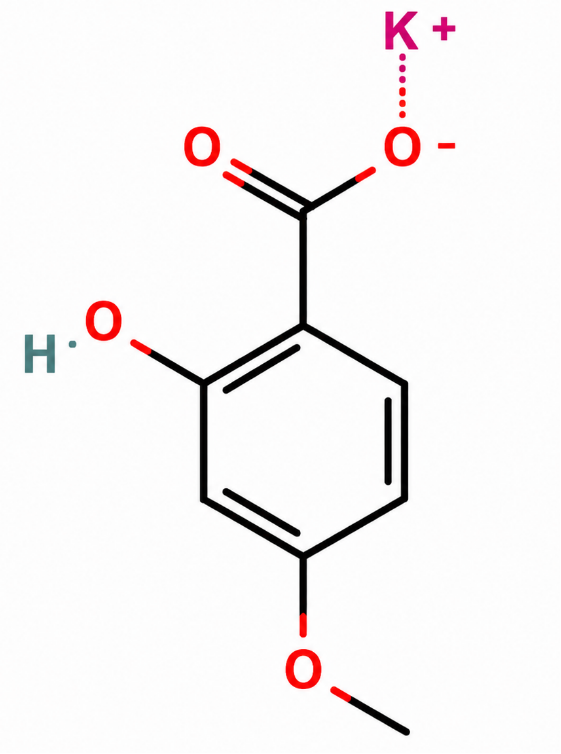
From the perspective of chemical structure, the parent compound of 4-MSK is 4-methoxysalicylic acid, namely 2-hydroxy-4-methoxybenzoic acid. The carboxyl group in the benzoic acid structure exists in the form of a potassium carboxylate salt; the benzene ring retains an ortho-hydroxyl group and carries a methoxy group at the 4-position. Unlike salicylic acid, which is commonly used as a keratin-regulating ingredient, the core value of 4-MSK in skincare is mainly reflected in its dual-targeted skin-brightening action: inhibiting melanin production while improving the renewal and removal of pigment-containing keratinocytes.
2. How Melanin Forms and Affects Skin Tone
Skin darkening, deepening of dark spots, and uneven skin tone are not caused by a single cell type or a single reaction. Rather, they result from the combined involvement of melanocytes, keratinocytes, and epidermal renewal.
Melanin production, or melanogenesis, mainly occurs in melanocytes. Stimuli such as ultraviolet radiation, inflammation, barrier damage, and hormonal fluctuations can activate melanocytes. Tyrosinase (TYR) then participates in the conversion of tyrosine into 3,4-dihydroxyphenylalanine (DOPA) and dopaquinone, which subsequently lead to the formation of melanin.
Microphthalmia-associated transcription factor (MITF) is an important regulator of melanocyte function. MITF can regulate pigment-related genes such as TYR, tyrosinase-related protein 1 (TYRP1), and dopachrome tautomerase (DCT, also known as TYRP2), thereby influencing the capacity for melanin synthesis.
After melanin is produced, it does not simply exist as a “free” substance in the skin. It is mainly synthesized and deposited within melanosomes inside melanocytes. Mature melanosomes are then transferred to surrounding keratinocytes. After keratinocytes receive these melanin-containing melanosomes, they gradually move outward with normal epidermal renewal and enter the stratum corneum during keratinization. Eventually, some melanin-containing keratinocytes are naturally shed together with the stratum corneum, carrying pigment components away. This reduces melanin retention in the superficial epidermis and makes the skin appear brighter and more even.
Melanin production, melanosome transfer, and the dual-targeted action mechanism of 4-MSK are shown in the figure below.
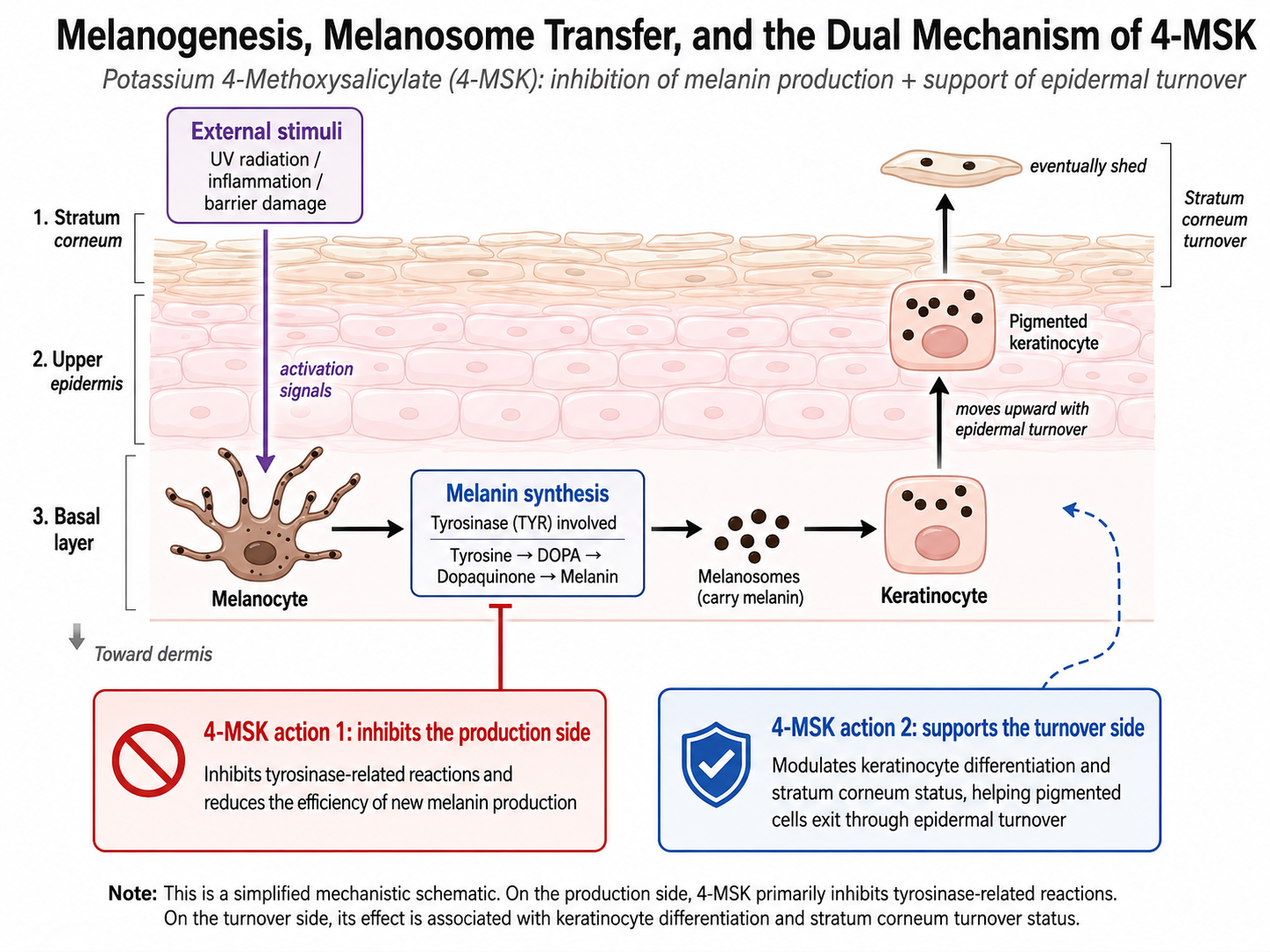
This process shows that skin tone and dark spots are not determined only by “how much melanin is produced.” They also depend on whether already formed melanin can leave the skin surface smoothly through keratinocyte turnover.
3. Effects of 4-MSK on the Melanin Production End
The first aspect of 4-MSK’s action is to reduce the efficiency of melanin production. In a 2025 study published by Shirasugi et al. in the Journal of Cosmetic Dermatology, human melanocytes, human keratinocytes, and a three-dimensional epidermal model were used to evaluate the effects of 4-MSK. The results showed that 4-MSK significantly reduced melanin content in cultured human melanocytes and in the three-dimensional epidermal model. In an in vitro mushroom tyrosinase assay, 4-MSK was also observed to inhibit the L-DOPA oxidation reaction.
3.1 Inhibition of Tyrosinase-Related Reactions
Tyrosinase is a key enzyme in the melanin synthesis pathway. It participates in the early stages of melanogenesis. Once this reaction continues to intensify, subsequent melanin production also increases.
UV radiation, inflammation, and other stimuli → melanocyte activation → enhanced tyrosinase-related reactions → increased melanin production
After adding 4-MSK:
tyrosinase-related reactions are inhibited → melanin production efficiency decreases → the source of new pigment is reduced
The “melanin-inhibiting” effect of 4-MSK does not involve damaging melanocytes. Instead, it reduces the reaction intensity of the melanin synthesis pathway.
4. Effects of 4-MSK on the Keratinocyte Renewal End
The second aspect of 4-MSK’s action is to influence keratinocyte differentiation and the renewal state of the stratum corneum, helping keratinocytes that already carry melanin leave the skin surface more smoothly.
4.1 Hyperpigmentation Is Also Related to Impaired “Removal”
After melanin is formed, it does not remain in melanocytes indefinitely. It enters melanosomes and is then transferred to keratinocytes. As the epidermis renews, melanin-containing keratinocytes gradually move outward and are eventually shed with the stratum corneum. If keratinocyte turnover is uneven, pigment-containing keratinocytes may remain in the superficial epidermis. In this situation, even if new melanin production has already decreased, the skin may still appear dull or grayish, and localized dark spots may become more noticeable.
4.2 What 4-MSK Improves Is the Renewal State
The 2025 study by Shirasugi et al. showed that 4-MSK promoted the gene expression of differentiation markers in human keratinocytes. In the human study, a formulation containing 4-MSK also reduced the proportion of the desquamation area on the cheeks and improved skin lightness. 4-MSK is associated with keratinocyte differentiation and improvement of the stratum corneum condition. It may help reduce abnormal retention of keratinocytes containing melanosomes or melanin in the superficial epidermis, allowing pigment to gradually decrease through normal epidermal renewal.
5. The Dual-Aspect Skin-Brightening Logic of 4-MSK
4-MSK is referred to as a “dual-effect skin-brightening ingredient” because it covers two key aspects of pigmentation: first, reducing the production of new melanin; and second, promoting the movement of already formed pigment away from the skin surface through keratinocyte renewal.
Site of Action | Main Issue | Effect of 4-MSK |
Melanin production end | Melanocytes are active, and new pigment continues to increase | Inhibits tyrosinase-related reactions and reduces the efficiency of melanin production |
Keratinocyte renewal end | Pigment-containing keratinocytes remain in the skin, causing dullness and uneven tone | Influences keratinocyte differentiation and stratum corneum condition, and may reduce pigment retention in the superficial epidermis |
Final appearance | Dark spots, dullness, and uneven skin tone | The source of new pigment is reduced, retention of existing pigment is alleviated, and skin lightness improves |
6. Effective Concentration of 4-MSK and Product Evaluation
6.1 Reference Concentration in Published Human Studies
In the study published by Shirasugi et al. in the Journal of Cosmetic Dermatology, a formulation containing 3% 4-MSK was used to evaluate its effects on facial hyperpigmentation and skin lightness. The study showed that the formulation improved skin lightness in both pigmented and non-pigmented cheek areas and reduced the proportion of the desquamation area on the cheeks. A 3% concentration of 4-MSK can be regarded as an important reference concentration in published human studies. At the same time, under Chinese regulatory requirements, 3% is also the maximum permitted concentration of potassium 4-methoxysalicylate in cosmetics. Actual efficacy still needs to be assessed comprehensively based on formulation delivery, stability, duration of use, and human efficacy testing.
6.2 The Formulation System Affects the Actual Performance of 4-MSK
The actual performance of 4-MSK is related to its added amount, dissolution state, formulation stability, skin delivery efficiency, and product tolerability. Even among products that contain 4-MSK, differences in the formulation system may affect how efficiently the ingredient enters the skin and exerts its effects.
Shiseido’s 2025 announcement on its 4-MSK fluid penetration technology indicates that 4-MSK is solid at room temperature. By combining it with other ingredients, 4-MSK can be liquefied and can continue to maintain a fluid state after application to the skin, thereby increasing its skin penetration. According to Shiseido’s data, this technology can increase the amount of 4-MSK that enters the skin and enhance its skin-brightening effect. Experiments using a three-dimensional skin model also showed that this technology can improve the inhibitory effect of 4-MSK on melanin production.
Shiseido’s data also mention that combining 4-MSK with trimethylglycine, also known as betaine, at an appropriate ratio can form a system that helps 4-MSK maintain a fluid state. This indicates that the efficacy performance of 4-MSK depends not only on whether the ingredient is added, but also on whether the formulation can improve its dissolution, stability, and skin delivery.
Therefore, when evaluating products containing 4-MSK, three aspects should be considered: whether 4-MSK is clearly positioned as the core skin-brightening active ingredient; whether the concentration is disclosed or human efficacy testing is provided; and whether the formulation system supports the stable presence and effective delivery of 4-MSK.
7. Frequently Asked Questions About 4-MSK
7.1 Does 4-MSK “Shut Down” Melanocytes?
No. The goal of 4-MSK is not to damage or shut down melanocytes, but to reduce the efficiency of tyrosinase-related reactions in the melanin production pathway. Melanocytes themselves play an important role in protecting the skin and defending against UV-induced damage. Skin-brightening ingredients in skincare products should not aim to destroy melanocytes.
7.2 Does 4-MSK Act as a Substrate Mimic and Occupy the Active Site of Tyrosinase?
Currently available public information supports an association between 4-MSK and inhibition of tyrosinase-related reactions, but it does not allow a direct conclusion that 4-MSK necessarily works through competitive occupation of the active site. 4-MSK can inhibit tyrosinase-related reactions and reduce the efficiency of melanin production. Whether this represents competitive inhibition requires complete enzyme kinetic data.
7.3 Why Does 4-MSK Also Need to Affect Keratinocyte Renewal?
Because already formed melanin is transferred to keratinocytes. If pigment-containing keratinocytes do not renew smoothly, pigment may remain in the superficial epidermis for longer, making the skin appear dull and uneven. By influencing keratinocyte differentiation and the condition of the stratum corneum, 4-MSK may help reduce pigment retention in the superficial epidermis.
7.4 Is 4-MSK’s “Promotion of Pigment-Containing Keratinocyte Removal” the Same as Strong Exfoliation?
No. The keratinocyte-related action of 4-MSK is mainly associated with keratinocyte differentiation and the renewal state of the stratum corneum. It does not work by strongly stimulating rapid peeling of the stratum corneum. Instead, it helps keratinocytes containing melanosomes and melanin gradually move upward along the normal epidermal renewal pathway and be naturally shed with the stratum corneum, thereby reducing pigment retention in the superficial epidermis. Excessive exfoliation can damage the skin barrier, trigger inflammatory responses, and increase the risk of post-inflammatory hyperpigmentation. The “guiding” effect of 4-MSK emphasizes normal keratinocyte renewal and is not equivalent to forced exfoliation of the stratum corneum.
7.5 Is 4-MSK Suitable for All Types of Dark Spots?
4-MSK is suitable for the daily management of post-sun uneven skin tone, mild to moderate hyperpigmentation, dullness, and skin tone concerns related to uneven keratinocyte renewal. Melasma, persistent solar lentigines, and obvious post-inflammatory hyperpigmentation are usually more complex and often require a combined approach involving sun protection, anti-inflammatory care, and barrier repair. Dermatological evaluation may be necessary when appropriate.
8. Classification Tables of Representative Chemicals Related to the Dual-Pathway Skin-Brightening Mechanism of 4-MSK
Table 1. 4-MSK Core Ingredient, Structurally Related Compounds, and Melanogenesis Model Materials
Category | CAS No. | Aladdin Cat. No. | Name | Specification or Purity | Product Features and Applications |
4-MSK core ingredient | 152312-71-5 | Potassium 4-methoxysalicylate | ≥97% | Used for research on the skin-brightening mechanism of 4-MSK, involving tyrosinase-related reactions, inhibition of melanin production, keratinocyte differentiation, and evaluation of pigment-containing keratinocyte renewal | |
4-MSK acid-form related compound | 2237-36-7 | 4-Methoxysalicylic acid | ≥98% | Used for research on 4-MSK structural relationships, analysis of potassium carboxylate salt precursors, structural comparison of salicylic acid derivatives, and raw-material synthesis research | |
Melanogenesis substrate | 60-18-4 | L-Tyrosine | Animal-free, ≥99%, fermentation-derived | Upstream substrate for melanin synthesis; used in tyrosinase reaction systems, melanogenesis models, and evaluation of melanin-inhibiting activity | |
Melanogenesis intermediate | 59-92-7 | Levodopa | Moligand™, ≥99% | Key intermediate in melanin synthesis; used for DOPA oxidation reactions, tyrosinase activity assays, and screening of melanin production inhibitors | |
Melanin model material | 8049-97-6 | Melanin | Moligand™, Synthetic | Used for pigment deposition models, light absorption evaluation, antioxidant experiments, and analysis of the effects of skin-brightening ingredients |
Table 2. Related to Melanin Production Inhibition, Pigment-Signaling Regulation, and Melanosome Transfer
Category | CAS No. | Aladdin Cat. No. | Name | Specification or Purity | Product Features and Applications |
Classical positive control for melanin inhibition | 123-31-9 | Hydroquinone | AR | Used for melanin production inhibition experiments, dark-spot mechanism research, and positive-control evaluation | |
Glycoside-type melanin-inhibiting ingredient | 497-76-7 | Arbutin | Moligand™, ≥98% | Used for tyrosinase-related inhibition, melanogenesis regulation, and skin tone-evening research | |
Organic acid-type melanin-inhibiting ingredient | 501-30-4 | Kojic acid | ≥99% | Used for tyrosinase inhibition screening, melanogenesis experiments, and comparative evaluation of skin-brightening activity | |
Resorcinol-type melanin-inhibiting ingredient | 18979-61-8 | 4-Butylresorcinol | ≥98% (GC) | Used for tyrosinase-related inhibition, hyperpigmentation intervention, and comparative research on resorcinol-type activity | |
Resorcinol-type melanin-inhibiting ingredient | 136-77-6 | 4-Hexylresorcinol | ≥98% (GC) | Used for melanin production inhibition, antioxidant synergy, and skin tone-evening research | |
Resorcinol-type melanin-inhibiting ingredient | 85-27-8 | 4-(α-Methylbenzyl)resorcinol | ≥98% | Used for tyrosinase-related inhibition, evaluation of dark-spot-reducing activity, and research on resorcinol-type skin-brightening formulations | |
Thiazolyl resorcinol-type melanin-inhibiting ingredient | 1428450-95-6 | N-(4-(2,4-Dihydroxyphenyl)thiazol-2-yl)isobutyramide | ≥98% | Used for human tyrosinase-related inhibition, melanogenesis research, and evaluation of dark-spot intervention activity | |
Melanin precursor-regulating ingredient | 2101538-28-5 | 2-MNG | ≥98% | Used for melanin precursor conversion, regulation of the pigment production pathway, and research on novel skin-brightening mechanisms | |
Dicarboxylic acid-type hyperpigmentation-management ingredient | 123-99-9 | Azelaic acid | Moligand™, ≥99% | Used for research on hyperpigmentation, post-acne marks, abnormal keratinization, and inflammation-related uneven skin tone | |
Azelaic acid derivative | 477773-67-4 | Potassium azeloyl diglycinate | ≥99% | Used for research on water-soluble azelaic acid derivatives, skin tone-evening evaluation, sebum regulation, and development of combined skin-brightening systems | |
Pigment-signaling modulator | 1197-18-8 | Tranexamic acid (TXA; also known as transaminic acid) | Moligand™ ≥98% | Used for research on UV-, inflammation-, and hyperpigmentation-related signaling; suitable for model evaluation of melasma and post-inflammatory hyperpigmentation | |
Melanosome transfer-regulating ingredient | 98-92-0 | Niacinamide | PharmPure™, USP | Used for regulation of melanosome transfer to keratinocytes, barrier support, skin tone evening, and skin-brightening synergy research | |
Co-active ingredient for transfer and keratin metabolism | 7512-17-6 | N-Acetyl-D-glucosamine | ≥98% | Used for keratinocyte metabolism, glycosamine metabolism, niacinamide-synergistic brightening, and skin tone-evening evaluation |
Table 3. Related to Antioxidant Brightening, Vitamin C Systems, and Plant Polyphenols
Category | CAS No. | Aladdin Cat. No. | Name | Specification or Purity | Product Features and Applications |
Prototype vitamin C | 50-81-7 | L-Ascorbic acid | Anhydrous grade, Moligand™, ACS, ≥99% | Used for antioxidant research, reduction of oxidized pigments, collagen-related studies, and skin-brightening synergy experiments | |
Lipid-soluble vitamin C derivative | 183476-82-6 | Ascorbyl tetraisopalmitate | Cosmetic grade, ≥90% | Used for lipid-phase antioxidation, skin tone brightening, oil-phase formulation stability, and comparison of vitamin C derivatives | |
Etherified vitamin C derivative | 86404-04-8 | 3-O-Ethyl-L-ascorbic acid | Moligand™, ≥98% (HPLC)(T) | Used for stable antioxidant brightening systems, melanogenesis regulation, and activity evaluation of vitamin C derivatives | |
Phosphate-type vitamin C derivative | 113170-55-1 | L-Ascorbic acid 2-phosphate sesquimagnesium salt hydrate | Moligand™, ≥98% (HPLC) | Used for mild brightening, antioxidation, cell experiments, and research on vitamin C phosphate systems | |
Phosphate-type vitamin C derivative | 66170-10-3 | Trisodium L-ascorbic acid 2-phosphate | ≥96% | Used for water-soluble antioxidant systems, acne-prone skin hyperpigmentation, melanogenesis regulation, and cell model experiments | |
Glycoside-type vitamin C derivative | 129499-78-1 | 2-O-α-D-Glucopyranosyl-L-ascorbic acid | ≥98% (HPLC) | Used for stable vitamin C systems, brightening formulations, antioxidation, and skin tone-evening research | |
Polyphenolic antioxidant ingredient | 501-36-0 | Resveratrol | Moligand™, ≥99% | Used for antioxidant research, photoaging, inflammation-related hyperpigmentation, and skin-brightening synergy research | |
Polyphenolic melanin-inhibiting ingredient | 29700-22-9 | Oxyresveratrol | Moligand™, ≥95% | Used for tyrosinase-related inhibition, screening of plant-derived skin-brightening activity, and melanogenesis research | |
Polyphenolic antioxidant ingredient | 476-66-4 | Ellagic acid | Moligand™, ≥96% | Used for plant polyphenol-based skin brightening, antioxidation, pigmentation regulation, and screening of natural active compounds | |
Phenolic acid-type antioxidant ingredient | 1135-24-6 | Ferulic acid | Moligand™, ≥99% | Used for antioxidant systems, photoprotection synergy, vitamin C stabilization compatibility, and skin tone management research | |
Phenolic acid-type antioxidant ingredient | 537-98-4 | trans-Ferulic acid | ≥99% | Used for antioxidation, intervention against UV-induced damage, photoaging, and brightening formulation synergy research |
Table 4. Related to Keratinocyte Renewal, Epidermal Metabolism, and Removal of Pigment-Containing Keratinocytes
Category | CAS No. | Aladdin Cat. No. | Name | Specification or Purity | Product Features and Applications |
α-Hydroxy acid keratinocyte-renewal ingredient | 79-14-1 | Glycolic acid | BioReagent, ≥98% (T) | Used for keratinocyte renewal, epidermal metabolism, improvement of dullness, and research related to shedding of pigment-containing keratinocytes | |
α-Hydroxy acid keratin-regulating ingredient | 50-21-5 | DL-Lactic acid | AR, 85–90% | Used for mild keratin regulation, moisturizing-related research, improvement of dullness, and epidermal renewal evaluation | |
α-Hydroxy acid keratinocyte-renewal ingredient | 90-64-2 | DL-Mandelic acid | AR, ≥99% | Used for keratinocyte renewal, post-acne hyperpigmentation, uneven skin tone, and research on mild acid-based formulations | |
β-Hydroxy acid keratin-regulating ingredient | 69-72-7 | Salicylic acid | UltraBio™, ultrapure grade, ≥99% | Used for keratin regulation, rough pores, improvement of dullness, and research on epidermal renewal mechanisms | |
Lipid-soluble salicylic acid derivative | 78418-01-6 | Capryloyl salicylic acid | ≥98% | Used for lipid-soluble keratin regulation, roughness and dullness, oily skin, and epidermal renewal research | |
Polyhydroxy acid keratinocyte-renewal ingredient | 90-80-2 | G106880 | D-(+)-Glucono-δ-lactone | PharmPure™, USP | Used for mild keratinocyte renewal, moisturization, barrier-friendly brightening, and sensitive-skin brightening systems |
Polyhydroxy acid keratinocyte-renewal ingredient | 96-82-2 | Lactobionic acid | ≥97% | Used for mild epidermal renewal, antioxidation, moisturization, and improvement of dull skin tone | |
Keratin-softening and moisturizing ingredient | 57-13-6 | Urea | UltraBio™, molecular biology grade, ≥99.5% (T) | Used for keratin softening, moisturization, improvement of roughness, and epidermal barrier-related research | |
Vitamin A-type epidermal renewal ingredient | 68-26-8 | Retinol | Moligand™, ≥95% | Used for epidermal renewal, photoaging, keratin metabolism, and synergistic improvement of hyperpigmentation | |
Vitamin A-type epidermal renewal ingredient | 116-31-4 | all-trans-Retinal | Moligand™, ≥98% | Used for epidermal metabolism, retinoic acid pathway research, photoaging, and skin tone-evening research | |
Vitamin A-type epidermal renewal ingredient | 893412-73-2 | Hydroxypinacolone retinoate | ≥99% | Used for vitamin A-type renewal systems, keratin metabolism, anti-aging, and hyperpigmentation synergy research |
Table 5. Related to 4-MSK Formulation Delivery, Moisturizing Repair, and Soothing Support
Category | CAS No. | Aladdin Cat. No. | Name | Specification or Purity | Product Features and Applications |
4-MSK fluid-state auxiliary ingredient | 107-43-7 | Betaine, anhydrous | Moligand™, ultrapure grade, ≥99% | Used for moisturization, penetration systems, research on the fluid state of 4-MSK, and formulation delivery design | |
Basic moisturizing ingredient | 56-81-5 | Glycerol | Anhydrous grade, UltraBio™, molecular biology grade, ≥99.5% (GC) | Used for moisturization, barrier support, reduction of irritation, and basic systems for skin-brightening active formulations | |
Barrier-repair ingredient | 81-13-0 | D-Panthenol | ≥98% | Used for barrier repair, soothing, moisturization, and tolerability research for skin-brightening active formulations | |
Soothing and repairing ingredient | 97-59-6 | Allantoin | ≥98% | Used for soothing, skin protection, barrier support, and buffering of irritation from active ingredients | |
Soothing and anti-inflammatory ingredient | 515-69-5 | (±)-α-Bisabolol | ≥90% | Used for soothing, inflammatory response evaluation, control of post-inflammatory hyperpigmentation risk, and sensitive-skin formulation research | |
Soothing and anti-inflammatory ingredient | 68797-35-3 | Dipotassium glycyrrhizinate hydrate | ≥75% (HPLC) | Used for soothing, inflammatory signaling regulation, barrier support, and post-inflammatory hyperpigmentation formulation research |
Table 6. Related to Sun Protection and Photostimulus Control
Category | CAS No. | Aladdin Cat. No. | Name | Specification or Purity | Product Features and Applications |
Inorganic UV filter | 13463-67-7 | T431947 | Titanium dioxide (IV) | Premium grade, ≥99% | Used for UV protection, light scattering, photostability evaluation, and upstream protection research in skin-brightening systems |
Inorganic UV filter | 1314-13-2 | Zinc oxide | Reagent grade, high purity, ≥99.9% metals basis, powder, <5 μm | Used for broad-spectrum UV protection, intervention against skin photodamage, and prevention of hyperpigmentation | |
Long-wave UV filter | 70356-09-1 | 1-(4-tert-Butylphenyl)-3-(4-methoxyphenyl)propane-1,3-dione | ≥98% | Used for long-wave UV protection, photostability compatibility, and UV-induced melanin production research | |
Long-wave UV filter | 302776-68-7 | Hexyl 2-[4-(diethylamino)-2-hydroxybenzoyl]benzoate (DHHB) | ≥98% | Used for long-wave UV protection, photoaging intervention, upstream control of stimuli that trigger melanin production, and sunscreen formulation research | |
Broad-spectrum UV filter | 103597-45-1 | 2,2'-Methylenebis[6-(benzotriazol-2-yl)-4-tert-octylphenol] | ≥98% | Used for broad-spectrum UV protection, photoprotection systems, and prevention of UV-induced hyperpigmentation | |
Broad-spectrum UV filter | 187393-00-6 | Bis-ethylhexyloxyphenol methoxyphenyl triazine | ≥98% | Used for broad-spectrum UV protection, photostable systems, prevention of photodamage, and skin-brightening/sunscreen synergy research | |
Medium-wave UV filter | 88122-99-0 | Ethylhexyl triazone | ≥98% | Used for medium-wave UV protection, photoprotection systems, and prevention of UV-induced skin darkening |
Note: The above are representative Aladdin products related to scientific research and formulation studies. For more information on product specifications, grades, and COA details, search by “product name/CAS/catalog number” on the Aladdin official website.
References
[1] Shirasugi Y, Shibata T, Koike S, Hara M, Hasegawa K, Iino M, Sonoki A, Funasaka Y. Potassium 4-Methoxysalicylate (4MSK) Exerts a Skin Lightening Effect by Acting on Melanocytes and Keratinocytes. Journal of Cosmetic Dermatology. 2025;24(3):e70112. DOI: 10.1111/jocd.70112.
[1a] Correction to “Potassium 4-methoxysalicylate (4MSK) exerts a skin lightening effect by acting on melanocytes and keratinocytes”. Journal of Cosmetic Dermatology. 2025;24(7):e70317. DOI: 10.1111/jocd.70317.
[2] Shiseido Company. Shiseido Develops “4MSK/fluid penetration technology” Penetrating Brightening Effective Ingredient 4MSK into Skin. News Release. 2025-01-31.
[3] Hida T, Kamiya T, Kawakami A, Ogino J, Sohma H, Uhara H, Jimbow K. Elucidation of Melanogenesis Cascade for Identifying Pathophysiology and Therapeutic Approach of Pigmentary Disorders and Melanoma. International Journal of Molecular Sciences. 2020;21(17):6129. DOI: 10.3390/ijms21176129.
[4] Wang F, Ma W, Fan D, Hu J, An X, Wang Z. The biochemistry of melanogenesis: an insight into the function and mechanism of melanogenesis-related proteins. Frontiers in Molecular Biosciences. 2024;11:1440187. DOI: 10.3389/fmolb.2024.1440187.
[5] PubChem. Potassium methoxysalicylate, CID 23683261. Molecular Formula: C₈H₇KO₄.
[6] Ministry of Health of the People’s Republic of China. Notice of the Ministry of Health on Approving Potassium 4-Methoxysalicylate as a Cosmetic Ingredient. Health Supervision Document [2007] No. 141. 2007-04-26.
For more related articles, see below:
Role of Sphingolipid Metabolic Remodeling in Apoptotic and Inflammatory Signaling
How to decipher the whitening code?
Niacin (Vitamin B3): Structural Features, Metabolic Roles, and Application Landscape
The "Six Key Checkpoints" of Skin Lightening
Tyrosinase: a key regulatory enzyme in melanin synthesis and its biological and applied significance
Enzymatic Hydroxylation Mechanism of Salicylate Conversion to Catechol


 危险品化学品经营许可证(带存储)