
MacMillan Imidazolidinone Organocatalysts
MacMillan Imidazolidinone Organocatalysts

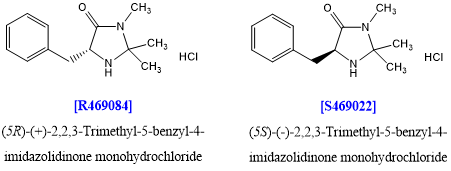
In recent years, asymmetric organic catalytic processes have increasingly become more mature and have been utilized in practical application scenarios.In comparison to metal catalytic processes, organic amine catalysts present numerous potential advantages, such as a more stable physicochemical properties, lower cost, easier access, absence of risk of metal ion leakage into the environment or product, and lower requirements for the operating environment. Additionally, organic amines have been demonstrated to be an effective means of achieving asymmetric transformation.MacMillan imidazolidinone organocatalysts are a specific type of organamine catalyst.Aladin provided a summary of the research progress on this type of catalyst in enantioselective Mukaiyama-Michael reaction, asymmetric epoxylation of α, β-unsaturated aldehydes, asymmetric 1, 3-addition of aldehydes, and other asymmetric catalytic reactions, and presented a diverse range of commercial products for you to select from.
MacMillan Imidazolidinone Organocatalysts

Applications
Enantioselective Mukaiyama−Michael Reaction [1]

The first enantioselective organo-catalytic Mukaiyama-Michael reaction was performed using α, β-unsaturated aldehydes. The use of imine catalysts provided a new strategy for the enantioselective addition of 2-sirofuran to unsaturated aldehydes to generate various butenolide systems, butenolactone is an important chiral synthetic product found in many natural isolates, and a wide variety of aldehyde substrates can be accommodated in this new organo-catalytic transformation.
Asymmetric Epoxidation of α,β-Unsaturated Aldehydes [2]

An example of a 1, 4-hetero-conjugate addition reaction involving a high iodine reagent is reported in which an imidazolinone catalyst is used for the organic catalytic asymmetric epoxidation of α, β-unsaturated aldehydes. The development of an "internal syringe pump" effect through the slow release of iodobenzene by imine iodobenzene provides a high level of reaction efficiency and enantiomer control in the asymmetric epoxidation of electron-deficient alkenes.
Asymmetric 1,3-Addition of Aldehydes [3]

The enantioselective organo-catalytic α-enolization of aldehydes was achieved for the first time by the use of single-occupied molecular orbital (SOMO) catalysis. Chiral secondary amines react with aldehydes to form transient enamines that undergo selective one-electron oxidation to produce electrophilic base cations. These SOMO-activated radical cations are susceptible to attack by keto-derived enolsilanes, giving a uniformly high level of asymmetric induction of α-substitution-γ-keto-aldehyde products. The broad distribution of aldehyde and enolactone components can be easily adjusted and a variety of enantiomer-enriched 1, 4-dicarbonyl compounds are universally available, making it possible to develop entirely new classes of asymmetric reactions without conventional catalyst equivalents.
References
1. S.P. Brown, N.C. Goodwin, D. W. C. MacMillan, J. Am. Chem. Soc. 2003, 125, 1192. https://doi.org/10.1021/ja029095q
2. S. Lee, D. W. C. MacMillan, Tetrahedron 2006, 62, 11413.
https://doi.org/10.1016/j.tet.2006.07.055
3. H. -Y. Jang, J. -B. Hong, D. W. C. MacMillan, J. Am. Chem. Soc. 2007, 129, 7004.
https://doi.org/10.1021/ja0719428


 危险品化学品经营许可证(带存储)