
PCR Reagent
PCR Reagent
Polymerase Chain Reaction (PCR) is one of the most widely used amplification techniques in molecular biology, enabling the rapid and large-scale replication of specific DNA fragments. As the critical components of PCR, reagents directly determine the sensitivity, specificity, and reproducibility of amplification results.
I. Composition and Function of PCR Reagents
A typical PCR system consists of the following core reagents:
- DNA Polymerase: e.g., Taq polymerase, catalyzes the synthesis of DNA strands.
- Reaction Buffer: Provides a stable reaction environment, including pH and ionic strength.
- Mg2+Ions: Essential cofactors that influence enzyme activity and amplification efficiency.
- dNTPs (Deoxynucleotide Triphosphates): Raw materials for DNA synthesis.
- Primers: Define amplification specificity.
In addition, some advanced PCR reagents contain stabilizing components or inhibitor-removing agents to further enhance system performance.
II. Quality Requirements and Standards
- High purity: Free of proteases, nucleases, and other impurities that could degrade DNA templates.
- Low inhibition: Free from substances that affect polymerase activity.
- Batch-to-batch consistency: Ensures minimal Ct value variation across production lots.
- High sensitivity: Effective amplification even with low-copy-number templates.
III. Application Fields
- Basic Research: Gene cloning, mutation detection, transgenic analysis.
- Medical Diagnostics: Pathogen detection, genetic disorder screening, tumor biomarker analysis.
- Forensic Identification: Individual recognition, paternity testing.
- Food and Environmental Testing: Detection of genetically modified organisms (GMOs), microbial monitoring.
IV. Common Experimental Problems and Solutions
1.Low amplification efficiency with weak target bands
Solution: PCR-specific reagents are optimized for enzyme activity and ionic conditions, ensuring stable amplification even under low-template conditions.
2.Nonspecific bands make results difficult to interpret
Solution: Strict removal of inhibitory factors and optimized buffer formulations significantly reduce nonspecific amplification, ensuring clear band patterns.
3.Large Ct value fluctuations and inconsistent results across batches
Solution: PCR-grade reagents ensure high batch-to-batch consistency, maintaining stable Ct values and improving data comparability.
4.Low-copy templates are difficult to detect
Solution: High-sensitivity formulations allow reliable amplification even at extremely low template copy numbers, meeting the stringent requirements of both clinical and research applications.
V. Operation and Storage Precautions
- Enzymes and dNTPs: Should be aliquoted to avoid repeated freeze–thaw cycles; otherwise, amplification efficiency may decrease.
- Storage conditions: Enzymes should be stored at –20 °C; buffers and dNTPs should be kept protected from light to prevent degradation and maintain reaction sensitivity.
- Contamination control: PCR is extremely sensitive to contamination; if the workspace is not isolated, false positives may occur. It is recommended to use nuclease-free consumables and designate a dedicated reagent preparation area.
- Shelf life: Reagents used beyond their expiration date may cause Ct value drift and reduced reproducibility; instructions must be followed strictly.
VI. Advantages of Aladdin Products
- High purity and inhibitor-free: Ensures amplification sensitivity and specificity.
- Reliable quality: Strong batch consistency reduces experimental variability.
- Comprehensive applications: Suitable for conventional PCR, qPCR, RT-PCR, and other techniques.
VII. Comparison of Reagent Grades
Type | Amplification Efficiency | Inhibitor Control | Sensitivity | Reproducibility |
General Molecular Reagents | Unstable amplification efficiency | Inhibitors may remain | Low sensitivity | Large batch-to-batch variation |
Maintain moderate efficiency | Controlled for chemical impurities but not optimized for PCR | Average sensitivity | Limited reproducibility | |
High amplification efficiency | Strict removal of inhibitors | High sensitivity, detects low-copy templates | Good batch consistency | |
Advanced PCR-optimized Reagents (Clinical/Diagnostic Use) | Clinical-grade efficiency | Fully compliant with regulatory standards | Extremely high sensitivity, suitable for clinical testing | Highest stability |
PCR reagents are core consumables in molecular biology and clinical testing. High-quality PCR reagents not only improve amplification efficiency and sensitivity but also ensure data stability and reproducibility. With rigorous manufacturing processes and consistent quality, Aladdin’s PCR reagents provide reliable technical support for both research and industrial applications.
View all PCR Products


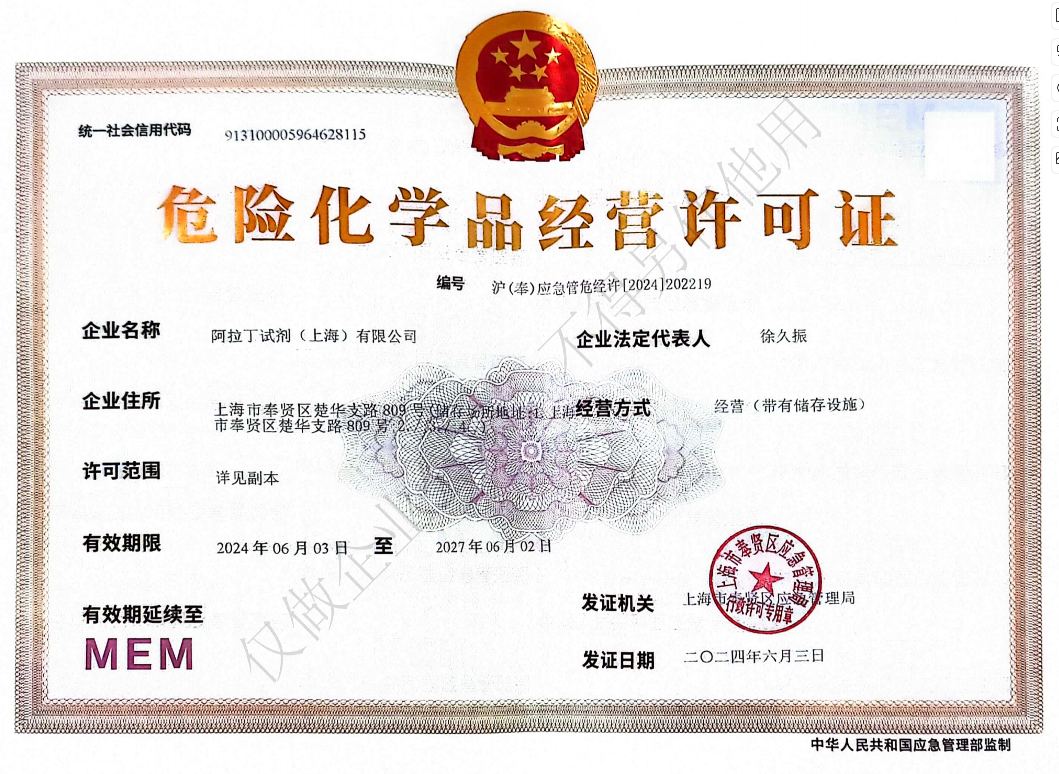 危险品化学品经营许可证(带存储)