
Reaction Mechanism of Pyrrole Skeletal Recasting: Reconstruction of Intraring Atomic Connectivity during Dearomatization—Skeletal Reorganization—Rearomatization
Reaction Mechanism of Pyrrole Skeletal Recasting: Reconstruction of Intraring Atomic Connectivity during Dearomatization—Skeletal Reorganization—Rearomatization
1. Starting from a Seemingly Simple Question: When Pyrrole Becomes Pyrrole, What Has Changed?
Zhou et al. reported in ACS Central Science a method for the skeletal recasting of pyrroles: simple pyrroles and azoalkenes are used as starting materials and, under phosphoric acid catalysis, highly substituted pyrroles are obtained through a one-pot reaction.[1]
Taking the model reaction as an example, 2,5-dimethyl-1H-pyrrole 1a reacts with azoalkene 2a under the optimized conditions using 10 mol% of a phosphoric acid catalyst and chloroform as the solvent, affording tetrasubstituted pyrrole 3a in 90% isolated yield.[1]
From the perspective of the ring structures of the reactant and product, both are five-membered nitrogen-containing aromatic heterocycles. This therefore raises an obvious question:
Since the product is still a pyrrole, why is this reaction considered “skeletal recasting” rather than ordinary pyrrole functionalization?
The answer lies in the fact that the origins and connectivity of the atoms within the ring have changed.
1.1 Peripheral Functionalization and Skeletal Recasting Alter Different Structural Features
Taking a typical electrophilic aromatic substitution of pyrrole as an example, the reaction transiently forms a non-aromatic σ-intermediate, followed by deprotonation and restoration of aromaticity. Before and after the reaction, the pyrrole ring remains composed of the original atoms, and the original intraring C–C and C–N bonds are retained overall.
The skeletal recasting reported in this work involves a deeper level of structural change.[1]
Aspect of Comparison | Typical Peripheral Functionalization | Skeletal Recasting in This Work |
Major change | Addition or replacement of substituents outside the ring | Reorganization of the connectivity between atoms within the ring |
Nitrogen of the starting pyrrole | Retained within the ring | Not retained in the final pyrrole ring |
External reaction component | Primarily provides a new substituent | Azoalkene participates in formation of the new pyrrole skeleton |
Process after dearomatization | Restores the original ring connectivity | Forms a new aromatic pyrrole after new connectivity has been established |
Level of structural change | Structural change at the ring periphery | Reorganization of the ring skeleton |
It can therefore be seen that dearomatization itself is not sufficient to define skeletal recasting. Typical aromatic substitution can likewise proceed through a transient non-aromatic intermediate. An important criterion for distinguishing these two types of reactions is whether the connectivity between atoms within the ring has already been reorganized before the system regains aromaticity.[1]
2. Why Can Dearomatization Create the Reaction Conditions Required for Skeletal Reorganization?
2.1 Aromatic Pyrrole Tends to Restore Its Original Conjugated Structure
Pyrrole possesses a 6π aromatic electron system, in which a lone pair of electrons on the nitrogen atom participates in cyclic conjugation.
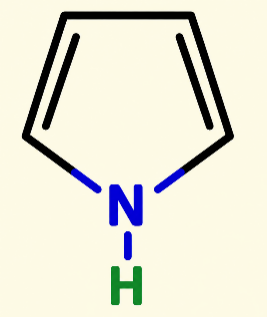
In conventional peripheral functionalization reactions, even if aromaticity is temporarily lost during the reaction, the subsequent steps generally restore the original connectivity of the five-membered ring. Consequently, the major changes in the final product occur in the substituents on the ring rather than in the relationships among the atoms constituting the pyrrole ring.
To alter the internal C–N or C–C connectivity of the ring, the dearomatized intermediate must continue to undergo new bond-forming and ring-forming processes before entering the stage in which aromaticity is restored.
The reaction designed by Zhou et al. proceeds precisely according to this sequence:[1]
Aromatic pyrrole → dearomatized intermediate → establishment of new connectivity → cleavage of original connectivity → formation of a new aromatic pyrrole
Role of dearomatization: it converts the pyrrole from a continuous aromatic conjugated system into a non-aromatic intermediate capable of undergoing further tautomerization, addition, and cyclization.
When subsequent rearomatization occurs, new connectivity has already been established, and the C–N bond of the original pyrrole has also entered the cleavage process. The result is therefore a pyrrole whose skeleton has been reorganized, rather than simple restoration of the original connectivity of the starting pyrrole.[1]
3. Why Was an Azoalkene Selected to Participate in Skeletal Recasting?
Simply causing pyrrole to undergo a single addition reaction is not sufficient to complete the entire skeletal reorganization. The other reaction component must also provide the atoms and reactive sites required for the subsequent cyclization.
The authors refer to such a reaction component as a molecular perturbator.[1]
In the reaction described in this work, the azoalkene performs this role.
3.1 Azoalkenes Participate in Both Deconstruction and Reconstruction
When designing the skeletal recasting reaction, the authors proposed that a suitable molecular perturbator should possess two fundamental characteristics:[1]
1. It should be a dipolar molecule capable of enabling a deconstruction–reconstruction sequence, meaning that it can react with the original heterocycle and continue to participate in the subsequent skeletal deconstruction and reconstruction;
2. It should contain at least one nitrogen atom to facilitate re-formation of the pyrrole ring.
In this reaction, the azoalkene satisfies these requirements and provides new structural units for the recast pyrrole skeleton. In particular, a nitrogen atom derived from the azoalkene enters the newly formed pyrrole ring.[1]
Previous research by Lu’s group demonstrated that azoalkenes can serve as CCN 1,3-dipole surrogates in formal [3+2] cycloaddition reactions, providing three contiguous atoms for the construction of nitrogen-containing five-membered rings.[2]
In the present study, the azoalkene participates in the following consecutive processes:
First addition → tautomerization → second addition → cyclization → C–N bond cleavage and reconstruction.[1]
Thus, the azoalkene not only changes the reactive state of the starting pyrrole; its structural units are also incorporated into the reconstructed molecule. Most importantly, the nitrogen derived from the azoalkene participates in formation of the new pyrrole ring, whereas the ring nitrogen of the starting pyrrole is ultimately not retained in the product.[1]
4. How Does Skeletal Recasting Occur?
Based on ^18O and ^15N isotope-labeling experiments together with liquid chromatography–mass spectrometry experiments, the authors proposed the mechanism shown in Figure 7C.[1] This mechanism represents a plausible reaction pathway supported by the experimental results; not all transient intermediates were independently isolated and fully structurally characterized.
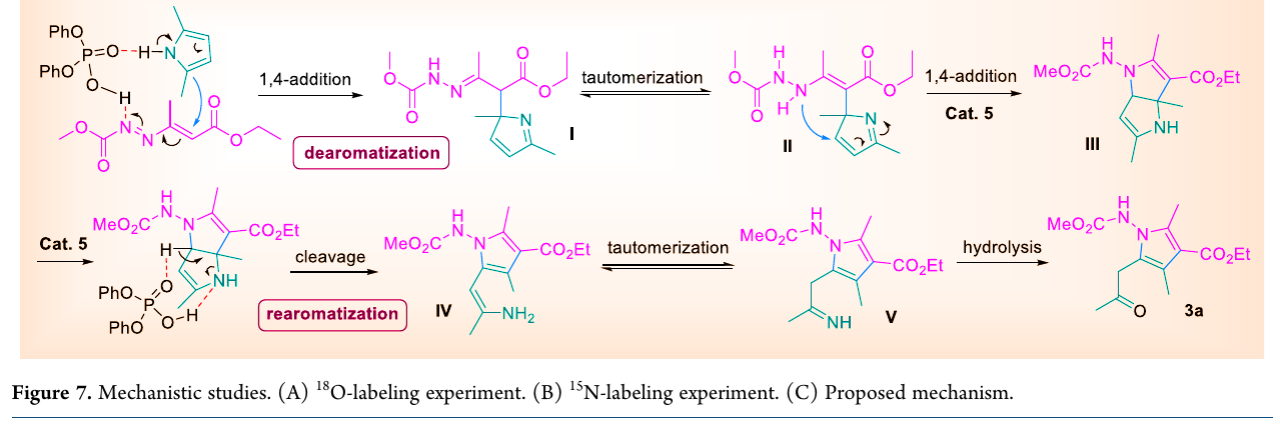
The proposed mechanism for pyrrole skeletal recasting is shown above. The blue-green structural units in the figure are derived from the starting pyrrole, whereas the magenta structural units are derived from the azoalkene. The reaction proceeds sequentially through the first 1,4-addition and dearomatization, tautomerization, the second 1,4-addition, C–N bond cleavage and rearomatization, another tautomerization, and hydrolysis.[1]
How the ring nitrogen of the starting pyrrole is transformed from an intraring position into an exocyclic nitrogen-containing group, and how the nitrogen derived from the azoalkene enters the re-formed five-membered aromatic ring.
According to the structural numbering in Figure 7C, the proposed reaction pathway is:
Pyrrole + azoalkene
→ I (dearomatized hydrazine intermediate)
⇌ II (enamine intermediate)
→ III (bicyclic intermediate)
→ IV (intermediate formed after C–N bond cleavage and rearomatization)
⇌ V (tautomer)
→ hydrolysis
→ 3a
4.1 Step 1: Friedel–Crafts-Type 1,4-Addition Initiates Dearomatization
Under promotion by the phosphoric acid catalyst, pyrrole undergoes a Friedel–Crafts-type 1,4-addition to the azoalkene, forming dearomatized hydrazine intermediate I.[1]
This step produces two consequences:
① A new C–C bond is formed between the pyrrole and the azoalkene;
② The aromatic electronic structure of the starting pyrrole is disrupted.
At this point, the ring atoms constituting the original pyrrole are still present, but the original aromatic conjugated system has been converted into a non-aromatic structure, thereby creating the reaction conditions required for subsequent tautomerization and further bond formation.[1]
4.2 Step 2: Hydrazine–Enamine Tautomerization Forms Intermediate II
Intermediate I subsequently undergoes hydrazine–enamine tautomerization to give enamine intermediate II.[1]
I ⇌ II
This process changes the positions of the double bonds and protons, providing the intermediate with the electronic structure required for the subsequent second 1,4-addition.
Thus, the first addition brings the pyrrole into a dearomatized state, while the subsequent tautomerization enables this intermediate to continue its conversion toward a new ring-forming structure.
4.3 Step 3: The Second 1,4-Addition Forms Bicyclic Intermediate III
Under the action of the phosphoric acid catalyst, intermediate II undergoes a second 1,4-addition to form bicyclic intermediate III.[1]
II → second 1,4-addition → III
At this stage, new intraring connectivity has already been established.
According to the pathway proposed in Figure 7C, the reaction does not first completely fragment the starting pyrrole into mutually independent small molecules and then carry out a conventional pyrrole synthesis. Instead, new connectivity is established first to form a bicyclic intermediate, after which a specific C–N bond in the original pyrrole is cleaved.
Skeletal recasting is therefore a continuous bond-forming–bond-breaking process.[1]
4.4 Step 4: C–N Bond Cleavage and Rearomatization Form Intermediate IV
Bicyclic intermediate III subsequently undergoes the key structural change of the entire recasting process.
According to the labeling in Figure 7C, with participation of the phosphoric acid catalyst, a C–N bond at the position containing the original pyrrole nitrogen is cleaved, while the system simultaneously undergoes rearomatization to form intermediate IV.[1]
III → cleavage of the original pyrrole C–N bond → rearomatization → IV
At this point, the new five-membered aromatic ring has already been established.
The atomic origins shown in the figure reveal that:
① The nitrogen derived from the azoalkene is located within the newly formed pyrrole ring;
② The nitrogen derived from the starting pyrrole has moved from its original intraring position into an exocyclic nitrogen-containing group in IV.
Therefore, although the newly formed aromatic heterocycle remains a pyrrole in terms of its structural class, the origin of its nitrogen atom and its intraring connectivity are different from those of the starting pyrrole.
4.5 Step 5: IV → V Tautomerization and Hydrolysis Produce Product 3a
According to the structural numbering in Figure 7C, intermediate IV subsequently undergoes enamine–imine tautomerization to form intermediate V.[1]
IV ⇌ V
V then undergoes hydrolysis to afford the final tetrasubstituted pyrrole 3a:
V → hydrolysis → 3a
After hydrolysis, the nitrogen derived from the starting pyrrole is no longer retained in the final organic product, and the corresponding side-chain position is converted into a carbonyl group; by contrast, the nitrogen derived from the azoalkene remains within the newly formed pyrrole ring.[1]
Accordingly, the complete skeletal transformation described in Figure 7C can be summarized as follows:
First 1,4-addition and dearomatization
→ tautomerization
→ second 1,4-addition and establishment of new connectivity
→ cleavage of the original pyrrole C–N bond and rearomatization
→ tautomerization
→ hydrolysis to afford the recast pyrrole
Throughout this continuous process, the core events that change the identity of the skeleton are the establishment of new connectivity and cleavage of the original pyrrole C–N bond.
5. How Does the Experimental Evidence Support the Skeletal Recasting Mechanism?
Comparison of the reactants with the final product alone is insufficient to establish what structural changes the original pyrrole undergoes during the reaction.
The authors therefore used isotope labeling and reaction-process monitoring to investigate key questions associated with the proposed mechanism.[1]
5.1 H₂¹⁸O Experiment: Supporting the Advanced Intermediate and Subsequent Hydrolysis Process
The authors placed pyrrole 1a and azoalkene 2a in anhydrous chloroform, added 10 equivalents of H₂¹⁸O, and then monitored the reaction using liquid chromatography–mass spectrometry (LC–MS).[1]
After approximately 5 min of reaction, signals assigned by the authors to advanced intermediate 3a′ and ^18O-labeled product 3a″ could be detected. After the reaction was allowed to proceed overnight, the signal corresponding to 3a′ disappeared, whereas 3a″ remained and was further analyzed by high-resolution mass spectrometry (HRMS).[1]
This result is consistent with a reaction process in which an advanced intermediate is formed first and subsequently undergoes further transformation and hydrolysis.
This experiment mainly supports the existence of an advanced intermediate and the hydrolysis process; by itself, it cannot establish the specific structures of all transient intermediates and proton-transfer steps shown in Figure 7C.
5.2 ¹⁵N Labeling: Directly Tracing the Fate of the Nitrogen of the Starting Pyrrole
With regard to whether genuine skeletal reorganization occurs, the ^15N isotope experiment provides more direct information for tracing atomic origins.
The authors performed the reaction using pyrrole 1d′, in which the ring nitrogen was labeled with ^15N, as the starting material.[1]
If the reaction involved only peripheral modification of the original pyrrole while the original pyrrole nitrogen remained within the five-membered ring throughout the process, the ^15N label should still be observed in the final product.
The experimental result showed that:
The recast product 3ad did not retain the ^15N label from the starting pyrrole.[1]
This result demonstrates that the nitrogen of the starting pyrrole does not enter the final recast pyrrole, consistent with the pathway shown in Figure 7C involving cleavage of the original pyrrole C–N bond and removal of this nitrogen from the new pyrrole skeleton.[1]
5.3 ¹³C Labeling Further Demonstrates Incorporation of the Azoalkene Fragment into the Product
The paper also employed azoalkenes labeled with ^13C at different positions for skeletal recasting and obtained the corresponding highly substituted pyrroles containing ^13C labels at the respective positions.[1]
One of the main purposes of these experiments was to demonstrate the synthetic application of this reaction for site-selective ^13C labeling. At the same time, from the perspective of atomic origin, the experiments also demonstrate that carbon-skeleton fragments of the azoalkene are incorporated into the final pyrrole product.[1]
Combining the ^15N tracing results with Figure 7C provides a relatively complete picture of the atomic origins:
① The starting pyrrole provides part of the carbon skeleton;
② The nitrogen of the starting pyrrole is ultimately not retained in the product;
③ The azoalkene provides new structural units;
④ These structural units reconnect with part of the skeleton derived from the original pyrrole to form a new aromatic pyrrole.
6. Substrate Experiments Demonstrate That Dearomatization Does Not Necessarily Mean Completion of Skeletal Recasting
The paper examined pyrroles with different degrees of substitution.
Trisubstituted pyrroles were able to form the expected recast products, whereas monosubstituted and unsubstituted pyrroles mainly afforded 1,4-addition products under the conditions studied and did not proceed further to form the corresponding recast pyrroles.[1]
This result helps distinguish two different stages:
1. The first 1,4-addition and dearomatization;
2. Subsequent tautomerization, the second addition, cyclization, C–N bond cleavage, and rearomatization of the dearomatized intermediate.
Some substrates are able to complete the first stage but do not proceed through the subsequent skeletal reorganization.
Therefore, dearomatization provides reactive intermediates for subsequent skeletal changes, whereas formation of the final recast product additionally requires the continuous progression of subsequent bond-forming, cyclization, and bond-cleavage processes.
The original paper did not further establish the specific energetic reasons underlying the differences among pyrroles with different degrees of substitution through systematic kinetic studies or computational chemistry. Consequently, general electronic-effect or steric-effect rules cannot currently be derived from these results.
Dearomatization converts aromatic pyrrole into a non-aromatic intermediate capable of undergoing further tautomerization, addition, and cyclization; before aromaticity is re-established, the azoalkene participates in forming new connectivity. The original pyrrole C–N bond is subsequently cleaved and rearomatization occurs, thereby forming a new pyrrole in which both the atomic origins and intraring connectivity have changed.[1]
7. Representative Chemicals Relevant to Mechanistic Studies of Pyrrole Skeletal Recasting
Category | CAS No. | Aladdin Cat. No. | Name | Specification or Purity | Product Features and Applications |
Pyrrole reaction substrate | 109-97-7 | Pyrrole | ≥99% | Parent aromatic pyrrole heterocycle that can be used in pyrrole skeletal reactions, dearomatization reactions, and studies of heterocyclic reactivity; in skeletal recasting studies, it can be used to investigate the influence of the degree of substitution on the initial 1,4-addition and subsequent skeletal reorganization processes. | |
Pyrrole reaction substrate | 625-84-3 | 2,5-Dimethylpyrrole | ≥98% | Representative model substrate for studies of pyrrole skeletal recasting. It can react with azoalkenes under phosphoric acid catalysis through dearomatization, consecutive bond formation, C–N bond cleavage, and rearomatization, and can be used to study skeletal reorganization reactions leading to highly substituted pyrroles. | |
Acid catalyst | 838-85-7 | Diphenyl phosphate | ≥99% | Phosphoric acid catalyst that can be used to promote the 1,4-addition of pyrroles to azoalkenes and the subsequent skeletal reorganization process; suitable for studies of pyrrole skeletal recasting, dearomatization, and related acid-catalyzed heterocyclic transformations. | |
Reaction solvent | 67-66-3 | C1506322 | Chloroform (controlled precursor chemical) | ACS, ≥99.8%, contains ethanol as stabilizer | Reaction medium used in the model pyrrole skeletal recasting reaction. It can be used for studies of acid-catalyzed skeletal reorganization between pyrroles and azoalkenes and is also suitable for condition screening and synthetic experiments involving related heterocyclic reactions. |
Reaction solvent | 75-09-2 | Dichloromethane | Electronic grade, UPS grade, ≥99.5% | Can serve as the reaction medium for skeletal recasting reactions of certain substituted pyrroles and can be used for related skeletal transformations of aryl-substituted substrates, reaction-condition optimization, and heterocyclic synthesis studies. | |
Stable isotope-labeling starting material | 58735-82-3 | Ethyl acetate-2-¹³C | ≥99 atom% ¹³C | Carbon-13 stable isotope-labeling starting material that can be used to prepare carbon-13-labeled azoalkenes and subsequently obtain recast pyrroles labeled with carbon-13 at specific positions; suitable for tracing atomic origins, isotope-labeling synthesis, and reaction-pathway studies. | |
Stable isotope tracer | 14314-42-2 | Oxygen-18 water | ≥97 atom% ¹⁸O | Oxygen-18 stable isotope tracer that can be used in mechanistic studies of pyrrole skeletal recasting. Through introduction of an oxygen isotope combined with mass-spectrometric analysis, it can be used to investigate the conversion of advanced intermediates into the final product and the terminal hydrolysis process. |
Note: The above are representative Aladdin products relevant to scientific research. Specific uses should be determined in conjunction with product specifications, batch COAs, and the target reaction or evaluation system. Additional information on product specifications, grades, and COAs can be retrieved from the Aladdin official website using the “product name/CAS/catalog number.”
References
[1] Zhou, X.; Huang, Q.; Guo, J.; Dai, L.; Lu, Y. Molecular Editing of Pyrroles via a Skeletal Recasting Strategy. ACS Central Science 2023, 9, 1758–1767. DOI: 10.1021/acscentsci.3c00812.
[2] Mei, G.-J.; Zheng, W.; Gonçalves, T. P.; Tang, X.; Huang, K.-W.; Lu, Y. Catalytic Asymmetric Formal [3+2] Cycloaddition of Azoalkenes with 3-Vinylindoles: Synthesis of 2,3-Dihydropyrroles. iScience 2020, 23, 100873. DOI: 10.1016/j.isci.2020.100873.
For more related articles, see below:
Nicewicz Photoredox Catalysts for Anti-Markovnikov Alkene Hydrofunctionalization
Reactions of strained alkenes in click chemistry


 危险品化学品经营许可证(带存储)