
What Is “Plant Collagen”? Distinguishing Ingredient Types, Structural Differences, Production Methods, and Skincare Effects
What Is “Plant Collagen”? Distinguishing Ingredient Types, Structural Differences, Production Methods, and Skincare Effects
“Plant collagen” in skincare products does not refer to a single substance with a completely uniform composition and structure. The term may refer to plant-derived protein peptides such as hydrolyzed soy protein and hydrolyzed wheat protein; it may also refer to recombinant collagen produced using plant cells or whole plants; or it may describe composite ingredients consisting of plant proteins, amino acids, polysaccharides, and plant extracts.
Although these ingredients may all be associated with the concepts of “plant” and “collagen,” they differ substantially in amino acid sequence, three-dimensional structure, production process, and skincare effects. Whether an ingredient is actually collagen must be confirmed on the basis of its specific sequence and structure. Whether it can exert the corresponding skincare effects must also be evaluated in relation to its molecular weight, formulation state, distribution within the skin, and evidence from human topical-use studies.
1 What Types of Ingredients Are Commonly Referred to as Plant Collagen?
1.1 Ingredient Types Covered by the Term “Plant Collagen”
The National Medical Products Administration defines “collagen” as a general category of ingredients that may include collagen extracted from animal tissues, genetically recombinant collagen, and different collagen types such as type I and type III collagen. This indicates that collagen may be produced from different sources, but the specific composition, manufacturing process, and collagen type of an ingredient must still be clearly identified. The name “plant collagen” alone does not indicate whether an ingredient contains collagen sequences, nor does it prove that the ingredient possesses a triple-helical structure.[1]
Ingredients marketed under this name mainly include the following categories.
Ingredient Type | Actual Composition | Whether It Is Collagen | Whether It Has a Collagen Triple Helix |
Plant protein hydrolysates | Mixtures of peptides and amino acids produced by hydrolyzing plant proteins from soy, wheat, rice, peas, and other sources | Usually no | Usually no |
Plant protein composite ingredients | Composites of plant protein peptides, amino acids, polysaccharides, sugars, or plant extracts | Usually no | Usually no |
Plant-expressed recombinant collagen | Human collagen sequences, collagen fragments, or designed sequences expressed in plant cells or whole plants | May qualify as collagen | Depends on sequence design and structural testing |
Microbially fermented recombinant collagen | Collagen proteins, collagen fragments, or collagen-like proteins expressed by engineered bacteria or yeasts | May qualify as collagen | Not necessarily |
Collagen-related plant-derived active ingredients | Vitamin C, polyphenols, sugars, or other plant-derived components | No | No |
1.2 Natural Plant Structural Proteins Are Not Animal Collagen
Animal collagen is an important structural protein in the extracellular matrix. Plants rely primarily on cell-wall components such as cellulose, hemicellulose, pectin, and lignin to maintain tissue structure. Plant cell walls also contain hydroxyproline-rich glycoproteins, including extensins and arabinogalactan proteins. However, these proteins have plant-specific sequences, glycosylation patterns, and crosslinking modes and are not human or animal type I or type III collagen.[2,3]
Hydroxyproline is also not an exclusive marker of collagen. Plant extensins may likewise contain hydroxyproline, which is often linked to arabinose chains. Detecting hydroxyproline alone does not prove that an ingredient contains human collagen sequences or a collagen triple helix.[2]
2 Which Structural Features Determine Whether a Protein Is Collagen?
2.1 Gly–X–Y Repeats Form the Basis of Collagen Structure
Collagen polypeptide chains contain numerous Gly–X–Y repeating sequences, in which Gly represents glycine, while X and Y represent variable amino acids. Proline and hydroxyproline frequently occur at the X or Y positions.
Each of the three collagen polypeptide chains adopts a conformation similar to a polyproline II helix, and the three chains then wind around one another to form a right-handed triple helix. Because the side chain of glycine consists of only one hydrogen atom, glycine can fit into the tightly packed center of the three-chain helix. Consequently, glycine generally appears once every three amino acid residues within the collagen repeat region.[4]
Hydroxyproline is formed mainly through hydroxylation of proline residues in procollagen chains during translation and after translation. This modification helps stabilize the conformation of collagen chains and the triple helix. Different expression hosts vary in their ability to carry out proline hydroxylation, interchain pairing, and protein folding. Therefore, producing a collagen amino acid sequence does not necessarily mean that a mature and stable collagen structure has been obtained.[4,5]
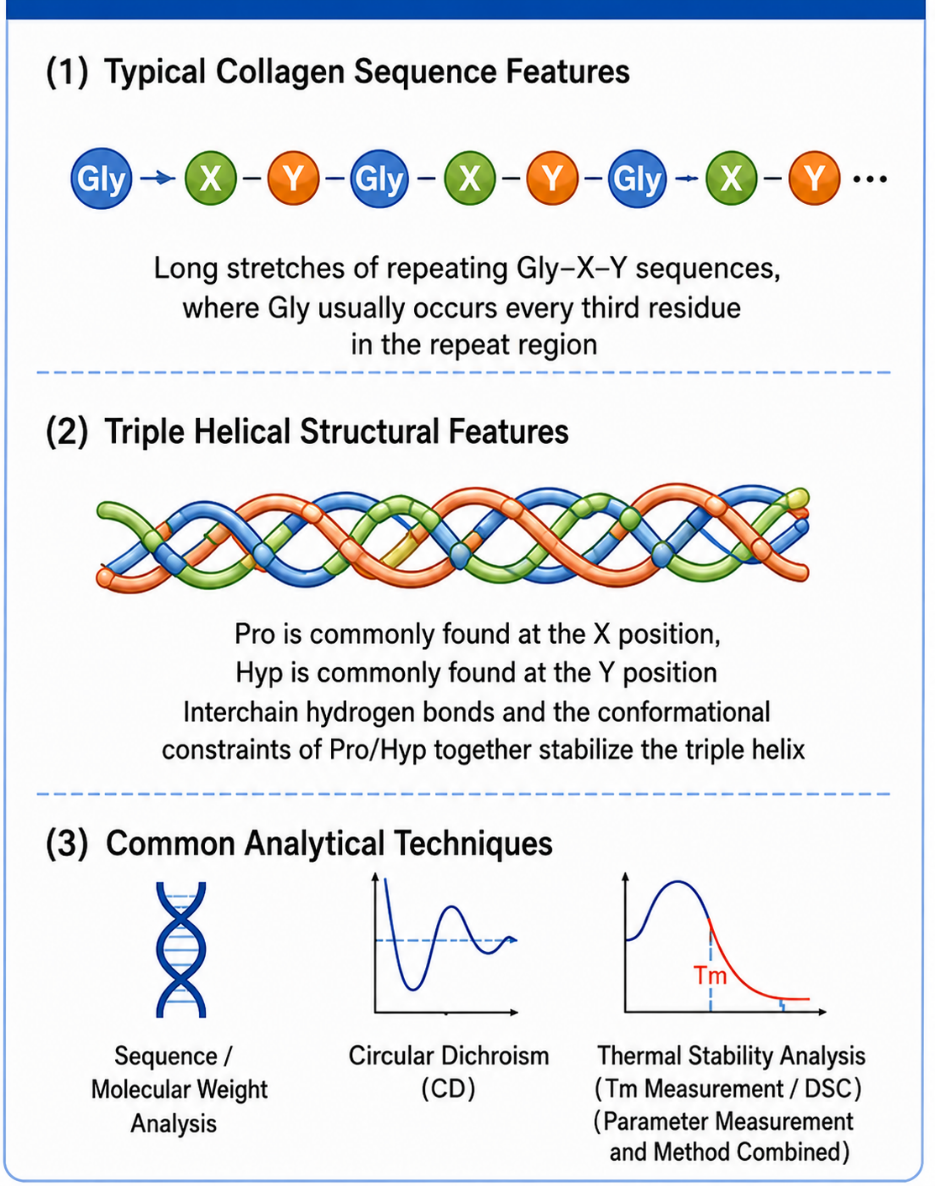
2.2 Collagen Sequence, Triple Helix, and Fibrils Represent Different Structural Levels
Collagen ingredients can be evaluated at three structural levels.
Structural Level | Main Features | Common Evaluation Methods | What It Can Demonstrate |
Primary structure | Amino acid sequence, Gly–X–Y repeat regions, and functional sites | Peptide mapping, mass spectrometry, amino acid sequencing, and terminal-group analysis | Which collagen sequences are present in the ingredient |
Triple helix | Pairing and folding state of the three polypeptide chains | Circular dichroism, differential scanning calorimetry, thermal denaturation analysis, and protease sensitivity | Whether the ingredient forms a collagen-characteristic conformation |
Higher-order assembly | Assembly of collagen molecules into fibrils or fibers | Transmission electron microscopy, atomic force microscopy, turbidity measurements, and assembly assays | Whether the ingredient has the capacity for further assembly |
2.3 Conventional Plant Protein Hydrolysates Do Not Possess Collagen-Characteristic Sequences
The major proteins in soy, wheat, rice, and peas are plant storage proteins or functional proteins. Their amino acid sequences do not contain the long Gly–X–Y repeat regions characteristic of collagen.
When plant proteins are hydrolyzed by enzymes, acids, or other methods, they form peptides of different lengths and free amino acids. Hydrolysis can alter solubility, viscosity, interfacial properties, and film-forming ability, but it cannot convert a plant protein sequence into a human collagen sequence, nor can it cause disordered peptide fragments to spontaneously form a native collagen triple helix.
3 How Are Plant Collagen-Related Ingredients Produced?
3.1 Production of Plant Protein Hydrolysates
Plant protein hydrolysates are commonly produced from soy, wheat, rice, corn, peas, or other plant materials. A typical production process includes:
Plant raw-material pretreatment → defatting or removal of non-protein components → protein extraction and separation → enzymatic hydrolysis, acid hydrolysis, or other controlled hydrolysis → enzyme inactivation or neutralization → filtration and decolorization → concentration → formulation as a liquid product or spray drying
During hydrolysis, proteases cleave specific peptide bonds and generate peptide fragments with different molecular weights. The enzyme type, reaction time, temperature, pH, and enzyme dosage collectively affect the degree of hydrolysis and molecular-weight distribution.
The principal components of these products remain hydrolysates of naturally occurring plant proteins. Even when enzyme preparations or microbial proteases are used during production, this does not mean that the product is fermentation-derived recombinant collagen.
3.2 Production of Plant-Expressed Recombinant Collagen
Plant-expressed recombinant collagen is produced by introducing a target collagen gene into plant cells so that the plant synthesizes a predesigned collagen protein or collagen fragment. A typical production process includes:
Collagen sequence selection and gene design → construction of a plant expression vector → introduction of the target sequence into plant cells or whole plants through stable transformation or transient expression → selection of stable expression lines or optimization of transient expression conditions → plant cultivation or scale-up of expression → harvesting of plant tissue or culture medium → extraction and clarification → separation and purification → concentration and formulation → sequence, structural, and impurity testing
A 2009 study co-expressed human type I collagen α chains, prolyl 4-hydroxylase, and lysyl hydroxylase 3 in transgenic tobacco. The resulting heterotrimeric recombinant human type I collagen formed a thermally stable triple helix and exhibited corresponding cell-binding activity.[7]
Plant-expressed products may also consist only of collagen fragments. A 2026 study used moss photobioreactors to secrete a human type III collagen polypeptide of approximately 30 kDa containing 334 amino acids and confirmed multiple proline hydroxylation sites by mass spectrometry. The product was a hydrophilic fragment selected from human type III collagen and was not equivalent to full-length type III collagen.[8]
Plant hosts can express both full-length collagen and functional collagen fragments. The actual structure of the product depends on the introduced sequence, co-expression of modifying enzymes, chain-pairing behavior, and the subsequent purification and folding state.
3.3 Production of Microbially Fermented Recombinant Collagen
Microbially fermented recombinant collagen is commonly produced using Escherichia coli, Saccharomyces cerevisiae, Pichia pastoris, or other engineered microorganisms. A typical production process includes:
Gene design and strain construction → seed culture → fermentation-tank cultivation → induced or secretory expression → cell disruption or clarification of the fermentation broth → membrane separation and chromatographic purification → removal of host-derived residues → concentration and formulation
Researchers have obtained hydroxylated recombinant collagen by co-expressing human type I, type II, or type III procollagen chains with prolyl 4-hydroxylase in Pichia pastoris.[9]
Recombinant collagen produced by microbial fermentation may be classified as non-animal-derived collagen, but it is not a protein extracted from plants. When terms such as “non-animal-derived,” “vegan-derived,” “plant-based collagen,” and “plant-expressed collagen” are used interchangeably in the market, the expression host and manufacturing-process documentation should be examined.
3.4 Relationships Between Different Ingredient Types and Fermentation, Extraction, and Purification
Ingredient Type | Whether Plant Extraction Is Required | Whether Fermentation Is Usually Involved | Whether Protein Purification Is Required |
Plant protein hydrolysates | Yes | Usually no | Filtration, decolorization, and fractionation are required, but purification to a single protein is not necessarily achieved |
Recombinant collagen expressed in whole plants | Yes | Usually not microbial fermentation | Yes |
Recombinant collagen expressed in plant-cell or moss bioreactors | May be isolated from the culture medium or cells | Produced in a cell-culture bioreactor system | Yes |
Bacterial or yeast recombinant collagen | No | Yes | Yes |
Plant-extract composite ingredients | Yes | Depends on the specific process | Extract refinement is usually performed rather than collagen-protein purification |
4 How Do Plant Collagen-Related Ingredients Act on the Skin?
4.1 Surface Hydration Arises from the Hydrophilic Groups of Proteins and Peptides
Proteins and polypeptides contain polar groups such as peptide bonds, carboxyl groups, amino groups, and hydroxyl groups, which can interact with water through hydrogen bonding or ionic interactions. After application to the skin, some proteins and peptide fragments remain on the skin surface and the outer side of the stratum corneum, increasing local water binding and surface hydration.
The degree of hydrolysis affects this function. As molecular weight decreases, plant proteins generally exhibit improved dispersibility in water and lower viscosity. However, when hydrolysis is excessive, the proportion of free amino acids and short peptides increases, and the ability to form a continuous film may decline.
This moisturizing effect mainly arises from the intrinsic hydrophilicity and surface retention of the ingredient. It does not mean that plant proteins have been converted into collagen within the skin.
4.2 Protein Films Improve the Surface Feel of the Skin
Proteins and polypeptides of sufficient chain length can remain on the skin surface after water evaporates, forming a continuous or partially continuous film. This film can alter skin-surface friction, smoothness, and tactile properties, causing dry skin to feel temporarily softer and smoother.
When hydrolyzed wheat protein is used in cosmetics, its main functions include skin conditioning and film formation. Its film-forming performance is affected by molecular-weight distribution, protein concentration, humidity, plasticizers, and the emulsion system.[6]
Film formation is not equivalent to repairing dermal collagen fibers. A surface film is a formulation and interfacial effect, whereas dermal collagen is a tissue structure synthesized and assembled by fibroblasts.
4.3 The Topical Effects of Intact Collagen Are Generally Concentrated at the Skin Surface
The healthy stratum corneum consists of corneocytes and intercellular lipids and serves as the principal barrier to the entry of topically applied substances into the skin. Intact collagen and most recombinant collagens are relatively large and highly hydrophilic proteins, making it difficult for them to passively diffuse in substantial amounts through an intact stratum corneum. Research on skin-diffusion mechanisms also shows that molecular size, lipophilicity, charge, and the formulation vehicle collectively determine the distribution of topically applied ingredients within the skin.[10]
Therefore, for intact collagen or high-molecular-weight recombinant collagen without validated delivery data, the better-supported topical effects mainly include:
① hydration of the skin surface;
② protein film formation;
③ improvement in skin feel and softness;
④ conditioning of the surface state of the stratum corneum.
Hydrolysis can reduce the molecular weight of peptide fragments, but their ability to reach the dermis cannot be inferred from average molecular weight alone. The charge, hydrophilicity, conformation, aggregation state, and formulation composition of the peptides also affect their distribution within the skin.
4.4 Potential Cellular Effects of Plant-Expressed Recombinant Collagen Fragments
Plant-expressed recombinant collagen may consist of intact collagen proteins or functional fragments containing specific collagen sequences. Some collagen fragments with clearly defined sequences may affect cell adhesion, proliferation, or extracellular-matrix-related processes under cell-culture conditions. However, their specific effects depend on the amino acid sequence, three-dimensional structure, test concentration, and cell model and cannot be inferred solely from the designation “collagen fragment.”
Conventional plant protein hydrolysates, such as soy protein peptides and wheat protein peptides, do not possess the same collagen-characteristic sequences and therefore cannot be assumed to exert the same collagen-sequence-related cellular effects.
Cell-based experiments reflect the potential activity of a specific collagen fragment under defined conditions. When plant-expressed recombinant collagen is used in topical skincare products, its actual effects must also be evaluated in relation to formulation stability, distribution within the skin, and human topical-use studies.
5 Differences Among Plant Protein Hydrolysates, Plant-Expressed Recombinant Collagen, and Other Plant-Derived Ingredients
Plant protein hydrolysates, plant-expressed recombinant collagen, plant extracts, and plant-derived moisturizing ingredients may all be used in skincare formulations, but they differ in chemical composition, structural features, principal functions, and quality-evaluation methods.
Comparison Item | Plant Protein Hydrolysates | Plant-Expressed Recombinant Collagen | Plant Extracts | Plant-Derived Moisturizing Ingredients |
Core composition | Mainly plant protein peptides of different lengths; may contain free amino acids and small amounts of incompletely hydrolyzed protein | Collagen proteins, collagen chains, or functional collagen fragments expressed according to the target gene | Multicomponent mixtures that vary according to the botanical source, plant part used, and extraction process | Glycerol, sugar alcohols, betaine, monosaccharides, oligosaccharides, plant polysaccharides, and related substances |
Basis for ingredient definition | Botanical source, protein type, hydrolysis method, protein or peptide content, and molecular-weight distribution | Expression host, amino acid sequence, collagen type, molecular weight, and three-dimensional structure | Botanical source, extraction part, extraction solvent, marker compounds, and extract content | Individual small molecules are evaluated by chemical identity, content, and purity; plant polysaccharides also require evaluation of source, molecular weight, monosaccharide composition, and viscosity |
Collagen-characteristic sequence | Usually does not contain continuous collagen Gly–X–Y repeats | May contain human collagen or designed collagen sequences | Usually does not contain collagen-characteristic sequences | Usually does not contain collagen-characteristic sequences |
Triple-helical structure | Usually absent | May form in some products and must be confirmed through structural testing | Absent | Absent |
Principal topical effects | Surface humectancy, film formation, skin conditioning, and improvement in skin feel | Surface hydration and film formation; fragments containing specific functional sequences may exhibit sequence-dependent activity | Effects depend on the specific components and may involve antioxidant, soothing, skin-conditioning, or other biological activities | Humectancy, water binding, reduction of surface water loss, or formation of a hydrated film |
Key quality indicators | Protein or peptide content, degree of hydrolysis, molecular-weight distribution, residual intact protein, solubility, and potential allergens | Sequence, molecular weight, purity, post-translational modifications, three-dimensional conformation, aggregates, host-derived impurities, and stability | Marker compounds, extraction solvents, pesticide residues, heavy metals, microorganisms, and batch consistency | Content, purity, molecular weight, viscosity, moisture-absorption or water-retention performance, and formulation compatibility |
Plant protein hydrolysates are evaluated mainly according to protein source, degree of hydrolysis, and peptide-fragment distribution. Their skincare effects are generally concentrated on surface hydration, film formation, and conditioning. Plant-expressed recombinant collagen requires confirmation of the target sequence, collagen type, three-dimensional structure, and host-related impurities. The presence of a triple helix cannot be inferred solely from the terms “recombinant” or “plant-expressed.”
Plant extracts are multicomponent systems whose composition varies with the botanical source and processing method. Their effects must be linked to specific marker compounds and test results. Plant-derived moisturizing ingredients include both structurally defined small molecules and more complex plant polysaccharides with heterogeneous composition and molecular-weight distributions. They should be evaluated according to their specific chemical classes rather than being characterized solely as “plant-derived.”
6 Application Value and Limitations of Plant Collagen-Related Ingredients
In skincare products, “plant collagen” may refer to plant protein hydrolysates or to plant-expressed recombinant collagen. Both types can avoid conventional collagen derived from animal tissues, but their structural basis, skincare effects, and technical requirements are different.
6.1 Application Value and Limitations of Plant Protein Hydrolysates
Plant protein hydrolysates prepared from soy, wheat, rice, or pea proteins generally consist of plant protein peptides of different lengths together with small amounts of free amino acids. These ingredients do not possess typical human collagen sequences or a triple-helical structure. Their skincare value mainly arises from the moisture-binding, film-forming, and surface-conditioning properties of the protein peptides.
Application Value | Main Limitations |
Can reduce reliance on raw materials derived from bovine, porcine, or fish tissues | Not collagen in the structural sense |
Usually exhibits some water solubility after hydrolysis, facilitating incorporation into aqueous formulations | Complex peptide composition and substantial differences among products |
Can form a protein film on the skin surface and improve softness and smoothness | Effects are mainly concentrated on the skin surface and near the stratum corneum |
Solubility, film-forming properties, and skin feel can be adjusted through the degree of hydrolysis | Excessive hydrolysis may reduce film-forming ability, whereas insufficient hydrolysis may cause turbidity or precipitation |
Can be used in skincare products designed to avoid animal-derived ingredients | Wheat- and soy-derived materials require attention to residual proteins and potential allergenic risks |
6.2 Application Value and Limitations of Plant-Expressed Recombinant Collagen
Plant-expressed recombinant collagen is produced by introducing human collagen sequences or designed collagen sequences into plant cells or whole plants, allowing the plant expression system to synthesize the target protein. In this process, the plant serves as the production host. The resulting protein may contain collagen-derived sequences, but whether it forms a stable triple helix must be confirmed for the specific product.
Application Value | Main Limitations |
Collagen type and amino acid sequence can be specifically designed | Expression of a collagen sequence does not necessarily mean that the correct triple helix has formed |
Can produce full-length collagen, collagen chains, or specific functional fragments | Long repetitive sequences may result in low expression levels, degradation, or aggregation |
Reduces reliance on collagen extracted from animal tissues | Plant hosts may lack some of the modifications required for collagen maturation |
Helps control target-protein composition and batch consistency | Plant host proteins, nucleic acids, pigments, and other process-related residues must be controlled |
Sequence length, hydrophilicity, and functional sites can be adjusted according to the intended use | Separation, purification, structural confirmation, and stability control are technically demanding |
The value of plant-expressed recombinant collagen lies mainly in the designability of its sequence and the traceability of its production source. Its skincare effects also depend on protein molecular weight, triple-helical state, formulation stability, and distribution within the skin. Larger intact collagen molecules generally act mainly through surface hydration and film formation. Collagen fragments containing specific functional sequences may have additional biological effects, but these require support from topical-delivery and human studies.
6.3 Differences in the Effects of Plant Protein Hydrolysates and Plant-Expressed Recombinant Collagen
Plant protein hydrolysates and plant-expressed recombinant collagen may both be referred to as “plant collagen,” but the basis of their effects is different.
Plant protein hydrolysates:
Natural plant proteins → hydrolysis into peptide mixtures → surface humectancy and protein film formation → skin conditioning and improvement in skin feel
Plant-expressed recombinant collagen:
Collagen gene or designed sequence → expression and purification in plant cells → production of collagen protein or collagen fragments → hydration, film formation, or sequence-dependent effects according to molecular structure
Plant protein hydrolysates are derived from naturally occurring plant proteins. Their skincare effects are mainly associated with humectancy, film formation, and conditioning of the skin surface. Findings from studies of collagen-derived peptides cannot be directly applied to plant protein hydrolysates to infer collagen-sequence-related biological effects.
Even when plant-expressed recombinant collagen is labeled as “plant-expressed” or “humanized,” its actual structure must be confirmed according to the product’s sequence design and intended structure through testing of the amino acid sequence, molecular weight, post-translational modifications, and corresponding conformation. Whether it can reach the relevant skin layers after topical application must also be evaluated through studies of skin distribution and human topical use.
The skincare value of plant collagen-related ingredients should be assessed by considering the ingredient type, the content of the target protein or peptide fragment, molecular structure, stability in the final formulation, and efficacy evidence obtained under conditions relevant to topical use.
7 Classification and Research Applications of Representative Chemicals Related to Plant Collagen Ingredients, Collagen Structural Features, Protein Processing, and Skincare Evaluation
Note: The products listed below include plant-expressed recombinant collagen, plant protein and collagen structural controls, collagen-characteristic amino acids and peptides, reagents for protein hydrolysis and purification, components used in hydroxylation studies, protein quality-analysis reagents, and reference materials for moisturizing-performance evaluation. Gluten, soy protein isolate, gelatin, glycerol, and sodium hyaluronate are used primarily as structural, performance, or formulation controls and are not necessarily classified as plant collagen.
Table 1 Plant-Expressed Recombinant Collagen, Plant Protein, and Collagen Structural Control Products
Category | CAS No. | Aladdin Item No. | Name | Specification or Purity | Product Features and Applications |
Core plant-expressed recombinant collagen ingredient | 9007-34-5 | Recombinant Humanized Type III Collagen | Animal-origin-free, carrier-free, recombinant, ≥90% (SDS-PAGE), expressed in Nicotiana benthamiana | Used to study the sequence, molecular weight, purity, structural stability, protein hydration, film-forming properties, and formulation compatibility of plant-expressed recombinant humanized type III collagen. | |
Denatured collagen structural control | 9000-70-8 | Gelatin | Suitable for microbiology, gel strength ~250 g Bloom | Used as a structural control for collagen after triple-helix denaturation and in studies of gel formation, hydration, film formation, thermal response, and proteolysis. | |
Wheat plant protein control | 8002-80-0 | G757920 | Gluten (from Wheat) | Total Nitrogen min. 12.0% | Used for comparative studies of conventional plant proteins and recombinant collagen in terms of amino acid composition, solubility, protein hydrolysis, aggregation behavior, and film-forming performance. |
Soy plant protein control | 9010-10-0 | Soy Protein Isolate | ≥90% | Used to study plant protein extraction, degree of hydrolysis, molecular-weight distribution, hydration and film formation, and differences in structure and performance between plant proteins and recombinant collagen. |
Table 2 Products Related to Collagen-Characteristic Amino Acids, Peptides, and Hydroxylation Studies
Category | CAS No. | Aladdin Item No. | Name | Specification or Purity | Product Features and Applications |
Core amino acid in collagen repeat sequences | 56-40-6 | Glycine | Moligand™, molecular biology grade, ≥99% (NT) | Used to study collagen repeat sequences, amino acid composition, glycine content, and collagen-like peptide sequence design. | |
Amino acid associated with collagen conformation | 147-85-3 | L-Proline | Animal-origin-free, USP, European Pharmacopoeia (Ph. Eur.), for cell culture, ≥99% | Used to study proline-rich collagen sequences, peptide-chain conformation, amino acid composition, and cell-culture systems. | |
Collagen hydroxylation-characteristic amino acid | 51-35-4 | L-Hydroxyproline | Moligand™, ≥99% | Used for collagen-related hydroxyproline quantification, evaluation of hydroxylation levels, calibration-curve preparation, and analysis of protein hydrolysates. | |
Amino acid related to collagen hydroxylation and crosslinking | 56-87-1 | L-Lysine | Moligand™, ≥98%, metals <500 ppm | Used to study collagen amino acid composition, lysine hydroxylation, glycosylation, and crosslinking precursors. | |
Collagen repeat-sequence tripeptide control | 2239-67-0 | Glycine-Proline-Hydroxyproline | Moligand™, ≥98% | Used in collagen repeat-sequence models, tripeptide conformational studies, identification of enzymatic hydrolysis products, and studies of cellular responses to specific collagen peptides. | |
Collagen-derived dipeptide control | 18684-24-7 | 4-Hydroxy-1-L-prolyl-L-proline | ≥98% | Used as a chromatographic and mass-spectrometric reference for collagen-derived dipeptides and in the identification of hydrolysis products, cellular uptake studies, and comparative cellular-response studies. | |
Reducing cofactor for collagen hydroxylation | 50-81-7 | L-Ascorbic Acid | Anhydrous grade, Moligand™, ACS, ≥99% | Used to study its reducing cofactor function in collagen proline- and lysine-hydroxylation systems and as a collagen-synthesis-related control in cell culture. | |
Cosubstrate for collagen hydroxylation reactions | 328-50-7 | α-Ketoglutaric Acid | Moligand™, ≥98% | Used as a cosubstrate in collagen prolyl hydroxylase and lysyl hydroxylase reaction systems and in studies of enzyme activity and reaction conditions. | |
Ferrous ion source for collagen hydroxylation reactions | 7720-78-7 | Ferrous Sulfate Solution | 5% in H₂O | Used as a source of ferrous ions in collagen hydroxylase reaction systems and for studying metal-ion dependence and screening hydroxylation conditions. |
Table 3 Products Related to Proteolysis, Recombinant Protein Purification, and Quality Analysis
Category | CAS No. | Aladdin Item No. | Name | Specification or Purity | Product Features and Applications |
Enzyme for collagen degradation and enzyme-sensitivity studies | 9001-12-1 | Collagenase from Clostridium histolyticum (Animal-Origin-Free, C) | EnzymoPure™, ≥200 units/mg dry weight | Used to study collagen degradation, enzyme sensitivity, structural integrity, degradation kinetics, and recombinant collagen stability. | |
Enzyme for acidic collagen digestion and peptide-mapping analysis | 9001-75-6 | Recombinant Pepsin, Mass Spectrometry Grade | Animal-origin-free, carrier-free, biologically active, mass spectrometry grade (MS), ActiBioPure™, EnzymoPure™, for protein sequencing, ≥10,000 U/g enzyme powder; ≥20,000 U/g protein | Used for acidic digestion of collagen, telopeptide processing, peptide-map preparation, protein sequencing, and mass-spectrometry sample preparation. | |
Enzyme for plant protein hydrolysis | 9001-73-4 | Papain | Biologically active, ActiBioPure™, natural, high-performance, EnzymoPure™, from Carica papaya; ≥2,000 U/mg enzyme powder, using casein as the substrate | Used for controlled enzymatic hydrolysis of soy, wheat, and other plant proteins, peptide preparation, and studies of degree of hydrolysis and molecular-weight distribution. | |
Protein denaturation and sample-solubilization reagent | 57-13-6 | Urea Solution | UltraBio™, ~8 M in H₂O | Used for protein denaturation, aggregate dissociation, solubilization of poorly soluble protein samples, and electrophoresis or mass-spectrometry sample preparation. | |
Protein electrophoresis denaturant | 151-21-3 | Sodium Dodecyl Sulfate (SDS) | Anhydrous grade, ACS, ≥99% | Used for sample denaturation in sodium dodecyl sulfate–polyacrylamide gel electrophoresis and for analysis of recombinant collagen molecular weight, purity, and degradation fragments. | |
Protein-chain reducing agent | 3483-12-3 | DL-Dithiothreitol (DTT) | Molecular biology grade, ≥99% | Used to reduce protein disulfide bonds, analyze interchain linkages, and prepare samples for electrophoresis and mass spectrometry. | |
Recombinant protein affinity-purification reagent | 288-32-4 | Imidazole | Anhydrous grade, ACS, ≥99% | Used for washing and eluting polyhistidine-tagged recombinant collagen or related proteins during immobilized metal-affinity chromatography. | |
Protein quantification dye | 6104-58-1 | Coomassie Brilliant Blue G-250 | AR | Used for protein quantification by the Coomassie Brilliant Blue method, evaluation of recombinant collagen recovery, and comparison of protein-sample concentrations. | |
Free amino group colorimetric reagent | 485-47-2 | Ninhydrin Hydrate | AR | Used for colorimetric analysis of free amino acids, reactive free amino groups, degree of protein hydrolysis, and plant protein hydrolysates. | |
Hydroxyproline colorimetric reagent | 100-10-7 | p-Dimethylaminobenzaldehyde | ≥98% | Used together with chloramine-T for colorimetric quantification of hydroxyproline and analysis of hydroxyproline content in collagen-related samples. | |
Hydroxyproline oxidation reagent | 127-65-1 | Chloramine-T | ≥98% | Used in the oxidative colorimetric reaction of hydroxyproline and, together with p-dimethylaminobenzaldehyde, for quantitative analysis of collagen-related samples. |
Table 4 Reference Products for Moisturizing, Film-Forming, and Formulation Performance
Category | CAS No. | Aladdin Item No. | Name | Specification or Purity | Product Features and Applications |
Small-molecule humectant control | 56-81-5 | Glycerol | Anhydrous grade, UltraBio™, molecular biology grade, ≥99.5% (GC) | Used as a solvent, humectant, and protein-film plasticizing component in plant protein or recombinant collagen formulations and as a small-molecule humectant control. | |
High-molecular-weight hydration and film-forming control | 9067-32-7 | Sodium Hyaluronate | European Pharmacopoeia (Ph. Eur.) | Used as a reference for high-molecular-weight hydration, film formation, and moisturizing performance and in rheological and skin-hydration studies of recombinant collagen combination systems. |
References
[1] National Medical Products Administration. Filing of New Cosmetic Ingredients: Under What Circumstances Is an Ingredient Not Considered a New Cosmetic Ingredient? [EB/OL]. Government Service Portal of the National Medical Products Administration.
[2] Kieliszewski MJ, Lamport DTA. Extensin: Repetitive Motifs, Functional Sites, Post-Translational Codes, and Phylogeny. The Plant Journal. 1994;5(2):157–172. DOI: 10.1046/j.1365-313X.1994.05020157.x.
[3] Xiao C, Anderson CT. Interconnections Between Cell Wall Polymers, Wall Mechanics, and Cortical Microtubules: Teasing Out Causes and Consequences. Plant Signaling & Behavior. 2016;11(9):e1215396. DOI: 10.1080/15592324.2016.1215396.
[4] Shoulders MD, Raines RT. Collagen Structure and Stability. Annual Review of Biochemistry. 2009;78:929–958. DOI: 10.1146/annurev.biochem.77.032207.120833.
[5] Rappu P, Salo AM, Myllyharju J, Heino J. Role of Prolyl Hydroxylation in the Molecular Interactions of Collagens. Essays in Biochemistry. 2019;63(3):325–335. DOI: 10.1042/EBC20180053.
[6] Cosmetic Ingredient Review Expert Panel. Safety Assessment of Hydrolyzed Wheat Protein and Hydrolyzed Wheat Gluten as Used in Cosmetics: Final Report[R]. Washington, DC: Cosmetic Ingredient Review, 2014.
[7] Stein H, Wilensky M, Tsafrir Y, Rosenthal M, Amir R, Avraham T, Ofir K, Dgany O, Yayon A, Shoseyov O. Production of Bioactive, Post-Translationally Modified, Heterotrimeric, Human Recombinant Type-I Collagen in Transgenic Tobacco. Biomacromolecules. 2009;10(9):2640–2645. DOI: 10.1021/bm900571b.
[8] Bohlender LL, Parsons J, Mitgau A, Hoernstein SNW, Grigolon G, Henes B, Decker EL, Reski R. Secretion-Based Production of Prolyl-Hydroxylated Human Type III Collagen in Scalable Physcomitrella Photobioreactors. Plant Cell Reports. 2026;45:45. DOI: 10.1007/s00299-026-03727-7.
[9] Myllyharju J, Nokelainen M, Vuorela A, Kivirikko KI. Expression of Recombinant Human Type I–III Collagens in the Yeast Pichia pastoris. Biochemical Society Transactions. 2000;28(4):353–357. DOI: 10.1042/BST0280353.
[10] Neubert RHH. Mechanisms of Penetration and Diffusion of Drugs and Cosmetic Actives Across the Human Stratum Corneum. European Journal of Pharmaceutics and Biopharmaceutics. 2024;202:114394. DOI: 10.1016/j.ejpb.2024.114394.
For more related articles, see below:
Antioxidant Mechanisms, Stability, and Delivery Strategies of Resveratrol in Skincare Research
Beneath the Skin: Protein- and Peptide-Based Actives in Skincare and Aesthetic Medicine
Hyaluronidase: Unlocking a “Magic Enzyme” in Biomedicine
Trehalose: Physicochemical Characteristics, Manufacturing Processes, and Application Guidelines
Sources, Biological Functions, Isolation/Characterization, and Emerging Applications of Exosomes
Applicability Comparison of Vitronectin, Laminin and Fibronectin in Cell Culture Coating Systems
Ferulic Acid: Structural Features, Preparation Routes, and Key Points for Research Applications
Role of Sphingolipid Metabolic Remodeling in Apoptotic and Inflammatory Signaling
How to decipher the whitening code?
Niacin (Vitamin B3): Structural Features, Metabolic Roles, and Application Landscape
The "Six Key Checkpoints" of Skin Lightening
Tyrosinase: a key regulatory enzyme in melanin synthesis and its biological and applied significance
Enzymatic Hydroxylation Mechanism of Salicylate Conversion to Catechol


 危险品化学品经营许可证(带存储)