氧化型谷胱甘肽 (GSSG)是还原型谷胱甘肽 (GSH)的氧化形式,又称为二硫代谷胱甘肽,是两分子的谷胱甘肽氧化而成。GSSG会被谷胱甘肽还原酶还原成GSH,因此机体中大多数是以还原型形式存在。测定细胞内GSH和 GSSG 含量以及GSH/GSSG比值,能够很好地反映细胞所处的氧化还原状态。
本试剂盒检测原理:还原型谷胱甘肽能和5,5-二硫双(2-硝基苯甲酸)(DTNB)反应生成2-硝基-5-巯基苯甲酸,在波长412 nm处具有最大光吸收,通过2-乙烯吡啶抑制样品中原有的还原型谷胱甘肽,然后利用谷胱甘肽还原酶(Glutathione reductase,GR)将 GSSG还原为GSH,借此测定氧化型谷胱甘肽的含量。
G1373338 | 组件 | 物料外观 | 96T | 储存 | 单次测试使用量 |
G1373338A | 检测缓冲液 | 无色液体 | 14 mL | -20℃. | 133 µL |
G1373338B | 提取液 | 无色液体 | 60 mL | -20℃. | 按需 |
G1373338C | 抑制剂 | 淡黄色液体 | 200 µL | -20℃.避光. | 2 µL |
G1373338D | 谷胱甘肽还原酶 | 无色液体 | 200 µL | -20℃.避光. | 2 µL |
G1373338E | 辅因子 | 粉末 | 8.4 mg | -20℃.避光. | 按需 |
G1373338F | 显色液 | 淡黄色液体 | 4 mL | -20℃.避光. | 40 µL |
G1373338G | GSSG标准品 | 无色液体 | 1 mL | -20℃.避光. | 按需 |
注意:抑制剂有毒,建议在通风橱内操作。
使用方法
1. 自备试剂耗材
(1) 96 孔板,1.5 mL离心管,匀浆器或者超声破碎仪。
(2) 37℃恒温培养箱或者水浴锅,酶标仪。
(3) 无水乙醇,无菌去离子水,PBS。
2. 试剂准备
(1) 辅因子工作液配制:将8.4 mg辅因子粉末用1 mL无菌去离子水完全溶解,终浓度10 mM。在使用时建议分装成多支小管,-20℃避光保存,避免反复冻融。
(2) 抑制剂工作液配制:取1体积抑制剂+2体积无水乙醇混匀后即可,-20℃避光保存。
(3) 谷胱甘肽还原酶在冰上解冻,检测缓冲液,提取液和显色液可平衡至室温。
(4) 标准品配制:取10 μL GSSG标准品(1 mg/mL)+ 90 μL提取液稀释至100 μg/mL,然后再用提取液分别稀释至20 μg/mL,10 μg/mL,5 μg/mL,2.5μg/mL,1.25 μg/mL,0.625 μg/mL,0 μg/mL。建议每次实验都重新制作标准曲线。
3. 样本制备
(1) 组织样本:请尽量使用新鲜的组织样本进行测定。每10 mg组织样本加入100-200 μL提取液,快速冰上匀浆(匀浆器提前放冰上预冷)。匀浆后的样本,4℃,8,000 g 离心10 min,取上清液,置冰上待测。
(2) 血液样品:对于血清样品,将全血在常温下静置30分钟-2小时,4ºC约1000-2000×g离心10分钟,取上清;对于血浆样品,将全血用肝素或者EDTA进行抗凝,4ºC约1000-2000×g离心10分钟,取上清。
(3) 细胞(菌)样本:请尽量使用新鲜的细胞(菌)进行测定,而不要使用冻存的细胞(菌)进行测定。收集个细胞(菌),首先用预冷的PBS 清洗细胞(菌)2 次(PBS 重悬,4℃ 500 g 离心 5 min),1×106 个细胞(菌)建议加入100-200 μL提取液重悬,冰浴超声波破碎 (200W,超声 2s,间隔 3s,5min),4℃,8,000 g 离心 5 min,取上清液,置冰上待测。
4. 样品测定
在1.5 mL EP管内按照如下方式加样
试剂 | 空白孔 (μL) | 测定孔 (μL) | 标准孔 (μL) |
样本 | - | 28 | - |
去离子水 | 28 | - | - |
标准品 | - | - | 28 |
抑制剂工作液 | 2 | 2 | 2 |
混匀,37℃孵育 15 min,离心,分别吸取20 μL至96孔板当中,并按照如下方式加样 |
检测缓冲液 | 133 | 133 | 133 |
谷胱甘肽还原酶 | 2 | 2 | 2 |
辅因子工作液 | 5 | 5 | 5 |
显色液 | 40 | 40 | 40 |
混匀后,于37℃避光孵育10 min,然后读取 A₄₁₂ 。Δ标准=A测定 - A空白;Δ标=A标准 - A空白
注意:添加抑制剂时,需在1.5 mLEP内进行添加,不能直接在96孔板中添加,抑制剂会直接腐蚀96孔板,影响消除效率。
5. 结果计算
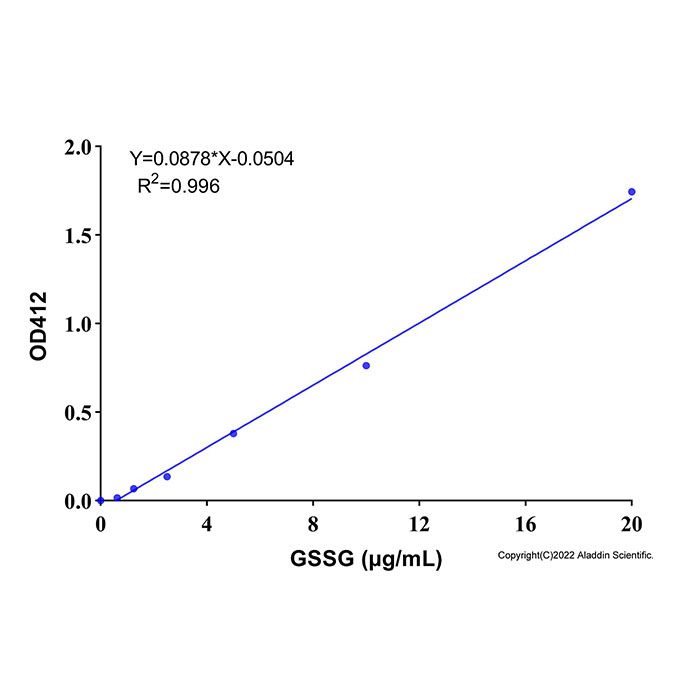
(1) 标准曲线:y=0.0878*X -0.0504(仅供参考);x是GSSG的浓度(μg/mL),y 是△A。

可根据标准曲线计算出样品中的GSSG浓度(C),计算公示如下:
C (μg/mL)=A×n
注:A为根据标准曲线计算出的GSSG浓度(μg/mL);n为样品稀释倍数。
注意事项
1. 辅因子配制完后记得分装-20℃避光保存,抑制剂,GSSG标准品和显色液同样避光保存。
2. 抑制剂有毒,建议在通风橱内操作。
3. 添加抑制剂消除GSH时,需在1.5 mLEP内进行添加,不能直接在96孔板中添加,抑制剂会直接腐蚀96孔板,影响消除效率。
4. 本产品仅限于专业人员的科学研究用,不得用于临床诊断或治疗,不得用于食品或药品,不得存放于普通住宅内。
Oxidized Glutathione (GSSG), also known as disulfide glutathione, is the oxidized form of reduced Glutathione (GSH) and is formed by the oxidation of two GSH molecules. GSSG can be reduced back to GSH by glutathione reductase in vivo, so glutathione predominantly exists in the reduced form in organisms. The detection of intracellular GSH and GSSG contents, as well as the GSH/GSSG ratio, serves as a reliable indicator for evaluating the intracellular redox state.
In this kit: Reduced glutathione reacts with 5,5'-dithio-bis-(2-nitrobenzoic acid) (DTNB) to produce 2-nitro-5-thiobenzoic acid, which exhibits maximum light absorption at a wavelength of 412 nm. 2-vinylpyridine is used to inhibit endogenous reduced glutathione in samples. Subsequently, glutathione reductase (GR) reduces GSSG to GSH, enabling the quantitative detection of oxidized glutathione content.
G1373338 | Components | Appearance | 96T | Storage | Usage volume per test |
G1373338A | Assay Buffer | Colorless liquid | 14 mL | -20℃. | 133 µL |
G1373338B | Extraction Buffer | Colorless liquid | 60 mL | -20℃. | As need |
G1373338C | Inhibitor | light yellow liquid | 200 µL | -20℃.Store in the dark. | 2 µL |
G1373338D | GR | Colorless liquid | 200 µL | -20℃.Store in the dark. | 2 µL |
G1373338E | Cofactor | Powder | 8.4 mg | -20℃.Store in the dark. | As need |
G1373338F | Chromogen | light yellow liquidd | 4 mL | -20℃.Store in the dark. | 40 µL |
Note: The inhibitor is toxic. All operations should be carried out in a fume hood.
Usage Method
1. Self-supplied Reagents and Consumables
(1) 96-well plate, 1.5 mL centrifuge tubes, homogenizer or sonicator.
(2) 37 °C constant temperature incubator or water bath, microplate reader.
(3) Absolute ethanol, sterile deionized water, PBS
2. Reagent Preparation
(1) Preparation of cofactor working solution: Completely dissolve 8.4 mg of cofactor powder in 1 mL of sterile deionized water to obtain a final concentration of 10 mM. It is recommended to aliquot the solution into small tubes before use, store at −20 °C protected from light, and avoid repeated freeze–thaw cycles.
(2) Preparation of inhibitor working solution: Mix 1 volume of inhibitor with 2 volumes of absolute ethanol thoroughly. Store at −20 °C protected from light.
(3) Thaw glutathione reductase on ice. Equilibrate the detection buffer, extraction buffer, and chromogenic solution to room temperature before use.
(4) Preparation of standard solution: Dilute 10 μL of GSSG standard (1 mg/mL) with 90 μL of Extraction Buffer to prepare a 100 μg/mL working solution. Further serially dilute the solution with Extraction Buffer to obtain concentrations of 20 μg/mL, 10 μg/mL, 5 μg/mL, 2.5 μg/mL, 1.25 μg/mL, 0.625 μg/mL, and 0 μg/mL. It is recommended to prepare a fresh standard curve for each experiment.
3. Sample Preparation
(1) Tissue samples: Use fresh tissue samples for detection whenever possible. Add 100–200 μL of Extraction Buffer per 10 mg of tissue, and perform rapid homogenization on ice (pre‑cool the homogenizer on ice in advance). Centrifuge the homogenized sample at 8,000 g and 4 °C for 10 min, and collect the supernatant for detection on ice.
(2) Blood samples: For serum samples, allow whole blood to stand at room temperature for 30 minutes to 2 hours, then centrifuge at 1,000–2,000 g and 4 °C for 10 minutes and collect the supernatant. For plasma samples, anticoagulate whole blood with heparin or EDTA, centrifuge at 1,000–2,000 g and 4 °C for 10 minutes, and collect the supernatant.
(3) Cell/bacterial samples: Use fresh cells or bacteria for detection; frozen samples are not recommended. Collect cells or bacteria and wash twice with pre-cooled PBS (resuspend in PBS and centrifuge at 500 g and 4 °C for 5 min). Resuspend 1×10⁶ cells or bacteria in 100–200 μL of Extraction Buffer, and lyse by ultrasonic disruption on ice (200 W, 2 s ultrasound, 3 s interval, 5 min total duration). Centrifuge the lysate at 8,000 g and 4 °C for 5 min, and collect the supernatant for detection on ice.
4. Sample Detection
Add reagents in 1.5 mL EP tubes as listed below:
Reagent | Blank well (μL) | Sample well (μL) | Standard well (μL) |
Sample | - | 28 | - |
Deionized water | 28 | - | - |
Standard solution | - | - | 28 |
Inhibitor Workig Solution | 2 | 2 | 2 |
Mix thoroughly, incubate at 37 °C for 15 min, then centrifuge. Transfer 20 μL of each mixture to a 96-well plate, and add the following reagents: |
Assay buffer | 133 | 133 | 133 |
GR | 2 | 2 | 2 |
Cofactor Working Solution | 5 | 5 | 5 |
Chromogen | 40 | 40 | 40 |
Mix well, incubate at 37 °C in the dark for 10 min, then measure absorbance at 412 nm.
Δ Aₛₜₐₙdₐᵣd = Aₛₐₘₚₗₑ− Abₗₐₙₖ; ΔStandard = Aₛₜₐₙdₐᵣd-Abₗₐₙₖ.
5. Calculation of Results
(1) Standard curve: y = 0.0878*X − 0.0504 (for reference only); X represents GSSG concentration (μg/mL), and y refers to ΔA.

The GSSG concentration (C) in samples can be calculated via the standard curve using the formula below:
C (μg/mL) = A × n
Note: A is the GSSG concentration (μg/mL) calculated from the standard curve; n is the sample dilution factor.
Precautions
1. Aliquot the prepared cofactor working solution and store at −20 °C protected from light. The inhibitor, GSSG standard and chromogenic solution shall also be stored away from light.
2. The inhibitor is toxic; all related operations should be performed in a fume hood.
3. The inhibitor used to block endogenous GSH must be added in 1.5 mL EP tubes rather than directly into the 96-well plate. The inhibitor may corrode the plate and reduce masking efficiency.
4. This product is for research use only by qualified professionals. It shall not be used for clinical diagnosis or treatment, food or pharmaceutical manufacturing, and shall not be stored in residential premises.

 ZJ26F0838522


 危险品化学品经营许可证(带存储)