血钾在保持机体的正常渗透压及酸碱平衡、糖及蛋白代谢、保证神经肌肉的正常功能方面具有重 要作用,其含量与多种重要的生理功能密切相关,过高或过低都会影响正常的生理功能。血钾含量过高会使神经、肌肉应激性增高,使心肌应激性降低,导致心动过缓;血钾含量过低会引起肌无力甚至肌肉弛缓性麻痹,引起心肌应激性增高,出现心动过速、心律紊乱甚至在收缩期停跳等问题。
检测原理:血清中钾离子K⁺与四苯硼钠作用,形成不溶于水的四苯硼钾,产生的浊度在一定范围内与钾离子浓度成正比,通过测定其浊度来测定血清中钾离子的含量。
适用样本:血清
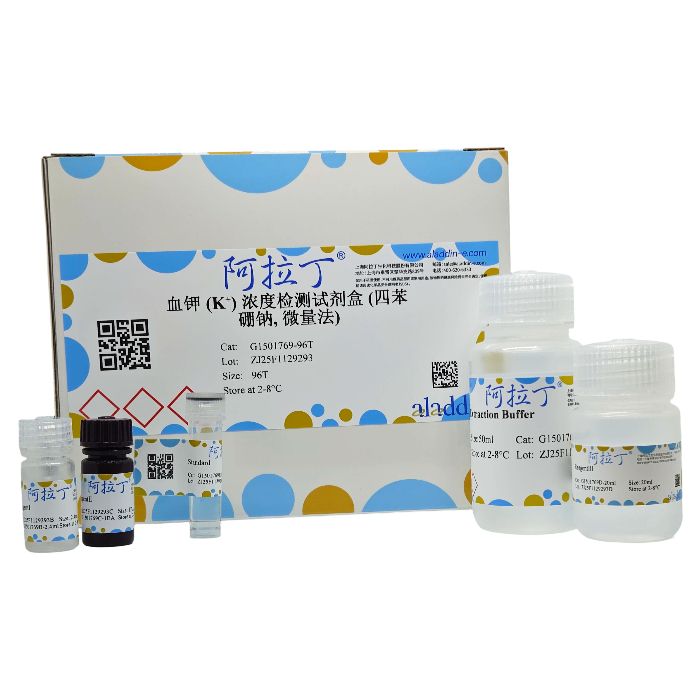
G1501769
| Component
| 96 T
| Storage
|
G1501769A
| Extraction Buffer
| 50 mL
| 2-8℃
|
G1501769B
| ReagentⅠ
| 2.4 mL
| 2-8℃
|
G1501769C
| ReagentⅡ
| 1EA
| 2-8℃. Store in the dark.
|
G1501769D
| ReagentⅢ
| 20 mL
| 2-8℃
|
G1501769E
| Standard
| 1 mL
| 2-8℃ |
注意:正式检测前,建议选择2-3个预期差异较大的样本进行预实验。
自备仪器和试剂
酶标仪或可见分光光度计(能测520nm处的吸光度)
96孔板或微量玻璃比色皿、可调节式移液枪及枪头
离心机
去离子水、浓硫酸
实验流程
1、试剂准备
试剂名称
| 试剂准备
| 注意事项
|
Extraction Buffer
| / | 有一定的刺激性,建议在使用过程中做好个人防护
|
Working Extraction Buffer
| 临用前,按Extraction Buffer (mL):浓硫酸 (μL)=5:12的比例按需配制,现用现配
| 若有沉淀,重新配制 |
ReagentⅡ工作液
| 临用前配制,取ReagentⅠ,全部加入到ReagentⅡ瓶中,混匀,即为ReagentⅡ工作液
| 4℃避光保存1周
|
ReagentⅢ
| 置于25℃水浴中预热30min以上
| / |
Standard
| 即用型;使用前平衡到室温
| 4℃保存
|
2、样本制备
血清预处理:取EP管,依次加入50μL 血清,450μL Working Extraction Buffer,充分混匀后,室温(25℃左右),8,000 rpm,离心10min,取上清液,待测。
3、实验步骤
3.1 酶标仪或可见分光光度计预热30min以上,波长调节到520nm,可见分光光度计用去离子水调零。
3.2 操作表(在96孔板或微量玻璃比色皿中操作):
| 试剂 | 空白孔 (μL) | 标准孔 (μL) | 测定孔 (μL) |
| 去离子水 | 40 | 0 | 0
|
Standard
| 0
| 40
| 0
|
上清液
| 0
| 0
| 40
|
ReagentⅡ工作液
| 20 | 20
| 20
|
混匀,静置5min。
3.3 混匀后,检测520nm处吸光值。空白孔记为A 空 ,标准孔记为A 标 、测定孔记为A 测 。
注意:
空白管和标准管只需做1-2次。
实验之前建议选择2-3个预期差异大的样本做预实验。如果A 测 小于0.02可适当加大样本量。如果A 测 大于1.1,样本可用Working Extraction Buffer进一步稀释,计算结果乘以稀释倍数,或减少提取用样本量。
4、结果计算
注意:我们为您提供的计算公式,包括推导过程计算公式和简洁计算公式。两者完全相等。建议以加粗的简洁计算公式为最终计算公式。
血钾浓度 (mmol/L) =[C Standard ×(A 测 -A 空 )÷(A 标 -A 空 )]×n=5×(A 测 -A 空 )÷(A 标 -A 空 )
参数说明:
C Standard :0.5 mmol/L;
n:样品稀释倍数,10。
注意事项
1、正式检测前,建议选择2-3个预期差异较大的样本进行预实验。
2、生化检测试剂普遍具有刺激性、生物毒性等,为了您的安全和健康,请在实验全程做好生物安全防护,穿戴实验服、口罩、手套、头套等安全护具,在通风橱、生物安全柜中进行实验。
3、本产品仅供科学研究使用,不适用于临床诊断。
Blood potassium plays a crucial role in maintaining normal osmotic pressure, acid-base balance, sugar and protein metabolism, and ensuring normal neuromuscular function. Its concentration is closely related to various important physiological functions. Abnormally high or low levels can disrupt normal physiological activities. Hyperkalemia increases neuromuscular excitability but decreases myocardial excitability, leading to bradycardia. Hypokalemia can cause muscle weakness or even flaccid paralysis, increase myocardial excitability, and result in tachycardia, arrhythmias, or even cardiac arrest during systole.
Detection Principle: Potassium ions (K⁺) in serum react with sodium tetraphenylboron to form water-insoluble potassium tetraphenylboron. The turbidity produced is directly proportional to the potassium ion concentration within a certain range. The serum potassium ion content is determined by measuring this turbidity.
Applicable Sample: Serum
G1501769
| Component
| 96 T
| Storage
|
G1501769A
| Extraction Buffer
| 50 mL
| 2-8℃
|
G1501769B
| ReagentⅠ
| 2.4 mL
| 2-8℃
|
G1501769C
| ReagentⅡ
| 1EA
| 2-8℃. Store in the dark.
|
G1501769D
| ReagentⅢ
| 20 mL
| 2-8℃
|
G1501769E
| Standard
| 1 mL
| 2-8℃ |
Note: Before formal testing, it is recommended to perform a preliminary test with 2-3 samples expected to have significant differences.
User-Prepared Instruments and Reagents
Microplate reader or visible spectrophotometer (capable of measuring absorbance at 520 nm)
96-well plate or micro glass cuvettes, adjustable micropipettes and tips
Centrifuge
Deionized water, Concentrated Sulfuric Acid
Experimental Procedure
1. Reagent Preparation
Reagent Name
| Reagent Preparation
| Notes
|
Extraction Buffer
| / | Slightly irritating. Use appropriate personal protective equipment during handling.
|
Working Extraction Buffer
| Prepare before use: Mix Extraction Buffer (mL) and Concentrated Sulfuric Acid (μL) in a 5:12 ratio as needed. Prepare freshly for each use.
| If precipitate forms, prepare a new batch. |
Reagent Ⅱ Working Solution
| Prepare before use: Add the entire contents of Reagent Ⅰ into the Reagent Ⅱ vial. Mix well. This is the Reagent Ⅱ Working Solution.
| Can be stored at 4°C protected from light for one week.
|
ReagentⅢ
| Preheat in a 25°C water bath for at least 30 minutes before use.
| / |
Standard
| Ready-to-use; Equilibrate to room temperature before use.
| Store at 4°C.
|
2. Sample Preparation
Serum Pretreatment: Take a microcentrifuge tube. Sequentially add 50 μL of serum and 450 μL of Working Extraction Buffer. Mix thoroughly. Centrifuge at 8,000 rpm for 10 minutes at room temperature (approximately 25°C). Collect the supernatant for assay.
3. Assay Steps
3.1 Preheat the microplate reader or visible spectrophotometer for at least 30 minutes. Set the wavelength to 520 nm. For spectrophotometers, zero the instrument with deionized water.
3.2 Assay Procedure (perform in a 96-well plate or micro glass cuvette):
| Reagent | Blank Well (μL) | Standard Well (μL) | Test Well (μL) |
| Deionized Water | 40 | 0 | 0
|
Standard
| 0
| 40
| 0
|
Supernatant
| 0
| 0
| 40
|
Reagent Ⅱ Working Solution
| 20 | 20
| 20
|
| Mix well and let stand for 5 minutes. | |
3.3 Mix well after addition. Measure the absorbance at 520 nm. Record the absorbance of the Blank well as A blank , the Standard well as A standard , and the Test well as A test .
Note:
The Blank and Standard tubes only need to be set up 1-2 times.
It is recommended to perform a preliminary test with 2-3 samples expected to have significant differences before the formal experiment. If A <sub> test </sub> is less than 0.02, consider increasing the sample volume appropriately. If A <sub> test </sub> is greater than 1.1, further dilute the sample with Working Extraction Buffer (multiply the result by the dilution factor) or reduce the sample volume used for extraction.
4. Calculation of Results
Note: We provide both the derived formula and a simplified formula. They are equivalent. It is recommended to use the simplified formula in bold for final calculation.
Blood Potassium Concentration (mmol/L) = [C Standard × (A test - A blank ) ÷ (A standard - A blank )] × n = 5 × (A test - A blank ) ÷ (A standard - A blank )
Parameter Definitions:
Precautions
1. Before formal testing, it is recommended to perform a preliminary test with 2-3 samples expected to have significant differences.
2. Biochemical reagents are generally irritating and potentially biologically toxic. For your safety and health, please use appropriate biosafety precautions throughout the experiment, including wearing lab coats, masks, gloves, and head covers. Perform experiments in a fume hood or biosafety cabinet.
3. This product is for research use only. Not for use in clinical diagnosis.

 ZJ25F1129293


 危险品化学品经营许可证(带存储)