产品介绍
过氧化氢酶广泛存在于动物、植物、微生物和培养细胞中,是生物演化过程中建立起来的生物防御系统关键酶,其主要功能是催化生物体内的H₂O₂分解,使机体免受自由基损伤,在活性氧清除系统中具有重要作用。
过氧化氢酶催化H₂O₂分解为氧和水,钼酸铵能够迅速中止过氧化氢酶分解H₂O₂的反应,而剩余的H₂O₂与钼酸铵作用产生一种淡黄色的络合物,在波长405 nm处测定其生成量,可计算出过氧化氢酶的活力。
产品组分
G1527854 | 组分名称 | 物理外观 | 50 T | 100 T | 储存 | 单次测试使用量 |
G1527854A | 检测缓冲液 | 液体 | 50 mL | 100 mL | 2-8°C. | 按需 |
G1527854B | 过氧化氢 (约1 mol/L) | 液体 | 6 mL | 15 mL | 2-8°C.避光 | 按需 |
G1527854C | 试剂I | 液体 | 15 mL | 30 mL | 2-8°C | 300 μL |
G1527854D | 钼酸铵试剂 | 粉末 | 1EA | 1EA×2 | 2-8°C.避光 | 750 μL |
使用方法
1. 样本处理
(1)血清或血浆样本:直接测定。
(2)组织样本:按照组织样本质量(g):检测缓冲液体积(mL)=1:9的比例,冰上超声或匀浆(如0.1 g组织样本,加入0.9 mL检测缓冲液)。4°C,10000 × g,离心10 min,取上清液置于冰盒上待测。
(3)细胞样本:收集细胞并用1×PBS清洗细胞。5×10⁶个细胞加入1 mL检测缓冲液,冰上超声或匀浆。匀浆后,4℃,10000 × g离心10 min,取上清置于冰上待测。
2. 试剂准备
(1)钼酸铵溶液的配制:取1支钼酸铵试剂粉末,加入41 mL的超纯水,充分溶解后备用。
(2)过氧化氢浓度标定:由于过氧化氢不是非常稳定,使用前需自行测定过氧化氢的实际浓度以进行校准。把浓度约为1 mol/L的过氧化氢用水稀释100倍,使过氧化氢的浓度约为10 mmol/L,测定A240。A240的测定可采用如下的任一方法:普通紫外分光光度计法、微量紫外分光光度计法、96孔紫外酶标仪法,其中用比色皿检测的过氧化氢浓度最接近实际浓度。以光程为1 cm的比色皿校准为例,用下列公式计算计算过氧化氢的浓度:过氧化氢浓度(mmol/L)=22.94 ×A240。得到结果后再乘以稀释倍数100即为过氧化氢校准后的浓度。
(3)过氧化氢底物溶液的配制:按照标准品和样品的数量配制底物溶液,每孔150 μL,其中每个样品均需设一个对照管。按照标定后的过氧化氢浓度,用去离子水将其稀释为100 μmol/mL的稀释液即为底物溶液,现配现用。
3. 标准曲线设置
按照标定后的过氧化氢浓度,取一支EP管用去离子水将其稀释为100 μmol/mL的稀释液。例如若标定后的过氧化氢浓度为1 mol/L,即1000 μmol/mL,则吸取40 μL过氧化氢,加入360 µL的去离子水,混匀即可得到100 μmol/mL的稀释液。
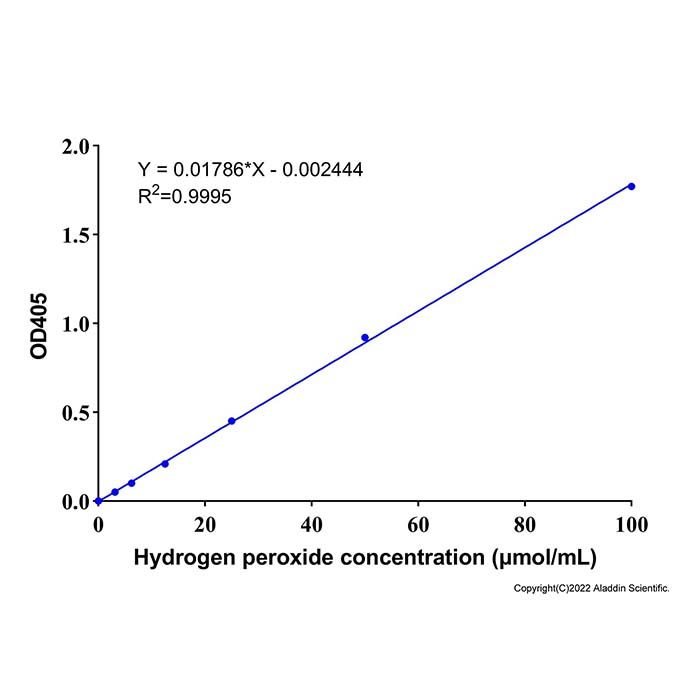
共取7支EP管,第1支EP管为刚稀释得到的400 µL的100 μmol/mL过氧化氢稀释液,剩余6支EP管中各加入200 μL去离子水。从第1支EP管中吸取200 μL液体到第2支EP管,混匀;再从第2支吸取200 μL到第3支,按此步骤依次稀释到第6支EP管。第7支EP管仅加入200 μL去离子水,作为空白对照管。此时,各个EP管中过氧化氢的浓度依次为100、50、25、12.5、6.25、3.125、0 μmol/mL。
4. 标准品和样品测定
按照下表依次加入各试剂。标准管和对照管没有严格的反应时间要求,测定管请严格按照反应时间进行反应。
试剂 | 标准管 (μL) | 对照管 (μL) | 测定管 (μL) |
样本 | 0 | 0 | 60 |
检测缓冲液 | 60 | 0 | 0 |
过氧化氢底物溶液 | 0 | 150 | 150 |
系列标准品 | 150 | 0 | 0 |
37℃混匀,反应2 min |
试剂I | 300 | 300 | 300 |
钼酸铵试剂 | 750 | 750 | 750 |
样本 | 0 | 60 | 0 |
反应结束后,吸取1 mL反应液转移至1 mL比色皿中,测定405 nm处吸光值。测定管、对照管、标准管和空白管的吸光值分别记为A测定、A对照、A标准和A空白,其中空白管为标曲的空白对照管,不需要单独设置。ΔA 测定=A 对照-A 测定,ΔA 标准=A 标准-A 空白。
5. 结果计算
以过氧化氢浓度(μmol/mL)为横坐标(X),以其对应的 ΔA标准 为纵坐标(Y),绘制标准曲线,得到标准方程 Y=kX+b,将 ΔA测定 带入公式中得到 X (μmol/mL)。酶活定义为每分钟催化 1 μmol H₂O₂降解定义为一个酶活力单位。简写计算公式如下:
(1)按组织蛋白浓度计算:
CAT(U/mg prot)= (X×V底物× n)/(Cpr×V样 ×T)=(1.25 × X × n) / Cpr
(2)按组织样本质量计算:
CAT(U/g)=(X×V底物× V样总 × n)/(W× V样×T )=(1.25 × X × n) / W
(3)按细菌或细胞数量计算:
CAT(U/10⁴ cell)= (X×V底物× V样总 × n)/(N× V样×T )=(1.25 × X × n) / N
(4)按液体样本体积计算:
CAT(U/mL)=(X×V底物× n) /(V样 ×T)=1.25 × X× n
注: V底物为为加入过氧化氢底物溶液的体积(0.15 mL); V样为样本体积(0.06 mL);V样总 :粗酶液总体积,1 mL;T为反应时间(2 min);W:样本质量,g;Cpr:粗酶液蛋白浓度,mg/mL;N: 细胞/细菌数量(以10⁴为单位);n:样本稀释倍数。
6. 结果展示

注意事项
1. 正式检测前,建议选择2-3个预期差异较大的样本进行预实验。
2. 组织样本建议稀释100-200倍再进行检测。其他样本若加入体系后出现浑浊现象,请用检测缓冲液稀释后再进行检测,可降低样本基质干扰。
3. 请严格按照反应时间和反应条件进行检测。
4. 生化检测试剂普遍具有刺激性、生物毒性等,为了您的安全和健康,请在实验全程做好生物安全防护。
Product Introduction
Catalase is widely present in animals, plants, microorganisms, and cultured cells. It is a key enzyme of the biological defense system established during evolution, and its main function is to catalyze the decomposition of H₂O₂ in organisms, thereby protecting the body from free radical damage. It plays an important role in the reactive oxygen species (ROS) scavenging system.
Catalase catalyzes the decomposition of H₂O₂ into oxygen and water. Ammonium molybdate can rapidly terminate the catalase‑mediated decomposition of H₂O₂, while the remaining H₂O₂ reacts with ammonium molybdate to form a pale yellow complex. The amount of this complex can be determined by measuring the absorbance at 405 nm, from which the catalase activity can be calculated.
Components
G1527854 | Component Name | Appearance | 50 T | 100 T | Storage | Quantity Per Test |
G1527854A | Assay Buffer | Liquid | 50 mL | 100 mL | 2-8°C. | As needed |
G1527854B | Hydrogen Peroxide (~1 mol/L) | Liquid | 6 mL | 15 mL | 2-8°C. Store in the dark | As needed |
G1527854C | Reagent I | Liquid | 15 mL | 30 mL | 2-8°C. | 300 μL |
G1527854D | Ammonium Molybdate Reagent | Powder | 1EA | 1EA× 2 | 2-8°C. Store in the dark | 750 μL |
Usage Protocol
1. Sample Preparation
1) Serum and plasma samples: Measure directly.
2) Tissue samples: Add Assay Buffer at a ratio of tissue mass (g) to buffer volume (mL) of 1:9, and homogenize or sonicate on ice (e.g., 0.1 g tissue with 0.9 mL Assay Buffer). Centrifuge at 10,000 × g for 10 min at 4 °C. Collect the supernatant and keep on ice for testing.
3) Cell samples: Collect cells and wash once with 1× PBS. Add 1 mL of Assay Buffer to 5 × 10⁶ cells, and homogenize or sonicate on ice. After homogenization, centrifuge at 10,000 × g for 10 min at 4 °C. Collect the supernatant and keep on ice for testing.
2. Reagent Preparation
1) Preparation of ammonium molybdate solution: Take one vial of ammonium molybdate reagent powder, add 41 mL of ultrapure water, and dissolve thoroughly before use.
2) Calibration of hydrogen peroxide concentration: Since hydrogen peroxide is not very stable, its actual concentration must be determined by the user before use for calibration. Dilute the approximately 1 mol/L hydrogen peroxide solution 100‑fold with water to obtain a concentration of approximately 10 mmol/L, and measure A₂₄₀. The A₂₄₀ measurement can be performed by any of the following methods: ordinary UV spectrophotometer, micro‑volume UV spectrophotometer, or 96‑well UV microplate reader. Among these, the hydrogen peroxide concentration measured using a cuvette is closest to the actual concentration. Taking calibration using a cuvette with a 1 cm pathlength as an example, calculate the hydrogen peroxide concentration using the following formula: Hydrogen peroxide concentration (mmol/L) = 22.94 × A₂₄₀. Multiply the result by the dilution factor of 100 to obtain the calibrated concentration of hydrogen peroxide.
3) Preparation of hydrogen peroxide substrate solution: Prepare the substrate solution according to the number of standards and samples, with 150 μL per well. A control tube should be set up for each sample. Based on the calibrated hydrogen peroxide concentration, dilute it with deionized water to a concentration of 100 μmol/mL to obtain the substrate solution. Prepare it immediately before use.
3. Standard Curve Setup
Based on the calibrated hydrogen peroxide concentration, take one EP tube and dilute it with deionized water to a concentration of 100 μmol/mL. For example, if the calibrated hydrogen peroxide concentration is 1 mol/L (i.e., 1000 μmol/mL), pipette 40 μL of hydrogen peroxide, add 360 μL of deionized water, and mix well to obtain a 100 μmol/mL diluted solution.
Take a total of 7 EP tubes. The first EP tube contains 400 μL of the freshly prepared 100 μmol/mL hydrogen peroxide dilution. Add 200 μL of deionized water to each of the remaining 6 tubes. Transfer 200 μL from the first tube to the second tube and mix well; then transfer 200 μL from the second to the third, and continue this sequential dilution up to the sixth tube. The seventh tube contains only 200 μL of deionized water and serves as the blank control tube. At this point, the hydrogen peroxide concentrations in each tube are 100, 50, 25, 12.5, 6.25, 3.125, and 0 μmol/mL, respectively.
4. Standard and Sample Assay
Add the reagents sequentially according to the table below. There is no strict reaction time requirement for the standard tube and control tube, but the sample tube must be reacted exactly according to the specified reaction time.
Reagent | Standard tube (μL) | Control tube (μL) | Sample tube (μL) |
Sample | 0 | 0 | 60 |
Assay Buffer | 60 | 0 | 0 |
Hydrogen Peroxide Substrate Solution | 0 | 150 | 150 |
Series of standards | 150 | 0 | 0 |
Mix at 37 °C, react for 2 min |
Reagent I | 300 | 300 | 300 |
Ammonium Molybdate Reagent | 750 | 750 | 750 |
Sample | 0 | 60 | 0 |
After the reaction, pipette 1 mL of the reaction solution, transfer it to a 1 mL cuvette, and measure the absorbance at 405 nm. The absorbance values of the sample tube, control tube, standard tube, and blank tube are recorded as Asample, Acontrol, Astandard, and Ablank, respectively. The blank tube is the blank control tube for the standard curve and does not need to be set up separately. ΔAsample = Acontrol – Asample; ΔAstandard = Astandard – Ablank.
5. Result Calculation
Plot a standard curve with hydrogen peroxide concentration (μmol/mL) as the abscissa (X) and the corresponding ΔAₛₜₐₙdₐᵣd as the ordinate (Y), to obtain the standard equation Y = kX + b. Substitute ΔAₛₐₘₚₗₑ into the equation to calculate X (μmol/mL). One unit of enzyme activity is defined as the amount of enzyme that catalyzes the degradation of 1 μmol of H₂O₂ per minute. The abbreviated formulas for calculation are as follows:
(1) Calculated by tissue protein concentration:
CAT (U/mg prot) = (X × Vₛᵤbₛₜᵣₐₜₑ× n) / (Cpr × Vₛₐₘₚₗₑ× T) = (1.25 × X × n) / Cpr
(2) Calculated by tissue mass:
CAT (U/g) = (X × Vₛᵤbₛₜᵣₐₜₑ ×Vₜₒₜₐₗ× n) / (W ×Vₛₐₘₚₗₑ× T) = (1.25 × X × n) / W
(3) Calculated by bacterial or cell number:
CAT (U/10⁴ cells) = (X × Vₛᵤbₛₜᵣₐₜₑ × Vₜₒₜₐₗ × n) / (N × Vₛₐₘₚₗₑ × T) = (1.25 × X × n) / N
(4) Calculated by liquid sample volume:
CAT (U/mL) = (X × Vₛᵤbₛₜᵣₐₜₑ × n) / ( Vₛₐₘₚₗₑ × T) = 1.25 × X × n
Notes: Vₛᵤbₛₜᵣₐₜₑ: volume of substrate added (0.15 mL); Vₛₐₘₚₗₑ: volume of sample (0.06 mL); Vₜₒₜₐₗ: total volume of crude enzyme extract (1 mL); T: reaction time (2 min); W: sample mass (g); Cpr: protein concentration of crude enzyme extract (mg/mL); N: number of cells or bacteria (in units of 10⁴); n: dilution factor of the sample.
6. Results Presentation

Precautions
1. Before formal testing, it is recommended to perform a preliminary experiment using 2–3 samples with expected large differences.
2. Tissue samples are recommended to be diluted 100–200‑fold before testing. For other samples, if turbidity appears after adding to the reaction system, dilute with assay buffer prior to testing to reduce sample matrix interference.
3. Strictly follow the specified reaction time and conditions for all measurements.
4. Biochemical assay reagents generally have irritancy and biological toxicity. For your safety and health, please take proper biological safety precautions throughout the experiment.

 ZJ26F1040133


 危险品化学品经营许可证(带存储)