过氧化氢(H₂O₂)是生物体内最常见的活性氧分子,是一种活性氧代谢的副产物,主要由SOD和XOD 等催化产生,由 CAT 和 POD 等催化降解。过氧化氢不仅是重要的活性氧之一,也是活性氧相互转化的枢纽。一方面,H₂O₂可以直接或间接地氧化细胞内核酸,蛋白质等生物大分子,使细胞膜遭受损害,从而加速细胞的衰老和解体;另一方面,H₂O₂也是许多氧化应急反应中的关键调节因子。H₂O₂可以激活NF-κB 等因子,这些过氧化氢相关的信号途径和哮喘、炎症性关节炎、动脉硬化以及神经退行性疾病等许多疾病相关。H₂O₂也和细胞凋亡、细胞增殖等密切相关。
本试剂盒的检测原理为:利用H₂O₂氧化二价铁离子产生三价铁离子,然后和xylenol orange(二甲酚橙)在特定的溶液中形成紫色的产物,在595nm的OD值与H₂O₂浓度成正比,从而实现对H₂O₂浓度的测定。
使用方法
1. 试剂准备
(1)将显色试剂A和显色试剂B冰上解冻,使用前平衡到室温。按照10 μL显色试剂A+990 μL显色试剂B按需配置显色工作液,冰上保存,建议现配现用。
(2)将检测缓冲液(10×)用去离子水按照1:10 稀释为1×备用。
2、过氧化氢标准品的校准
由于过氧化氢不是非常稳定,使用前需自行测定过氧化氢的实际浓度以进行校准。把浓度约为1 M的过氧化氢用水稀释100倍,使过氧化氢的浓度约为10 mM,测定A240。A240的测定可采用如下的任一方法:普通紫外分光光度计法、微量紫外分光光度计法、96孔紫外酶标仪法。其中用比色皿检测的过氧化氢浓度最接近实际浓度,以光程为1 cm的比色皿校准为例,用下列公式计算过氧化氢的浓度:过氧化氢浓度(mM)=22.94 ×A240。得到结果后再乘以稀释倍数100即为过氧化氢校准后的浓度。
3、标准品配制
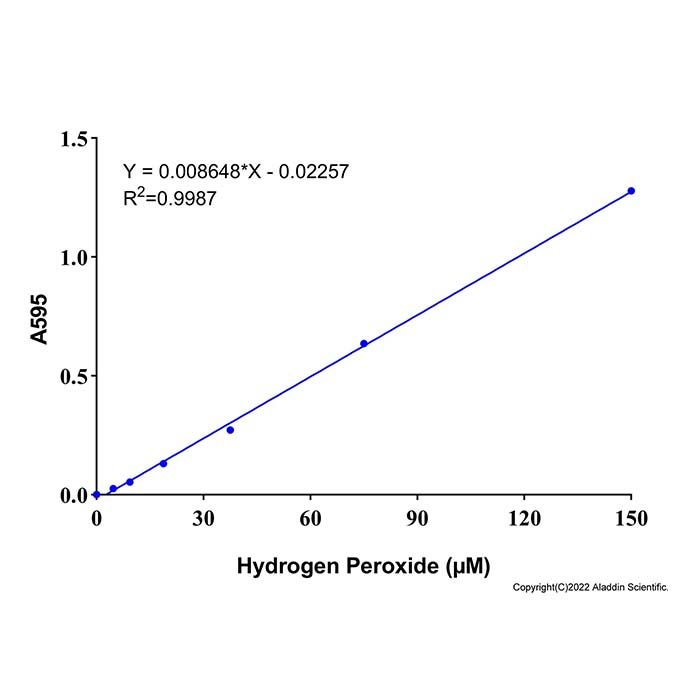
按照校准的过氧化氢浓度,用检测缓冲液(1×)将过氧化氢标准品稀释为150 μM。取7只EP管,第一支EP管中加入200 μL的150 μM H₂O₂溶液,其他每管中加入100 μL检测缓冲液。从第一只EP管中取出100 μL到第2支EP管中混匀,按此步骤往后依次稀释,最后一支EP管为100 μL检测缓冲液。此时,标准品的浓度依次为150、75、37.5、18.75、9.38、4.69、0 µM。
每次实验请使用新配制的标准品。此外样品在什么溶液中标准品也需用什么溶液稀释,这样可以减小误差。
4. 样本制备
推荐使用新鲜样本,如果不立即进行实验,样本可在-80℃保存1个月。当准备好进行该项实验时,将样本从-80℃拿出后,冰上解冻,但是请注意,这可能会影响样本的稳定性,实验结果可能会低于预期。
(1)动物组织
用冷的PBS清洗组织,尽可能去除血液。吸干组织上的水分,称取0.1 g,加入1 mL预冷的检测缓冲液(1×),将样本冰浴匀浆。10000g,4℃离心5 min,取上清液置冰上待测。
(2)植物组织
称取约0.1 g样本,加入1 mL预冷的检测缓冲液(1×)捣碎,冰浴超声破碎5 min(功率20%或200W,超声3s,间隔7s,重复30次),10000g,4℃离心5min,取上清液置冰上待测。
(3)细胞 (菌)
收集5×10⁶ 个细胞或细菌,用冷PBS清洗细胞或细菌后,加入1 mL预冷的检测缓冲液(1×) 冰浴匀浆或冰浴超声破碎5 min(功率20%或200W,超声3s,间隔7s,重复30次)。10000 g,4℃离心5 min,取上清液置冰上待测。
(4)血浆、血清和尿液 (和其他生物体液):
去除蛋白后,取上清。去除蛋白的方式:可使用10 kDa的超滤管过滤后取滤液或是将样本:30% ZnSO₄溶液=20:1进行混合后涡旋,再10000g室温离心5min,取上清。
5. 样本中过氧化氢浓度测定
(1)根据标准孔和样本孔的数量按照10 μL显色试剂A+990 μL显色试剂B按需配置显色工作液。按照下表进行标准品和样本测试。
试剂 | 标准孔 | 测定孔 |
不同浓度标准品 | 20 μL | / |
样本 | / | 20 μL |
显色液 | 200 μL | 200 μL |
(2)反应体系充分混匀后在37℃孵育15-20 min。
(3)在595 nm处读取吸光度值,分别记为A空白 、A标准和A测定。ΔA标准=A 标准-A空白,ΔA 测定=A 测定-A空白。其中空白孔为标准孔中未加过氧化氢的孔。
(4)以标准品浓度为横坐标,ΔA标准为纵坐标,绘制标准曲线。将ΔA测定代入方程,根据标准曲线计算出样品中过氧化氢的浓度。
注意事项
1. 正式检测前,建议选择2-3个预期差异较大的样本进行预实验。
2. 由于过氧化氢不是非常稳定,使用前需自行测定过氧化氢的实际浓度以进行校准,按照校准后的浓度进行标曲制作。
3. 每次实验请使用新配制的标准品。
Hydrogen peroxide (H₂O₂) is the most common reactive oxygen species (ROS) in living organisms. It is a byproduct of ROS metabolism, mainly produced by the catalytic actions of SOD and XOD, and degraded by CAT and POD. H₂O₂ is not only an important ROS but also a hub for the interconversion of various ROS. On one hand, H₂O₂ can directly or indirectly oxidize intracellular nucleic acids, proteins, and other biological macromolecules, causing damage to cell membranes and thereby accelerating cell aging and disintegration. On the other hand, H₂O₂ is also a key regulator in many oxidative stress responses. H₂O₂ can activate factors such as NF-κB, and these H₂O₂‑related signaling pathways are associated with many diseases, including asthma, inflammatory arthritis, atherosclerosis, and neurodegenerative diseases. H₂O₂ is also closely related to apoptosis, cell proliferation, and other processes.
The detection principle of this kit is as follows: H₂O₂ oxidizes ferrous ions (Fe²⁺) to ferric ions (Fe³⁺), which then form a purple complex with xylenol orange in a specific solution. The OD value at 595 nm is directly proportional to the H₂O₂ concentration, thereby allowing the quantification of H₂O₂.
Usage Protocol
1. Reagent Preparation
1) Thaw Chromogenic Reagent A and Chromogenic Reagent B on ice, and equilibrate to room temperature before use. Prepare the Chromogenic Working Solution as needed by mixing 10 μL of Chromogenic Reagent A with 990 μL of Chromogenic Reagent B. Store on ice. It is recommended to prepare the working solution fresh immediately before use.
2) Dilute the Assay Buffer (10×) with deionized water at a ratio of 1:10 to obtain 1× Assay Buffer for later use.
2. Calibration of Hydrogen Peroxide Standard
Since hydrogen peroxide is not very stable, its actual concentration must be determined by the user before use for calibration. Dilute the approximately 1 M hydrogen peroxide solution 100‑fold with water to obtain a concentration of approximately 10 mM, and measure A₂₄₀.
The A₂₄₀ measurement can be performed by any of the following methods: ordinary UV spectrophotometer, micro‑volume UV spectrophotometer, or 96‑well UV microplate reader. Among these, the hydrogen peroxide concentration measured using a cuvette is closest to the actual concentration. Taking calibration using a cuvette with a 1 cm pathlength as an example, calculate the hydrogen peroxide concentration using the following formula: Hydrogen peroxide concentration (mM) = 22.94 × A₂₄₀. Multiply the result by the dilution factor of 100 to obtain the calibrated concentration of hydrogen peroxide.
3. Standard Preparation
Based on the calibrated hydrogen peroxide concentration, dilute the hydrogen peroxide standard with Assay Buffer (1×) to 150 μM. Take seven EP tubes. Add 200 μL of the 150 μM H₂O₂ solution to the first tube, and add 100 μL of Assay Buffer to each of the remaining tubes. Transfer 100 μL from the first tube to the second tube and mix thoroughly. Continue this serial dilution to the subsequent tubes. The last tube contains 100 μL of Assay Buffer. The resulting standard concentrations are 150, 75, 37.5, 18.75, 9.38, 4.69, and 0 μM, respectively.
Use freshly prepared standards for each experiment. In addition, the standard must be diluted with the same solution as the sample solution to minimize errors.
4. Sample Preparation
Fresh samples are recommended. If the experiment is not performed immediately, samples can be stored at –80 °C for up to one month. When ready to perform the experiment, thaw samples on ice after removing from –80 °C. However, please note that this may affect sample stability, and the experimental results may be lower than expected.
1) Animal Tissue
Wash the tissue with cold PBS to remove blood as much as possible. Blot the tissue dry, weigh 0.1 g, add 1 mL of pre‑cooled Assay Buffer (1×), and homogenize the sample on ice. Centrifuge at 10,000 g for 5 min at 4 °C, and collect the supernatant on ice for testing.
2) Plant Tissue
Weigh approximately 0.1 g of sample, add 1 mL of pre‑cooled Assay Buffer (1×), and mash. Perform ultrasonic disruption on ice for 5 min (power 20% or 200 W, sonicate for 3 s, pause for 7 s, repeat 30 times). Centrifuge at 10,000 g for 5 min at 4 °C, and collect the supernatant on ice for testing.
3) Cells (or Bacteria)
Collect 5 × 10⁶ cells or bacteria, wash with cold PBS, then add 1 mL of pre‑cooled Assay Buffer (1×). Homogenize on ice or perform ultrasonic disruption on ice for 5 min (power 20% or 200 W, sonicate for 3 s, pause for 7 s, repeat 30 times). Centrifuge at 10,000 g for 5 min at 4 °C, and collect the supernatant on ice for testing.
4) Plasma, Serum, and Urine (and other biological fluids)
Remove protein and collect the supernatant. Protein removal can be performed using a 10 kDa ultrafiltration tube (collect the filtrate) or by mixing the sample with 30% ZnSO₄ solution at a ratio of 20:1, vortexing, then centrifuging at 10,000 g for 5 min at room temperature. Collect the supernatant.
5. Determination of Hydrogen Peroxide Concentration in Samples
1) Prepare the Chromogenic Working Solution as needed according to the number of standard wells and sample wells by mixing 10 μL of Chromogenic Reagent A with 990 μL of Chromogenic Reagent B. Perform the standard and sample tests according to the following table.
Reagent | Standard Well | Sample Well |
Different concentrations of standard | 20 μL | / |
Sample | / | 20 μL |
Chromogenic Solution | 200 μL | 200 μL |
2) After thoroughly mixing the reaction system, incubate at 37 °C for 15-20 min.
3) Read the absorbance at 595 nm and record as Ablank, Astandard, and Asample. ΔAstandard = Astandard – Ablank, ΔAsample = Asample – Ablank. The blank well is the standard well without hydrogen peroxide.
4) Plot the standard curve with the standard concentration as the abscissa and ΔAstandard as the ordinate. Substitute ΔAsample into the equation to calculate the hydrogen peroxide concentration in the sample according to the standard curve.
Precautions
1. Before formal testing, it is recommended to perform a preliminary experiment using 2–3 samples with expected large differences.
2. Since hydrogen peroxide is not very stable, the actual concentration of hydrogen peroxide must be determined by the user before use for calibration. Prepare the standard curve based on the calibrated concentration.
3. Use freshly prepared standards for each experiment.

 ZJ26F0535414


 危险品化学品经营许可证(带存储)