过氧化氢(H₂O₂)是生物体内最常见的活性氧分子,是一种活性氧代谢的副产物,主要由SOD和XOD等催化产生,由CAT和POD 等催化降解。过氧化氢不仅是重要的活性氧之一,也是活性氧相互转化的枢纽。一方面,H₂O₂可以直接或间接地氧化细胞内核酸,蛋白质等生物大分子,使细胞膜遭受损害,从而加速细胞的衰老和解体;另一方面,H₂O₂也是许多氧化应急反应中的关键调节因子。H₂O₂可以激活NF-κB 等因子,这些过氧化氢相关的信号途径和哮喘、炎症性关节炎、动脉硬化以及神经退行性疾病等许多疾病相关。H₂O₂也和细胞凋亡、细胞增殖等密切相关。
检测原理:H₂O₂与硫酸钛反应生成的过氧化物-钛复合物黄色沉淀,溶解于强酸中,其黄色深浅与H₂O₂浓度在一定范围内呈线性关系,通过酶标仪微板法测定412 nm处吸光度,主要用于检测植物组织、血清、血浆等样品中H₂O₂含量。该试剂盒仅用于科研领域,不适用于临床诊断或其他用途。
自备仪器和试剂
1、蒸馏水、丙酮
2、匀浆器或研钵、低温离心机、酶标仪、96孔板
使用方法
1. 样品准备
(1)植物样品
取正常或逆境下的新鲜植物组织,清洗干净,擦干,切碎,迅速称取5 g,加入5 mL预冷的丙酮,在冰浴条件下迅速匀浆或研磨,4℃ 12000 g离心20 min,收集上清液,测量提取液总体积,4℃保存备用。
(2)血浆、血清和尿液样品
血浆、血清按照常规方法制备后可以直接用于该试剂盒的测定,4℃保存,用于过氧化氢的测定。
(3)高活性样品
如果样品中含有较高浓度的过氧化氢,可以使用丙酮进行恰当的稀释。
2、过氧化氢标准品的校准
由于过氧化氢不是非常稳定,使用前需自行测定过氧化氢的实际浓度以进行校准。把浓度约为1 M的过氧化氢用水稀释100倍,使过氧化氢的浓度约为10 mM,测定A240。
A240的测定可采用如下的任一方法:普通紫外分光光度计法、微量紫外分光光度计法、96孔紫外酶标仪法。其中用比色皿检测的过氧化氢浓度最接近实际浓度,以光程为1 cm的比色皿校准为例,用下列公式计算计算过氧化氢的浓度:过氧化氢浓度(mM)=22.94 ×A240。得到结果后再乘以稀释倍数100即为过氧化氢校准后的浓度。
3、标准品的配制
根据校准后的过氧化氢浓度,用丙酮稀释H₂O₂基液配制10 mM H₂O₂-丙酮标准溶液。按下表依次稀释标准曲线(常用浓度0.3-3mM,即1~5号)。
序号 | H₂O₂-丙酮标准(10 mM) (μL) | 预冷丙酮(μL) | H₂O₂浓度(mM) |
1 | 15 | 485 | 0.3 |
2 | 25 | 475 | 0.5 |
3 | 40 | 460 | 0.8 |
4 | 50 | 450 | 1 |
5 | 150 | 350 | 3 |
6 | 250 | 250 | 5 |
7 | 400 | 100 | 8 |
8 | 500 | 0 | 10 |
4. 样本检测
按照下表设置空白管、标准管、测定管,溶液应按照顺序依次加入,并注意避免产生气泡;如果样品中的H₂O₂浓度过高,可以减少样品用量或适当稀释后再进行测定,样品的检测最好能设置平行管。
加入物 | 空白管(mL) | 标准管(mL) | 测定管(mL) |
预冷丙酮 | 0.5 | - | - |
系列H₂O₂-丙酮溶液(1~5号) | - | 0.5 | - |
待测样品 | - | - | 0.5 |
碱性基液 | 0.1 | 0.1 | 0.1 |
硫酸钛溶液 | 0.05 | 0.05 | 0.05 |
混匀,室温放置5 min,12000g离心15 min,弃上清液,留取沉淀,如有必要可加入预冷丙酮反复洗涤沉淀物,向各管的沉淀中加入1 mL酸性基液,摇动,使沉淀完全溶解,取各管溶液300 μL加入96孔板,空白调零,酶标仪测定412 nm处各标准孔、测定孔的吸光度。
5. 结果计算
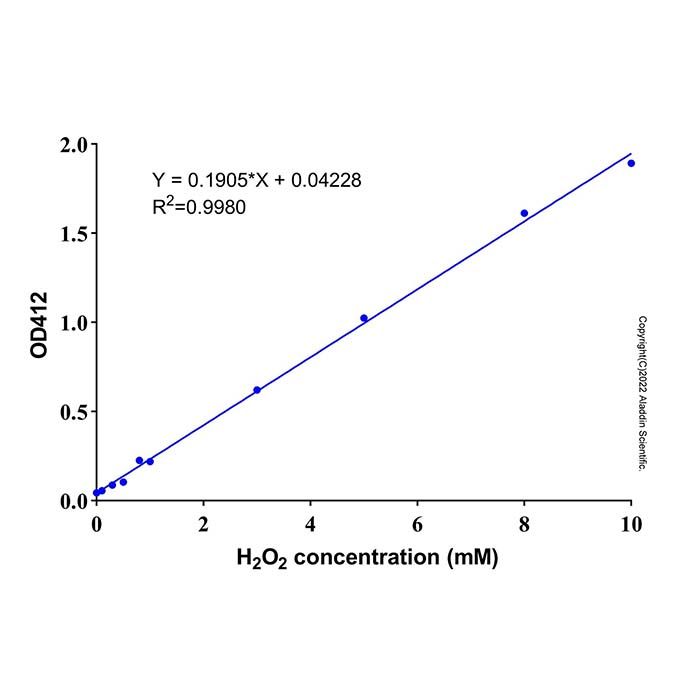
以系列H₂O₂-丙酮标准为横坐标,以对应的吸光度为纵坐标,绘制标准曲线,求得回归方程。以测定管吸光度代入回归方程求得待测样品中H₂O₂的浓度。
6. 结果展示
标准曲线
注意事项
1. 该试剂盒亦可用分光光度计进行检测,但检测的样本数相应减少。
2 . 加入碱性基液、硫酸钛溶液时,应直接加入至溶液中,不要粘到管壁。
3. 过氧化物-钛复合物黄色沉淀溶解于酸性基液时需要一段时间,需完全溶解,否则有可能影响测定结果。
4. H₂O₂基液和碱性基液应严格密闭保存,避免挥发,否则效率会下降。
5. H₂O₂基液和酸性基液有一定腐蚀性,请小心操作。
6. 试剂开封后请尽快使用,以防影响后续实验效果。
7. 为了您的安全和健康,请穿实验服并戴一次性手套操作。
Hydrogen peroxide (H₂O₂) is the most common reactive oxygen species (ROS) in living organisms. It is a byproduct of ROS metabolism, mainly produced by the catalytic actions of SOD and XOD, and degraded by CAT and POD. H₂O₂ is not only an important ROS but also a hub for the interconversion of various ROS. On one hand, H₂O₂ can directly or indirectly oxidize intracellular nucleic acids, proteins, and other biological macromolecules, causing damage to cell membranes and thereby accelerating cell aging and disintegration. On the other hand, H₂O₂ is also a key regulator in many oxidative stress responses. H₂O₂ can activate factors such as NF-κB, and these H₂O₂‑related signaling pathways are associated with many diseases, including asthma, inflammatory arthritis, atherosclerosis, and neurodegenerative diseases. H₂O₂ is also closely related to apoptosis, cell proliferation, and other processes.
Detection Principle: H₂O₂ reacts with titanium sulfate to form a yellow precipitate of a peroxide‑titanium complex, which is then dissolved in strong acid. The yellow color intensity is linearly related to the H₂O₂ concentration within a certain range. The absorbance is measured at 412 nm using a microplate reader. This kit is primarily used to detect H₂O₂ content in plant tissues, serum, plasma, and other samples. This kit is intended for research use only and is not suitable for clinical diagnosis or other purposes.
Instruments and Reagents to be Prepared by the User
1. Distilled water, acetone
2. Homogenizer or mortar, refrigerated centrifuge, microplate reader, 96-well plate
Usage Protocol
1. Sample Preparation
1) Plant samples
Take fresh plant tissues under normal or stress conditions, wash thoroughly, wipe dry, and cut into small pieces. Quickly weigh 5 g, add 5 mL of pre‑cooled acetone, and immediately homogenize or grind on ice. Centrifuge at 12,000 × g for 20 min at 4 °C. Collect the supernatant and measure the total volume of the extract. Store at 4 °C for later use.
2) Plasma, serum, and urine samples
Plasma and serum prepared by conventional methods can be directly used for determination with this kit. Store at 4 °C for hydrogen peroxide measurement.
3) High‑activity samples
If the sample contains a high concentration of hydrogen peroxide, dilute appropriately with acetone.
2. Calibration of Hydrogen Peroxide Standard
Since hydrogen peroxide is not very stable, its actual concentration must be determined by the user before use for calibration. Dilute the approximately 1 M hydrogen peroxide solution 100‑fold with water to obtain a concentration of approximately 10 mM, and measure A₂₄₀.
The A₂₄₀ measurement can be performed by any of the following methods: ordinary UV spectrophotometer, micro‑volume UV spectrophotometer, or 96‑well UV microplate reader. Among these, the hydrogen peroxide concentration measured using a cuvette is closest to the actual concentration. Taking calibration using a cuvette with a 1 cm pathlength as an example, calculate the hydrogen peroxide concentration using the following formula: Hydrogen peroxide concentration (mM) = 22.94 × A₂₄₀. Multiply the result by the dilution factor of 100 to obtain the calibrated concentration of hydrogen peroxide.
3. Preparation of Standard
Based on the calibrated hydrogen peroxide concentration, dilute the H₂O₂ base solution with acetone to prepare a 10 mM H₂O₂‑acetone standard solution. Dilute the standard sequentially according to the table below (common concentration range 0.3‑3 mM, i.e., No. 1~5).
No. | H₂O₂‑acetone standard (10 mM) (μL) | Pre‑cooled acetone (μL) | H₂O₂ concentration (mM) |
1 | 15 | 485 | 0.3 |
2 | 25 | 475 | 0.5 |
3 | 40 | 460 | 0.8 |
4 | 50 | 450 | 1 |
5 | 150 | 350 | 3 |
6 | 250 | 250 | 5 |
7 | 400 | 100 | 8 |
8 | 500 | 0 | 10 |
4. Sample Detection
Set up blank tubes, standard tubes, and sample tubes according to the table below. Add the solutions in the order listed, taking care to avoid bubble formation. If the H₂O₂ concentration in the sample is too high, reduce the sample volume or dilute appropriately before measurement. It is recommended to set up duplicate tubes for each sample.
Added reagent | Blank tube (mL) | Standard tube (mL) | Sample tube (mL) |
Pre‑cooled acetone | 0.5 | - | - |
Serial H₂O₂‑acetone solutions (No. 1~5) | - | 0.5 | - |
Test sample | - | - | 0.5 |
Alkaline Base Solution | 0.1 | 0.1 | 0.1 |
Titanium Sulfate Solution | 0.05 | 0.05 | 0.05 |
Mix well, let stand at room temperature for 5 min, centrifuge at 12,000 × g for 15 min. Discard the supernatant and keep the precipitate. If necessary, wash the precipitate repeatedly with pre‑cooled acetone. Add 1 mL of acidic base solution to the precipitate of each tube, shake to completely dissolve the precipitate. Take 300 μL of the solution from each tube and add to a 96‑well plate. Set zero with the blank, and measure the absorbance of each standard tube and sample tube at 412 nm using a microplate reader.
5. Result Calculation
Plot a standard curve with the series of H₂O₂‑acetone standards as the abscissa and the corresponding absorbance as the ordinate, and obtain the regression equation. Substitute the absorbance of the sample tube into the regression equation to obtain the H₂O₂ concentration in the test sample.
6. Results Presentation
Standard curve

Precautions
1. This kit can also be used with a spectrophotometer, but the number of detectable samples will be reduced accordingly.
2. When adding the Alkaline Base Solution and Titanium Sulfate Solution, add them directly into the solution and avoid touching the tube wall.
3. The yellow precipitate of the peroxide‑titanium complex requires some time to dissolve in the Acidic Base Solution; it must be completely dissolved, otherwise the determination results may be affected.
4. The H₂O₂ Base Solution and Alkaline Base Solution should be stored in tightly sealed containers to avoid evaporation, otherwise their efficiency will decrease.
5. The H₂O₂ Base Solution and Acidic Base Solution are corrosive; please handle with care.
6. Use the reagent promptly after opening to prevent affecting subsequent experimental results.
7. For your safety and health, please wear a lab coat and disposable gloves during operation.

 ZJ26F0737073


 危险品化学品经营许可证(带存储)