
计算溶液所需的质量、体积或浓度。
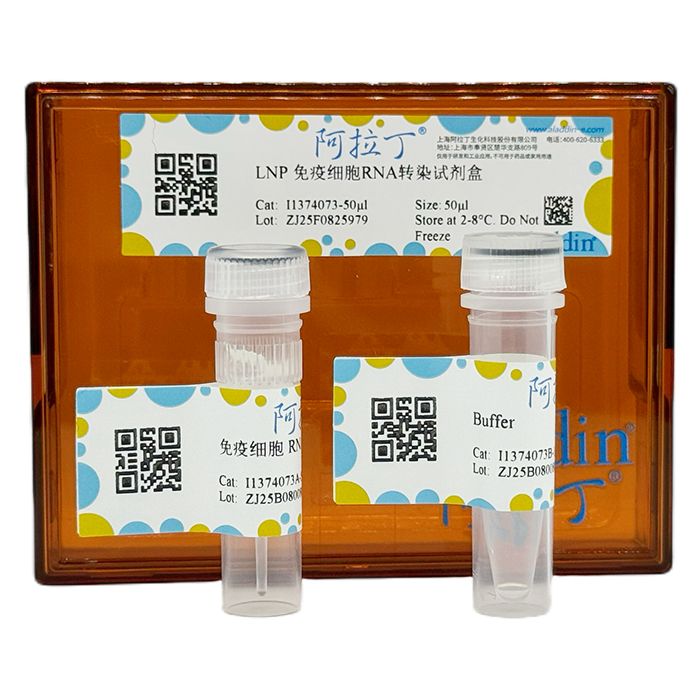
LNP 免疫细胞RNA转染试剂盒
有货
BioReagent,分子生物学级,无菌 级 ,适用于对基线干扰要求严格的色谱和分析工作流程。
2-8°C储存,禁止冷冻。低温运输,禁止冷冻 。请查阅批次 COA 获取详细规格。
SDS、COA、产品数据表及规格说明书均可下载。可通过批号查询获取批次 COA。
在色谱分析、有机合成和交叉偶联反应领域已被 0 篇同行评审文献引用。
LNP免疫细胞系 RNA 转染试剂盒是基于脂质纳米粒(LNP)技术研发的针对 Jurkat 等免疫细胞系的新型即用型转染试剂,利用 LNP 独特的跨膜转运和内体逃逸机制,实现对 RNA 高效递送,适用于不同类型 RNA 在免疫细胞系的体外转染。
易用:无需特定包封设备,一步混合即可实现 RNA-LNP 瞬时包封,无需孵育。
高效:微量样品的包封率可达 80%以上,对 Jurkat 等免疫细胞系转染效率轻松达到 80%以上。
安全:本品采用新型生物可降解脂质材料,细胞毒性极低,且经 0.2μm 微孔滤膜过滤。
产品组分表
| I1374073 | Component | 50ul | 1.5 ml | 3.0 ml | 5.0 ml | Storage |
| I1374073A | 免疫细胞 RNA 转染试剂 | 50ul | 1.5 ml | 3.0 ml | 5.0 ml | 2-8℃ |
| I1374073B | Buffer | 1ml | 8mL | 8mL | 8mL | 2-8℃ |
运输与保存方法
受控常温(≤25℃)运输。2℃~8℃保存。不得冷冻!
适用范围
LNP免疫细胞系 RNA 转染试剂盒适用于 Jurkat、THP-1、DC2.4、U266、RAW264.7 等免疫细胞系的 RNA 转染,其中 RNA 类型包括 siRNA、miRNA、gRNA 和 mRNA 等。
本产品仅供研究使用。
注意事项
(1) RNA 原液的最佳溶剂为无酶水,且 mRNA 浓度不低于 200ng/μL、siRNA 浓度不低于 10μM,其他类型的溶剂对转染效果可能会有一定影响,具体情况可以联系我们。
(2) 制备 RNA 预混液请确保使用试剂盒专用 Buffer 稀释 RNA 原液,不得使用 PBS 或培养基。
(3) 请确保 RNA 预混液浓度为 40ng/μL。若多种 RNA 共转染,如 CRISPR Cas9 mRNA 与 gRNA 共转染,则 RNA 预混液浓度为 Cas9 mRNA + gRNA 的总浓度,Cas9 mRNA 与 gRNA 的推荐用量比为 1:1~1:2(μgmRNA:μggRNA)。
(4) RNA/LNP 的比例是 LNP 包封的关键因素,如需增减每孔用量,请按以下操作进行:
1、对于 mRNA 转染和 mRNA+gRNA 共转染,如需增减每孔 mRNA 用量,请按比例增加或减少加入细胞的每孔RNA-LNP复合物的体积。
2、对于 siRNA 转染,如需增加每孔 siRNA 用量,请按比例增加加入细胞的每孔 RNA-LNP复合物的体积。
如需减少每孔 siRNA 用量,LNP转染试剂的最低用量应不低于附录 B 推荐用量。以 96 孔为例,siRNA 每孔用量降为 1.5pmol 时,仅需调整 siRNA 预混液浓度为 1.5μM,转染试剂用量维持在 1μL/孔,其他操作维持不变。
(5) RNA-LNP 复合物在室温条件下可稳定存放 8 小时,请勿将 RNA-LNP复合物置于冷冻条件。
(6) 转染前后均无需更换细胞培养基,含有血清、双抗的完全培养基对转染效果无明显影响;转染 6h 以后可按细胞常规培养流程,进行换液或其他操作。
附录 A:免疫细胞系 mRNA 转染操作说明
1. LNP免疫细胞系 RNA 转染试剂盒操作流程

2. 不同培养容器中每孔 mRNA 和 LNP免疫细胞系 RNA 转染试剂用量
步骤 | 试剂 | 培养容器 |
|
|
|
| 96 孔板 | 24 孔板 | 6 孔板 |
1) 40ng/μL mRNA 预混液制备 | Buffer(以 mRNA 原液浓度 1μg/μL 为例) | 2.4μL | 12μL | 60μL |
| mRNA | 0.1μg | 0.5μg | 2.5μg |
2) mRNA-LNP复合物制备 | LNP 免疫细胞系 RNA 转染试剂 | 2.5μL | 12.5μL | 62.5μL |
| mRNA 预混液 | 2.5μL | 12.5μL | 62.5μL |
3) 加入细胞 | mRNA-LNP复合物 | 5μL | 25μL | 125μL |
3. 注意事项
(1) 请确保 mRNA 原液的溶剂为无酶水,且浓度不低于 200ng/μL。
(2) 不得使用 PBS 或培养基稀释 mRNA 原液,请确保稀释得到的 mRNA 预混液浓度为 40ng/μL。
(3) mRNA-LNP复合物在室温条件下可稳定存放 8 小时,请勿将 mRNA-LNP复合物置于冷冻条件。
(4) 请注意 mRNA/LNP 的比例是 LNP 包封的关键因素,如需增减每孔 mRNA 用量,您可以按比例增加或减少加入细胞的每孔 mRNA-LNP复合物的体积。
附录 B: 免疫细胞系 siRNA 转染操作说明
1. LNP免疫细胞系 RNA 转染试剂盒操作流程

2. 不同培养容器中每孔 siRNA 和 LNP免疫细胞系 RNA 转染试剂用量
步骤 | 试剂 | 培养容器 |
|
|
|
| 96 孔板 | 24 孔板 | 6 孔板 |
1) 3pmol/μL siRNA 预混液制备 (即 3μM) | Buffer(以 siRNA 原液浓度 10μM 为例) | 0.7μL | 3.5μL | 17.5μL |
| siRNA | 3pmol | 15pmol | 75pmol |
2) siRNA-LNP复合物制备 | LNP 免疫细胞系 RNA 转染试剂 | 1μL* | 5μL* | 25μL* |
| siRNA 预混液 | 1μL | 5μL | 25μL |
3) 加入细胞 | siRNA-LNP复合物 | 2μL | 10μL | 50μL |
*每孔 LNP转染试剂推荐用量为 siRNA 转染的最低用量。
3. 注意事项
(1) 请确保 siRNA 原液的溶剂为无酶水,且浓度不低于 10μM。
(2) 不得使用 PBS 或培养基稀释 siRNA 原液,请确保稀释得到的 siRNA 预混液浓度为 3pmol/μL(即 3μM)。
(3) siRNA-LNP复合物在室温条件下可稳定存放 8 小时,请勿将 siRNA-LNP复合物置于冷冻条件。
(4) 请根据 siRNA 用量调整 LNP转染试剂用量。以 96 孔为例,如每孔 siRNA 用量>3pmol,可按比例增加每孔 siRNA-LNP复合物的体积。例如:每孔需加入 6pmolsiRNA,仅需取 4μL 上述 siRNA-LNP复合物加入细胞即可。
如每孔 siRNA 用量<3pmol,转染试剂用量应维持在 1μL/孔,仅需对应调整 siRNA 预混液的浓度,其他操作维持不变。例如:每孔需加入 1.5pmol siRNA,仅需调整 siRNA 预混液浓度为 1.5μM 即可。
附录 C:免疫细胞系 CRISPR/Cas9 mRNA+gRNA 共转染推荐方案
1. Cas9 mRNA+gRNA 共转染操作流程

2. 不同培养容器中每孔 RNA 和 LNP免疫细胞系 RNA 转染试剂用量
Cas9 mRNA+gRNA 细胞转染步骤 | 试剂 | 96 孔板 | 24 孔板 | 6 孔板 |
1) 40ng/μL RNA 预混液制备 | Buffer | 4.8μL | 24μL | 120μL |
| Cas9 mRNA(以 mRNA 原液浓度 1μg/μL 为例) | 0.1μg | 0.5μg | 2.5μg |
| gRNA(以 gRNA 原液浓度 1μg/μL 为例) | 0.1μg | 0.5μg | 2.5μg |
2) RNA-LNP 复合物制备 | LNP 免疫细胞系 RNA 转染试剂 | 5μL | 25μL | 125μL |
| RNA 预混液 | 5μL | 25μL | 125μL |
3) 加入细胞 | RNA-LNP 复合物 | 10μL | 50μL | 250μL |
3. 注意事项
(1) 请确保 RNA 原液的溶剂为无酶水,且浓度不低于 200ng/μL。使用试剂盒 Buffer 溶液制备 RNA 预混液。
(2) 若多种 RNA 共转染,如 CRISPR Cas9 mRNA 与 gRNA 共转染,则 RNA 预混液浓度(40ng/μL)为Cas9 mRNA + gRNA 的总浓度,Cas9 mRNA 与 gRNA 的推荐用量比为 1:1~1:2(μgmRNA:μggRNA)。
(3) RNA-LNP复合物在室温条件下可稳定存放 8 小时,请勿将 RNA-LNP 复合物置于冷冻条件。
(4) 请注意 RNA/LNP 的比例是 LNP 包封的关键因素,如需增减每孔 RNA 用量,您可以按比例增加或减少加入细胞的每孔 RNA-LNP 复合物的体积。
LNP RNA Transfection Reagent (Immune Cells) is a novel, ready-to-use transfection reagent based on lipid nanoparticle (LNP) technology and developed for immune cell lines such as Jurkat. It uses the unique transmembrane transport and endosomal escape mechanisms of LNPs to deliver RNA efficiently and is suitable for the in vitro transfection of different RNA types into immune cell lines.
Easy to use: No specialized encapsulation equipment is required. A single mixing step enables instantaneous RNA-LNP encapsulation, with no incubation required.
Efficient: Encapsulation efficiency can reach 80% or higher for small-volume samples, and transfection efficiency in immune cell lines such as Jurkat can readily reach 80% or higher.
Safe: This product uses novel biodegradable lipid materials, has extremely low cytotoxicity, and is filtered through a 0.2 μm microporous membrane.
Stability & Storage
Store at 2-8 °C. Do not freeze.
Recommended Applications
LNP RNA Transfection Reagent (Immune Cells) is suitable for RNA transfection into immune cell lines including Jurkat, THP-1, DC2.4, U266, and RAW264.7. Compatible RNA types include siRNA, miRNA, gRNA, and mRNA. This product is for research use only.
Precautions
1. Nuclease-free water is the preferred solvent for RNA stocks. The mRNA stock concentration must be at least 200 ng/μL, and the siRNA stock concentration must be at least 10 μM. Other solvents may affect transfection performance; please contact us for advice on specific conditions.
2. When preparing the RNA premix, use only the Buffer supplied with the kit to dilute the RNA stock. Do not use PBS or culture medium.
3. Ensure that the RNA premix concentration is 40 ng/μL. When co-transfecting multiple RNA species, such as CRISPR Cas9 mRNA and gRNA, the RNA premix concentration refers to the combined concentration of Cas9 mRNA + gRNA. The recommended ratio of Cas9 mRNA to gRNA is 1:1 to 1:2( μgmRNA:μggRNA ).
4. The RNA/LNP ratio is a critical factor in LNP encapsulation. To increase or decrease the amount per well, follow the instructions below:
1) For mRNA transfection and mRNA + gRNA co-transfection, increase or decrease the volume of RNA-LNP complexes added per well in proportion to the desired change in mRNA amount.
2) For siRNA transfection, increase the volume of siRNA-LNP complexes added per well in proportion to the desired increase in siRNA amount.
To decrease the siRNA amount per well, do not reduce the LNP transfection reagent below the amount recommended in Appendix B. For example, in a 96-well plate, when reducing the siRNA amount to 1.5 pmol per well, adjust only the siRNA premix concentration to 1.5 μM, maintain the transfection reagent amount at 1 μL per well, and leave all other steps unchanged.
5. RNA-LNP complexes are stable at room temperature for 8 h. Do not freeze RNA-LNP complexes.
6. There is no need to replace the culture medium before or after transfection. Complete medium containing serum and dual antibiotics has no appreciable effect on transfection performance. From 6 h after transfection, medium changes and other procedures may be performed according to the routine cell culture protocol.
Appendix A: Instructions for mRNA Transfection into Immune Cell Lines
1. Immune Cell Line RNA Transfection Kit Workflow

Figure 1. mRNA transfection workflow for immune cell lines.
2. Per-Well Amounts of mRNA and LNP Immune Cell Line RNA Transfection Reagent for Different Culture Vessels
Step | Reagent | Culture vessel | ||
96-well plate | 24-well plate | 6-well plate | ||
1) Prepare a 40 ng/μL mRNA premix | Buffer (example: mRNA stock at 1 μg/μL) | 2.4 μL | 12 μL | 60 μL |
mRNA | 0.1 μg | 0.5 μg | 2.5 μg | |
2) Prepare mRNA-LNP complexes | LNP Immune Cell Line RNA Transfection Reagent | 2.5 μL | 12.5 μL | 62.5 μL |
mRNA premix | 2.5 μL | 12.5 μL | 62.5 μL | |
3) Add to cells | mRNA-LNP complexes | 5 μL | 25 μL | 125 μL |
3. Precautions
1) Ensure that the mRNA stock is dissolved in nuclease-free water and has a concentration of at least 200 ng/μL.
2) Do not use PBS or culture medium to dilute the mRNA stock. Ensure that the resulting mRNA premix concentration is 40 ng/μL.
3) mRNA-LNP complexes are stable at room temperature for 8 h. Do not freeze mRNA-LNP complexes.
4) The mRNA/LNP ratio is a critical factor in LNP encapsulation. To increase or decrease the mRNA amount per well, increase or decrease the volume of mRNA-LNP complexes added per well proportionally.
Appendix B: Instructions for siRNA Transfection into Immune Cell Lines
1. Immune Cell Line RNA Transfection Kit Workflow

Figure 2. siRNA transfection workflow for immune cell lines.
2. Per-Well Amounts of siRNA and LNP Immune Cell Line RNA Transfection Reagent for Different Culture Vessels
Step | Reagent | Culture vessel | ||
96-well plate | 24-well plate | 6-well plate | ||
1) Prepare a 3 pmol/μL siRNA premix (i.e., 3 μM) | Buffer (example: siRNA stock at 10 μM) | 0.7 μL | 3.5 μL | 17.5 μL |
siRNA | 3 pmol | 15 pmol | 75 pmol | |
2) Prepare siRNA-LNP complexes | LNP Immune Cell Line RNA Transfection Reagent | 1 μL* | 5 μL* | 25 μL* |
siRNA premix | 1 μL | 5 μL | 25 μL | |
3) Add to cells | siRNA-LNP complexes | 2 μL | 10 μL | 50 μL |
* The recommended amount of LNP transfection reagent per well is the minimum amount for siRNA transfection.
3. Precautions
1) Ensure that the siRNA stock is dissolved in nuclease-free water and has a concentration of at least 10 μM.
2) Do not use PBS or culture medium to dilute the siRNA stock. Ensure that the resulting siRNA premix concentration is 3 pmol/μL (i.e., 3 μM).
3) siRNA-LNP complexes are stable at room temperature for 8 h. Do not freeze siRNA-LNP complexes.
4) Adjust the amount of LNP transfection reagent according to the siRNA amount. For a 96-well plate, if the siRNA amount is >3 pmol per well, increase the volume of siRNA-LNP complexes proportionally. For example, to add 6 pmol siRNA per well, add 4 μL of the siRNA-LNP complexes prepared above to the cells. If the siRNA amount is <3 pmol per well, maintain the transfection reagent amount at 1 μL per well and adjust only the siRNA premix concentration, leaving all other steps unchanged. For example, to add 1.5 pmol siRNA per well, adjust the siRNA premix concentration to 1.5 μM.
Appendix C: Recommended Protocol for CRISPR/Cas9 mRNA + gRNA Co-Transfection into Immune Cell Lines
1. Cas9 mRNA + gRNA Co-Transfection Workflow

Figure 3. Cas9 mRNA + gRNA co-transfection workflow for immune cell lines.
2. Per-Well Amounts of RNA and LNP Immune Cell Line RNA Transfection Reagent for Different Culture Vessels
Step | Reagent | Culture vessel | ||
96-well plate | 24-well plate | 6-well plate | ||
1) Prepare a 3 pmol/μL siRNA premix (i.e., 3 μM) | Buffer (example: siRNA stock at 10 μM) | 0.7 μL | 3.5 μL | 17.5 μL |
siRNA | 3 pmol | 15 pmol | 75 pmol | |
2) Prepare siRNA-LNP complexes | LNP Immune Cell Line RNA Transfection Reagent | 1 μL* | 5 μL* | 25 μL* |
siRNA premix | 1 μL | 5 μL | 25 μL | |
3) Add to cells | siRNA-LNP complexes | 2 μL | 10 μL | 50 μL |
3. Precautions
1) Ensure that the RNA stock is dissolved in nuclease-free water and has a concentration of at least 200 ng/μL. Use the kit Buffer to prepare the RNA premix.
2) When co-transfecting multiple RNA species, such as CRISPR Cas9 mRNA and gRNA, the RNA premix concentration (40 ng/μL) refers to the combined concentration of Cas9 mRNA + gRNA. The recommended ratio of Cas9 mRNA to gRNA is 1:1 to 1:2 (μgmRNA:μggRNA).
3) RNA-LNP complexes are stable at room temperature for 8 h. Do not freeze RNA-LNP complexes.
4) The RNA/LNP ratio is a critical factor in LNP encapsulation. To increase or decrease the RNA amount per well, increase or decrease the volume of RNA-LNP complexes added per well proportionally.
通过匹配包装上的批号来查找并下载产品的 COA,每批产品都进行了严格的验证,您可放心使用!
| 批号(Lot Number) | 证书类型 | 货号 |
|---|---|---|
 ZJ25F0825978 |
分析证书 | I1374073 |
| ZJ25F0825979 |
分析证书 | I1374073 |
我们的级别选择指南涵盖了目录中所有的变体的纯度、稳定剂状态和应用适用性。
查看 BioReagent 级别指南 → 查看 Suitable for molecular biology 级别指南 → 查看 Sterile 级别指南 →

 危险品化学品经营许可证(带存储)