
计算溶液所需的质量、体积或浓度。
为什么选择此级别
,适用于对基线干扰要求严格的色谱和分析工作流程。
储存与运输
干燥,-80℃储存。特低温运输 。请查阅批次 COA 获取详细规格。
质量文档
SDS、COA、产品数据表及规格说明书均可下载。可通过批号查询获取批次 COA。
文献证明
在色谱分析、有机合成和交叉偶联反应领域已被 0 篇同行评审文献引用。
概述
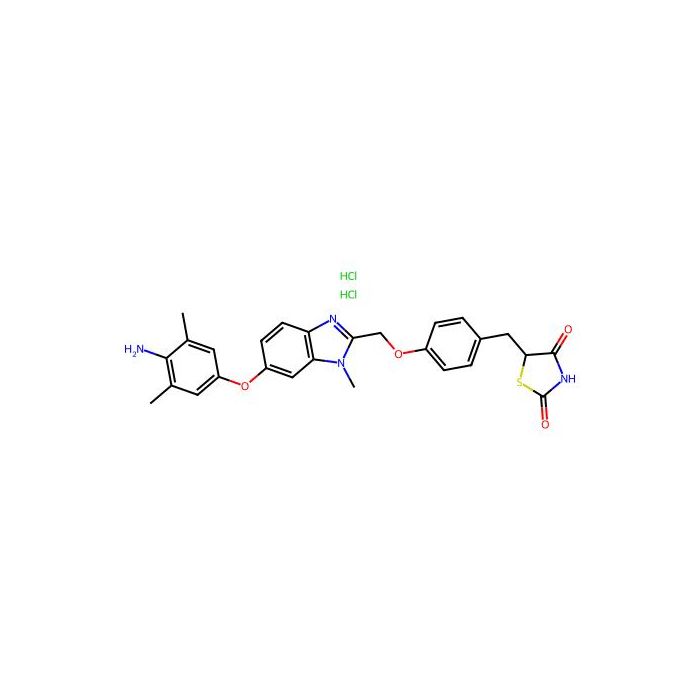
Inolitazone dihydrochloride (Efatutazone dihydrochloride) is a novel high-affinity PPARγ agonist that is dependent upon PPARγ for its biological activity with IC 50 of 0.8 nM for growth inhibition.
In Vitro
Inolitazone dihydrochloride (Efatutazone dihydrochloride) upregulates the cell cycle kinase inhibitor, p21 WAF1/CIP1 . Silencing p21 WAF1/CIP1 rendered cells insensitive to Inolitazone. A 10 nM dose of Inolitazone activates PPARγ:RXRα-dependent transcription as demonstrated in a transient transfection assay utilizing a PPRE response element fused to a luciferase reporter gene (PPRE3-tk-luc). DRO cells are treated in culture with Inolitazone, Rosiglitazone, or Troglitazone at the indicated concentrations. DRO cells are transiently transfected with PPRE3-tk-luc to examine effective concentrations at which EC 50 occurs. The EC 50 s are 1 nM (Inolitazone), 65 nM (Rosiglitazone) and 631 nM (Troglitazone). Similarly, the calculated inhibitory concentration at IC 50 is 0.8 nM for Inolitazone, 75 nM for Rosiglitazone, and 1412 nM for Troglitazone. Inolitazone specifically activates PPARγ, but not PPARα or PPARδ. Exposure of 10 nM Inolitazone following transient transfection with the appropriate PPAR isoform (γ, α, or δ) and PPAR response element linked to a luciferase reporter in RIE rat small intestinal cell line, which does not express PPARs, yields increased luciferase activity only in the presence of PPARγ and PPRE3-tk-luc. DRO cells are growth inhibited by 10 nM Inolitazone (RS5444) through a PPARγ-dependent mechanism. MCE has not independently confirmed the accuracy of these methods. They are for reference only.
In Vivo
Inolitazone dihydrochloride (Efatutazone dihydrochloride) plus Paclitaxel demonstrate additive antiproliferative activity in cell culture and minimal ATC tumor growth. When Inolitazone is administered in the diet to athymic nude mice prior to DRO tumor cell implantation, tumor growth is inhibited in a dose responsive fashion. At the highest dose, 0.025% Inolitazone inhibits growth on day 32 by 94.4% as compared to that of control. In this treatment group, five of 10 animals do not develop demonstrable tumors. In the 0.0025% treatment group, tumor growth is inhibited by 62.3% compared to that of control on day 32 while the 0.00025% dose demonstrated no growth inhibitory activity as compared to control. Tumors is nest allowed to establish in the mouse and began 0.025% Inolitazone treatment of mice 1 week after DRO or ARO tumor cell implantation. Inolitazone treated animals demonstrate tumor growth inhibition of 68.9% in DRO tumors and 48.3% in ARO tumors as compared to that of their respective controls on day 35 . MCE has not independently confirmed the accuracy of these methods. They are for reference only.
IC50& Target:PPARγ
规格
别名
盐酸伊诺他酮
规格或纯度
10mM in DMSO
英文名称
Inolitazone dihydrochloride
生化机理
盐酸伊诺他宗(盐酸依法他宗)是一种新型高亲和力 PPARγ 激动剂,其生物活性依赖于 PPARγ,抑制生长的 IC 50 为 0.8 nM。
储存条件
干燥,-80℃储存
运输条件
特低温运输
作用类型
激动剂
作用机制
过氧化物酶体增殖激活受体伽马激动剂
名称和识别符
分子类型
小分子
Isomeric SMILES
CC1=CC(=CC(=C1N)C)OC2=CC3=C(C=C2)N=C(N3C)COC4=CC=C(C=C4)CC5C(=O)NC(=O)S5.Cl.Cl
关联CAS
PubChem CID
MeSH Entry Terms
CS 7017;CS-7017;CS7017;efatutazone;efatutazone hydrochloride;RS 5444;RS-5444;RS5444
分子量
575.51
技术文档
高级数据
安全和危险性(GHS)
质检证书(CoA,COO,BSE/TSE 和分析图谱)
C of A & Other Certificates(BSE/TSE, COO):
输入批号以搜索分析图谱:
溶液计算器
常见问题
本产品应如何储存?
请于?80 °C、干燥条件下保存。请与干燥剂一同密封保存,本品对湿气敏感。
本产品如何运输?
本产品采用干冰配冷袋冷冻运输。收货后请立即拆包,并按上述储存条件保存;处理干冰时请戴隔热手套并保持通风。
本产品的 CAS 号、分子式和分子量是多少?
本产品的 CAS 号为 223132-38-5,分子式为 C27H28Cl2N4O4S,分子量为 575.51 g/mol。
如何获取批次专用COA?
每个订单都会随附分析证书(COA),您也可以从账户订单历史中下载。如需订购前的COA,请联系您的客户代表,或使用PDP上的"申请COA"按钮——我们将提供代表性批次的COA。
产品仅提供给经过验证的企业、机构和合格的专业人员用于研发。不适用于人类、动物、诊断或治疗。
Copyright © 2023至今 上海阿拉丁生化科技股份有限公司 SSE:688179 保留所有权利。


 危险品化学品经营许可证(带存储)