
计算溶液所需的质量、体积或浓度。
| 活性类型 | 活性值-log(M) | 作用机制 | 期刊 | 参考文献(PubMed IDs) |
|---|
,适用于对基线干扰要求严格的色谱和分析工作流程。
-80℃储存。特低温运输 。请查阅批次 COA 获取详细规格。
SDS、COA、产品数据表及规格说明书均可下载。可通过批号查询获取批次 COA。
在色谱分析、有机合成和交叉偶联反应领域已被 0 篇同行评审文献引用。
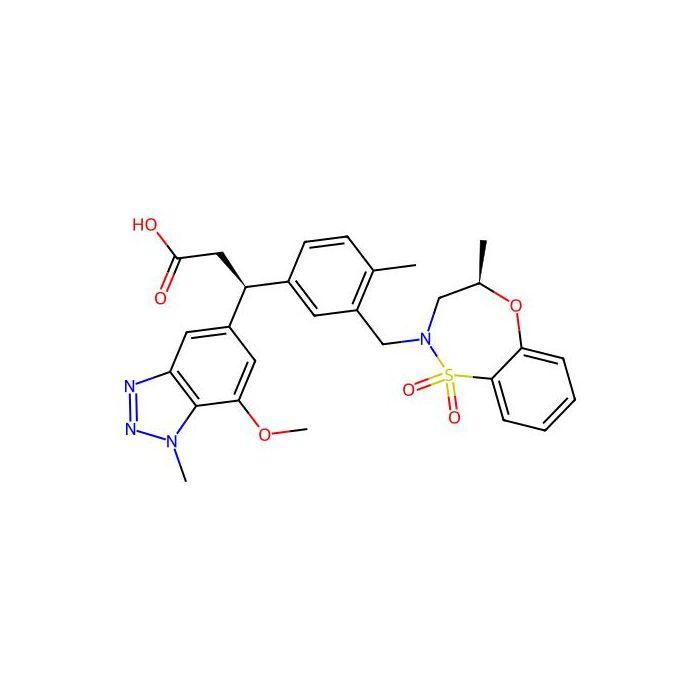
KI696 是一种干扰 Keap1/NRF2 相互作用的高亲和力探针。KI696 是有效、选择性的 KEAP1/NRF2 相互作用抑制剂。
KI696 is a high affinity probe that disrupts the Keap1/NRF2 interaction. KI696 is a potent and selective inhibitor of the KEAP1 / NRF2 interaction
In Vitro
KI696 (compound 7) exhibits very high affinity for the KEAP1 Kelch domain (ITC K d =1.3 nM with the exception of the organic anion transporting polypeptide 1B1 (OATP1B1) (IC 50 =2.5 µM), the bile salt export pump BSEP (IC 50 =4.0 µM), and the phosphodiesterase PDE3A (IC 50 =10 µM), no significant cross-reactivity is observed. No cytotoxicity is observed towards BEAS-2B cells with KI696 at concentrations up to 10 µM. KI696 increases NRF2 Nuclear Translocation in Normal Human Bronchial Epithelial cells. KI696 increases mRNA expression of the NRF2-dependent genes NQO1 and GCLM in NHBE cells transfected with the non-targeting siRNA, while NRF2 gene silencing significantly decreases compound activity. KI696 increases NQO1 Activity in an NRF2-Dependent Manner. Treatment with tBHP clearly has a detrimental effect on cell health and appearance while pre-treatment of cells with 1 µM KI696 before the exposure to tBHP maintained cell morphology consistent with the DMSO control. KI696 Induces the Expression of NRF2-Regulated Genes in COPD patient-derived bronchial epithelial cells. MCE has not independently confirmed the accuracy of these methods. They are for reference only.
In Vivo
KI696 induces the expression of each of the Nqo1, Ho-1, Txnrd1, Srxn1, Gsta3, Gclc genes in a dose-dependent manner, with maximum increases over vehicle controls of 37-(Nqo1), 17-(Ho-1), 9-(Txnrd1), 28-(Srxn1), 15-(Gsta3) and 13-fold (Gclc) occurring at the 50 µmol/kg dose. EC 50 values are 44.0, 25.7, 42.6, 33.8, 28.4, and 44.1 µmol/kg, respectively, giving an average EC 50 value of 36.4±3.4 µmol/kg. KI696 attenuates ozone-Induced pulmonary inflammation. KI696 restores ozone-induced depletion of lung GSH levels. KI696 is administered to rats at 10, 35 and 50 µmol/kg by IV infusion, resulting in steady state compound concentrations in the blood of 407±44 nM, 946±50 nM and 1437±186 nM, respectively, over the 6 hour infusion period. Exposure to ozone 24 hours post-dose produces a significant depletion in lung levels of the anti-oxidant molecule, GSH, which is restored by KI696 in a dose-dependent manner . MCE has not independently confirmed the accuracy of these methods. They are for reference only.
IC50& Target:Target: Keap1-NRF2


 危险品化学品经营许可证(带存储)