
计算溶液所需的质量、体积或浓度。
| 活性类型 | 活性值-log(M) | 作用机制 | 期刊 | 参考文献(PubMed IDs) |
|---|
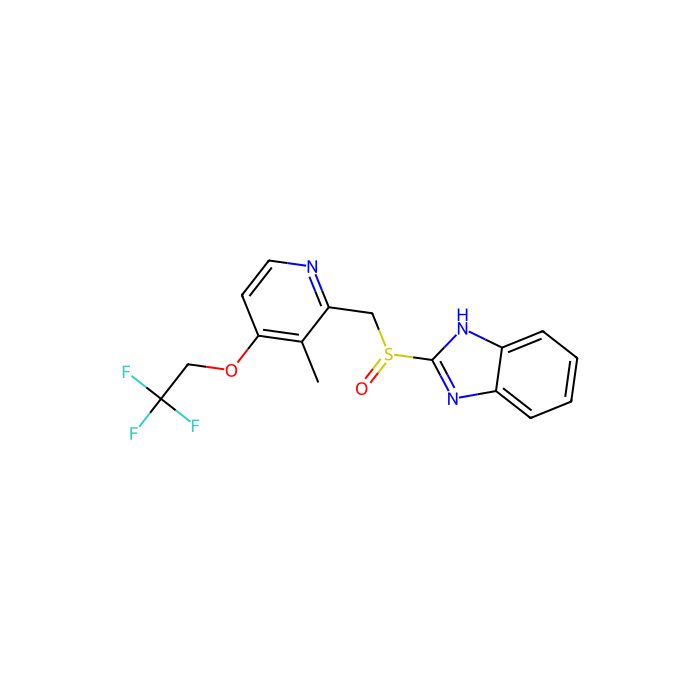
Lansoprazole is a ATP4A (H+,K+-ATPase) inhibitor (IC50 = 6.3 μM) that displays antisecretory and antiulcer activity. Inhibits gastric acid secretion (IC50 = 0.09 μM for histamine-induced acid formation) and reduces gastric lesion formation induced by a variety of ulcerative stimuli. Antibacterial against Helicobacter pylori in vitro. Also blocks swelling-dependent chloride channel (ICI swell) in NIH3T3 fibroblasts. Lansoprazole is more potent than omeprazoleA H+,K+-ATPase inhibitor that displays antisecretory activity
Information
Lansoprazole Lansoprazole (A-65006, AG-1749) is a proton-pump inhibitor (PPI) that binds covalently to parietal cell H(+),K(+)-ATPase . Lansoprazole prevents the stomach from producing gastric acid.
In vitro
Lansoprazole inhibits gastric acid secretion via inhibition of gastric hydrogen/potassium adenosine triphosphatase (H+,K(+)-ATPase), an enzyme of the gastric parietal cell membrane that forms part of the proton pump that performs the final step in the acid secretory process. Lansoprazole binds covalently to parietal cell H+,K(+)-ATPase, rendering it nonfunctional and inhibiting the secretion of gastric acid. Lansoprazole is a strong anti-secretory agent that acts on gastric H+/K+-adenosine triphosphatase (H+/K+ ATPase) of parietal cells. Lansoprazole inhibits the increased expression of vascular adhesion molecules, the activation of neutrophils, and the production of pro-inflammatory cytokines from activated endothelial cells. Lansoprazole induces several genes, including phase II detoxifying enzyme (NADPH-ubiquinone oxidoreductase, glutathione S-transferase) and antioxidant stress proteins (HO-1, thioredoxin reductase, and superoxide dismutase) in gastric epithelial cells. Lansoprazole significantly inhibits the production of CINC-1 from stimulated RGM-1 cells with IL-1β. Lansoprazole up-regulates HO-1 expression throughout Nrf2 in rat gastric epithelial cells, and the up-regulated HO-1 has anti-inflammatory effects.
In vivo
Lansoprazole inhibits acute inflammatory reactions as well as intestinal mucosal injuries induced by ischemia-reperfusion or indomethacin administration in rats. Lansoprazole significantly inhibits intestinal injuries induced by ischemia-reperfusion or indomethacin. lansoprazole administered exogenously prevents the small intestine against ischemia-reperfusion or indomethacin-induced damage, the action being dependent on its anti-inflammatory and anti-oxidative responses.
Cell Data
cell lines:A431, HCC827, NCI-H292, NCI-H358, NCI-H23, NCI-H1299, Calu-6 and NCI-H460 cells
Concentrations:
Incubation Time:
Powder Purity:≥95%
| ALogP | 2.8 |
|---|
H302: 吞食有害
H410: 对水生生物毒性极大并具有长期持续影响
P264: 处理后要彻底洗手。
P270: 使用本产品时,请勿进食、饮水或吸烟。
P273: 避免释放到环境中。
P330: 漱口
P391: 收集溢出物
P301+P312: 如误吞咽:如感觉不适,呼叫急救中心/医生。
P501: 将内容物/容器送到批准的废物处理厂处理


 危险品化学品经营许可证(带存储)