苹果酸是一种生物体生成的二羧酸,是人体必需的一种有机酸。苹果酸有L-苹果酸和D-苹果酸2种异构体,天然存在的苹果酸几乎都是L型的。苹果酸作为三羧酸循环的重要中间体,在代谢过程中起着重要作用。在植物的C4固定过程中,苹果酸是卡尔文循环中CO2的来源。在低等生物中,苹果酸在苹果酸-乳酸发酵过程中通过二氧化碳的形成转化为乳酸。苹果酸也可以通过植物叶片保卫细胞中磷酸烯醇式丙酮酸的羧化作用合成的。苹果酸作为一种双阴离子,在溶质被吸收到保卫细胞的过程中经常伴随着钾阳离子,以维持细胞内的电位平衡。这些溶质在保卫细胞内的积累降低了溶质电位,使水进入细胞并促进气孔的开口。
本试剂盒的检测原理为L-苹果酸在苹果酸脱氢酶(Malate dehydrogenase, MDH)的作用下氧化生成草酰乙酸(Oxalacetic acid, OAA),在这一反应过程中NAD+被还原为NADH;生成的NADH在电子耦合试剂的作用下将WST-8还原生成橙黄色的Formazan,在450nm左右有最大吸收峰。反应体系中生成的Formazan与样品中L-苹果酸的含量成正比。在样品体积为20 µL时,本试剂盒可以检测浓度低达20 μM的苹果酸,在20-500 μM (0.4-10 nmol)浓度范围内有良好的线性关系。
使用方法
1. 样本制备
(1)血液样品的准备:对于血清样品,将全血在常温下静置30分钟-2小时,4ºC约1000-2000×g离心10分钟,取上清;对于血浆样品,将全血用肝素或者EDTA进行抗凝,4ºC约1000-2000×g离心10分钟,取上清。
(2)细胞样本的准备:对于培养的贴壁细胞,PBS洗涤细胞一次。对于培养的悬浮细胞,离心收集细胞用PBS洗涤细胞一次。按照每100万细胞加入200 μL 裂解液的比例加入裂解液,适当吹打,冰浴10分钟充分裂解细胞。4ºC, 12,000×g离心5分钟,取上清用于后续检测。
(3)对于组织样品,按照每10 mg组织加入100 μL 裂解液的比例,使用匀浆器冰浴匀浆。4ºC约12,000×g离心5分钟,取上清用于后续检测。
(4)细胞培养上清样品的准备:对于贴壁细胞,直接取培养液;对于悬浮细胞,离心取培养液。
以上所有操作均需在4ºC或冰上操作。制备好的细胞或组织样品如果不能立即检测,可以-20ºC或-80ºC冻存。
2. L-苹果酸标准曲线的设置
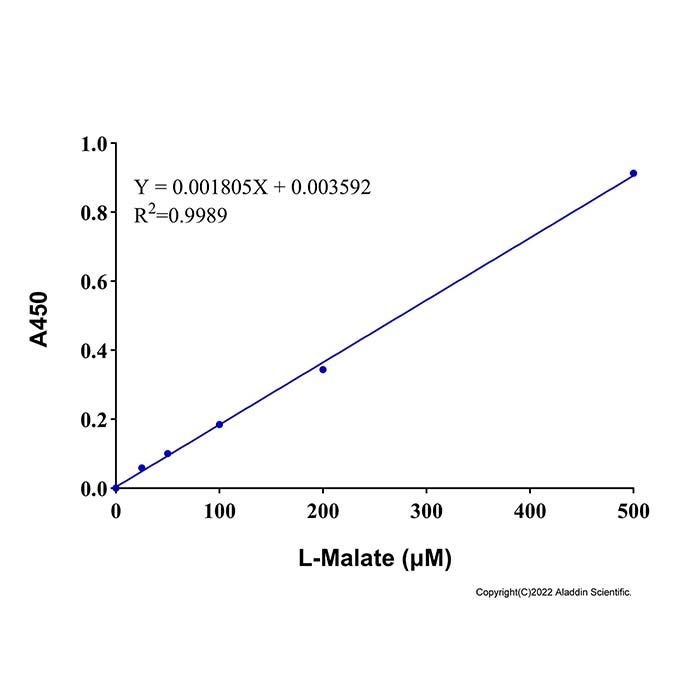
取5 μL L-苹果酸标准品 (10 mM),加入95 μL检测裂解液或检测缓冲液(如果检测需要裂解处理的细胞或组织样品,使用裂解液;如果检测血液、上清等无需裂解处理的样品,使用检测缓冲液),配制成浓度为500 μM的苹果酸标准溶液。分别取500 μM的苹果酸标准溶液0、1、2、4、8、20 μL加入96孔板的标准品孔中,并用对应的裂解液或检测缓冲液补足到20 μL,此时标准曲线的浓度为0、25、50、100、200、500 μM。
3. WST-8 Working Solution的配制
按照下表配置WST-8工作液,注意冰上操作。
样本数 | 1 | 10 | 20 | 50 |
L-苹果酸检测液 | 72 μL | 720 μL | 1440 μL | 3600 μL |
酶液 | 2 μL | 20 μL | 40 μL | 100 μL |
辅酶 | 4 μL | 40 μL | 80 μL | 200 μL |
显色液 | 2 μL | 20 μL | 40 μL | 100 μL |
总体积 | 80 μL | 800 μL | 1600 μL | 4000 μL |
4. 样本测定
(1)加入1-20 μL样品或稀释后的样品到96孔板样品孔中,并相应地再加入检测裂解液或检测缓冲液至样品孔中,补足到20 µL。同时设置仅含裂解液或检测缓冲液的孔为空白对照孔(如果检测需要裂解处理的细胞或组织样品,使用裂解液;如果检测血液、上清等无需裂解处理的样品,使用检测缓冲液)。
(2)各孔加入WST-8显色工作液80 μL,混匀。37ºC避光孵育30分钟。如果颜色较浅,可适当延长反应时间至45或者60分钟。
(3)反应结束后,使用酶标仪在450 nm测定吸光度。
5. 结果计算
建立标准曲线,并计算样品中L-苹果酸的浓度(记录为A),如果样品背景对照孔吸光度比较高,样品的吸光度需要减去样品背景对照的吸光度。L-苹果酸浓度的计算公式如下:
C (μM) = A × n
注1:A为根据标准曲线确定的稀释后的样品L-苹果酸浓度(μM);n为样品总稀释倍数;
注2:计算获得的L-苹果酸浓度其中包含了L-苹果酸和L-苹果酸根的摩尔浓度,也可以理解为包含了L-苹果酸和L-苹果酸盐的摩尔浓度。上述仅为了表述方便,仅描述为L-苹果酸。如有必要,可根据L-苹果酸的分子量134.09计算出样品中L-苹果酸的质量浓度(μg/mL) = C × 0.13409。
注意事项
1. 各组分需要完全解冻并平衡至室温后再使用,否则会影响检测结果。酶溶液和苹果酸标准溶液使用时应在冰上进行。
2. NADH和NADPH以及会影响NADH和NADPH水平的物质等的存在会对检测产生干扰。如果样品含有干扰物质,须同时设置样品的背景对照孔,即配制WST-8显色工作液时酶液用检测液替代。计算时样品孔的读数值需要减去背景对照孔的读数。
3. 为确保数值在标准曲线范围内,建议进行预实验将样品同时设定多个稀释倍数,以确定样品的大致浓度。如果数值不在标准曲线范围内,可调整样品的稀释倍数或者增加样品的量。
4. 请按照实验需求将组分进行分装,避免反复冻融。
Malate is a biologically produced dicarboxylic acid and an essential organic acid for the human body. It exists in two isomeric forms, L-malate and D-malate, with the naturally occurring form being almost exclusively the L-isomer. As a key intermediate in the tricarboxylic acid (TCA) cycle, malate plays a vital role in metabolism. In the C4 carbon fixation pathway of plants, malate serves as the source of CO₂ for the Calvin cycle. In certain microorganisms, malate is converted to lactate via malolactic fermentation, with the concomitant release of carbon dioxide. Malate can also be synthesized in plant guard cells through the carboxylation of phosphoenolpyruvate (PEP). As a dianion, malate often accompanies potassium cations (K⁺) during solute uptake into guard cells to maintain intracellular electrical balance. The accumulation of these solutes lowers the osmotic potential within the guard cells, driving water influx and promoting stomatal opening.
The detection principle of this kit is as follows: L-malate is oxidized to oxaloacetate (OAA) by malate dehydrogenase (MDH), during which NAD⁺ is reduced to NADH. The generated NADH then reduces WST-8 to an orange-yellow formazan dye in the presence of an electron coupling reagent. This formazan product exhibits a maximum absorption peak at approximately 450 nm. The amount of formazan generated is directly proportional to the concentration of L-malate in the sample. With a sample volume of 20 µL, this kit can detect malate at concentrations as low as 20 µM and exhibits a strong linear relationship within the range of 20 to 500 µM (equivalent to 0.4–10 nmol).
Usage Protocol
1. Sample Preparation
1) Preparation of Blood Samples:
For serum samples: Allow whole blood to clot at room temperature for 30 minutes to 2 hours. Centrifuge at approximately 1000-2000 × g for 10 minutes at 4°C and collect the supernatant.
For plasma samples: Collect whole blood using heparin or EDTA as an anticoagulant. Centrifuge at approximately 1000-2000 × g for 10 minutes at 4°C and collect the supernatant.
2) Preparation of Cell Samples:
For cultured adherent cells: Wash the cells once with PBS; For cultured suspension cells: Centrifuge to collect the cells and wash them once with PBS. Add Lysis Buffer at a ratio of 200 µL per 1 million cells. Pipette appropriately to mix and incubate on ice for 10 minutes for complete lysis. Centrifuge at 12,000 × g for 5 minutes at 4°C. Collect the supernatant for subsequent assays.
3) Preparation of Tissue Samples:
Add Lysis Buffer at a ratio of 100 µL per 10 mg of tissue. Homogenize the tissue using a homogenizer on ice. Centrifuge at approximately 12,000 × g for 5 minutes at 4°C. Collect the supernatant for subsequent assays.
4) Preparation of Cell Culture Supernatant Samples:
For adherent cells: Directly collect the culture medium; For suspension cells: Centrifuge the culture and collect the supernatant.
All the above procedures must be performed at 4°C or on ice. Prepared cell or tissue samples can be stored at -20°C or -80°C if not assayed immediately.
2. Establishment of L-malate Standard Curve
Pipette 5 μL of the malate standard solution (10 mM) and add it to 95 μL of either assay lysis buffer or assay buffer (use lysis buffer for lysed cell or tissue samples; use assay buffer for samples not requiring lysis, such as blood or supernatant) to prepare a 500 μM malate intermediate standard solution.
For the standard curve setup, add 0, 1, 2, 4, 8, and 20 μL of the 500 μM malate intermediate standard solution into the standard wells of a 96-well plate, respectively. Then, bring the volume in each well to 20 μL by adding the corresponding lysis buffer or assay buffer. The resulting standard curve concentrations are 0, 25, 50, 100, 200, and 500 μM.
3. Preparation of WST-8 Working Solution
Prepare the WST-8 Working Solution according to the table below. Note: This procedure must be performed on ice.
Samples | 1 | 10 | 20 | 50 |
L-Malate Assay Buffer | 72 μL | 720 μL | 1440 μL | 3600 μL |
Enzyme Solution | 2 μL | 20 μL | 40 μL | 100 μL |
Coenzyme | 4 μL | 40 μL | 80 μL | 200 μL |
Chromogenic Solution | 2 μL | 20 μL | 40 μL | 100 μL |
Total volume | 80 μL | 800 μL | 1600 μL | 4000 μL |
4. Sample Assay
1) Add 1–20 µL of the sample or diluted sample to the sample wells of a 96 well plate. Then bring the volume in each well to 20 µL by adding the corresponding Assay Lysis Buffer (for lysed cell or tissue samples) or Assay Buffer (for samples that do not require lysis, such as blood or supernatant). Also set up blank control wells containing only the corresponding lysis buffer or assay buffer (use lysis buffer if detecting lysed cell or tissue samples; use assay buffer if detecting samples such as blood or supernatant that do not require lysis), with a final volume of 20 µL.
2) Add 80 µL of WST‑8 Color Developer Working Solution to each well and mix. Incubate at 37 °C in the dark for 30 minutes. If the color development is weak, the incubation time may be appropriately extended to 45 or 60 minutes.
3) After the reaction, measure the absorbance at 450 nm using a microplate reader.
5. Calculation of Results
Establish a standard curve and calculate the concentration of L-malate in the sample (recorded as A). If the absorbance of the sample background control well is relatively high, subtract the absorbance of the sample background control from that of the sample. The formula for calculating the L-malate concentration is as follows:C (μM) = A × n
Note 1: A is the concentration of L-malate (μM) in the diluted sample as determined from the standard curve; n is the total dilution factor of the sample.
Note 2: The calculated L-malate concentration includes the molar concentration of both L-malic acid and L-malate ions, which can also be understood as including both L-malic acid and L-malate salts. For simplicity, it is referred to here only as "L-malate." If necessary, the mass concentration of L-malate in the sample can be calculated using the molecular weight of L-malic acid (134.09): Mass concentration (μg/mL) = C × 0.13409.
Precautions
1. All components must be completely thawed and equilibrated to room temperature before use, otherwise detection results may be affected. The Enzyme Solution and Malate Standard Solution should be kept on ice during use.
2. The presence of NADH, NADPH, or other substances that influence NADH/NADPH levels may interfere with the assay. If the sample contains potential interfering substances, a sample background control well must be set up by replacing the Enzyme Solution in the WST-8 chromogenic working solution with Assay Buffer. During calculation, subtract the absorbance value of the background control well from that of the sample well.
3. To ensure measurements fall within the range of the standard curve, it is recommended to perform a preliminary experiment by testing the sample at multiple dilution factors to estimate its approximate concentration. If the measured value lies outside the standard curve range, adjust the sample dilution factor or increase the sample volume.
4. Aliquot the components according to experimental needs to avoid repeated freeze‑thaw cycles.

 ZJ26F0433894


 危险品化学品经营许可证(带存储)