透明质酸 (Hyaluronic acid,HA)是人体细胞外基质的重要组成成分,具有保水、维持细胞外空间、调节渗透压、润滑、促进细胞修复等重要生理功能。HA已通过FDA批准,具有优异的生物安全性,并广泛应用于生物医学领域。
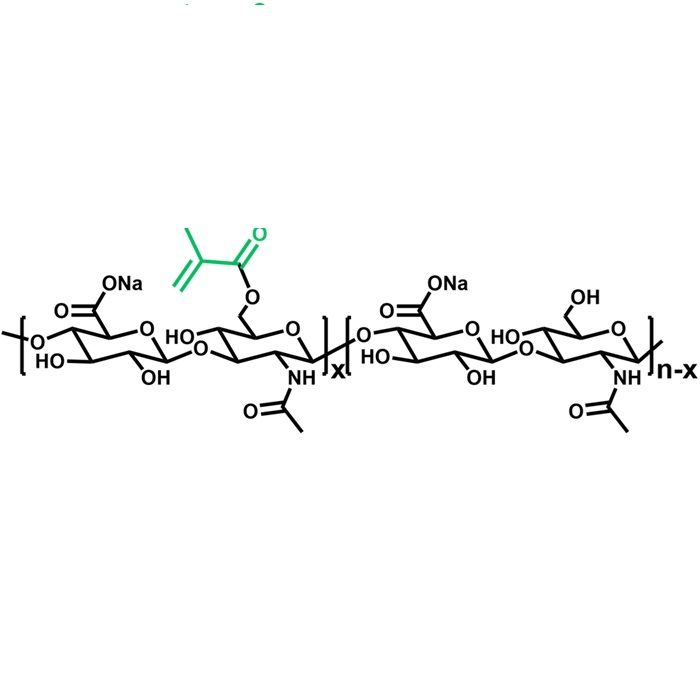
HAMA是由透明质酸钠经甲基丙烯酸酐 (MA)修饰得到的、具有光敏特性的高分子材料,可与蓝光或紫外光引发剂配合使用,在蓝光或紫外光辐照下交联固化。该高分子生物相容性优异、固化简单,现已被广泛应用在细胞2D/3D培养、药物缓释、组织工程器官构建、软骨再生、创伤敷料、生物传感器、防黏连保护层等生物医药领域。
产品规格
| 组分 | 外观 | 规格 | 备注 |
| HAMA | 白色或类白色粉末颗粒 | 1 g/瓶、5 g/瓶 | 避光保存 |
使用建议
1、HAMA可与邻硝基苄醇化高分子,如PEGNB、HANB、GelNB联合使用。二者由光引发剂LAP、NAP光照引发聚合并交联,仅需数秒即可获得高强度水凝胶材料。
2、HAMA可与甲基丙烯基修饰的高分子,如CMCMA、GelMA、CSMA、ChMA以及丙烯基修饰的高分子,如F127DA联合使用,由光引发剂光照引发聚合,构建不同理化性能的水凝胶材料。
3、HAMA单独使用,由光引发剂光照引发聚合并交联。
配制方法
1、配制光引发剂标准液:取一定质量的NAP或LAP配制成浓度为0.1 wt%-0.25 wt%范围内的溶液,2-8 ℃避光保存;
2、取所需质量的HAMA放入离心管,并取所需体积的引发剂标准溶液加入到上述离心管中;
3、将上述样品于室温下避光搅拌或于摇床振荡,直至完全溶解。样品如在溶液中结块,可先用药匙碾碎;若样品溶解速度偏慢,可置于50-60 ℃环境加热搅拌助溶。
注意事项
1、HAMA的标记率越高,配制的浓度越高,固化后形成的凝胶模量越大,固化时间越短。
2、HAMA的分子量越高,固化后形成的凝胶韧性越好,不易破碎。
3、HAMA的分子量越高,配制成的溶液粘度越大。分子量为340 kDa的HAMA,建议使用浓度不超过5 wt%;分子量为40 kDa的HAMA,建议使用浓度不超过20 wt%。
4、光引发剂标准液浓度越高,HAMA溶液固化速度越快,固化后形成的凝胶越脆。
产品应用
3D软骨细胞培养、生物打印、肿瘤模型、药物控释、微针制备、伤口敷料、生物传感器及术后防粘连等领域。
灭菌方式
1、过滤灭菌 (建议):使用0.22 μm无菌针头过滤器过滤溶液灭菌,此方法仅限于低粘度溶液使用,如溶液粘度较高时,请选用巴氏灭菌或湿热灭菌法;
2、巴氏灭菌:将溶液加热到80 ℃,保持30 min;再迅速转移至冰水混合物中冷却至常温。共循环上述操作三次;
3、湿热灭菌:将溶液于高温高压灭菌锅内,121 ℃下灭菌8 min,手动放气后,将溶液迅速转移至冰水混合物中冷却至常温。需注意,高温条件会导致凝胶性能下降,因此使用该方法灭菌时应严格遵守上述操作步骤。
注:无菌溶液可以2-8 ℃避光暂存,建议7天内使用;非无菌溶液可以2-8 ℃避光暂存,建议48小时内使用。
产品特点
1、原位、快速构建高强度水凝胶:可与PEGNB秒级构建高强韧仿生界面键合纳米复合水凝胶。
2、可用于3D打印复杂高精度结构
产品优势
1、批次稳定:采用标准化的生产工艺,保证不同批次的HAMA在成分、理化特性和生物学方面具有高度的重复性和可控性。
2、超高纯度:采用独特的生产工艺,有效地去除甲基丙烯酸小分子和工艺杂质,实现超低杂质水平,保证HAMA在生物医学应用的安全性。
3、可靠的安全性:HAMA是业内第一款同时经中检院和第三方机构完成双重生物相容性评价的市售HAMA产品,产品安全无毒性,加速下游产品从实验室到临床的转化。
4、高稳定性:参照《无源植入性医疗器械稳定性研究指导原则》,经过实时稳定性和加速稳定性试验证明:HAMA产品在标示贮存条件下质量稳定。
Product Introduction
Hyaluronic acid (HA) is a key component of the human extracellular matrix, with important physiological functions including water retention, maintenance of extracellular space, osmotic pressure regulation, lubrication, and promotion of cell repair.HA has been approved by the FDA, exhibits excellent biosafety, and is widely used in the biomedical field.
HAMA is a photosensitive polymer obtained by modifying sodium hyaluronate with methacrylic anhydride (MA). It can be used with blue-light or UV-light photoinitiators and crosslinks upon irradiation with blue or ultraviolet light.This polymer features excellent biocompatibility and simple photocuring, and is widely applied in biomedical fields including 2D/3D cell culture, drug delivery, tissue engineering and organ construction, cartilage regeneration, wound dressings, biosensors, and anti-adhesion barriers.
Product Specifications
| Component | Appearance | Specification | Note |
| HAMA | White or off-white powder or granules | 1 g/bottle, 5 g/bottle | Store in the dark. |
Recommended Usage
1. HAMA can be used in combination with o-nitrobenzyl alcohol-modified polymers such as PEGNB, HANB, and GelNB. Polymerization and crosslinking are initiated by photoinitiators LAP or NAP under light exposure, yielding high-strength hydrogels within seconds.
2. HAMA can be blended with methacryl-modified polymers (e.g., CMCMA, GelMA, CSMA, ChMA) and acryl-modified polymers (e.g., F127DA), and polymerized under light irradiation to form hydrogels with tunable physicochemical properties.
3. HAMA can be used alone and crosslinked via photoinitiated polymerization.
Preparation Method
1. Preparation of photoinitiator stock solution: Dissolve NAP or LAP to a concentration of 0.1 wt%-0.25 wt%. Store at 2-8 °C protected from light.
2. Weigh the required amount of HAMA into a centrifuge tube, then add the desired volume of photoinitiator stock solution.
3. Stir the mixture at room temperature in the dark or shake on an orbital shaker until fully dissolved. If clumps form, crush them with a spatula first. If dissolution is slow, heat and stir at 50–60 °C to assist solubilization.
Precautions
1. Higher modification degree of HAMA and higher solution concentration result in higher gel modulus and shorter curing time.
2. Higher molecular weight of HAMA leads to better toughness and less fragility of the cured gel.
3. Higher molecular weight of HAMA increases solution viscosity. For 340 kDa HAMA: recommended concentration ≤ 5 wt%; For 40 kDa HAMA: recommended concentration ≤ 20 wt%.
4. Higher photoinitiator concentration accelerates curing but produces more brittle hydrogels.
Applications
3D chondrocyte culture, bioprinting, tumor models, controlled drug release, microneedle fabrication, wound dressings, biosensors, and postoperative anti-adhesion.
Sterilization Methods
1. Filter sterilization (recommended): Sterilize the solution using a 0.22 μm sterile syringe filter. Only applicable for low-viscosity solutions. For high-viscosity solutions, use pasteurization or autoclaving.
2. Pasteurization: Heat the solution to 80 °C for 30 min, then rapidly cool to room temperature in an ice-water bath. Repeat the cycle three times.
3. Moist heat sterilization (autoclaving): Autoclave the solution at 121 °C for 8 min. After manual pressure release, cool rapidly to room temperature in an ice-water bath. Note that high temperatures may reduce gel performance; strictly follow the above procedure.
Note: Sterile solutions: store at 2-8 °C protected from light, use within 7 days; Non-sterile solutions: store at 2-8 °C protected from light, use within 48 hours.
Product Features
1. In-situ rapid formation of high-strength hydrogels: Can form high-toughness biomimetic interface-bonded nanocomposite hydrogels within seconds when used with PEGNB.
2. Suitable for 3D printing of complex high-precision structures
Product Advantages
1. Batch-to-batch consistency: Standardized manufacturing ensures high repeatability and controllability of composition, physicochemical properties, and biological performance across different HAMA batches.
2. Ultra-high purity: Proprietary production process effectively removes methacrylic acid monomers and process impurities, achieving ultra-low impurity levels and ensuring safety in biomedical applications.
3. Reliable safety: HAMA is the first commercial product on the market that has completed dual biocompatibility evaluations by both the National Institutes for Food and Drug Control (NIFDC) and third-party institutions. It is safe and non-toxic, accelerating the translation of downstream products from lab to clinic.
4. High stability: In accordance with the Guiding Principles for Stability Study of Non-Invasive Implantable Medical Devices, real-time and accelerated stability tests confirm that HAMA maintains stable quality under labeled storage conditions.



 ZJ26F1039735


 危险品化学品经营许可证(带存储)