葡萄糖是细胞能量代谢的核心底物,细胞葡萄糖摄取水平直接反映其代谢活性、增殖状态及病理生理变化。本试剂盒适用于贴壁 / 悬浮细胞的葡萄糖摄取检测,可兼容荧光酶标仪、流式细胞仪、激光共聚焦显微镜等多种检测设备,广泛应用于肿瘤代谢、糖尿病机制研究、降糖药物筛选等领域。
本试剂盒采用荧光标记的葡萄糖类似物 2-NBDG(2-Deoxy-2-[(7-nitro-2,1,3-benzoxadiazol-4-yl) amino]-D-glucose),可被细胞膜上的葡萄糖转运体识别并进入细胞,且无法被进一步代谢而稳定滞留,其荧光信号强度与细胞葡萄糖摄取水平呈正相关。
组分与储存
| N1508405
| 组分 | 100 T | 500 T | 储存温度 | N1508405A | 2-NBDG (50×) | 0.2 mL | 1mL | -20℃. 避光保存. | N1508405B | 葡萄糖摄取工作液 | 50 mL | 250 mL | -20℃ |
|
使用方法
1. 试剂准备
按照本次用量,将 2-NBDG Solution 按照 1:50-1:200 的比例稀释到 Glucose Uptake Assay Buffer 中,即 2-NBDG 工作液。备注:具体的稀释比例可以根据实验需求进行调整。
2. 细胞培养
将细胞培养在细胞培养孔板、培养皿中,培养 24 小时,实验前的细胞密度应在 70-90%。备注:如果用于大通量荧光检测,建议采用 96 孔板(黑壁、透明底)。
3. 药物处理
将待评价的化合物药物用 Glucose Uptake Assay Buffer 稀释到特定的浓度,然后加入到细胞中,并处理细胞一定时间。备注:设置空白对照组(不含细胞的 Glucose Uptake Assay Buffer),并用相同的化合物处理。
4. 2-NBDG 染色
1)贴壁细胞:化合物处理结束后,吸掉培养基,加入适量 2-NBDG工作液(例如 96 孔板每孔 100 μL,6 孔板每孔 1 mL),37°C避光孵育 40 min。孵育结束后,用 1X Glucose Uptake Assay Buffer 清洗一次细胞。备注:最佳的 2-NBDG 孵育时间可以根据实验需求进行调整。
2)悬浮细胞:化合物处理结束后,室温 1000 rpm,5 min,吸掉培养基,加入适量 2-NBDG 工作液(例如 96 孔板每孔细胞量100 μL,6 孔板每孔细胞量 1 mL),37°C 避光孵育 40 min。孵育结束后,室温 1000 rpm,5 min,吸掉培养基,用 1X Glucose Uptake Assay Buffer 清洗一次细胞。备注:最佳的 2-NBDG 孵育时间可以根据实验需求进行调整。
5. 波长检测
2-NBDG的检测条件为为 Ex/Em=488nm/542nm。
6. 结果展示

图1. 葡萄糖摄取荧光检测试剂盒(2-NBDG)检测Jurkat细胞(人T淋巴细胞瘤细胞)葡萄糖摄取的流式细胞检测效果图。Jurkat细胞使用无糖RPMI 1640培养液 (R1370046-500mL)配制的完全培养液孵育2小时后,使用本试剂盒配制的0.0625X-4X的2-NBDG葡萄糖摄取工作液染色并使用流式细胞仪检测。图中可见,葡萄糖饥饿处理后的Jurkat细胞可摄取较多2-NBDG,荧光强度随着2-NBDG的浓度增加而增强。Control组未使用2-NBDG。实际结果会因实验条件、检测仪器等的不同而存在差异,图中效果仅供参考。

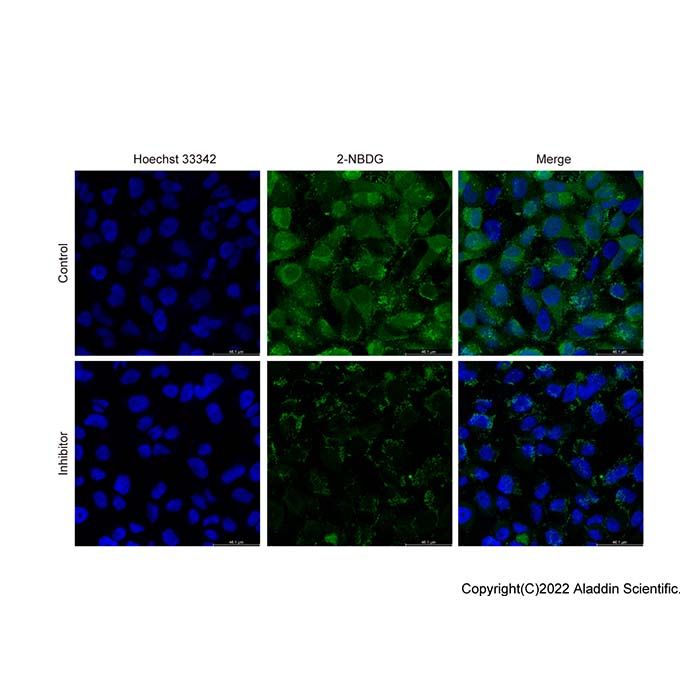
图2. 葡萄糖摄取荧光检测试剂盒(2-NBDG)检测Hela细胞葡萄糖摄取的效果图。Hela细胞在加或不加10 mM 2-DG处理4h后,使用本试剂盒葡萄糖摄取工作液孵育培养30 min并用Hoechst 33342进行染色,荧光显微镜检测葡萄糖摄取情况,加入 2-DG孵育可抑制Hela 细胞的葡萄糖摄取。
注意事项
1)2-NBDG荧光染料容易淬灭,稀释后尽快使用,短期可适量分装,避免反复冻融。
2)若细胞的葡萄糖摄取能力较弱,可适当延长孵育时间至 120 min。
3)本产品仅限于科学研究用,不得用于临床诊断或治疗,为了您的安全和健康,请穿实验服并戴一次性手套操作。
Glucose is the core substrate of cellular energy metabolism, and the cellular glucose uptake level directly reflects metabolic activity, proliferation status and pathophysiological changes. This kit is suitable for the detection of glucose uptake in adherent and suspension cells, compatible with multiple detection devices such as fluorescence microplate readers, flow cytometers and laser confocal microscopes. It is widely applied in research fields including tumor metabolism, diabetes pathogenesis and hypoglycemic drug screening.
This kit utilizes 2-NBDG (2-Deoxy-2-[(7-nitro-2,1,3-benzoxadiazol-4-yl)amino]-D-glucose), a fluorescently labeled glucose analog. 2-NBDG is recognized and internalized by cellular glucose transporters. It cannot be further metabolized and thus accumulates stably in cells. The fluorescence intensity is positively correlated with the cellular glucose uptake capacity.
Kit Components
| N1508405
| Components | 100 T | 500 T | Storage | N1508405A | 2-NBDG (50×) | 0.2 mL | 1mL | -20℃. Store in the dark. | N1508405B | Glucose Uptake Assay Buffer | 50 mL | 250 mL | -20℃ |
|
Protocol
1. Reagent Preparation
According to the experimental dosage, dilute 2-NBDG Solution into Glucose Uptake Assay Buffer at a ratio of 1:50–1:200 to prepare 2-NBDG working solution. Note: The dilution ratio can be adjusted as needed.
2. Cell Culture
Culture cells in cell culture plates or petri dishes for 24 hours, with cell confluence reaching 70%-90% before the experiment. Note: Black-wall and clear-bottom 96-well plates are recommended for high-throughput fluorescence detection.
3. Drug Treatment
Dilute the test compounds to the specified concentration with Glucose Uptake Assay Buffer, then add to cells for treatment with a specific duration. Note: Set a blank control group containing only Glucose Uptake Assay Buffer without cells and treat with the same compounds.
4. 2-NBDG Staining
1) Adherent Cells: After compound treatment, discard the medium and add an appropriate amount of 2-NBDG working solution (100 μL per well for 96-well plates, 1 mL per well for 6-well plates). Incubate at 37 °C for 40 min in the dark. After incubation, rinse cells once with 1× Glucose Uptake Assay Buffer. Note: The optimal incubation time can be adjusted according to experimental requirements.
2) Suspension Cells: After compound treatment, centrifuge at 1000 rpm for 5 minutes at room temperature and discard the medium. Add an appropriate amount of 2-NBDG working solution (100 μL per well for 96-well plates, 1 mL per well for 6-well plates). Incubate at 37 °C for 40 min in the dark. After incubation, centrifuge at 1000 rpm for 5 minutes at room temperature, remove the supernatant, and rinse cells once with 1× Glucose Uptake Assay Buffer. Note: The optimal incubation time can be adjusted according to experimental requirements.
5. Detection Wavelength
The detection parameters of 2-NBDG: Ex/Em = 488 nm / 542 nm.
6. Result Analysis and Presentation

Figure 1. Flow cytometry detection results of glucose uptake in Jurkat cells (human T-lymphoma cells) using the Glucose Uptake Fluorescence Detection Kit (2-NBDG). After Jurkat cells were incubated for 2 hours in complete medium prepared with glucose-free RPMI 1640 medium, they were stained with 0.0625-4X 2-NBDG glucose uptake working solution prepared by this kit and detected by flow cytometry. As shown in the figure, Jurkat cells after glucose starvation treatment could take up more 2-NBDG, and the fluorescence intensity increased with the increase of 2-NBDG concentration. The Control group was not treated with 2-NBDG. The actual results may vary due to differences in experimental conditions, detection instruments, etc., and the effects in the figure are for reference only.
Figure 2. Effect diagram of the Glucose Uptake Fluorescence Detection Kit (2-NBDG) for detecting glucose uptake in Hela cells. After Hela cells were treated with or without 10 mM 2-DG for 4 hours, they were incubated with the glucose uptake working solution of this kit for 30 minutes and stained with Hoechst 33342. Glucose uptake was detected by fluorescence microscopy, and incubation with 2-DG could inhibit glucose uptake in Hela cells.
Notes
1) The 2-NBDG fluorescent dye is prone to quenching. Use it as soon as possible after dilution. For short-term storage, it can be properly aliquoted to avoid repeated freeze-thaw cycles.
2) If the glucose uptake capacity of the cells is weak, the incubation time can be appropriately extended to 120 minutes.
3) This product is for scientific research use only and shall not be used for clinical diagnosis or treatment. For your safety and health, please wear a lab coat and disposable gloves during operation.

 ZJ26F0636216


 危险品化学品经营许可证(带存储)