透明质酸 (Hyaluronic acid,HA)是人体细胞外基质的重要组成成分,具有保水、维持细胞外空间、调节渗透压、润滑、促进细胞修复等重要生理功能。HA已通过FDA批准,具有优异的生物安全性,并广泛应用于生物医学领域。
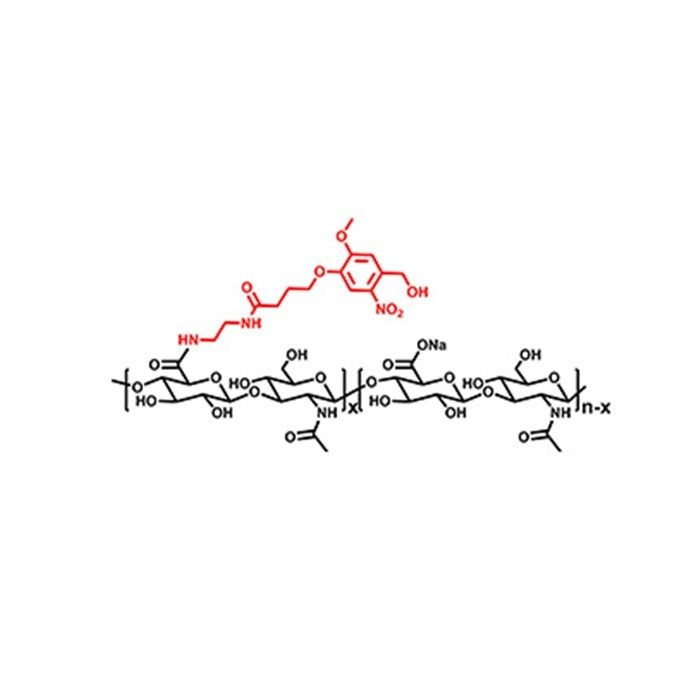
HANB是由透明质酸钠经邻硝基苄醇 (o-nitrobenzyl alcohol, NB)修饰得到的、具有光敏特性的高分子材料。其中NB可在365-405 nm波长光照射下发生光解反应,产生的醛基可与氨基反应,从而实现HANB与含氨基物质 (如蛋白、多肽、药物、活性因子等)的共价偶联,以及与组织的无缝整合与粘附。此外,当与含双键的光敏高分子联用时,NB的光解产物可参与自由基聚合反应,形成机械强度优异的水凝胶。
产品规格
| 组分 | 外观 | 规格 | 备注 |
HANB
| 淡黄色至黄色粉末颗粒
| 1 g/瓶、5 g/瓶 | 避光保存 |
使用建议
1、HANB可与含氨基的高分子材料,如多聚赖氨酸、壳聚糖、羧甲基壳聚糖、明胶等联合使用,在365-405 nm波长光照射下发生交联反应形成凝胶。
2、HANB可与甲基丙烯基修饰的高分子,如CMCMA、GelMA、HAMA、CSMA、ChMA、CMChMA以及丙烯基修饰的高分子,如F127DA联合使用,由光引发剂光照引发聚合,构建不同理化性能的水凝胶材料。
配制方法
1、与含双键的高分子及光引发剂联用时,光引发剂使用量如下:
低标记率HANB (标记率1.5%-2.0%):30mg (LAP/NAP)/1g (HANB);
中标记率HANB (标记率3.0%-4.0%):54mg (LAP/NAP)/1g (HANB);
2、配制光引发剂标准液 (如有):取一定质量的NAP或LAP配制成所需浓度的溶液,2~8 ℃避光保存;
3、取所需质量的HANB放入离心管,并取所需体积的引发剂标准溶液或配制液加入到上述离心管中,样品如在溶液中结块,可先用药匙碾碎;
4、将上述样品于室温下避光搅拌或于摇床振荡,直至完全溶解。
注意事项
1、HANB的标记率越高,配制的溶液浓度越大,组织粘附能力越强,但是对应的溶液阻光率越大,所需要的辐照时间越长。标记率为1.5%-2.5%的HANB,建议使用浓度不超过10 wt%;标记率为3.0%-4.0%的HANB,建议使用浓度不超过5 wt%。
2、HANB的分子量越高,配制成的溶液粘度越大。分子量为890 kDa的HANB,建议使用浓度不超过3 wt%;分子量为340 kDa的HANB,建议使用浓度不超过5 wt%。
产品应用
3D软骨细胞培养、止血材料、骨缺损修复、药物负载、组织工程、再生医学、蛋白固定、生物打印、术后防粘连等。
灭菌方式
1、过滤灭菌 (建议):使用0.22 μm无菌针头过滤器过滤溶液灭菌,此方法仅限于低粘度溶液使用,如溶液粘度较高时,请选用巴氏灭菌或湿热灭菌法。
2、巴氏灭菌:将溶液加热到80 ℃,保持30 min;再迅速转移至冰水混合物中冷却至常温。共循环上述操作三次;
3、湿热灭菌:将溶液于高温高压灭菌锅内,121 ℃下灭菌8 min,手动放气后,将溶液迅速转移至冰水混合物中冷却至常温。需注意,高温条件会导致凝胶性能下降,因此使用该方法灭菌时应严格遵守上述操作步骤。
注:无菌溶液可以2-8 ℃避光暂存,建议7天内使用;非无菌溶液可以2-8 ℃避光暂存,建议48小时内使用。
产品特点
1、原位构建高强度水凝胶:HANB光解产生的醛基与高分子骨架的氨基反应,实现凝胶网络的构建。
2、组织粘附与整合:HANB光解产生的醛基与施用部位组织表面的氨基反应,实现凝胶与组织的共价键合。
3、活性物质的固定:HANB光解产生的醛基与活性物质的氨基偶联,实现活性活性物质在水凝胶内部的可控固定。
典型应用
基于上述优势,HANB水凝胶体系被国内外的研究人员用于心脏止血、骨/软骨修复、创面治疗和3D细胞培养等场景,并取得一系列标志性的成果。
1、穿刺止血:秒级固化、高强、高粘附光交联水凝胶实现心脏穿刺口的止血
2、骨修复:结合微流控技术快速制备高强度载细胞微凝胶实现骨缺损的修复
3、软骨修复:秒级固化、高强、高粘附光交联水凝胶实现关节镜下软骨修复
4、创面治疗:快速固化、高粘附性光交联水凝胶实现缺损创面的修复
5、细胞培养:调控3D水凝胶中生物活性分子的固定实现细胞微环境的构建
产品优势
1、批次稳定:采用标准化的生产工艺,保证不同批次的HANB在成分、理化特性和生物学方面具有高度的重复性和可控性。
2、超高纯度:采用独特的生产工艺,有效地去除NB小分子和工艺杂质,实现超低杂质水平,保证HANB在生物医学应用的安全性。
3、可靠的安全性:HANB是业内第一款经第三方机构完成生物相容性评价的市售HANB产品,产品安全无毒性,加速下游产品从实验室到临床的转化。
4、高稳定性:参照《无源植入性医疗器械稳定性研究指导原则》,经过实时稳定性和加速稳定性试验证明:HANB产品在标示贮存条件下质量稳定。
Product Introduction
Hyaluronic acid (HA) is an important component of the human extracellular matrix, with key physiological functions including water retention, maintenance of extracellular space, osmotic pressure regulation, lubrication, and promotion of cell repair. HA has been approved by the FDA, exhibits excellent biosafety, and is widely used in the biomedical field.
HANB is a photosensitive polymer material obtained by modifying sodium hyaluronate with o‑nitrobenzyl alcohol (NB). Under light irradiation at 365–405 nm, NB undergoes photolysis to produce aldehyde groups that can react with amino groups, thereby enabling covalent conjugation of HANB with amino‑containing substances (e.g., proteins, peptides, drugs, bioactive factors) as well as seamless integration and adhesion to tissues.In addition, when used in combination with photosensitive polymers containing double bonds, the photolysis products of NB can participate in free‑radical polymerization to form hydrogels with excellent mechanical strength.
Product Specification
| Component | Appearance | Specification | Remarks |
| HANB | Pale yellow to yellow powder or granules | 1 g/vial, 5 g/vial | Store in the dark. |
Recommended Use
1. HANB can be used in combination with amino‑containing polymers such as polylysine, chitosan, carboxymethyl chitosan, and gelatin, and crosslinks to form a gel under light irradiation at 365-405 nm.
2. HANB can be used with methacrylate‑modified polymers (including CMCMA, GelMA, HAMA, CSMA, ChMA, CMChMA) and allyl‑modified polymers such as F127DA, and polymerized under photoinitiator and light exposure to construct hydrogel materials with diverse physicochemical properties.
Preparation Method
1. When used with double‑bond‑containing polymers and photoinitiators, the recommended photoinitiator dosage is:
Low substitution degree HANB (1.5%-2.0%): 30 mg (LAP/NAP) per 1 g HANB;
Medium substitution degree HANB (3.0%-4.0%): 54 mg (LAP/NAP) per 1 g HANB.
2. Preparation of photoinitiator stock solution (if applicable): Dissolve an appropriate amount of NAP or LAP to the desired concentration; store at 2-8 °C protected from light.
3. Weigh the required amount of HANB into a centrifuge tube, then add the corresponding volume of initiator stock solution or mixture. If clumps form, crush gently with a spatula first.
4. Stir the mixture at room temperature in the dark or shake on an orbital shaker until completely dissolved.
Precautions
1. Higher substitution degree of HANB and higher solution concentration lead to stronger tissue adhesion, but also higher light blocking and longer required irradiation time.
HANB with substitution degree 1.5%-2.5%: recommended concentration ≤ 10 wt%;
HANB with substitution degree 3.0%-4.0%: recommended concentration ≤ 5 wt%.
2. Higher molecular weight of HANB results in higher solution viscosity.
HANB with molecular weight 890 kDa: recommended concentration ≤ 3 wt%;
HANB with molecular weight 340 kDa: recommended concentration ≤ 5 wt%.
Applications
3D chondrocyte culture, hemostatic materials, bone defect repair, drug loading, tissue engineering, regenerative medicine, protein immobilization, bioprinting, postoperative anti‑adhesion, etc.
Sterilization Methods
1. Filter sterilization (recommended): Sterilize the solution using a 0.22 μm sterile syringe filter. Only suitable for low‑viscosity solutions. For high‑viscosity solutions, use pasteurization or autoclaving.
2. Pasteurization: Heat the solution to 80 °C for 30 min, then rapidly cool to room temperature in an ice‑water bath. Repeat the cycle three times.
3. Moist heat sterilization (autoclaving): Sterilize in an autoclave at 121 °C for 8 min. After manual venting, cool rapidly to room temperature in an ice‑water bath. Note that high temperature may reduce gel performance; strictly follow the above procedure.
Note: Sterile solutions: store at 2-8 °C protected from light, use within 7 days; Non‑sterile solutions: store at 2-8 °C protected from light, use within 48 hours.
Product Features
1. In situ formation of high‑strength hydrogelsThe aldehyde groups generated by HANB photolysis react with amino groups on polymer backbones to form a gel network.
2. Tissue adhesion and integrationAldehyde groups from HANB photolysis react with amino groups on tissue surfaces at the application site, achieving covalent bonding between the gel and tissue.
3. Immobilization of bioactive substancesAldehyde groups from HANB photolysis conjugate with amino groups on bioactive molecules, enabling controllable immobilization within the hydrogel.
Typical Applications
Benefiting from the above advantages, HANB hydrogel systems have been used by researchers worldwide in cardiac hemostasis, bone/cartilage repair, wound treatment, 3D cell culture, etc., with numerous landmark achievements.
1. Puncture hemostasis: Second-scale curing, high‑strength, high‑adhesion photocrosslinkable hydrogel for hemostasis of cardiac punctures.
2. Bone repair: Rapid preparation of high‑strength cell‑laden microgels via microfluidics for bone defect repair.
3. Cartilage repair: Second-scale curing, high‑strength, high‑adhesion photocrosslinkable hydrogel for arthroscopic cartilage repair.
4. Wound treatment: Fast-curing, high‑adhesion photocrosslinkable hydrogel for defective wound repair.
5. Cell culture: Regulation of bioactive molecule immobilization in 3D hydrogels to construct a favorable cellular microenvironment.
Product Advantages
1. Batch-to-batch consistencyStandardized manufacturing ensures high repeatability and controllability in composition, physicochemical properties, and biological performance across batches.
2. Ultra-high purityUnique purification process effectively removes residual NB monomers and process impurities, achieving an ultra-low impurity profile and ensuring safety in biomedical applications.
3. Reliable safetyHANB is the first commercially available product of its kind to have completed biocompatibility evaluation by a third-party institution, supporting safe and non-toxic use and accelerating lab-to-clinic translation.
4. High stabilityIn accordance with the Guidelines for Stability Studies of Non‑Active Implantable Medical Devices, real-time and accelerated stability tests confirm that HANB remains stable under labeled storage conditions.



 ZJ26F0434427


 危险品化学品经营许可证(带存储)