
 E2514351
计算溶液所需的质量、体积或浓度。
为什么选择此级别
,适用于对基线干扰要求严格的色谱和分析工作流程。
储存与运输
-20°C储存。超低温运输 。请查阅批次 COA 获取详细规格。
质量文档
SDS、COA、产品数据表及规格说明书均可下载。可通过批号查询获取批次 COA。
文献证明
在色谱分析、有机合成和交叉偶联反应领域已被 0 篇同行评审文献引用。
概述
产品介绍:
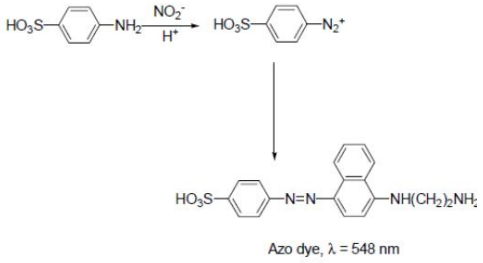
Griess 试剂可用于光度法检测亚硝酸盐。试剂含有两种化学物质,磺胺酸和 N-(1-萘基)乙二胺。在酸性条件下,磺胺酸被亚硝酸盐转化成重氮盐,可与 N-(1-萘基)乙二 胺形成高度着色的偶氮染料,可以在 548 nm 检测此染料:由于 NO 极其不稳定,被氧化生成亚硝酸盐和硝酸盐,Griess 通过检测亚硝酸盐的含量,间接反映出 NO 的含量。
注意事项:
1. 在使用 Griess 试剂之前,将其恢复至室温,并检查溶液是否有沉淀。如果 Griess Reagent I 取出时含有沉淀,可将其置于 37℃水浴锅中,水浴直至沉淀溶解。 2. 本品有潜在危害性,避免长时间或反复接触。避免进入眼睛,皮肤或衣服上。请穿实验服并戴一次性手套操作。
应用范围:
NO检测
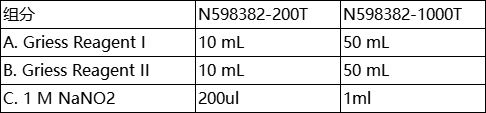
组分:
使用方法:
1. 取出 Griess Reagent I 和 II,使其恢复室温。
2. 标准品稀释:用待测样品所用溶液稀释标准品 NaNO2 (1-100 μM)。可将标准品稀释成 1 μM、10 μM、20 μM、40 μM、80 μM、100 μM,每孔加入 100 μL 标准品。若样品浓度太低,可适当降低标准曲线的范围(1 μM、2 μM、3 μM、4 μM、6 μM、8 μM、10 μM)。
3. 样品检测:
(1)按 200 μL/孔的总体积,在96 孔板中加入100 μL/孔的样品;如果样品为培养液上清,可直接取样,如有沉淀物则需离心后取上清。如样品为细胞或组织,可快速冻融裂解,再离心取上清,体积不足 100 μL 可以用diH2O或0.9%NaCl稀释(相应地标准品也需用 diH2O 或0.9%NaCl 稀释)。
(2)按 50 μL/孔,在各孔中加入Griess Reagent I。
(3)按 50 μL/孔,在各孔中加入Griess Reagent II。
(4)在 540 nm 处测定吸光度。如无540 nm滤光片,520-560nm 的滤光片也可。如无酶标仪或合适的滤光片,也可以通过目测比色,确定样品中一氧化氮的浓度。目测比色时标准品需要更为精细的浓度梯度。
Product introduction:
Griess reagent can be used for spectrophotometric detection of nitrite. The reagent contains two chemicals, sulfonic acid and n- (1-naphthyl) ethylenediamine. Under acidic conditions, sulfamic acid is converted into diazonium salt by nitrite, which can form a highly colored azo dye with n- (1-naphthyl) ethylenediamine. This dye can be detected at 548 nm: because no is extremely unstable, it is oxidized to form nitrite and nitrate. Griess indirectly reflects the content of no by detecting the content of nitrite.
Matters needing attention:
1. before using Griess reagent, return it to room temperature and check the solution for precipitation. If Griess reagent I contains sediment when taken out, it can be placed in a 37 ℃ water bath until the sediment dissolves. 2. this product is potentially harmful. Avoid prolonged or repeated exposure. Avoid entering eyes, skin or clothing. Please wear lab clothes and disposable gloves for operation.
Scope of application:
No detection
Component:
Instruction:
1.Griess Reagent I and II were taken out to restore the room temperature.
2.Standard dilution : The standard NaNO2 ( 1-100 μM ) was diluted with the solution used for the sample to be tested. The standard was diluted to 1 μM, 10 μM, 20 μM, 40 μM, 80 μM and 100 μM, and 100 μL standard was added to each well. If the sample concentration is too low, the range of the standard curve can be appropriately reduced ( 1 μM, 2 μM, 3 μM, 4 μM, 6 μM, 8 μM, 10 μM ).
3.Sample detection :
( 1 ) According to the total volume of 200 μL / hole, 100 μL / hole sample was added to the 96-well plate ; if the sample is the supernatant of the culture medium, it can be sampled directly, and if there is sediment, the supernatant should be taken after centrifugation. If the sample is a cell or tissue, it can be quickly lysed by freeze-thaw, and then centrifuged to obtain the supernatant. The volume of less than 100 μL can be diluted with diH2O or 0.9 % NaCl ( corresponding standards also need to be diluted with diH2O or 0.9 % NaCl ).
( 2 ) According to 50 μL / hole, Griess Reagent I was added to each hole.
( 3 ) According to 50 μL / hole, Griess Reagent II was added to each hole.
( 4 ) The absorbance was measured at 540 nm. If there is no 540 nm filter, 520-560 nm filter can also be. If there is no microplate reader or a suitable filter, the concentration of nitric oxide in the sample can also be determined by visual colorimetry. A more precise concentration gradient is required for the standard when visual colorimetric.
规格
英文名称
Nitric oxide assay kit
储存与运输
储存条件
-20°C储存
运输条件
超低温运输
技术文档
高级数据
质检证书(CoA,COO,BSE/TSE 和分析图谱)
溶液计算器
产品仅提供给经过验证的企业、机构和合格的专业人员用于研发。不适用于人类、动物、诊断或治疗。
Copyright © 2023至今 上海阿拉丁生化科技股份有限公司 保留所有权利。


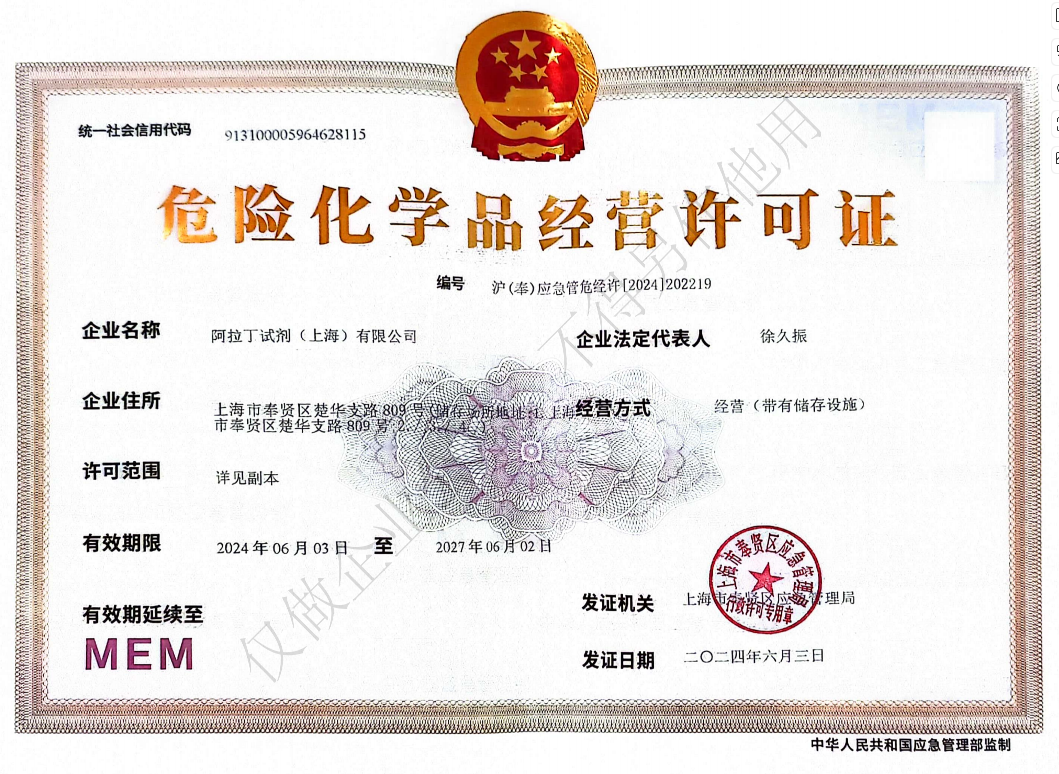 危险品化学品经营许可证(带存储)