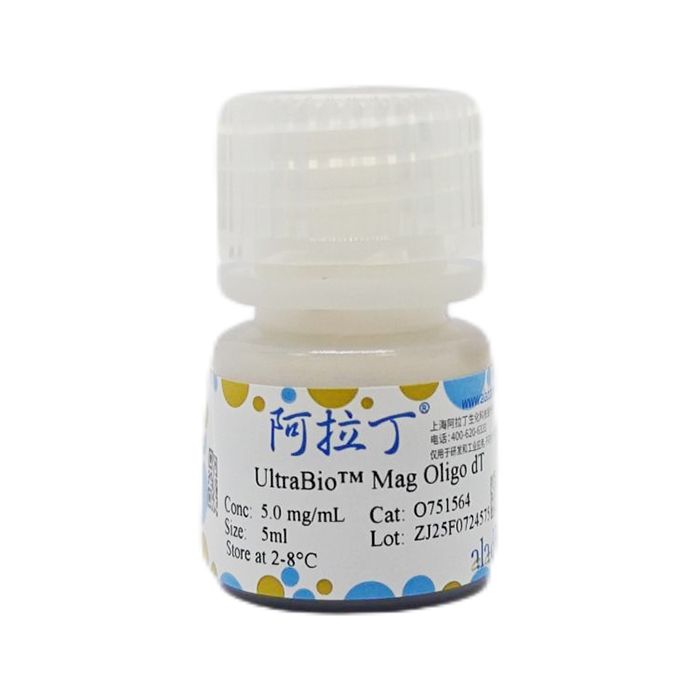
Oligo dT 包被的磁珠能够分离和提取多种样本中的mRNA,用于RT-PCR、cDNA文库构建、 cDNA微阵列、亲和纯化、引物延伸、消减杂交等应用。UltraBio™ Oligo dT磁珠还具有高表面积、高亲和力和高特异性的特性,来提取高纯度的mRNA。利用标准杂交条件,可以很容易地将聚腺苷酸化的RNA (poly-A+RNA) 结合到oligo dT上面,其他RNA种类 (rRNA和tRNA) 不包含polyA+序列,因此不会与Oligo (dT) 磁珠结合。
产品性质:
基质
| 聚合物磁珠
|
配体
| Oligo dT
|
平均粒径
| 1 μm
|
磁性类型
| 超顺磁性
|
应用方向
| mRNA分离纯化
|
应用方式
| 手动/自动
|
mRNA结合量
| ~2 μg/mg磁珠
|
磁珠浓度
| 5 mg/mL
|
保存溶液
| PBS, 0.05% ProClin 300, pH7.4
|
保存条件及效期
| 2-8℃,2年 |
使用说明:
一、其他的材料试剂要求:
Binding Buffer
| 20 mM Tris-HCl, pH 7.5, 1.0 M LiCl, 2 mM EDTA
|
Lysis/Binding Buffer
| 100 mM Tris-HCl, pH 7.5, 500 mM LiCl, 10 mM EDTA, 1% LiDS, 5 mM dithiothreitol (DTT)
如有沉淀产生,加热摇晃至澄清。
|
Washing Buffer A
| 10 mM Tris-HCl, pH 7.5, 0.15 M LiCl, 1 mM EDTA, 0.1% LiDS
|
Washing Buffer B
| 10 mM Tris-HCl, pH 7.5, 0.15 M LiCl, 1 mM EDTA
|
注:如洗脱下来的mRNA需要保存,在洗脱过程中加入RNase抑制剂。
二、洗涤磁珠
1、重悬试剂瓶中的磁珠(涡旋30s以上或者旋转混合5min以上);
2、吸取需要的磁珠体积(推荐磁珠用量:一般总RNA量在25µg以下磁珠用量为20µL,总RNA量增加磁珠用量相应增加,磁珠用量可根据预实验进行调节)至新的EP管或PCR管中;
3、加入相同体积的BindingBuffer,涡旋混匀;
4、将EP管或PCR管置于磁力架上静置1min,待澄清后吸弃上清液;
5、从磁力架上将EP管或PCR管取下,加入相同初始体积的Binding Buffer重悬磁珠。
三、样品准备
1、准备裂解产物(动物组织、植物、细胞)
推荐用量:动物组织20-50mg,植物100mg,细胞1-4×10²
个。也可根据需求放大或缩小比例。
2、固体动植物组织裂解产物准备
(1) 称取建议用量的动物或植物组织,过多的组织会减少mRNA的产量和纯度;
(2) 在液氮中研磨冷冻的组织,确保组织一致保持冷冻状态避免RNA降解;
(3) 将研磨后的冷冻样本转移至EP管中,加入1mL Lysis/Binding Buffer,匀浆1-2分钟,直至组织完全裂解;
注:应尽快完成匀浆防止RNA降解;如果样本粘性比较大,用匀浆机匀浆更佳。
(4) 将上述裂解物离心30-60s移除多余组织碎片,所得裂解物可用于mRNA的分离或-80℃中备用。
3、细胞悬浮液裂解产物准备
(1) 用PBS清洗细胞悬液,离心获得细胞沉淀,立即将细胞置于-80℃液氮中备用;
(2) 加入1mL Lysis/Binding Buffer 到上述细胞(1-4×10²个)中,吹打数次确保细胞完全裂解。细胞裂解后会释放DNA,导致溶液粘度增加,可视作裂解完全;
(3) 可通过剪切力剪切DNA以减小粘度。用1-2mL的注射器(21号针头)吹打3次。如果产生气泡,可离心30s消除气泡,气泡的存在并不影响mRNA的产量;
(4) 所得裂解物可用于mRNA的分离,或存于-80℃中备用。
四、从粗裂解液中分离mRNA
1、去除磁珠清洗后的溶液(见“洗涤磁珠”步骤),加入准备好的裂解产物;
2、混合磁珠和裂解产物:室温下用震荡器混匀3-5min,如果溶液呈粘稠状,则延长结合时间,该过程能够使mRNA结合到Oligo dT链上;
3、将上述离心管置于磁力架上静置2min后吸弃上清液;
4、将1mL Washing Buffer A 加入上述离心管中,重悬磁珠,然后置于磁力架上2min,彻底吸弃上清液;
5、用1mL Washing Buffer B 洗涤磁珠一次,步骤同上;
6、以下操作二选一:
a. 如果磁珠结合的mRNA用于酶促下游应用(如固相cDNA合成),用500μL的Washing Buffer B再洗涤一次,然后再用后续的酶缓冲液洗涤磁珠一次。
b. 将mRNA从磁珠上洗脱:加入10-20μL 10mM Tris-HCl,75℃-80℃孵育2min,然后迅速将管子置于磁力架上,澄清后立即将上清转移至新的RNase-free管中,最终得率会根据样本而稍有不同。
五、从总RNA中纯化mRNA
1、用DEPC处理水(阿拉丁货号W293452)将 0.01-25μg 纯度较好的总RNA体积调整至50μL;
2、加入50μL Binding Buffer;
注:如果总RNA体积调整超过50μL,则加入相同体积的Binding Buffer即可;
3、将上述总100μL总RNA溶液加入到处理好的的磁珠(见“洗涤磁珠”步骤)中,用移液器吹打6次以上以彻底混匀;
4、将样品置于PCR仪,65℃ 5min,25℃ 5min,4℃ hold,使mRNA与磁珠结合;
5、将样品置于磁力架上1-2min,待溶液澄清后吸弃上清液;
6、将样品从磁力架上取出,加入200μL Washing Buffer B,小心吹打数次混匀,置于磁力架上1-2min,待溶液澄清后吸弃上清液;
7、将样品从磁力架上取出,加入50μL DEPC处理水(阿拉丁货号W293452)重悬磁珠,用移液器吹打6次以上彻底混匀; 8、将样品置于PCR仪中,80℃ 2min,25℃ hold,将mRNA洗脱下来;
9、结束后加入50µL Binding Buffer,用移液器吹打至彻底混匀,室温放置结合5min;
10、将样品置于磁力架上1-2min,待溶液澄清后吸弃上清液;
11、将样品从磁力架上取出,加入200μL Washing Buffer B,吹打数次混匀。置于磁力架上1-2min,待溶液澄清后吸弃上清液。重复操作1次;
12、根据后续实验流程选择处理方式:
a. 若纯化产物用于逆转录反应,将样品从磁力架上取出,加入10-15µL DEPC处理水(阿拉丁货号W293452),用移液器吹打6次充分混匀,80℃ 2min洗脱,置于磁力架上1-2min,待溶液澄清后,小心吸取上清转移至新的Nuclease-free PCR 管中。
b. 若纯化产物用于RNA文库构建,可根据相关试剂盒说明书加入相应体积Frag/Prime Buffer进行文库构建。
c. 样品产物可置于冰上继续进行NGS文库构建或其他分析应用,建议立即进行后续反应,也可置于-80℃保存。
注意事项:
1、需提前准备所有需要的材料,以减缓RNA的降解。
2、在提取RNA过程中,需及时更换手套,以减少RNase的污染。
3、在使用缓冲液时,应使用干净的RNase-free的一次性枪头。
4、在可能的情况下,从单独分离出的总RNA中进行mRNA提取。
5、杂交温度从室温到40°C均可,杂交时间控制在5-15min内。
储存缓冲液:PBS, 0.05% ProClin 300, pH7.4
是否无菌:否
Oligo(dT)-coated magnetic beads enable the isolation and extraction of mRNA from a wide range of samples for applications including RT-PCR, cDNA library construction, cDNA microarray analysis, affinity purification, primer extension, and subtractive hybridization. UltraBio™ Oligo(dT) magnetic beads feature a large specific surface area, high binding affinity and superior specificity to recover high-purity mRNA. Under standard hybridization conditions, polyadenylated RNA (poly-A⁺ RNA) readily binds to oligo(dT). Other RNA species such as rRNA and tRNA lack poly-A⁺ sequences and thus do not interact with Oligo(dT) magnetic beads.
Product Properties
Matrix
| Polymeric magnetic beads
|
Ligand
| Oligo dT
|
Average particle size
| 1 μm
|
Magnetic type
| Superparamagnetic
|
Application
| mRNA isolation and purification
|
Operation mode
| Manual / Automated
|
mRNA binding capacity
| ~2 μg/mg of beads
|
Bead concentration
| 5 mg/mL
|
Storage buffer
| PBS, 0.05% ProClin 300, pH7.4
|
Storage conditions and shelf life
| 2–8°C, 2 years
|
Instructions for Use
I. Required Additional Materials and Reagents
Binding Buffer
| 20 mM Tris-HCl, pH 7.5, 1.0 M LiCl, 2 mM EDTA
|
Lysis/Binding Buffer
| 100 mM Tris-HCl, pH 7.5, 500 mM LiCl, 10 mM EDTA, 1% LiDS, 5 mM dithiothreitol (DTT)
If precipitate forms, warm and shake until the solution becomes clear.
|
Washing Buffer A
| 10 mM Tris-HCl, pH 7.5, 0.15 M LiCl, 1 mM EDTA, 0.1% LiDS
|
Washing Buffer B
| 10 mM Tris-HCl, pH 7.5, 0.15 M LiCl, 1 mM EDTA |
Note: For long-term storage of eluted mRNA, supplement with RNase inhibitor during the elution step.
II. Washing Magnetic Beads
1. Resuspend the magnetic beads in the reagent bottle (vortex for more than 30 s or rotate for more than 5 min).
2. Transfer the required volume of magnetic beads to a new EP tube or PCR tube. Recommended bead dosage: use 20 μL beads for total RNA ≤ 25 μg. Increase bead volume proportionally with higher total RNA input; the bead dosage can be adjusted based on preliminary tests.
3. Add an equal volume of Binding Buffer and vortex to mix thoroughly.
4. Place the EP tube or PCR tube on a magnetic stand and incubate for 1 min. Aspirate and discard the supernatant once the solution turns clear.
5. Remove the tube from the magnetic stand, then resuspend the beads with Binding Buffer at the same initial volume.
III. Sample Preparation
1. Prepare lysates (animal tissues, plant tissues, cells) Recommended sample amounts: 20–50 mg animal tissue, 100 mg plant tissue, 1–4 × 10⁶ cells. The amounts can be scaled up or down as required.
2. Preparation of lysates from solid animal and plant tissues
(1) Weigh the recommended amount of animal or plant tissue. Excess tissue will reduce the yield and purity of mRNA.
(2) Grind frozen tissue in liquid nitrogen. Keep the tissue frozen at all times to prevent RNA degradation.
(3) Transfer the ground frozen sample to an EP tube, add 1 mL Lysis/Binding Buffer, and homogenize for 1–2 min until the tissue is fully lysed.
Note: Complete homogenization promptly to avoid RNA degradation. A homogenizer is recommended if the sample is highly viscous.
(4) Centrifuge the lysate for 30–60 s to remove residual tissue debris. The resulting lysate can be used directly for mRNA isolation or stored at −80 °C for later use.
3. Preparation of lysates from cell suspensions
(1) Wash the cell suspension with PBS, centrifuge to collect the cell pellet, and immediately store the pellet in liquid nitrogen at −80 °C for later use.
(2) Add 1 mL Lysis/Binding Buffer to the above cells (1–4 × 10⁶ cells) and pipette up and down several times to achieve complete cell lysis. Cell lysis releases genomic DNA, which increases solution viscosity; this viscosity indicates full lysis.
(3) Shear genomic DNA to reduce viscosity using mechanical force: draw and eject the lysate 3 times with a 1–2 mL syringe fitted with a 21-gauge needle. If bubbles form, centrifuge for 30 s to eliminate them. Bubbles do not interfere with mRNA yield.
(4) The resulting lysate can be used directly for mRNA isolation or stored at −80 °C for later use.
IV. Isolation of mRNA from Crude Lysate
1. Discard the supernatant after bead washing (see section "Washing Magnetic Beads"), then add the prepared lysate.
2. Mix the magnetic beads with lysate by shaking on a shaker at room temperature for 3–5 min. Extend the incubation time if the solution is highly viscous. This step allows mRNA to bind to the oligo(dT) sequences.
3. Place the centrifuge tube on a magnetic stand and let it stand for 2 min, then aspirate and discard the supernatant.
4. Add 1 mL Washing Buffer A to the tube to resuspend the beads. Place the tube on the magnetic stand for 2 min and completely remove the supernatant.
5. Wash the beads once with 1 mL Washing Buffer B following the same procedure described above.
6. Select one of the two procedures below:
a. If bead-bound mRNA will be used for downstream enzymatic reactions (e.g., solid-phase cDNA synthesis), perform an additional wash with 500 μL Washing Buffer B, followed by one wash with the enzymatic reaction buffer to be used in subsequent experiments.
b. Elute mRNA from magnetic beads: Add 10–20 μL 10 mM Tris-HCl, incubate at 75–80 °C for 2 min. Immediately place the tube on a magnetic stand. Once the solution clears, transfer the supernatant to a new RNase-free tube right away. The final mRNA yield varies slightly depending on sample type.
V. Purification of mRNA from Total RNA
1. Adjust the volume of 0.01–25 μg high-purity total RNA to 50 μL with DEPC-treated Water (Aladdin Cat. No. W293452).
2. Add 50 μL Binding Buffer. Note: If the adjusted volume of total RNA exceeds 50 μL, add an equal volume of Binding Buffer accordingly.
3. Transfer the resulting 100 μL total RNA solution to pre-washed magnetic beads (refer to the section "Washing Magnetic Beads"). Pipette up and down more than six times to mix thoroughly.
4. Place the sample in a thermal cycler and run the program: 65 °C for 5 min, 25 °C for 5 min, hold at 4 °C to facilitate binding between mRNA and beads.
5. Place the sample tube on a magnetic stand for 1–2 min. Aspirate and discard the supernatant once the solution turns clear.
6. Remove the tube from the magnetic stand, add 200 μL Washing Buffer B, and gently pipette up and down several times to mix. Place back on the magnetic stand for 1–2 min, then aspirate and discard the supernatant after clarification.
7. Take the tube off the magnetic stand, add 50 μL DEPC-treated Water (Aladdin Cat. No. W293452) to resuspend the beads, and pipette up and down over six times for full mixing.
8. Incubate the sample in the thermal cycler at 80 °C for 2 min to elute bound mRNA, then hold at 25 °C.
9. After incubation, add 50 μL Binding Buffer and pipette thoroughly to homogenize. Incubate at room temperature for 5 min to allow re-binding.
10. Place the tube on the magnetic stand for 1–2 min and discard the clarified supernatant.
11. Remove the tube from the magnetic stand, add 200 μL Washing Buffer B, and pipette several times to mix. Set on the magnetic stand for 1–2 min, aspirate the clear supernatant, and repeat this wash step one more time.
12. Select the subsequent processing method according to downstream experiments:
a. For reverse transcription: Remove the tube from the magnetic stand, add 10–15 μL DEPC-treated Water (Aladdin Cat. No. W293452), and pipette vigorously six times to mix completely. Elute mRNA at 80 °C for 2 min, then place the tube on the magnetic stand for 1–2 min. Carefully transfer the clear supernatant to a new nuclease-free PCR tube.
b. For RNA library construction: Add the corresponding volume of Frag/Prime Buffer as instructed in the matching library construction kit manual. c. The purified RNA product can be kept on ice for immediate NGS library preparation or other analytical assays. Downstream reactions are recommended to be performed right away; alternatively, the RNA can be stored at −80 °C.
Precautions
1. Prepare all required materials in advance to slow down RNA degradation.
2. Change gloves frequently during RNA extraction to minimize RNase contamination.
3. Use clean disposable RNase-free pipette tips when handling all buffers.
4. Where possible, isolate mRNA from separately purified total RNA.
5. Hybridization can be performed at temperatures ranging from room temperature to 40 °C, with incubation time controlled between 5 and 15 min.

 ZJ25F0724575


 危险品化学品经营许可证(带存储)