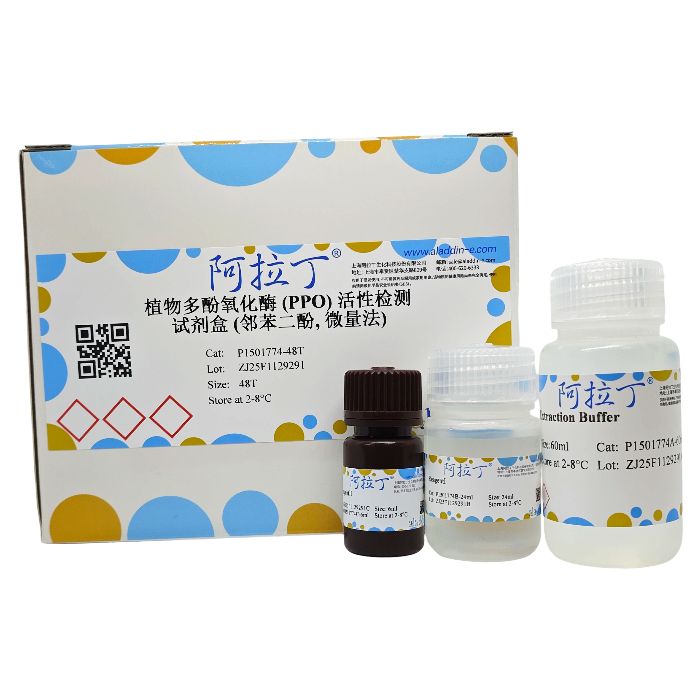
多酚氧化酶(Polyphenol Oxidase, PPO, EC1.10.3.1)普遍存在于植物、真菌、昆虫的质体中,是一种含铜的氧化酶,能使一元酚和二元酚氧化产生醌,从而引起褐化,与果蔬加工、茶叶品质和组培等密切相关。植物多酚氧化酶 (PPO) 活性检测试剂盒 (邻苯二酚, 微量法) 提供了一种简单的检测方法,用于检测植物组织样本中多酚氧化酶(PPO)的活性水平。
检测原理:样本中的多酚氧化酶(PPO)能够催化邻苯二酚产生醌,后者在410nm有特征光吸收,测定410nm光吸收增加的速率,计算多酚氧化酶(PPO)活性。
P1501774
| Component
| 48T | 96T | Storage
|
P1501774A
| Extraction Buffer
| 60 mL | 120 mL
| 2-8℃
|
P1501774B
| ReagentⅠ
| 24 mL | 48 mL | 2-8℃
|
P1501774C
| ReagentⅡ
| 6 mL | 12 mL | 2-8℃. Store in the dark. |
注意:正式检测前,建议选择2-3个预期差异较大的样本进行预实验。
自备仪器和试剂
酶标仪或可见分光光度计(能测410nm处的吸光度)
96孔板或微量玻璃比色皿、可调节式移液枪及枪头
冷冻离心机、制冰机、恒温水浴锅
去离子水
匀浆器
实验流程
1、试剂准备
试剂名称
| 试剂准备
| 注意事项
|
Extraction Buffer
| 即用型;使用前平衡到室温
| 4℃保存
|
ReagentⅠ
| 即用型;使用前平衡到室温
| 4℃保存
|
ReagentⅡ
| 即用型;使用前平衡到室温
| 4℃避光保存;有毒,使用时注意防护 |
2、样本制备
注意:建议使用新鲜样本,如果不立即使用,可将样本在-80°C保存一个月。
2.1 粗酶液的制备
按植物组织质量(g):Extraction Buffer体积(mL)为1:(5-10)的比例(建议称取0.1g组织,加入1mL Extraction Buffer)处理样品,冰浴匀浆,8,000g,4°C离心10min,取上清置于冰上待测。
2.2 煮沸样本
取适量粗酶液沸水浴5min(密封以防止水分散失),冷却至室温。
3、实验步骤
3.1 酶标仪或可见分光光度计预热30min以上,调节波长到410nm,可见分光光度计用去离子水调零。
3.2 样本测定(在1.5mL EP管中依次加入下列试剂):
| 试剂 | 对照管(μL) | 测定管(μL) | | 煮沸样本 | 50 | 0 | | 样本 | 0 | 50 | ReagentⅠ
| 200 | 200 | ReagentⅡ
| 50
| 50 |
|
3.3 充分混匀,25℃水浴 10 min 后,迅速沸水浴 10 min。混匀后,5000 g,25℃离心 10 min。
3.4 吸光度检测:取上清 200 μL 于 96 孔板中,410 nm 处测定吸光值,分别标记为 A 对照 和 A 测定 。
注意:
- 每个测定管需要设置一个对照管。
- 实验之前建议选择2-3个预期差异大的样本做预实验。
- 不同样本的PPO最佳的反应温度略有差别,可在25-37℃之间进行调节。
4、结果计算
以下为您提供的推导过程计算公式和简洁计算公式,两者完全相等。
1. 数据处理
计算 ΔA=A测定−A对照。
2. 样本 PPO 活性计算
按样本质量计算
单位定义:每分钟每 g 组织在每 mL 反应体系中使 410 nm 处吸光值变化 0.005 为一个酶活力单位。
PO (U/g)=ΔA×V反总÷(W×V样÷V样总)÷0.005÷T=120×ΔA÷W
按蛋白浓度计算
单位定义:每分钟每 mg 组织蛋白在每 mL 反应体系中使 410 nm 处吸光值变化 0.005 为一个酶活力单位
PPO (U/mg prot)=ΔA×V反总÷(V样×Cpr)÷0.005÷T=120×ΔA÷Cpr
V反总:反应体系总体积,0.3 mL;
V样:加入样本体积,0.05 mL;
V样总:加入 Extraction Buffer 体积,1 mL;
T:反应时间,10 min;
W:样本质量,g;
Cpr:蛋白浓度(mg/mL)
结果展示
示例‑1: 取 0.1 g 蓝莓,按照测定步骤操作,用 96 孔板进行检测。
测得 ΔA=A测定−A对照=0.349−0.261=0.088。
按样本质量计算得:PPO (U/g)=ΔA×V反总÷(W×V样÷V样总)÷0.005÷T=120×ΔA÷W=105.6 U/g。
FAQ
检测得到的样本 A测定过高或者过低怎么办?
如果样本 A测定>1,则说明样本 PPO 活性太高,需用 Extraction Buffer 适当稀释后重新测定或减少提取用样本量。如果样本的 A测定<0.02,可适当提高样本量。
注意事项
本产品仅供科学研究使用,不适用于临床诊断。为了您的安全和健康,请穿实验服并戴一次性手套操作。
Polyphenol Oxidase (PPO, EC1.10.3.1) is widely found in the plastids of plants, fungi, and insects. It is a copper-containing oxidase that can oxidize monophenols and diphenols to produce quinones, leading to browning. It is closely related to fruit and vegetable processing, tea quality, and tissue culture. The Plant Polyphenol Oxidase (PPO) Activity Assay Kit (Catechol, Micro method) provides a simple method to detect the activity level of polyphenol oxidase (PPO) in plant tissue samples.
Detection Principle: Polyphenol oxidase (PPO) in the sample catalyzes the oxidation of catechol to produce quinones, which have a characteristic absorption peak at 410 nm. The rate of increase in absorbance at 410 nm is measured to calculate PPO activity.
P1501774
| Component
| 48T | 96T | Storage
|
P1501774A
| Extraction Buffer
| 60 mL | 120 mL
| 2-8℃
|
P1501774B
| ReagentⅠ
| 24 mL | 48 mL | 2-8℃
|
P1501774C
| ReagentⅡ
| 6 mL | 12 mL | 2-8℃. Store in the dark. |
Note: Before formal testing, it is recommended to perform a preliminary test with 2-3 samples expected to have significant differences.
User-Prepared Instruments and Reagents
Microplate reader or visible spectrophotometer (capable of measuring absorbance at 410 nm)
96-well plate or micro glass cuvettes, adjustable micropipettes and tips
Refrigerated centrifuge, ice maker, constant temperature water bath
Deionized water
Homogenizer
Experimental Procedure
1. Reagent Preparation
Reagent Name
| Reagent Preparation
| Notes
|
Extraction Buffer
| Ready-to-use; Equilibrate to room temperature before use.
| Store at 4°C.
|
ReagentⅠ
| Ready-to-use; Equilibrate to room temperature before use.
| Store at 4°C.
|
ReagentⅡ
| Ready-to-use; Equilibrate to room temperature before use.
| Store at 4°C protected from light; Toxic, handle with care.
|
2. Sample Preparation
Note: Fresh samples are recommended. If not used immediately, samples can be stored at -80°C for one month.
2.1 Preparation of Crude Enzyme Extract
Homogenize the plant sample in ice-cold Extraction Buffer with a mass (g) to volume (mL) ratio of 1:5 to 1:10 (recommended: 0.1 g tissue + 1 mL Extraction Buffer). Centrifuge the homogenate at 8,000 g, 4°C for 10 minutes. Collect the supernatant and keep it on ice for assay.
2.2 Boiled Sample Control
Take an appropriate amount of the crude enzyme extract and heat it in a boiling water bath for 5 minutes (seal to prevent moisture loss). Cool to room temperature.
3. Assay Steps
3.1 Preheat the microplate reader or visible spectrophotometer for at least 30 minutes. Set the wavelength to 410 nm. For spectrophotometers, zero the instrument with deionized water.
3.2 Sample Measurement (Add reagents sequentially into 1.5 mL microcentrifuge tubes):
| Reagent | Control Tube (μL) | Test Tube (μL) | | Boiled Sample | 50 | 0 | | Sample (supernatant) | 0 | 50 | ReagentⅠ
| 200 | 200 | ReagentⅡ
| 50
| 50 |
|
3.3 Mix thoroughly, then incubate in a 25 °C water bath for 10 min, followed immediately by incubation in a boiling water bath for 10 min. After mixing, centrifuge at 5,000 × g at 25 °C for 10 min.
3.4 Absorbance measurement: Transfer 200 μL of the supernatant to a 96-well plate and measure the absorbance at 410 nm. Record the values as Acontrol and Asample (or Atest), respectively.
Note:
Each test tube requires a corresponding control tube.
It is recommended to perform a preliminary test with 2-3 samples expected to have significant differences before the formal experiment.
The optimal reaction temperature for PPO may vary slightly among different samples and can be adjusted between 25-37°C.
4. Calculation of Results
Note: We provide both the derived formula and a simplified formula. They are equivalent. It is recommended to use the simplified formula in bold for final calculation.
1. Data ProcessingCalculate ΔA = Asample − Acontrol.
2. Calculation of Sample PPO Activity
Calculation based on sample weight
Unit definition: One unit of enzyme activity is defined as the amount of enzyme that causes a 0.005 change in absorbance at 410 nm per minute per gram of tissue in each mL of reaction system.
PPO (U/g) = ΔA × Vtotal‑rxn ÷ (W × Vsample ÷ Vtotal‑sample) ÷ 0.005 ÷ T = 120 × ΔA ÷ W
Calculation based on protein concentration
Unit definition: One unit of enzyme activity is defined as the amount of enzyme that causes a 0.005 change in absorbance at 410 nm per minute per milligram of tissue protein in each mL of reaction system.
PPO (U/mg prot) = ΔA × Vtotal‑rxn ÷ (Vsample × Cpr) ÷ 0.005 ÷ T = 120 × ΔA ÷ Cpr
Vtotal‑rxn: Total volume of reaction system, 0.3 mL;
Vsample: Volume of added sample, 0.05 mL;
Vtotal‑sample: Volume of added Extraction Buffer, 1 mL;
T: Reaction time, 10 min;
W: Sample weight, g;
Cpr: Protein concentration (mg/mL).
Result Presentation
Example‑1: Weigh 0.1 g blueberry, perform the assay according to the test procedure, and detect with a 96‑well plate. Obtained ΔA = Asample − Acontrol = 0.349 − 0.261 = 0.088.
Calculated by sample weight: PPO (U/g) = ΔA × Vtotal‑rxn ÷ (W × Vsample ÷ Vtotal‑sample) ÷ 0.005 ÷ T = 120 × ΔA ÷ W = 105.6 U/g.
FAQ
What should I do if the measured Asample value is too high or too low? If Asample>1, the PPO activity of the sample is excessively high. Dilute the sample appropriately with Extraction Buffer and re‑measure, or reduce the sample weight for extraction. If Asample<0.02, increase the sample amount properly.
Precautions
This product is for research use only. Not for use in clinical diagnosis. For your safety and health, please wear lab coats and disposable gloves during operation.

 ZJ25F1129291


 危险品化学品经营许可证(带存储)