丙酮酸(Pyruvic acid),原称焦性葡萄酸,也称2-氧代丙酸,其分子式为C₃H₄O₃ ,分子量为88.06。丙酮酸可通过乙酰辅酶A和三羧酸循环实现体内糖、脂肪和氨基酸之间的互相转化,作为生物体三大营养物质 (糖、脂肪、氨基酸) 代谢的核心枢纽分子,其含量变化直接反映细胞代谢状态,在代谢调控研究、疾病机制探索及药物筛选等领域具有重要应用价值。例如在多数情况下,丙酮酸浓度的升高不会在组织内积累以致产生有害的作用,但当肝脏发生严重病变或存在遗传性代谢紊乱时血液中丙酮酸浓度会升高。因此,丙酮酸的含量检测对疾病的检测和治疗有重要意义。
本试剂盒检测原理:丙酮酸与二硝基苯肼反应,生成丙酮酸-二硝基苯腙复合物,在碱性环境下呈棕红色,通过测定520nm处吸光度,据此通过与标准曲线对比可以计算出丙酮酸水平。
P1505575 | 组件 | 物理外观 | 96 T | 储存条件 | 单次测试使用量 |
P1505575A | 提取液 | 液体 | 20 mL | 2-8℃. | 按需 |
P1505575B | 底物溶液 | 液体 | 2.5 mL | 2-8℃.避光. | 25 µL |
P1505575C | 终止显色液 | 液体 | 12.5 mL | 2-8℃. | 125 µL |
P1505575D | 丙酮酸标准品 (6mg/mL) | 液体 | 1 mL | 2-8℃.避光. | 按需 |
注意:P1505575C (终止显色液)有一定腐蚀性,建议规范穿戴手套和实验服,避免皮肤接触。
使用方法
1. 样品准备
(1) 细胞 (菌) 样本:离心收集细胞 (菌)后,建议每百万个细胞 (菌) 用100-200 μL提取液重悬,然后在4℃或冰浴等低温条件下进行超声破碎细胞 ( 200 W,超声2S,间隔3S,5 min)。4℃ , 12,000×g离心5分钟,取上清用于后续检测。
(2) 对于组织样品,每10 mg组织加入100 -200 μL 提取液,在4℃或冰浴等低温条件下进行匀浆破碎。4℃ 约12,000×g离心5分钟,取上清用于后续检测。
(3) 血液样品:对于血清样品,将全血在常温下静置30分钟-2小时,4ºC约1000-2000×g离心10分钟,取上清;对于血浆样品,将全血用肝素或者EDTA进行抗凝,4℃ 约1000-2000×g离心10分钟,取上清。
(4) 细胞培养上清样品:对于贴壁细胞,直接取培养液;对于悬浮细胞,离心后取培养液。
2. 标准品稀释
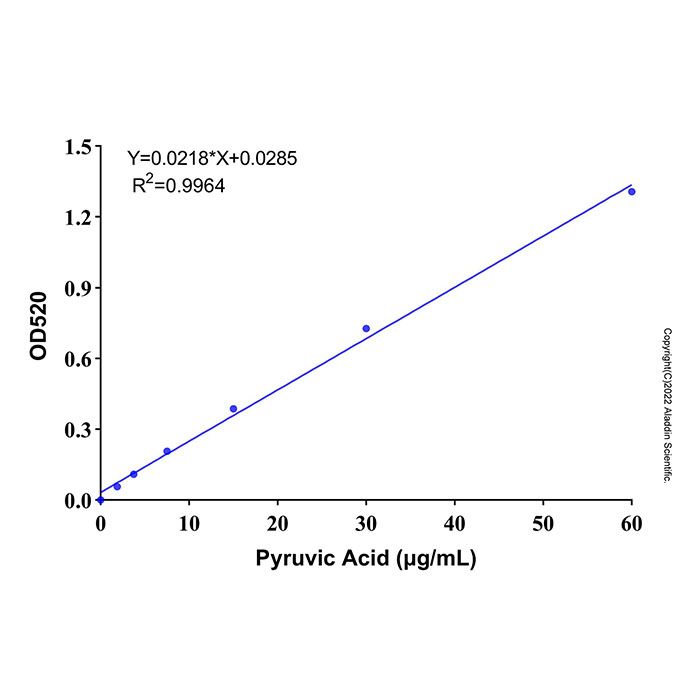
(1) 标准曲线绘制:取2 μL丙酮酸标准品(6 mg/mL) + 198 μL 超纯水稀释至 60 μg/mL,然后用提取液分别梯度稀释至60 μg/mL,30 μg/mL,15 μg/mL,7.5 μg/mL,3.75 μg/mL,1.875 μg/mL和0 ug/mL(空白孔,仅含提取液)。
3. 样品检测
(1) 在96孔板中,按照下表依次加入样品或者标准品
试剂 | 空白孔 (μL) | 测定孔 (μL) | 标准孔 (μL) |
样本 | - | 75 | - |
去离子水 | 75 | - | - |
标准品 | - | - | 75 |
底物溶液 | 25 | 25 | 25 |
(2) 混匀后,于室温静置2 min后,每孔添加125 μL终止显色液,室温继续静置2 min后,读取A₅₂₀。ΔA=A测定 - A空白;Δ标=A标准 - A空白。
4. 结果计算
(1) 标准曲线:Y=0.0218*X +0.0285(仅供参考);X是丙酮酸浓度 (μg/mL),Y是在520 nm对应的吸光值。

(2) 建立标准曲线时,需要减去空白孔对照。标准曲线建立完毕后,可根据标准曲线计算出样品中的丙酮酸浓度 (C),计算公示如下:
C(μg/mL)=A×n
注:A为根据标准曲线计算出的丙酮酸浓度(μg/mL);n为样品稀释倍数。
注意事项
1. 本试剂盒仅用于科研用途,不得用于临床检测或其它用途。
2. 在实验过程中,请规范穿戴手套和实验服,避免皮肤直接接触试剂盒组分。
Pyruvic acid, formerly known as pyroracemic acid and also referred to as 2-oxopropanoic acid, has a molecular formula of C₃H₄O₃ and a molecular weight of 88.06. Serving as a core hub molecule in the metabolism of three major nutrients including carbohydrates, lipids and amino acids, pyruvic acid facilitates the interconversion of these substances in vivo via acetyl coenzyme A and the tricarboxylic acid cycle. Its concentration directly reflects cellular metabolic status, granting it vital application value in metabolic regulation research, pathological mechanism investigation and drug screening. Generally, elevated pyruvic acid concentration does not accumulate in tissues to cause toxic effects. Nevertheless, abnormal rise of blood pyruvic acid level often occurs in patients with severe liver damage or hereditary metabolic disorders. Hence, the quantification of pyruvic acid is of great significance for disease diagnosis and therapeutic monitoring.
In this kit: pyruvate reacts with dinitrophenylhydrazine (DNPH) to form a pyruvate-dinitrophenylhydrazone complex, which exhibits a brownish-red color under alkaline conditions. The absorbance is measured at 520 nm, and the pyruvate concentration is calculated by comparison against the standard curve.
P1505575 | Components | Appearance | 96T | Storage | volume per test |
P1505575A | Extraction Buffer | liquid | 20 mL | 2-8℃. | As need |
P1505575B | Substrate Solution | liquid | 2.5 mL | 2-8℃.Store in the dark. | 25 µL |
P1505575C | Stop Reagent | liquid | 12.5 mL | 2-8℃. | 125 µL |
P1505575D | Pyruvate Standard (6mg/mL) | liquid | 1 mL | 2-8℃.Store in the dark. | As need |
Note: Reagent P1505575C (Stop Reagent) is corrosive. Wear gloves and a lab coat properly to avoid skin contact.
Usage Method
1. Sample Preparation
(1) Cell (bacterial) samples: Collect cells (bacteria) by centrifugation. Resuspend every one million cells (bacteria) in 100-200 μL Extraction Buffer. Perform sonication for cell lysis under low-temperature conditions (4 °C or ice bath; 200 W, sonicate for 2 s, interval 3 s, total 5 min). Centrifuge at 12 000×g for 5 min at 4 °C, and collect the supernatant for subsequent detection.
(2) Tissue samples: Add 100-200 μL Extraction Buffer per 10 mg tissue. Homogenize for tissue lysis under low-temperature conditions (4 °C or ice bath). Centrifuge at approximately 12 000×g for 5 min at 4 °C, and collect the supernatant for subsequent detection.
(3) Blood samples: For serum samples, allow whole blood to stand at room temperature for 30 min to 2 h, then centrifuge at 1000-2000 × g for 10 min at 4 °C and collect the supernatant. For plasma samples, anticoagulate whole blood with heparin or EDTA, then centrifuge at 1000-2000 × g for 10 min at 4 °C and collect the supernatant.
(4) Cell culture supernatant samples: For adherent cells, collect the culture medium directly. For suspension cells, centrifuge and collect the culture medium.
2. Standard Dilution
(1) Standard curve preparation: Pipette 2 μL of pyruvate standard stock solution (6 mg/mL) and add 198 μL of ultrapure water to dilute to 60 μg/mL. Subsequently, perform serial dilutions with extraction solution to obtain concentrations of 60 μg/mL, 30 μg/mL, 15 μg/mL, 7.5 μg/mL, 3.75 μg/mL, 1.875 μg/mL and 0 μg/mL (blank well containing extraction solution only).
3. Sample Assay
(1) Add samples or standards sequentially into the 96-well plate as shown in the table below.
Reagent | Blank well (μL) | Sample well (μL) | Standard well (μL) |
Sample | - | 75 | - |
Deionized Water | 75 | - | - |
Standard | - | - | 75 |
Substrate Solution | 25 | 25 | 25 |
(2) After mixing, incubate at room temperature for 2 min. Add 125 μL of Stop Reagent to each well, then incubate at room temperature for another 2 min. Read absorbance at 520 nm. ΔA = Asample - Ablank; ΔStandard = Astandard - Ablank.
4. Calculation of Results
(1) Standard curve: (Y = 0.0218*X + 0.0285) (for reference only); where X represents pyruvic acid concentration ( μg/mL), and Y denotes the corresponding absorbance at 520 nm.

(2) When establishing the standard curve, the blank well control needs to be subtracted. After the standard curve is established, the pyruvic acid concentration (C) in the sample can be calculated according to the standard curve, and the calculation formula is as follows:
C (μg/mL) = A × n
Note: A represents the pyruvic acid concentration (μg/mL) calculated from the standard curve; n is the sample dilution factor.
Precautions
1. This kit is for research-only use. It shall not be applied for clinical diagnosis or any other purposes.
2. During the experiment, wear gloves and lab coats as standard laboratory practice to avoid direct skin contact with kit components.



 危险品化学品经营许可证(带存储)