无机磷与钼酸作用形成磷钼酸,在还原剂的作用下,磷钼酸被还原成钼蓝,在660 nm处有最大吸收峰,在一定范围内吸光度值与浓度成正比。
使用方法
1. 磷酸盐标准品的制备。
将10mM磷酸盐标准液配制成1.5mM磷酸盐工作液。标准品稀释液优先推荐使用去离子水或双蒸水。稀释后的工作液可在4ºC至少稳定一天。若使用自行准备的试剂稀释标准品,需确保该试剂没有磷酸盐污染。
2. 显色剂的配制。
根据样本的数量,计算需要配制显色剂的体积。 磷钼酸试剂 C使用浓度为21.8 g/L,可根据每次使用量进行分装后溶解,避免反复冻溶,尽量先用现配。
磷钼酸试剂 A、磷钼酸试剂 B和磷钼酸试剂 C的使用比例为17:1:6。该显色剂在4ºC避光保存,可稳定一天。
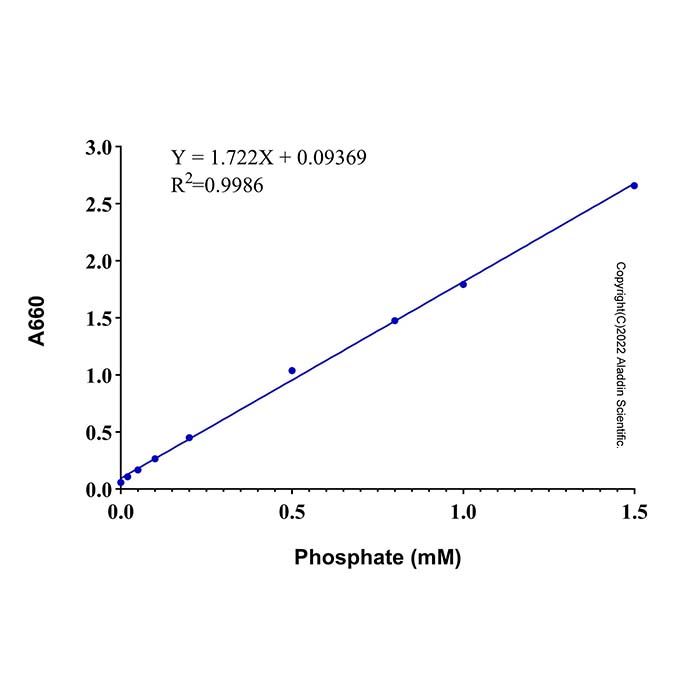
3. 标准曲线的设置。
4. 磷酸盐浓度的检测。
a. 加入适量体积的待测样品到1.5ml离心管中,若样品体积不足50μL,则用标准品稀释液补齐至50μL,记录样品此时的稀释倍数。
b. 从每管中依次吸取50μL不同浓度的磷酸盐标准品和待测样品加到96孔板的样品孔中。
c. 各孔加入200μL显色剂,使用多孔板混匀设备混匀或使用移液器轻轻吹打混匀,37℃静置30min。
d. 用酶标仪测定660nm的吸光度。
e. 根据标准曲线和待测样品的稀释倍数计算出样品的磷酸盐浓度。
注意事项:
1. 显色试剂须现配现用,配制后可以在4ºC保存一天。试剂在使用前必须恢复至室温。
2. 本实验测定波长在620-660 nm之间,660nm最佳。如果没有酶标仪,也可使用分光光度计进行测定。在这种情况下,需按比例调整显色剂、样本、标准品的体积,使最终待测体积符合比色皿的最小检测体积。
3. 本说明书中所述的加样体积以96孔板为例,若选择比色皿或384孔板,应按比例调整体积。
4. 实验室清洁剂含有高浓度的磷酸盐,需确保实验器皿彻底清洗,防止磷酸盐污染。
5. 为获得更好的检测效果,推荐对于所有的磷酸盐标准品和待测样品设置平行孔或三复孔。
6. 如果检测出来的吸光度偏低,可能是样品中磷酸盐含量较低,需要考虑在本试剂盒许可的范围内加大样品的用量。
7. 磷钼酸试剂 A呈强酸性,有腐蚀性,操作时请小心,并确保有效防护以避免直接接触人体,并须注意避免腐蚀其它物品。
8. 本产品仅限于专业人员的科学研究用,不得用于临床诊断或治疗,不得用于食品或药品,不得存放于普通住宅内。
9. 为了您的安全和健康,请穿实验服并戴一次性手套操作。
Inorganic phosphorus reacts with molybdic acid to form phosphomolybdic acid, which is reduced to molybdenum blue by a reducing agent.The maximum absorption peak appears at 660 nm, and the absorbance is proportional to the concentration within a certain range.
Operating Instructions
1. Preparation of Phosphate Standard
Prepare a 1.5 mM phosphate working solution from the 10 mM phosphate standard stock solution.
Deionized water or double-distilled water is preferred as the standard diluent.
The diluted working solution is stable for at least one day at 4 °C.
If using self-prepared reagents for standard dilution, ensure they are free of phosphate contamination.
2. Preparation of Color Reagent
Calculate the required volume of color reagent based on the number of samples.The working concentration of Phosphomolybdic Acid Reagent C is 21.8 g/L.It can be aliquoted before dissolution according to the usage amount each time to avoid repeated freeze-thaw cycles.It is recommended to prepare freshly before use as much as possible.
Phosphomolybdic acid Reagent A, Reagent B, and Reagent C are mixed at a ratio of 17:1:6.The color reagent should be stored at 4 °C, protected from light, and is stable for one day.
3. Setup of Standard Curve
(Set up standard curve points as required.)
4. Determination of Phosphate Concentration
a. Add an appropriate volume of sample to a 1.5 mL centrifuge tube.
If the sample volume is less than 50 μL, make up to 50 μL with standard diluent and record the dilution factor.
b. Pipette 50 μL of each phosphate standard (at different concentrations) and each test sample into separate wells of a 96-well plate.
c. Add 200 μL of color reagent to each well.
Mix using a plate mixer or by gentle pipetting, then incubate at 37 °C for 30 minutes.
d. Measure the absorbance at 660 nm using a microplate reader.
e. Calculate the phosphate concentration of the sample based on the standard curve and the sample dilution factor.
Notes
1.The chromogenic reagent must be prepared and used immediately. It can be stored at 4 ºC for one day after preparation. The reagent must be equilibrated to room temperature before use.
2.The detection wavelength of this experiment ranges from 620 to 660 nm, with 660 nm being optimal. If a microplate reader is not available, a spectrophotometer can be used instead. In this case, adjust the volumes of the chromogenic reagent, samples and standard solutions proportionally to ensure the final volume to be tested meets the minimum detection volume of the cuvette.
3.The sample volumes described in this instruction manual are based on a 96-well plate. If cuvettes or 384-well plates are used, the volumes should be adjusted proportionally.
4.Laboratory detergents contain high concentrations of phosphate. Ensure that the experimental utensils are thoroughly cleaned to prevent phosphate contamination.
5.For better detection results, it is recommended to set up duplicate or triplicate wells for all phosphate standard solutions and samples to be tested.
6.If the measured absorbance is low, it may be due to the low phosphate content in the sample. Consider increasing the sample dosage within the allowable range of this kit.
7.Phosphomolybdic Acid Reagent A is strongly acidic and corrosive. Handle it with care during operation, ensure effective protection to avoid direct contact with the human body, and take care to prevent corrosion of other items.
8.This product is intended for scientific research use by professionals only. It is not for clinical diagnosis or treatment, nor for use in food or pharmaceuticals, and should not be stored in ordinary residential premises.
9.For your safety and health, wear a lab coat and disposable gloves during operation.

 ZJ26F1039776


 危险品化学品经营许可证(带存储)