类黄酮(Flavonoids)是植物重要的一类次生代谢产物,它以结合态(黄酮苷)或自由态 (黄酮苷元)形式存在于水果、蔬菜、豆类和茶叶等许多食源性 植物中,槲皮素(Quercetin)是最典型的类黄酮,其在C3位羟基上结合糖分子即 形成植物中普遍的成分—芸香苷(Flavonoids);柑橘属的多种水果均含有大量的 黄酮化合物,如橘红素(Tangeretin)和川陈皮素(Nobiletin),大豆中含有一种异黄酮化合物—大豆异黄酮,茶叶中的茶多酚是由没食子酸和类黄酮—儿茶酚组成。
植物类黄酮检测试剂盒(微板法)检测原理是类黄酮溶于有机溶剂,以有机溶剂粗提类黄酮,根据提取液的吸收光谱特性,可利用酶标仪在特定波长325nm处测定其吸光度,通过与标准曲线比较计算出类黄酮含量,主要用于植物组织或果实中类黄酮的提取以及定量检测类黄酮含量。
该试剂盒仅用于科研领域,不适用于临床诊断或其他用途。本试剂盒仅用于科研领域,不适用于临床诊断或其他用途。
注意事项
1. 为了避免类黄酮见光分解,操作时应尽量避光,研磨或匀浆时应尽量缩短时间。
2. 取样量、试剂用量应根据类黄酮含量适当调整。
3. 类黄酮检测缓冲液应密闭保存,避免有效成分挥发。
4. 该试剂盒的线性范围是1-120 µg/mL,样品浓度在5-25 µg/mL为宜,超过100 µg/mL建议用类黄酮检测缓冲液稀释。
5. 如果没有酶标仪,也可以使用普通的分光光度计测定。
6. 为了您的安全和健康,请穿实验服并戴一次性手套操作。
使用方法
1. 试剂准备
额外所需材料:
(1) 实验材料:桃子、李子、苹果、杏等果实或其他植物组织。
(2) 所需仪器:酶标仪、离心机。
(3) 其它:96孔板、滤纸或纱布、离心管。
2. 类黄酮提取:
(1) 取果实或其他植物组织,洗净,擦干,称取剪碎的新鲜样品0.25 g,置于4℃预冷的研钵或匀浆器中。
(2) 加入4℃预冷的2-3 mL 类黄酮检测缓冲液,充分研磨或匀浆后转入10 mL离心管,用类黄酮检测缓冲液冲洗研钵或匀浆器并转移至离心管,补加类黄酮检测缓冲液至8 mL,4℃避光静置20分钟,期间摇动2-3次,然后过滤至离心管,也可用离心机8000 rpm/min离心3分钟,滤液(上清液)即为类黄酮粗提液。
3. 稀释类黄酮标准溶液:取适量的类黄酮标准 (1mg/mL),用类黄酮检测缓冲液稀释至100 µg/mL,再按下表进行梯度稀释:
加入物 ( µL) | 1 | 2 | 3 | 4 | 5 | 6 |
类黄酮标准品 (100 µg/mL) | 7.5 | 15 | 30 | 45 | 60 | 75 |
类黄酮检测缓冲液 | 292.5 | 285 | 270 | 255 | 240 | 225 |
类黄酮浓度 (µg/mL) | 2.5 | 5 | 10 | 15 | 20 | 25 |
4. 类黄酮加样:取96孔板,按照下表设置空白管、标准管、测定管,溶液应按照顺序依次加入,并注意避免产生气泡,小心混匀;如果样品中的类黄酮浓度过高,可以减少样品用量或适当稀释后再进行测定,样品的检测最好能设置2个平行孔,求平均值。
加入物 ( µL) | 空白管 | 标准管 | 测定管 |
类黄酮检测缓冲液 | 300 | - | - |
系列类黄酮标准 (1-6号孔) | - | 300 | - |
类黄酮粗提液 | - | - | 300 |
5. 类黄酮测定:以空白调零,以酶标仪测定系列标准孔、测定孔在325 nm处吸光度。
6. 计算:
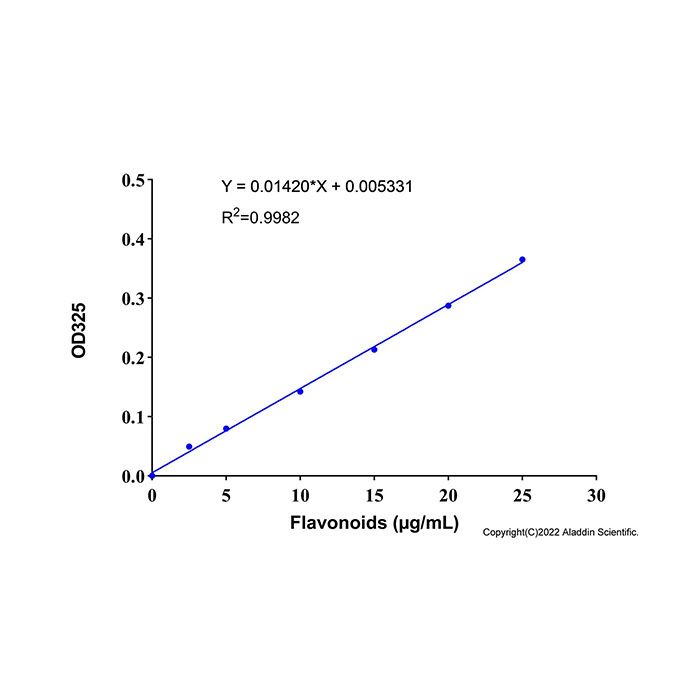
以1-6号管系列类黄酮标准浓度 (2.5、5、10、15、20、25 µg/mL)为横坐标,以对应的吸光度为纵坐标,绘制标准曲线,进而计算出各测定管类黄酮含量 (µg/mL)。
组织样品的类黄酮 (µg/g)= C × Vₜ × N / W
液体样品的类黄酮 (µg/ml)= C × N / V₁
式中: C=根据标准曲线求得的测定孔类黄酮含量(µg/mL)
Vₜ =类黄酮粗提液总体积(mL)=8
V₁ =加样时所用类黄酮粗提液的体积(ml)=2
W=样品鲜重(g)
N=稀释倍数
Flavonoids are major secondary metabolites in plants. They occur in numerous edible plants including fruits, vegetables, legumes and tea, existing either in the bound form as flavonoid glycosides or in the free form as flavonoid aglycones. Quercetin is the most representative flavonoid. The attachment of a sugar molecule to the hydroxyl group at its C3 position yields rutin, a ubiquitous component in plants.
Citrus fruits contain abundant flavonoids such as tangeretin and nobiletin. Soybeans are a source of isoflavones, namely soybean isoflavones. Tea polyphenols in tea consist of gallic acid and catechins, a subgroup of flavonoids.
Assay Principle of Plant Flavonoids Assay Kit (Microplate Method): Flavonoids are soluble in organic solvents, which are used for crude extraction. According to the absorption spectral characteristics of the extract, the absorbance is determined at the specific wavelength of 325 nm using a microplate reader. The flavonoid content is calculated by reference to the standard curve. This kit is mainly used for the extraction and quantitative detection of flavonoids in plant tissues and fruits.
For research use only. Not for clinical diagnosis or other applications.
Precautions
1. To prevent photodegradation of flavonoids, perform all operations away from light and minimize the duration of grinding or homogenization.
2. Adjust the sample volume and reagent dosage appropriately according to the flavonoid content.
3. Seal the Flavonoids Assay Buffer tightly during storage to prevent loss of active ingredients via volatilization.
4. The linear range of this kit is 1-120 µg/mL. The optimal sample concentration is 5-25 µg/mL. Samples with concentration above 100 µg/mL are recommended to be diluted with Flavonoids Assay Buffer.
5. If a microplate reader is not available, a conventional spectrophotometer can also be used for measurement.
6. Wear a lab coat and disposable gloves during operation for personal safety and health protection.
Procedure
1. Reagent Preparation
Additional materials required:
(1) Test samples: Fruits such as peach, plum, apple, apricot, or other plant tissues.
(2) Instruments: UV spectrophotometer, centrifuge.
(3) Others: Microplate Reader, 96-well Plate, Filter paper or gauze, Centrifuge tubes.
2. Flavonoid Extraction
(1) Rinse fruits or other plant tissues thoroughly and pat dry. Weigh 0.25 g of chopped fresh sample and place it into a pre-cooled mortar or homogenizer at 4 ℃.
(2) Add 2-3 mL of pre-cooled Flavonoids Assay Buffer (4 ℃). Grind or homogenize thoroughly, then transfer the mixture into a 10 mL centrifuge tube. Rinse the mortar or homogenizer with Flavonoids Assay Buffer and combine all liquid into the tube. Top up with Flavonoids Assay Buffer to a final volume of 8 mL. Keep the mixture standing for 20 minutes at 4 ℃ away from light, and shake it 2 to 3 times during this period. Afterwards, filter the liquid into a centrifuge tube. Alternatively, centrifuge at 8000 rpm for 3 minutes. The obtained filtrate (supernatant) is the crude flavonoid extract.
3. Dilution of Flavonoid Standard Solution: Take an appropriate amount of flavonoid standard solution (1 mg/mL), and dilute it to 100 µg/mL with Flavonoids Assay Buffer. Then prepare serial dilutions according to the table below:
Additive ( µL) | 1 | 2 | 3 | 4 | 5 | 6 |
Flavonoid Standard (100 µg/mL) | 7.5 | 15 | 30 | 45 | 60 | 75 |
Flavonoids Assay Buffer | 292.5 | 285 | 270 | 255 | 240 | 225 |
Flavonoid Concentration (µg/mL) | 2.5 | 5 | 10 | 15 | 20 | 25 |
4. Sample Loading for Flavonoid Assay: Take a 96-well plate and set up blank wells, standard wells and test wells as shown in the table below. Add solutions in sequence, avoid bubble formation and mix gently. If the flavonoid concentration of the sample is too high, reduce the sample volume or dilute the sample properly before testing. It is recommended to prepare two parallel tubes for each sample and calculate the average value.
Additive ( µL) | Blank Tube | Standard Tube | Test Tube |
Flavonoids Assay Buffer | 300 | - | - |
Serial Flavonoid Standard (Wells 1-6) | - | 300 | - |
Crude Flavonoid Extract | - | - | 300 |
5. Flavonoid Measurement: Zero with the blank wells, then measure the absorbance of standard wells and test wells at 325 nm using a microplate reader.
6. Calculation: Plot the standard curve with flavonoid concentrations of tubes No.1 to 6 (2.5, 5, 10, 15, 20, 25 µg/mL) on the horizontal axis and the corresponding absorbance values on the vertical axis. Calculate the flavonoid concentration (µg/mL) of each test tube based on the curve.
Flavonoid content in tissue samples (µg/g) = C × Vₜ × N / W
Flavonoid content in liquid samples (µg/mL) = C × N / V₁
Where:
C = Flavonoid concentration of the test sample obtained from the standard curve (µg/mL)
Vₜ =Total volume of crude flavonoid extract (mL)=8
V₁ =Volume of crude flavonoid extract used for loading(mL)=2
W=Fresh weight of sample (g)
N=Dilution factor

 H2626303


 危险品化学品经营许可证(带存储)