产品介绍
过氧化脂质降解产物中的丙二醛(MDA)在高温及酸性环境下可与硫代 巴比妥酸(TBA)反应产生红棕色产物 3,5,5’-三甲基恶唑 2,4-二酮(三甲川),该物质在532 nm处有最大吸收峰,其颜色的深浅与 MDA 含量呈正比,通过比色可计算出 MDA 含量。其检测原理如下图:

特点:本试剂盒中采用了特殊的抗氧化剂,可以有效地抑制样品在检测过程中产生新的MDA,使检测更加准确。同时本检测试剂盒在检测过程中可以把部分MDA天然形成的聚丙二醛分解成MDA,使对脂质氧化的测定更加准确。
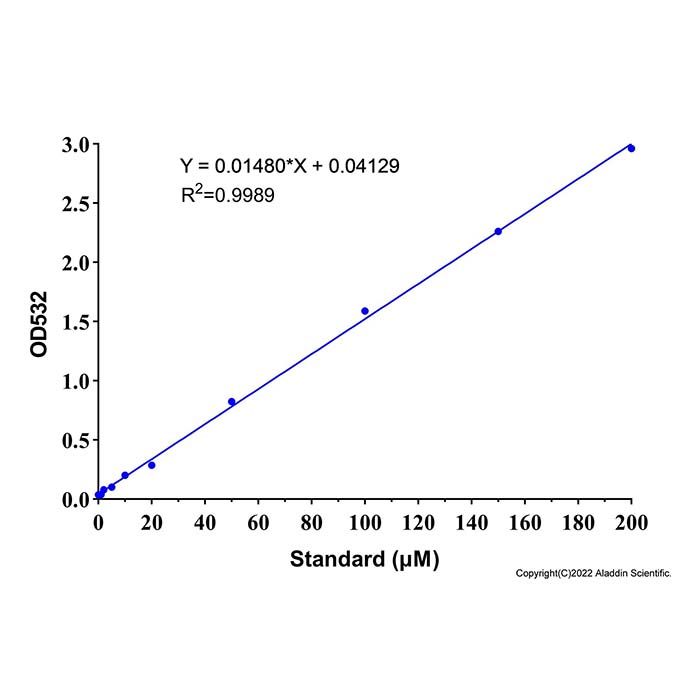
本试剂盒可以检测低达1 μM(参考图1)的MDA,也可检测高达200μM的MDA(参考图2)。不同浓度标准品使用本试剂盒的检测效果图。实测数据会因检测仪器等的不同而存在差异,图中数据仅供参考。


图1 图2
组分表
| 组分表-中文 | | 储运单元货号 | 储运单元名称 | 组分货号 | 组分名称 | 物理外观 | 50 T | 100 T | 500 T | 储存 | 单次测试使用量 | | P1524527WT | 植物丙二醛 (MDA) 含量检测试剂盒 (TBA, 微量法) (2-8℃组分) | P1524527A | TBA配制液 | 无色液体 | 3.5 mL | 7 mL | 35 mL | 2-8℃. | 按需 |
|
| P1524527B | TBA稀释液 | 无色液体 | 7.5 mL | 15 mL | 75 mL | 2-8℃. | 按需 |
|
| P1524527C | 组织匀浆液 | 无色液体 | 12.5 mL | 25 mL | 125 mL | 2-8℃. | 按需 | | P1524527DT | 植物丙二醛 (MDA) 含量检测试剂盒 (TBA, 微量法) (-20℃组分) | P1524527D | TBA | 白色至黄色粉末 | 12.5 mg | 25 mg | 125 mg | -20℃. 避光 | 按需 |
|
| P1524527E | 抗氧化剂 | 无色液体 | 0.15 mL | 0.3 mL | 1.5 mL | -20℃. 避光 | 按需 |
|
| P1524527F | 标准品 (1 mM) | 无色液体 | 0.1 mL | 0.2 mL | 1 mL | -20℃. 避光 | 按需 |
注: 发货时各组分依据储存温度 (2‑8℃/-20℃) 独立包装,差异化温控运输以保障产品性能。同一订单含多温区物料可能分批次送达,请以实际收货为准。收货后按组分表标注温度分类存放,有效期自生产之日起 12 个月。
|
注意事项
1)醛、较高浓度的可溶性糖(例如250mM蔗糖)对反应有干扰,可溶性糖与TBA显色反应的产物在532nm也有吸收(最大吸收在450nm)。如果可溶性糖对测定有干扰,可以通过测定450nm作为参考波长进行双波长测定,消除其干扰。
2)本产品仅限于专业人员的科学研究用,不得用于临床诊断或治疗,不得用于食品或药品,不得存放于普通住宅内。
3)为了您的安全和健康,请穿实验服并戴一次性手套操作。
使用方法
1. 样品的准备:
1)组织样本:常规匀浆处理1:10(w/v)匀浆介质为P1524527C TBA提取液,全程冰浴,4000rpm 4℃离心10min,取上清液即为待测样品MDA提取液。
2)在正式检测前,需选择2-3个预期差异大的样本稀释成不同浓度进行预实验
3) 本试剂盒对于样品中的常见化学成分的兼容性参考下表:
试剂类别 | 化学成分 | 是否干扰 |
缓冲试剂 | Borate (50 mM) | 否 |
缓冲试剂 | HEPES (10 0mM) | 否 |
缓冲试剂 | Phosphate (100 mM) | 否 |
缓冲试剂 | Tris (25 mM) | 否 |
去垢剂 | CHAPS (≤1%) | 否 |
去垢剂 | Triton X-100 (≤1%) | 否 |
去垢剂 | Tween 20 (≤1%) | 否 |
抑制剂 / 螯合剂 | Antipain (≤100 μg/mL) | 否 |
抑制剂 / 螯合剂 | Chymostatin (≤10 μg/mL) | 否 |
抑制剂 / 螯合剂 | Leupeptin (≤10 μg/mL) | 否 |
抑制剂 / 螯合剂 | PMSF (≤200 μM) | 否 |
抑制剂 / 螯合剂 | Trypsin (≤10 μg/mL) | 否 |
抑制剂 / 螯合剂 | EDTA (≤1 mM) | 否 |
抑制剂 / 螯合剂 | EGTA (≤1 mM) | 否 |
其它试剂 | Sucrose (250 mM) | 是 |
其它试剂 | Glycerol (≤10%) | 否 |
2. 试剂盒的准备工作:
1) TBA储存液的配制:称取适量TBA,用TBA配制液配制成浓度为0.37%的TBA储存液。例如18.5 mg TBA用5mL TBA配制液配制,或者25 mg TBA用6.76 mL TBA配制液配制,最终浓度即为0.37%。TBA配制液需完全溶解后再使用,可以加热到70℃以促进溶解。TBA储存液较难溶解,需加热到70℃,并通过剧烈Vortex以促进溶解。配制好的TBA储存液室温避光保存,至少3个月内有效。
2) MDA检测工作液的配制: 根据待测定的样品数(含对照),参考下表在临检测前新鲜配制适量的MDA检测工作液
试剂名称 | 1 次检测用量 | 10 次检测用量 | 20 次检测用量 | 50 次检测用量 |
TBA 稀释液 | 150 μL | 1500 μL | 3000 μL | 7500 μL |
TBA 储存液 | 50 μL | 500 μL | 1000 μL | 2500 μL |
抗氧化剂 | 3 μL | 30 μL | 60 μL | 150 μL |
注意: MDA检测工作液较难溶解,可以70℃加热,并剧烈Vortex以促进溶解。也可以通过超声处理以促进溶解。配制好的MDA检测工作液必须当天使用。
3) 标准品的稀释:取适量标准品用蒸馏水稀释至0、1、2、5、10、20、50 μM,用于后续制作标准曲线。如果样品中MDA的浓度很高,可以增加100、150和200 μM的标准品浓度。
3. 样品测定:
1) 在离心管或其它适当容器内加入0.1 mL匀浆液、裂解液或PBS等适当溶液作为空白对照,加入0.1 mL上述不同浓度标准品用于制作标准曲线,加入0.1 mL样品用于测定;随后加入0.2 mL MDA检测工作液。可参考下表设置检测反应体系:
加样组分 | 空白对照 | 标准品 | 待测样品 |
匀浆液、裂解液或PBS | 0.1 mL | - | - |
标准品 | - | 0.1 mL | - |
待测样品 | - | - | 0.1 mL |
MDA 检测工作液 | 0.2 mL | 0.2 mL | 0.2 mL |
2) 混匀后,100 ℃或沸水浴加热15分钟。加热时务必注意避免液体暴沸溅出。如果使用加热块(Heat block)进行加热注意用重物压紧离心管盖;如果使用沸水浴,则需使用可把盖子锁死的离心管或螺旋盖离心管,或用封口膜封住离心管口,用针头刺一小孔。最方便和准确的加热方法是使用带有热盖并可以加热0.5 ml PCR管的PCR仪。
3) 水浴冷却至室温,1000 g室温离心10分钟。取200 μL上清加入到96孔板中,随后用酶标仪在532 nm测定吸光度。如果不方便测定532 nm的吸光度,也可以测定530-540 nm之间的吸光度。可以设定450 nm为参考波长进行双波长测定。
4) MDA含量的计算:
标准品拟合曲线:y = ax + b
MDA (μmol/mg) = (∆A532 - b) ÷ a × f ÷ (m/V)
注解:
y:标准品 OD 值-空白 OD 值
x:标准品的浓度 ΔA532:样本 OD 值-空白 OD 值
a:标曲的斜率
b:标曲的截距
f:样本加入检测体系之前的稀释倍数
m:植物组织样本重量(g)
V:样本处理过程中加入试剂五抽提应用液的体积(mL)
常见问题
没有检测到MDA。可能样品中MDA浓度过低。在检测组织的MDA时,请使用更多的组织。不要稀释样品。
应用
1) 脂质过氧化(MDA)检测试剂盒已用于确定丙二醛(MDA)的水平。
2) 本试剂盒适用于检测植物组织中的MDA含量。
Product Introduction
Malondialdehyde (MDA), a degradation product of lipid peroxides, reacts with thiobarbituric acid (TBA) under high‑temperature and acidic conditions to yield the reddish‑brown product 3,5,5’‑trimethyloxazole‑2,4‑dione (trimethine), which exhibits a maximum absorption peak at 532 nm. The color intensity is positively proportional to MDA content, and MDA concentration can be quantified via colorimetric assay. The detection principle is shown in the figure below:

Features: This kit contains a proprietary antioxidant formulation that effectively inhibits de‑novo MDA generation during sample measurement to improve detection accuracy. In addition, the assay system partially decomposes naturally‑occurring polymeric malondialdehyde into monomeric MDA, enabling more reliable quantification of lipid peroxidation.
The kit is capable of detecting MDA at concentrations as low as 1 μM (see Figure 1) and as high as 200 μM (see Figure 2), which show detection performance of serial MDA standards. Actual measured values may vary depending on detection instruments and other experimental conditions; the data in figures are for reference only.
Figure 1 Figure2
Component
| 组分表-英文 | | Storage Unit No. | Storage Unit Name | Component No. | Component Name | Appearance | 50 T | 100 T | 500 T | Storage | Quantity Per Test | | P1524527WT | Plant Malondialdehyde (MDA) Content Assay Kit (TBA, Micro Method) (2-8℃ Components) | P1524527A | TBA preparation solution | Colorless liquid | 3.5 mL | 7 mL | 35 mL | 2-8℃. | As needed |
|
| P1524527B | TBA diluent | Colorless liquid | 7.5 mL | 15 mL | 75 mL | 2-8℃. | As needed |
|
| P1524527C | Tissue homogenate solution | Colorless liquid | 12.5 mL | 25 mL | 125 mL | 2-8℃. | As needed | | P1524527DT | Plant Malondialdehyde (MDA) Content Assay Kit (TBA, Micro Method) (-20℃ Components) | P1524527D | TBA | White to Yellow Powder | 12.5 mg | 25 mg | 125 mg | -20℃. Store in the dark. | As needed |
|
| P1524527E | Antioxidant | Colorless liquid | 0.15 mL | 0.3 mL | 1.5 mL | -20℃. Store in the dark. | As needed |
|
| P1524527F | Standard (1 mM) | Colorless liquid | 0.1 mL | 0.2 mL | 1 mL | -20℃. Store in the dark. | As needed |
Note: Each component is individually packaged according to its storage temperature (2‑8 °C / -20 °C) upon shipment, with differentiated temperature‑controlled transportation to guarantee product performance. Orders containing materials requiring multiple temperature zones may be delivered in separate batches; please refer to the actual received goods. Upon receipt, store components separately at the temperatures specified in the component list. The shelf‑life is 12 months from the date of manufacture.
|
Notes
1. Aldehydes and high concentrations of soluble sugars (e.g., 250 mM sucrose) interfere with the reaction. The colored product formed by the reaction of soluble sugars with TBA also absorbs at 532 nm (with maximum absorbance at 450 nm). If soluble sugar interference is present, it can be eliminated by performing a dual-wavelength assay using 450 nm as the reference wavelength.
2. This product is for research use only by qualified personnel. It is not intended for clinical diagnosis or treatment, nor for use in food or pharmaceutical applications. Do not store in residential areas.
3. For your personal safety and health, please wear a lab coat and disposable gloves during handling.
Protocol
1.Sample Preparation
1)Tissue samples: Perform routine homogenization at a ratio of 1:10 (w/v) using P1524527C TBA Extraction Solution as the homogenization medium. Carry out the whole procedure on ice. Centrifuge at 4000 rpm for 10 min at 4 °C, and collect the supernatant as MDA‑containing sample extract for subsequent measurement.
2)Prior to formal assay, select 2‑3 samples with expected large differences and prepare serial dilutions for pre‑experiment.
3)Refer to the table below for the compatibility of this kit with common chemical components present in samples:
Reagent Category | Chemical Component | Interference |
Buffers | Borate (50 mM) | No |
Buffers | HEPES (100 mM) | No |
Buffers | Phosphate (100 mM) | No |
Buffers | Tris (25 mM) | No |
Detergents | CHAPS (≤1%) | No |
Detergents | Triton X-100 (≤1%) | No |
Detergents | Tween 20 (≤1%) | No |
Inhibitors / Chelators | Antipain (≤100 μg/mL) | No |
Inhibitors / Chelators | Chymostatin (≤10 μg/mL) | No |
Inhibitors / Chelators | Leupeptin (≤10 μg/mL) | No |
Inhibitors / Chelators | PMSF (≤200 μM) | No |
Inhibitors / Chelators | Trypsin (≤10 μg/mL) | No |
Inhibitors / Chelators | EDTA (≤1 mM) | No |
Inhibitors / Chelators | EGTA (≤1 mM) | No |
Other Reagents | Sucrose (250 mM) | Yes |
Other Reagents | Glycerol (≤10%) | No |
2. Kit Preparation
1) Preparation of TBA Stock Solution
Weigh an appropriate amount of TBA and dissolve it with TBA Diluent to prepare a 0.37% TBA stock solution. For example, dissolve 18.5 mg of TBA in 5 mL of TBA Diluent, or dissolve 25 mg of TBA in 6.76 mL of TBA Diluent to obtain a final concentration of 0.37%. Ensure TBA is fully dissolved before use; heating to 70 °C can facilitate dissolution. Since TBA is poorly soluble, heat the mixture to 70 °C and vortex vigorously to achieve complete dissolution. The prepared TBA stock solution can be stored at room temperature away from light and remains stable for at least 3 months.
2) Preparation of MDA Working Solution
Prior to assay, prepare an appropriate volume of fresh MDA working solution according to the number of samples to be tested (including controls) and refer to the table below.
Reagent Name | Volume for 1 test | Volume for 10 tests | Volume for 20 tests | Volume for 50 tests |
TBA Diluent | 150 μL | 1500 μL | 3000 μL | 7500 μL |
TBA Stock Solution | 50 μL | 500 μL | 1000 μL | 2500 μL |
Antioxidant | 3 μL | 30 μL | 60 μL | 150 μL |
Note: The MDA working solution may be difficult to dissolve. Heat the solution to 70 °C and vortex vigorously to facilitate dissolution. Sonication is also an alternative method. The prepared MDA working solution must be used on the day of preparation.
3) Dilution of Standard Solution
Dilute the stock standard with distilled water to final concentrations of 0, 1, 2, 5, 10, 20 and 50 μM for standard curve generation. If the MDA concentration in test samples is relatively high, additional standard points at 100, 150 and 200 μM can be included.
3. Sample Assay
1) Add 0.1 mL of homogenate, lysis buffer or PBS into centrifuge tubes or other suitable vessels as the blank control. Add 0.1 mL of serially diluted standard solutions for standard curve generation, and 0.1 mL of test samples for detection. Then add 0.2 mL of MDA working solution. Refer to the table below for reaction system setup.
Component | Blank Control | Standard | Test Sample |
Homogenate, Lysis Buffer or PBS | 0.1 mL | - | - |
Standard Solution | - | 0.1 mL | - |
Test Sample | - | - | 0.1 mL |
MDA Working Solution | 0.2 mL | 0.2 mL | 0.2 mL |
2) Mix thoroughly, then heat the samples in a boiling water bath or at 100 °C for 15 minutes. Take precautions to prevent liquid bumping and splashing during heating.
If using a heat block, secure the centrifuge tube caps with weights.If using a boiling water bath, use lock-lid or screw-cap centrifuge tubes. Alternatively, seal the tube openings with Parafilm and poke a small hole with a needle.A PCR instrument with a heated lid (compatible with 0.5 mL PCR tubes) is recommended for the most convenient and accurate heating.
3) Cool the samples to room temperature in water, then centrifuge at 1000 g for 10 minutes at room temperature. Transfer 200 μL of the supernatant into a 96-well plate, and measure the absorbance at 532 nm using a microplate reader. Absorbance can also be detected within the range of 530–540 nm if 532 nm is unavailable. A dual-wavelength assay can be performed with 450 nm set as the reference wavelength. For fluorescence measurement, transfer 200 μL supernatant into a black opaque 96-well plate.
4) Calculation of MDA Content
Calibration curve fitted with standard samples: y = ax + b
MDA (μmol/mg) = (∆A₅₃₂ − b) ÷ a × f ÷ (m/V)
Notes:
y: OD value of standard − OD value of blank control
x: concentration of standard sample
∆A₅₃₂: OD value of test sample − OD value of blank control
a: slope of calibration curve
b: intercept of calibration curve
f: dilution factor of sample before adding into the detection system
m: weight of plant tissue sample (g)
V: volume (mL) of Reagent‑5 extraction working solution added during sample pretreatment
Frequently Asked Questions
No MDA signal detected. This may result from an excessively low MDA concentration in the sample. For MDA detection in tissues, increase the sample dosage and avoid sample dilution.
Applications
1)This Lipid Peroxidation MDA Assay Kit is used for the quantification of malondialdehyde (MDA) levels.
2)This kit is suitable for the determination of malondialdehyde (MDA) content in plant tissues.



 危险品化学品经营许可证(带存储)